The Macroeconomic Underpinnings of Africa's Payment Market Landscape

链捕手Опубліковано о 2026-06-05Востаннє оновлено о 2026-06-05

Анотація

The African payments market, characterized by the world's highest mobile money penetration and fastest-growing cryptocurrency adoption, is not a coincidence but a macroeconomic necessity driven by deep structural factors. Two key drivers create this landscape: (1) Africa's heavy reliance on commodity exports, trade, and remittances, generating massive cross-border settlement and remittance demand; and (2) chronically underdeveloped financial infrastructure, exacerbated by international bank de-risking, foreign exchange mismanagement, and persistent inflation. This vacuum has allowed mobile money and crypto to thrive. Mobile money platforms replace banks for domestic payments, while cryptocurrencies serve as a store of value against local currency depreciation and a low-cost medium for cross-border exchange. A crucial division lies along the Sahara Desert. North Africa is integrated into the oil-anchored MENA framework, while Sub-Saharan Africa (SSA), plagued by dollar shortages and fragmented currencies, has become a natural, massive market for mobile money and crypto. Nigeria, Kenya, and South Africa are global leaders in adoption. The SSA economy is deeply dollarized due to currency instability, yet suffers from a severe "dollar shortage" caused by trade deficits and limited export capacity. This creates parallel forex markets and high remittance costs. Cryptocurrencies, particularly stablecoins, fill this gap by providing access to dollar liquidity, cheaper cross-border...

Africa's payment market exhibits distinct characteristics, boasting the world's highest mobile money penetration rate and fastest cryptocurrency adoption growth. This is not a coincidence at the market level, but an inevitability stemming from the long-term evolution of its macroeconomic structure.

This article analyzes the two underlying structural drivers behind this inevitability: (1) Africa's long-term reliance on resource exports, trade flows, and remittances creates immense demand for cross-border settlement and money transfers; (2) Africa's local financial infrastructure is underdeveloped, plagued by international bank de-risking and mismanaged foreign exchange controls, leading to a chronic banking sector gap and persistent inflationary pressures.

These two forces jointly create a vacuum where mobile money and cryptocurrencies have flourished: mobile money platforms replace banks as daily payment channels, while cryptocurrencies assume roles traditionally held by local fiat currencies or the US dollar in emerging economies, serving both as a store of value against currency depreciation and as a low-cost cross-border exchange medium.

On this continent, the key dividing line is the Sahara Desert: north of it integrates into the Middle East and North Africa (MENA) framework anchored by oil and aligned with the Middle East; while Sub-Saharan Africa (SSA), amid severe dollar shortages and fragmented currency systems, has given rise to a vast market with an inherent need for mobile money and cryptocurrencies. SSA countries represented by Nigeria, Kenya, and South Africa are among the global leaders in mobile money and cryptocurrency adoption.

1 Africa's Macroeconomic Panorama: A Large, Young, Yet Commodity-Dependent Primary Economy

1.1 Demographic Structure

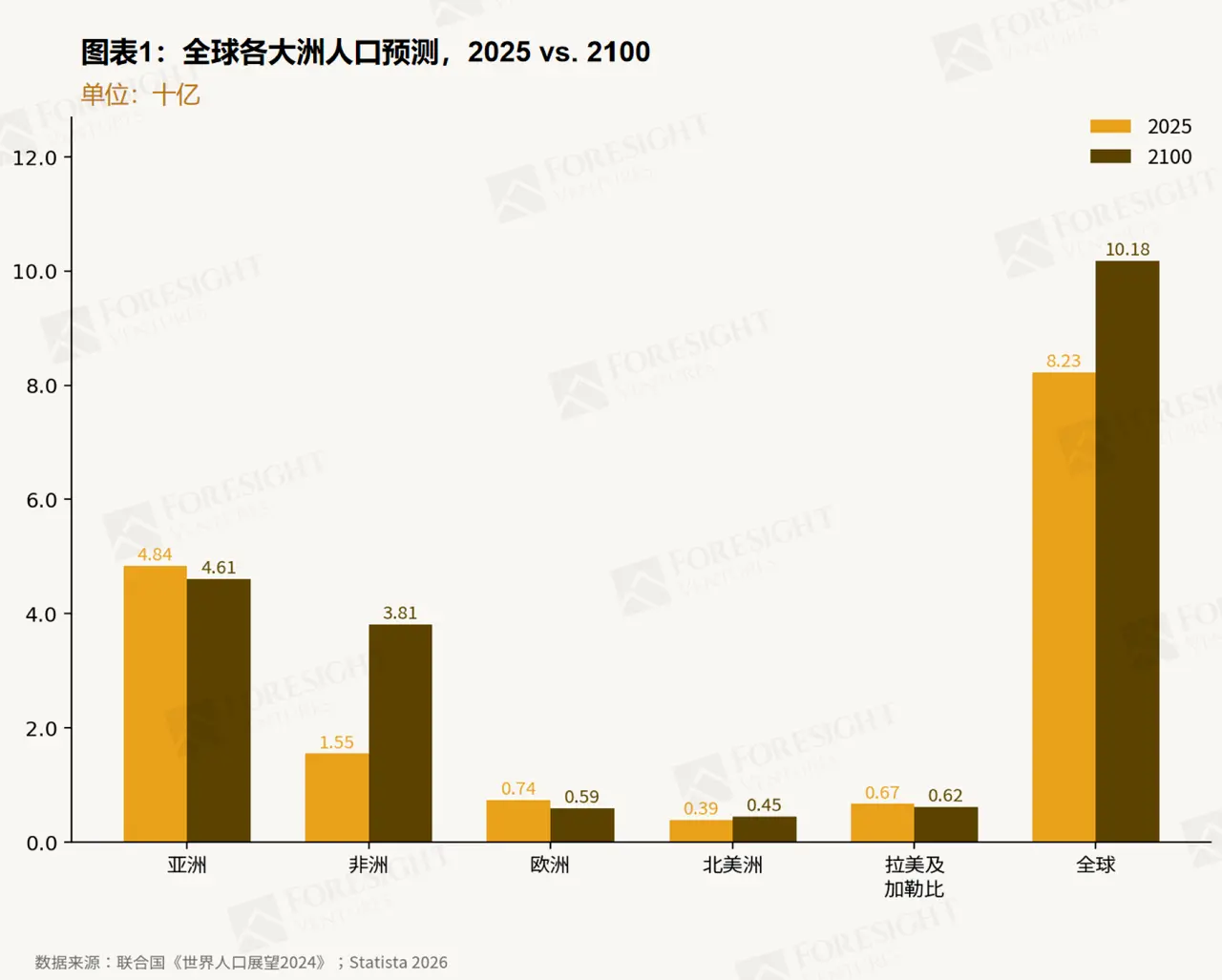
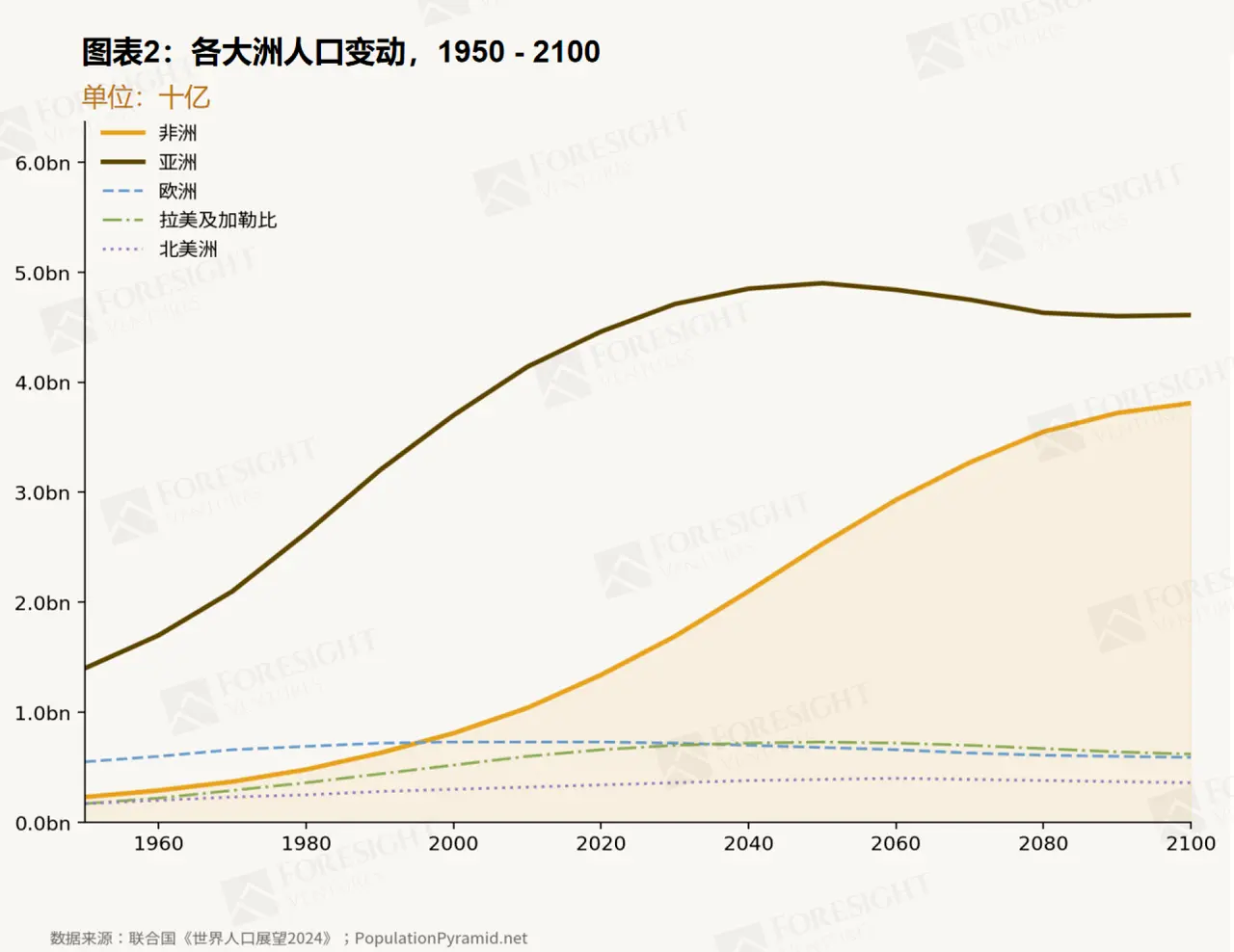
In 2025, Africa's population reached approximately 1.55 billion, accounting for about 19% of the global total. It is the world's youngest continent, with a median age of only 19, and also the fastest-growing continent, with an annual growth rate of around 2%, unmatched by other continents.

By 2100, Africa's population is projected to nearly triple to 3.81 billion, constituting 37% of humanity. In stark contrast, Asia's population is expected to peak mid-century before declining, while Europe and Latin America face absolute shrinkage; only Africa will experience substantial growth throughout the century (see Figures 1 and 2).

This demographic trend has profound implications for payment infrastructure. With traditional bank coverage still relatively low, large numbers of young, urbanizing, mobile-native cohorts are entering the labor market and consumer economy at scale. Consequently, demand for convenient, low-cost financial services (including payments, savings, and credit) will only intensify.
1.2 Resource Endowment and Industrial Structure

Africa possesses exceptionally rich natural resources. According to OPEC's Annual Statistical Bulletin, as of 2024, Africa's proven crude oil reserves were approximately 119.4 billion barrels, accounting for about 7.6% of the global total, with the largest reserves concentrated in Libya, Nigeria, Algeria, and Angola. Beyond hydrocarbons, Africa's mineral resources hold significant global importance and dominate several categories: the continent is the world's primary diamond-producing region, holds about 49% of global cobalt reserves, and is the absolute source for platinum group metals (PGMs), with South Africa alone controlling around 78% of global PGM reserves. These endowments make Africa a crucial node in the global commodity supply chain.

However, much of this wealth is still extracted and exported as raw materials, with minimal downstream processing or value addition. Concurrently, local manufacturing and agriculture are underdeveloped, infrastructure is severely lacking, and finished goods like refined petroleum and processed foods remain import-dependent. This economic structure of being "large in both imports and exports" locks the continent into the trade dependency pattern discussed next.

1.3 Trade Dependency and Remittance Flows

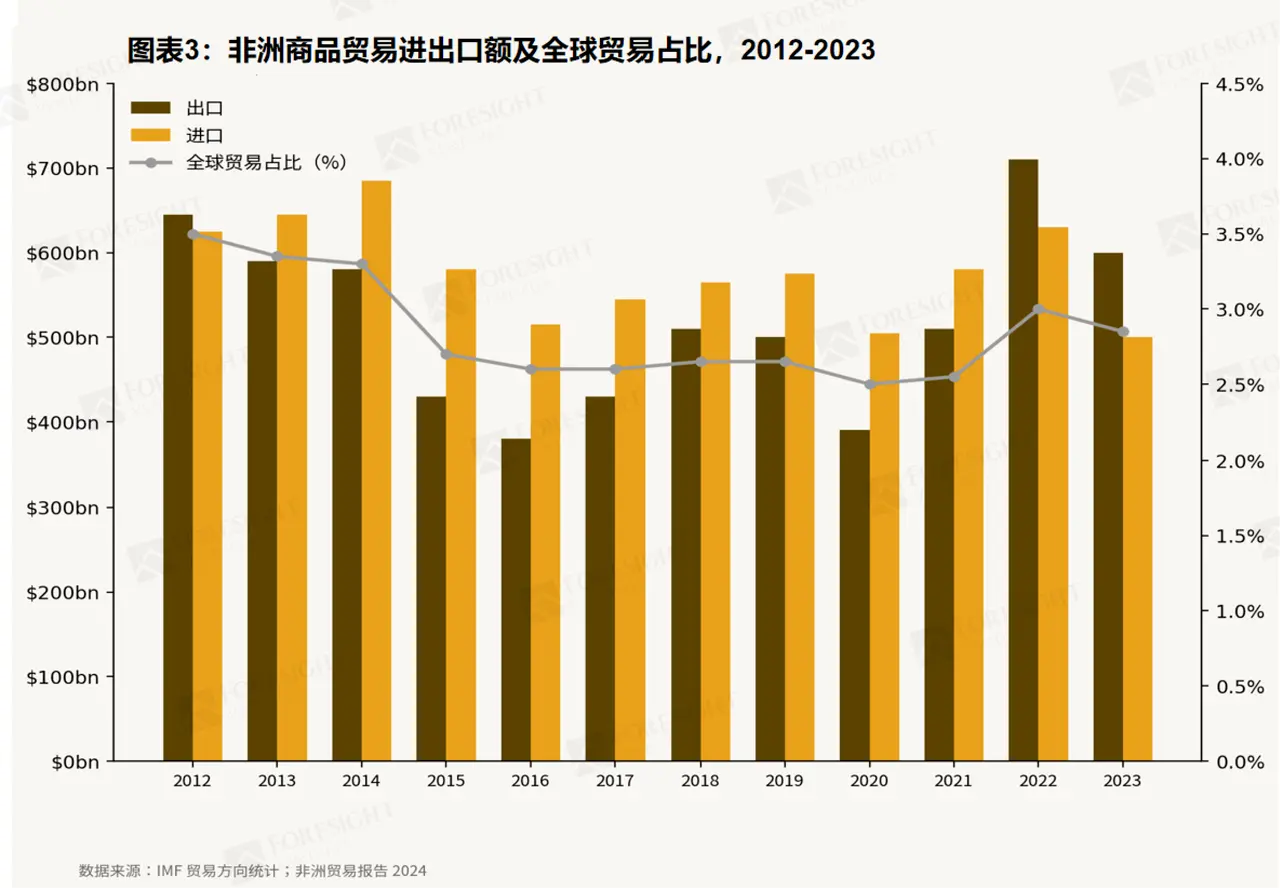
The African economy is deeply intertwined with global trade and overseas remittances. In 2023, Africa's cross-border merchandise exports and imports reached $604.5 billion and $684.5 billion, respectively, while remittance inflows stood at $52.16 billion. For reference, Africa's total GDP in 2023 was approximately $2.96 trillion. These two pillars—trade and remittances—are pivotal in Africa's economic structure and have generated massive demand for B2B cross-border trade settlement and C2C cross-border money transfers, respectively.

Cross-border trade is a vital pillar of the African economy, but its commodity-dependent export structure and persistent trade deficits make it highly sensitive to global macro cycles. In 2023, African merchandise exports totaled $604.5 billion (down 15.1% year-on-year), imports were $684.5 billion (down 1.6% year-on-year), resulting in a trade deficit of about $80 billion (see Figure 3). Over a ten-year trend, Africa is extremely sensitive to global commodity cycle volatility. The 2015–2016 oil price plunge pushed African trade volumes to a two-decade low, stalling resource-dependent economies (e.g., oil exporters like Nigeria, Angola) while non-resource economies maintained 7%–8% growth, creating a clear divergence. The 2020 COVID-19 shock triggered another collapse: global commodity prices plummeted, African GDP growth fell to -2%, followed by a V-shaped recovery in 2021. Most recently, in 2022–2023, driven by the commodity price surge from the Russia-Ukraine conflict, African exports briefly spiked. However, simultaneously, the Fed's aggressive rate hike cycle boosted the dollar and tightened global liquidity, subjecting the continent to severe imported inflation and currency depreciation.
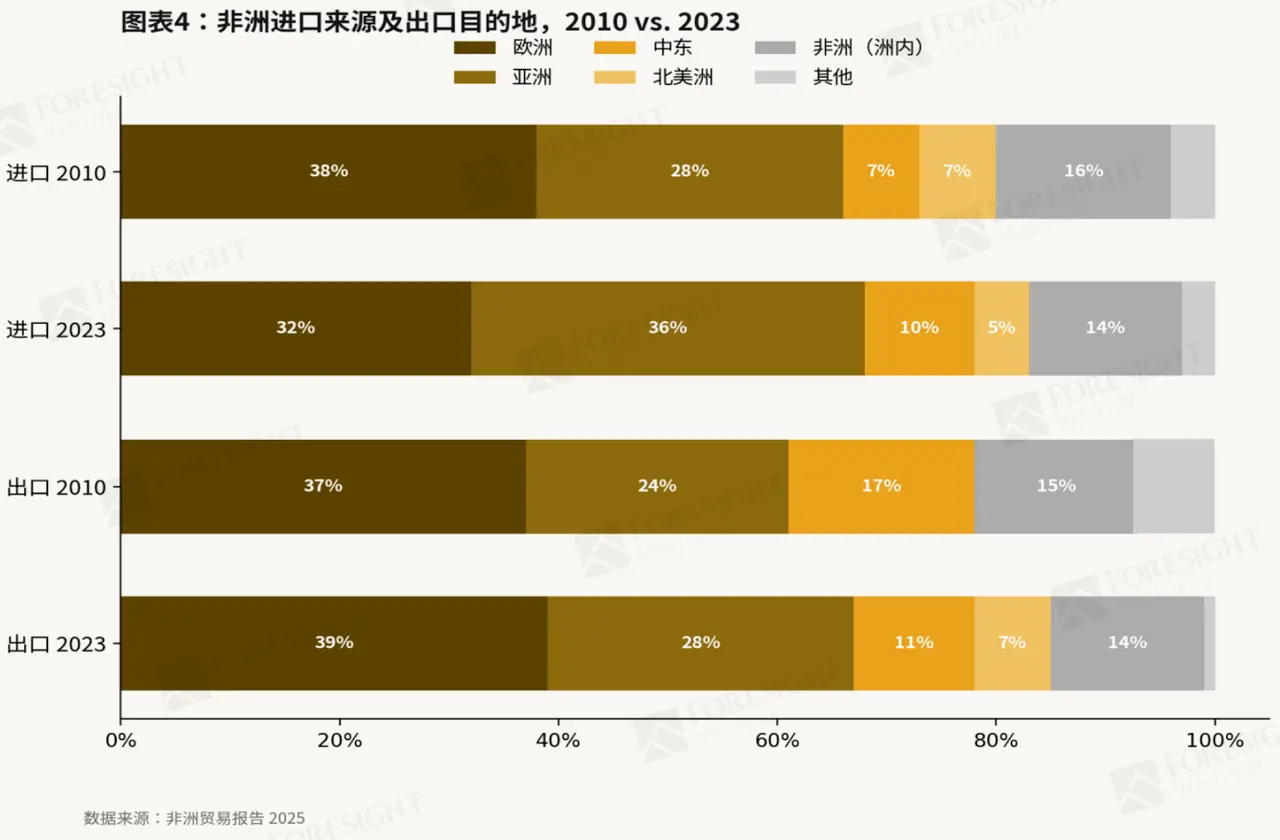
Africa's trade partner structure has shifted significantly over the past decade (see Figure 4). Asia, led by China and India, has surpassed Europe to become Africa's largest source of imports—its share of Africa's total imports rose from 28% in 2010 to 36% in 2023, while Europe's share fell from 38% to 32%. On the export side, Europe remains the top destination with a 39% share, but Asia's share grew from 24% to 28%, and the Middle East's share expanded sharply from 3% to 11%. North America's role has shrunk on both ends. These changes reflect the deepening commodity trade corridor with China and the growing importance of Gulf states as energy buyers and investment partners.

Beyond intercontinental trade, Intra-Africa Trade is also growing rapidly, but barriers such as currencies and languages between countries remain bottlenecks to be overcome. Intra-African trade volume reached $192.2 billion in 2023, up 3.8%. However, intra-regional trade accounts for only 18% of Africa's total exports, compared to 70% for Europe and 52% for Asia. This reflects persistent barriers like tariff fragmentation, currency inconvertibility, and weak cross-border infrastructure. Against this backdrop, the African Continental Free Trade Area (AfCFTA) began operation in 2021, aiming to boost intra-regional trade by 52% upon full implementation, but progress has been slow.

Remittances are another lifeline for the African economy and a source of massive C2C payment demand. According to World Bank data, remittance inflows to Africa were $52.2 billion in 2023. The top five remittance corridors were Saudi Arabia → Egypt, UAE → Egypt, USA → Nigeria, Kuwait → Egypt, France → Morocco. African labor export to the Gulf, North America, and Europe creates a continuous reverse flow of income to households. These corridors constitute one of the largest sources of cross-border C2C remittance demand and also feel the acute pain points of the traditional financial system in cross-border transfers—high cost, long time, and opaque progress—issues that will be discussed in detail in the next chapter.
2 The Deep Mismatch Between Trade/Remittance Demand and the Underdeveloped Financial System

2.1 Low Bank Coverage, Massive Unbanked Population Gap

Africa's formal financial system covers only a minority. According to the World Bank's Global Findex Database 2021–2022, only 49% of adults in Sub-Saharan Africa had a financial account; by 2024, this figure rose to 58%, still among the lowest globally. Beyond low coverage, bank branch density in Africa is also lagging. The IMF's Financial Access Survey shows Kenya has only 4.4 bank branches per 100,000 adults, Morocco has 22.2, and even South Africa, Africa's most developed banking system, has only 38.7, all well below the global average. The result is massive unmet demand for basic financial services: payments, savings, credit, and insurance.

2.2 International De-risking and Correspondent Banking Withdrawal

Africa's second major obstacle stems from the retreat of the international financial system itself. Due to concerns over anti-money laundering (AML) and know-your-customer (KYC) compliance risks, compounded by local realities like lack of formal ID, fixed addresses, incomplete tax records, and a high cash economy share, global major banks have engaged in a wave of de-risking. Since 2016, correspondent banking relationships have contracted sharply. According to SWIFT data, South Africa lost over 10% of its overseas correspondent banks, while Angola's decline reached 37%. This withdrawal directly increases the cost of legitimate cross-border transactions and excludes smaller African financial institutions from the global financial system.

2.3 Mismanaged Forex Controls and Chronic Inflation

Currency system fragility further amplifies these structural flaws. Due to fiscal deficits and a weak tax base, many African central banks resort to printing money to finance government spending, fueling persistent imported inflation. Food, fuel, and raw material prices for manufactured goods rise sharply due to currency depreciation. Concurrently, shallow capital markets, a highly concentrated banking sector, and a historical deficit in central bank independence lead to a broken monetary policy transmission mechanism, making interest rate hikes ineffective at curbing inflation or stabilizing exchange rates. In 2024, Africa's overall inflation rate reached 20.1%, the highest among major global regions, severely eroding the real value of local currency savings.

2.4 Consequence: Cash Dominance and Payment System Failure

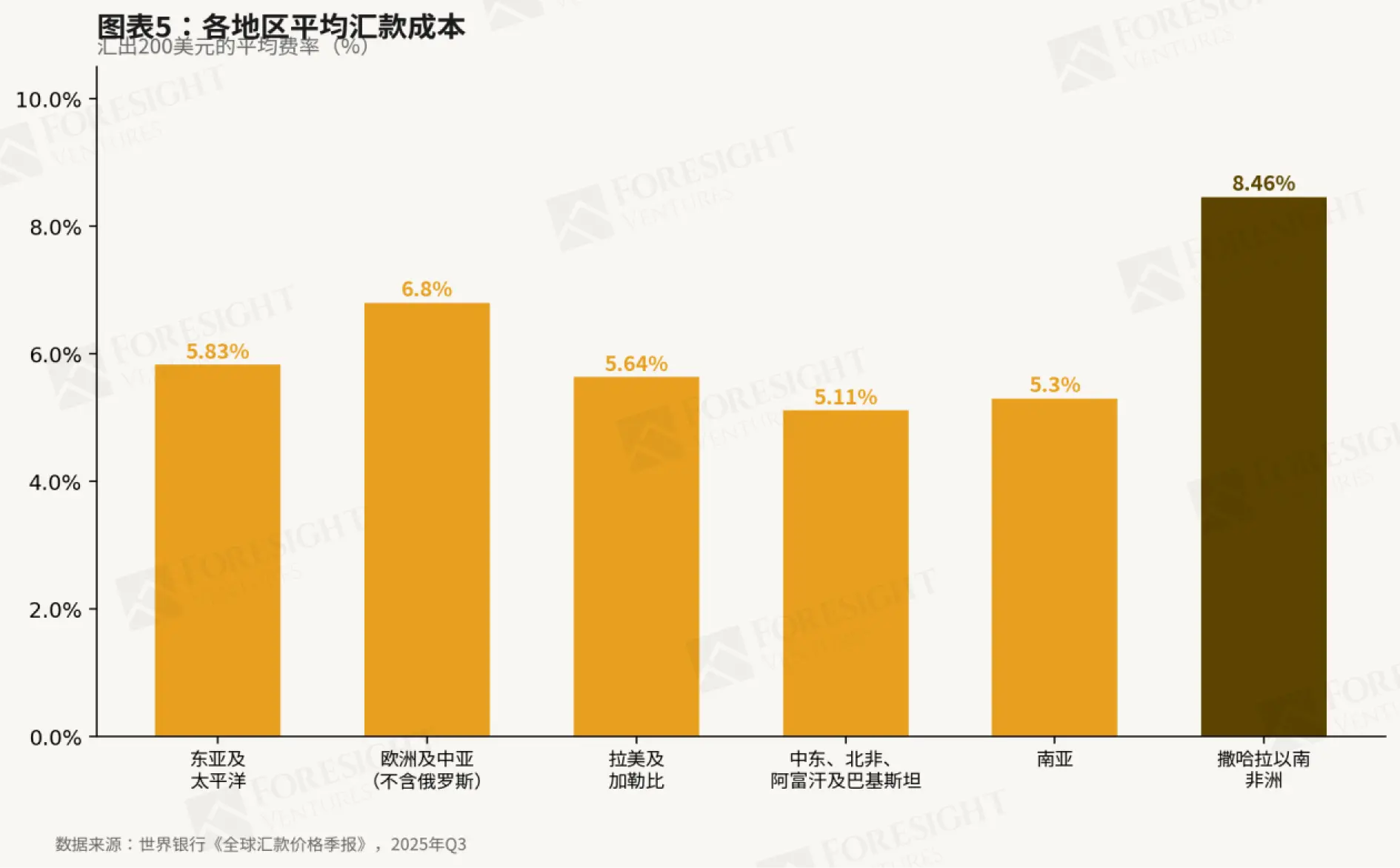
The triple failure of banking exclusion, de-risking, and monetary instability leads to evident consequences. The vast majority of Africans still rely on cash for daily transactions; Sub-Saharan Africa has the world's highest remittance costs, averaging 8.46% per transfer according to the World Bank's Q3 2025 Global Remittance Price Report; and ordinary citizens lack effective inflation-hedging stores of value. The banking system comprehensively fails on three dimensions: access convenience, affordability, and currency stability, thus creating a market vacuum rapidly being filled by emerging payment channels and cryptocurrencies.
3 In the Vacuum Left by the Traditional Financial System, Mobile Money and Cryptocurrencies Flourish

In the gap created by an absent banking system, forced by severe inflation and currency depreciation pressures, Africa has developed the world's most vibrant mobile money and cryptocurrency markets. The emergence of these alternative payment channels is not a matter of choice but of necessity—they solve real problems the banking system cannot address: accessibility, affordability, and stability.

3.1 Mobile Money: Africa Leads the World

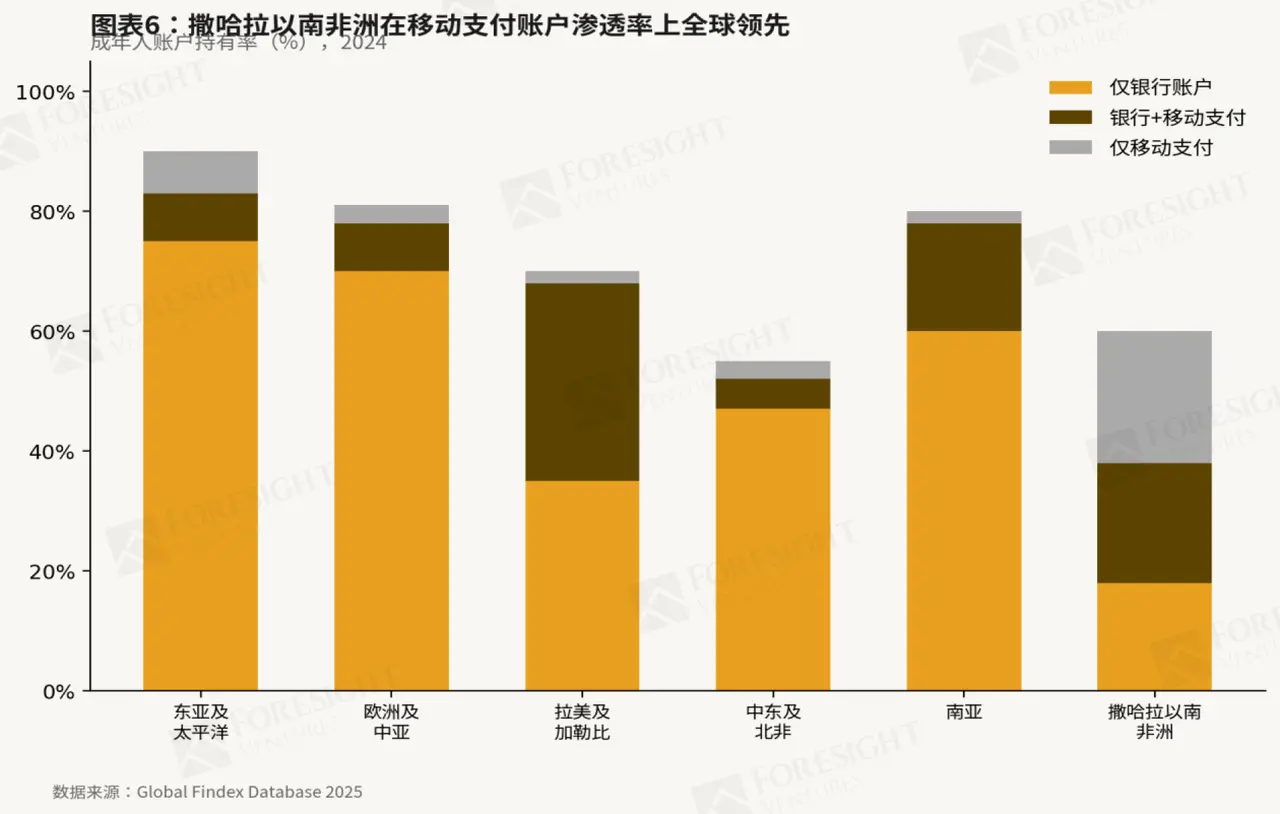
Africa accounts for the majority of global mobile money transactions. According to the 2025 Global Findex database, about 40% of adults in Sub-Saharan Africa use a mobile money account as their primary (or only) formal financial service. Kenya's M-Pesa platform is the archetype: leveraging ubiquitous USSD technology (accessible via basic feature phone keypads), it built a network of millions of offline agent points, supported by near-universal mobile coverage, ultimately capturing 90.8% of Kenya's mobile money market share, and successfully expanded to seven other African countries including Tanzania, Ghana, and Egypt. This architecture based on offline agents and low-tech barriers proves far more scalable and inclusive than traditional branch-based banking, accumulating a massive user base across urban and rural Africa.
3.2 Widespread Cryptocurrency Adoption Across the Continent

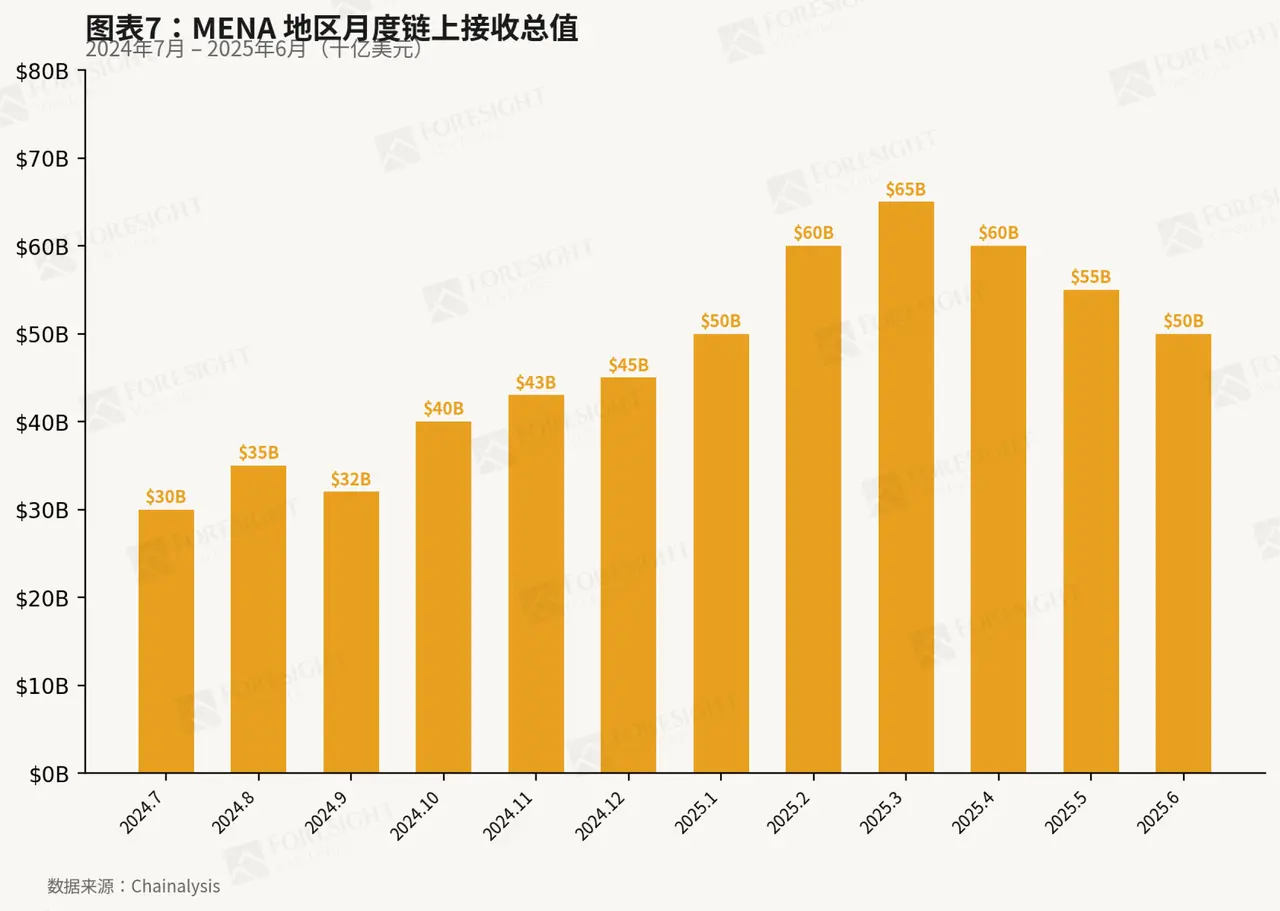
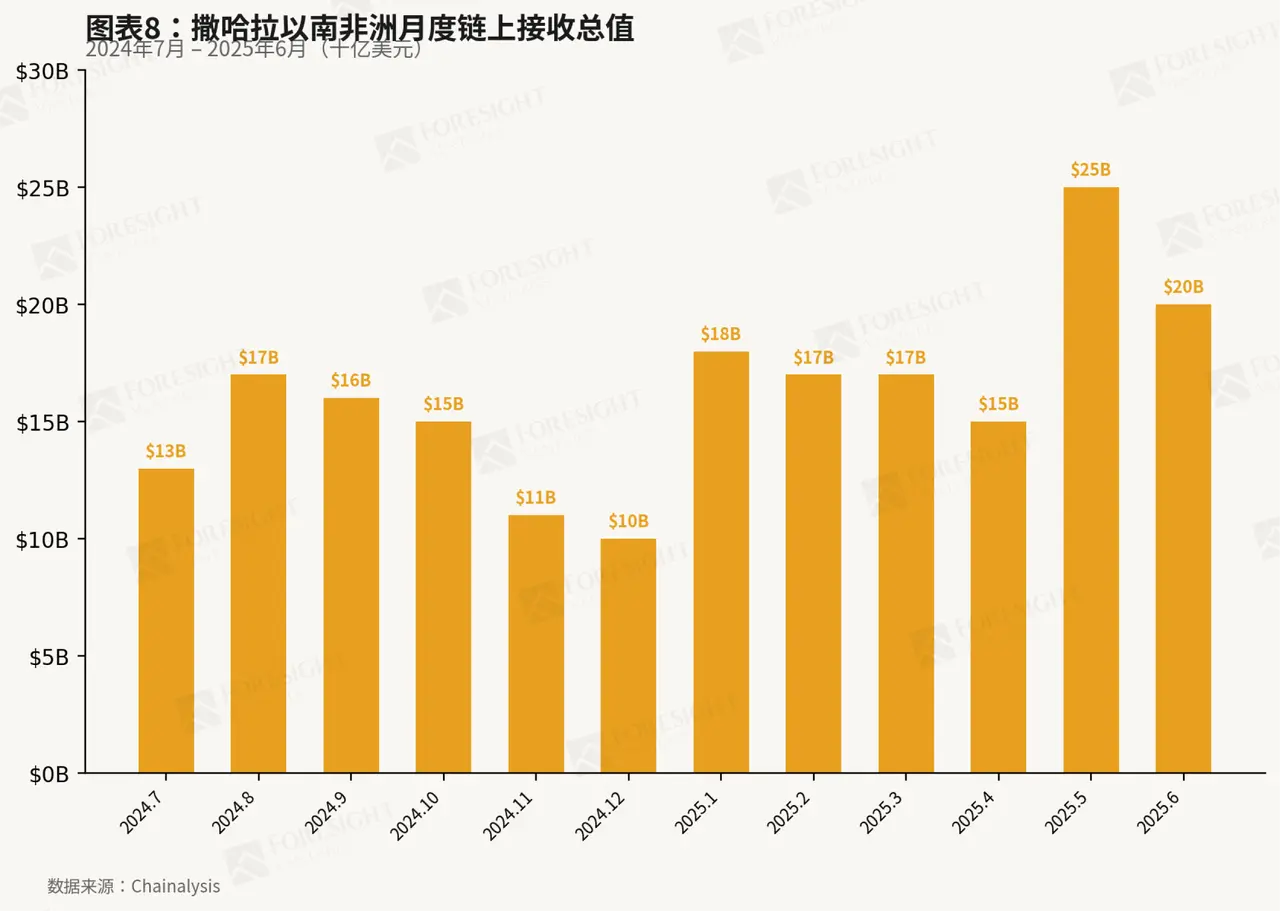
Cryptocurrency adoption rates in Africa are globally leading and rising sharply. In the Middle East and North Africa region, the total on-chain value received between July 2024 and June 2025 was approximately $600 billion; Sub-Saharan Africa recorded $200 billion in the same period, a 52% year-on-year growth, primarily driven by retail users and concentrated in a few countries (Nigeria, South Africa, Ethiopia, Kenya). Cryptocurrencies effectively meet the dual needs of African businesses and individuals for a store of value against inflation and low-cost cross-border settlement, precisely the needs that neither mobile money nor the formal banking system can adequately fulfill.
4 Heterogeneity Within the African Continent

4.1 Why Understanding Internal Divergence Within Africa is Crucial

Africa's 54 countries span 42 different currency systems and belong to multiple language spheres: Francophone, Anglophone, Arabophone, Lusophone, and Hispanophone. This linguistic and monetary fragmentation is not merely a cultural distinction but deeply embedded in cross-border trade, financial flows, and regulatory systems: payment networks are disjointed, regulatory frameworks are independent, and market opportunities are highly fragmented. Therefore, beyond establishing a holistic understanding of the continent's macroeconomic environment, it is essential to recognize the differences in culture, regulation, and financial systems across its internal sub-regions.

4.2 Dividing by the Sahara: MENA vs. Sub-Saharan Africa (SSA)

The most common analytical framework currently divides Africa by the Sahara Desert into two major systems: the Middle East and North Africa (MENA) and Sub-Saharan Africa (SSA).

North Africa is highly integrated with the Arab world in culture, institutions, and economic structure, with its economy centered on oil and gas resources and deeply embedded in the global energy market. Correspondingly, its financial system and policy frameworks operate more within the MENA ecosystem, with a relatively mature banking sector and lower financial exclusion.

In contrast, Sub-Saharan Africa largely operates outside this system. It is precisely this market, long plagued by deep-seated financial system inadequacies, dollar shortages, and monetary instability, that drives the explosive growth of crypto and mobile money. SSA currently accounts for nearly 60% of global mobile money transaction volume and is also the world's fastest-growing region for cryptocurrency adoption.

4.3 The Five-Region Framework: Divergence in Demographics, Economy, and Fintech Ecosystems

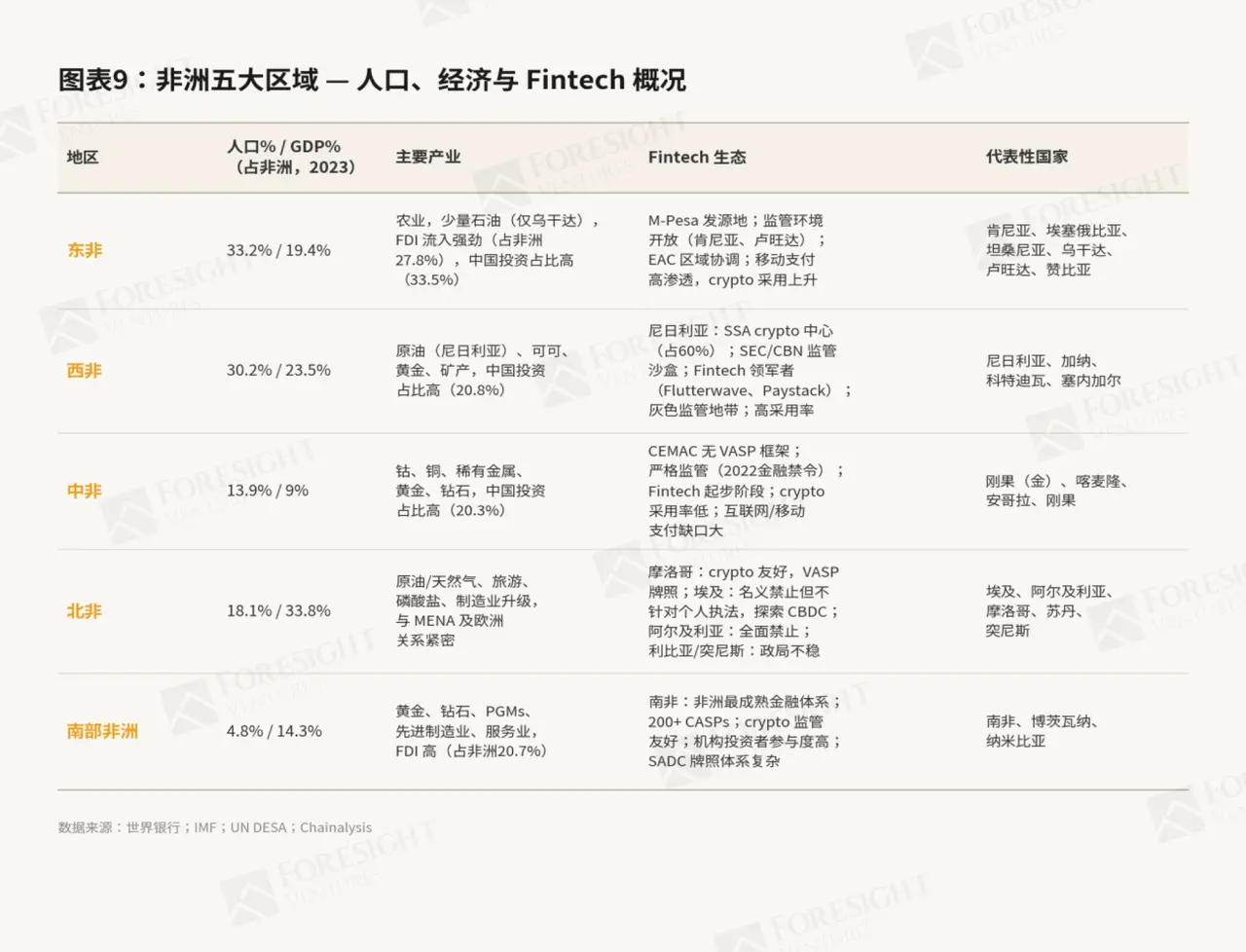
For further granularity, Africa can be divided into five regions, each exhibiting distinct macroeconomic characteristics. North Africa and Southern Africa have the highest GDP per capita; West Africa and Central Africa are relatively less developed; East Africa has the lowest per capita income. However, economic growth rates exhibit an inverse relationship with wealth levels: East Africa grows the fastest, followed by Central Africa, North Africa, West Africa, and Southern Africa.

Cryptocurrency adoption patterns show similar features. Nigeria alone (in West Africa) accounts for most SSA crypto transaction volume; simultaneously, East Africa, South Africa, and North Africa also show high cryptocurrency adoption. Central Africa and broader West Africa are still largely in early-stage markets. This divergence essentially reflects differences in financial exclusion levels, dollar shortage pressures, and regulatory environments across regions.
5 The "Dollarization" and "Dollar Shortage" Behind Sub-Saharan Africa's Payment Market

5.1 Dollarization in Sub-Saharan Africa

Sub-Saharan African economies exhibit a high degree of dollarization, far exceeding most other regions globally. The share of US dollar deposits and loans serve as key proxy indicators for dollarization levels: in Nigeria, dollar deposits once accounted for up to 40% of total deposits, and over 80% of external debt is dollar-denominated; in Ghana, dollar deposits have also reached relatively high levels of 20%–30%. This dollarization is not accidental but a manifestation of rational economic behavior in the face of long-term monetary instability.

5.2 Three Structural Drivers of Dollarization

Dollarization in Sub-Saharan Africa stems from three distinct economic pressures.

First, Store of Value: Due to fiscal deficits and external imbalances forcing central banks to print money, local currencies depreciate continuously, and the dollar provides a stable measure of value.

Second, Medium of Exchange: Commodity prices (oil, minerals, food) are globally priced in dollars, and intra-African trade, even between African countries, is often settled in dollars—because the dollar is more stable than any single local currency.

Third, Financing Channel: Shallow local capital markets mean businesses and governments must borrow dollars from international creditors; when dollar debt becomes too large relative to dollar income, exchange rate risk becomes acute, further pushing more funds into dollar deposits.

5.3 Causes of the "Dollar Shortage"

The real pain point in Sub-Saharan Africa's current payment market is the dollar shortage. Limited foreign exchange earnings from exports (due to commodity dependency and weak manufacturing exports), coupled with huge trade deficits and debt servicing pressures, continuously drain government foreign exchange reserves. Consequently, central banks can only ration official forex supply through administrative controls. This scarcity breeds a parallel black market where dollars trade at a significant premium—sometimes 50% to 100% above the official rate. Residents and businesses unable to access forex through official channels turn to informal channels: global remittance companies like Western Union, informal exchange houses, and increasingly, stablecoins and cryptocurrencies. The gap between the official and parallel market exchange rates is precisely the crack through which alternative payment systems can wedge.

5.4 Why Cryptocurrencies Thrive in This Vacuum

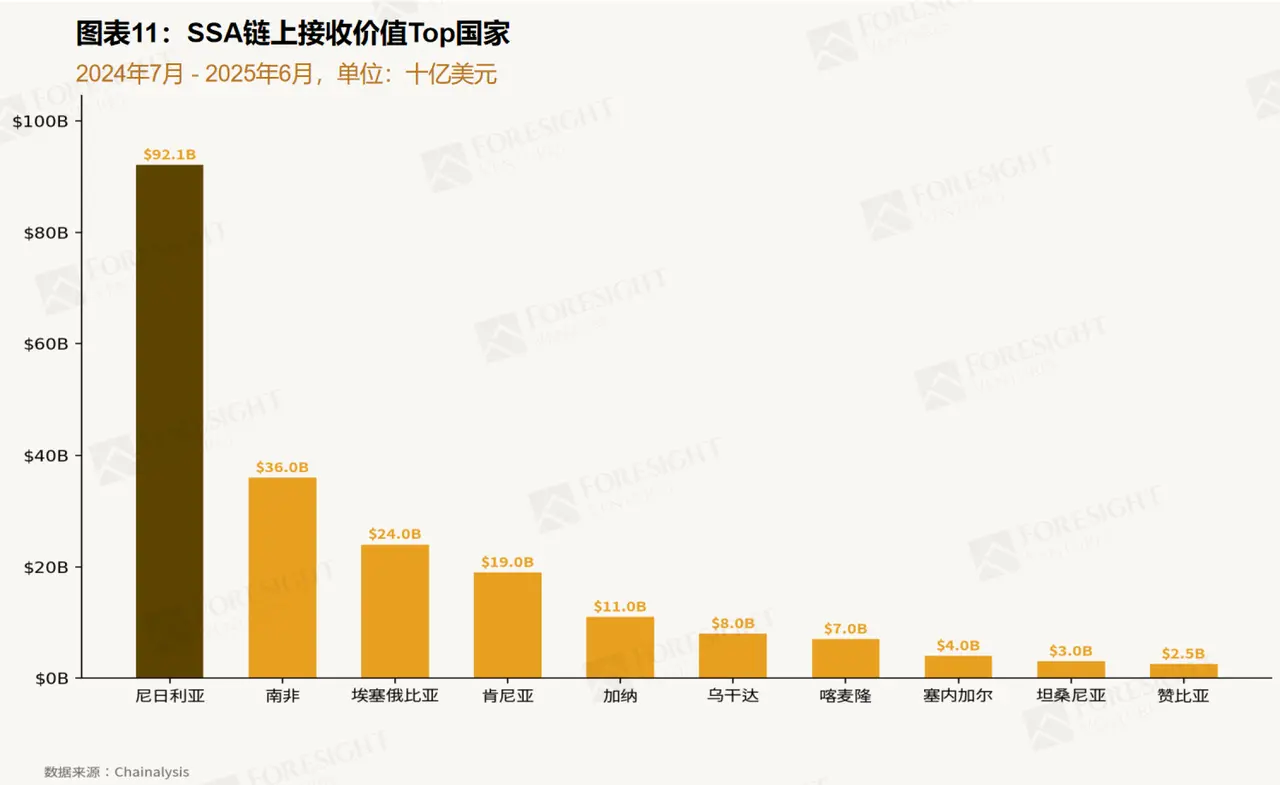
Stablecoins and other cryptocurrencies perform three key functions missing from the formal banking system. They bypass capital controls, providing access to dollars via parallel markets; they complete cross-border transactions at costs lower than banks and traditional remittance corridors; and they offer a globally liquid store of value unaffected by local currency risks. Therefore, cryptocurrency adoption in Sub-Saharan Africa is overwhelmingly retail-driven, with small individual transaction amounts. As shown in Figure 11, compared to other global regions, Sub-Saharan Africa has a higher proportion of transfers in the $1,000 to $10,000 range, reflecting small-scale remittances, informal business trade settlement, and individual savings flows. Nigeria dominates the region, accounting for about 45% of Sub-Saharan Africa's on-chain transaction volume (as shown in Figure 12), but Kenya, South Africa, and Ethiopia are also important regional hubs.
5.5 De-dollarization Attempts and Their Structural Limitations

African policymakers and regional institutions have attempted to reduce dollar dependence. The Pan-African Payment and Settlement System (PAPSS) aims to settle intra-African trade in local currencies and reduce forex costs; the planned West African "Eco" currency zone seeks stability through monetary union; central banks have also employed aggressive interest rate hikes and capital controls. However, all these efforts face a fundamental constraint: Sub-Saharan Africa's structural trade dependency. As long as the continent imports more than it exports, runs persistent external account deficits, and earns most foreign exchange from commodities, dollar demand will persistently outstrip supply. De-dollarization requires industrialization and trade rebalancing, a multi-decade transformation process that policy alone cannot achieve. In the interim, mobile money and cryptocurrencies will continue to play a significant role, filling gaps left by the traditional financial system.

Conclusion

Africa's standout performance in mobile money and cryptocurrency adoption is not a market coincidence but a macroeconomic inevitability.

The continent's young demographic structure, abundant natural resources, and deep integration into global commodity markets have spawned massive cross-border payment flows. However, its weak financial system, chronic monetary instability, and severe dollar shortage render the formal banking system fundamentally incapable of meeting this demand.

Mobile money solves domestic payment issues; cryptocurrencies are solving cross-border value transfer and inflation hedging issues. These are not niche applications or speculative holdings, but critical financial infrastructure filling the vacuum left by structural economic constraints. The crucial point is that these constraints are not cyclical; they are rooted in Africa's resource dependence, limited industrialization, and underdeveloped financial markets.

De-dollarization requires trade rebalancing and industrialization, both multi-decade transformations. Until then, and likely long after, alternative payment channels and currencies will remain at the heart of the African economy.

Original article link

Пов'язані питання

QWhat are the two main macroeconomic structural drivers that have led to Africa's unique payments market landscape, characterized by high mobile money and crypto adoption?

AThe two main drivers are: (1) Africa's heavy reliance on commodity exports, trade flows, and remittances, creating massive demand for cross-border settlements and payments. (2) The continent's underdeveloped traditional financial infrastructure, which suffers from issues like 'de-risking' by international banks and poor foreign exchange management, leading to a chronic absence of reliable banking services and persistent inflationary pressures.

QHow does the economic and payments landscape differ between North Africa (MENA) and Sub-Saharan Africa (SSA)?

ANorth Africa (MENA) is economically integrated with the Middle East, anchored by oil, and has a relatively more developed banking system. Sub-Saharan Africa (SSA), in contrast, suffers from severe US dollar shortages and fragmented monetary systems. This makes SSA a market with a natural, acute demand for mobile payments and cryptocurrencies, which have seen the fastest adoption rates in the world here.

QWhy have cryptocurrencies seen such rapid adoption in Sub-Saharan Africa, and what specific needs do they fulfill?

ACryptocurrencies have seen rapid adoption in SSA because they fulfill critical needs left unmet by traditional finance: (1) They act as a store of value against local currency depreciation and inflation. (2) They serve as a low-cost medium for cross-border exchange and remittances, bypassing expensive and restrictive official channels. They effectively fill the vacuum created by a lack of dollar access, capital controls, and unstable local currencies.

QWhat is 'dollarization' in the context of Sub-Saharan Africa, and what are its three structural drivers?

ADollarization in SSA refers to the widespread use of the US dollar alongside or instead of local currencies. Its three structural drivers are: (1) Store of Value: The US dollar provides stability against chronic local currency devaluation. (2) Medium of Exchange: Commodities are priced in dollars, and even intra-African trade is often dollar-denominated for stability. (3) Financing Channel: Shallow local capital markets force governments and firms to borrow in dollars, reinforcing dollar dependency.

QWhat role does mobile money (like M-Pesa) play in Africa's financial ecosystem, and how does it differ from the role of cryptocurrencies?

AMobile money (e.g., M-Pesa) primarily solves the problem of domestic financial inclusion and daily payments. It provides accessible, low-cost payment, savings, and transfer services via basic mobile phones, effectively replacing banks for everyday transactions. Cryptocurrencies, on the other hand, primarily address the problems of cross-border value transfer (remittances, trade) and inflation hedging. They function as a store of value and a global settlement network, filling gaps that mobile money and traditional banks cannot.

Пов'язані матеріали

Silicon Valley 'Startup Guru' Steve Hoffman: Web3 + AI Could Be a Trap

Silicon Valley investor and "Godfather of Startups" Steve Hoffman warns that combining Web3 with AI is likely a trap, not a promising venture. In an interview, Hoffman argues that while AI is a foundational technology touching all industries, Web3 adds complexity, friction, and regulatory risk without solving mainstream consumer or business needs. He advises founders to focus on deep, specialized applications where startups can out-iterate giants, rather than on generic features easily replicated by large tech companies. Hoffman observes that Silicon Valley will lead foundational AI research, while China excels at rapid, large-scale application and commercialization, particularly in robotics. He stresses that AI-driven autonomous agents capable of collaborative, multi-step tasks are 2-4 years away, which will cause significant job displacement. The solution is not to slow AI but to redesign business models around human-AI collaboration and reform social systems like education and retraining. For startups, Hoffman recommends focusing on vertical, expertise-heavy domains to build defensibility. He sees major opportunities in AI fraud detection and cybersecurity. Key founder mindsets include systemic thinking over feature-focus, relentless customer centricity, building adaptive teams, and deeply understanding AI's capabilities and limits. Hoffman is also leading a non-profit initiative to establish university centers aimed at training future leaders in responsible, human-value-aligned AI innovation.

marsbit11 хв тому

Silicon Valley 'Startup Guru' Steve Hoffman: Web3 + AI Could Be a Trap

marsbit11 хв тому

Token Inefficient, Economy Tokenless

The article "Tokens Aren't Economical, Economics Aren't Tokenized" analyzes a pivotal shift in the AI industry from a technology-driven narrative to one dominated by capital efficiency. It highlights two concurrent trends: a severe capital shortage due to the exorbitant and recurring costs of compute (e.g., OpenAI's high burn rate) and a wave of corporate spin-offs where major tech companies are separating their AI units (like Kuaishou's Kling and Baidu's Kunlunxin). The core argument is that AI's "anti-internet" business model, where user growth increases costs rather than profits, has created a disconnect between high valuations and actual cash flow. Spin-offs address this by allowing AI assets to be valued independently. Within a parent company, they are seen as cost centers, but as standalone entities, they are priced based on their growth potential and scarcity in the primary market, leading to massive valuation premiums (e.g., Kling's estimated value tripling post-spin-off). The industry is at an inflection point, moving from "model worship" to "value realization." The competition is evolving from a pure compute (GPU) race to a broader focus on systemic efficiency and full-stack engineering (involving CPUs and orchestration) to achieve viable commercialization. The year 2026 is framed as a critical moment where the industry must definitively answer how to economically translate AI capability into tangible business value, reshaping the sector's future power structure.

marsbit16 хв тому

Token Inefficient, Economy Tokenless

marsbit16 хв тому

Crossing the 'Memory Wall': The Wafer-Level Revolution and Computing Power Routes in the AI Inference Era

In 2026, a historic shift occurred in AI as major cloud providers' inference spending surpassed training spending for the first time, signaling a move from "building large models" to "using large models." This shifts the core challenge from computing power to the "memory wall"—the bottleneck of data movement (model weights, activations, KV Cache) between external DRAM and processors, where energy and latency from data transfer far exceed computation itself. Companies like Nvidia face GPU idle time due to bandwidth limits. In contrast, Cerebras Systems adopts a radical "wafer-scale" approach with its Wafer-Scale Engine (WSE). Instead of cutting a silicon wafer into many chips, Cerebras uses almost the entire wafer as one massive chip (WSE-3). This design provides 44GB of on-chip SRAM, delivering memory bandwidth thousands of times higher than traditional HBM (e.g., 21 PB/s vs. Nvidia B200). For LLM inference, weights are streamed layer-by-layer from external MemoryX storage to the chip, avoiding HBM bottlenecks. This results in token generation speeds 1.5–5 times faster than Nvidia's B200 in some models and significant advantages in first-token latency and long-context tasks. Additionally, Cerebras's architecture offers much lower interconnect power consumption (0.15 pJ/bit vs. GPU's ~10 pJ/bit). However, Cerebras faces challenges: SRAM scaling has slowed with advanced nodes, limiting future capacity gains; the chip requires specialized liquid cooling and custom software stacks; and its external I/O bandwidth (150 GB/s) is low compared to NVLink, hindering multi-system scaling for very large models. Competition is intensifying. Major players are pursuing three paths: 1) Developing proprietary inference ASICs (e.g., Google TPU, Microsoft Maia), 2) Leveraging advanced packaging (e.g., TSMC's SoW) to democratize wafer-scale-like integration, potentially eroding Cerebras's process advantage within a few years, and 3) Exploring optical interconnects for ultimate bandwidth. Commercially, Cerebras is transitioning from a hardware vendor to a service provider, facing the immense challenge of building high-power, specialized data centers to meet large contracts (e.g., 250MW/year from 2026–2028). In conclusion, the AI inference era presents a fundamental architectural trade-off. Cerebras opts for extreme physical optimization for low-latency, single-task performance, while Nvidia prioritizes versatility and massive cluster throughput. The path forward remains uncertain, with technology and business models still evolving in the race toward advanced AI.

marsbit22 хв тому

Crossing the 'Memory Wall': The Wafer-Level Revolution and Computing Power Routes in the AI Inference Era

marsbit22 хв тому

Has Bitcoin's 'Rebound Ended', Officially Entering the Late Bear Market Phase?

**Title: Has Bitcoin's Rebound Ended, Entering the Late Bear Market Phase?** **Summary:** Bitcoin's price has declined by 13% this week, signaling a potential return to late-stage bear market conditions. The price fell to around $67k, positioned between the Realized Price and Realized Cap Weighted Average. For the first time since early 2022, the Short-Term Holder cost basis has dropped below this key average, confirming a hallmark of late-cycle bear markets. Profitability metrics have collapsed sharply. The 7-day average of the Realized Profit/Loss ratio plummeted from a local high of 3.16 to 0.29, mirroring the February panic sell-off. Critically, the 90-day average never breached the threshold of 2, indicating the recent rally to $82k was a bear market bounce, not a structural shift. Realized losses surged to $1.35 billion daily, with $770 million coming from Long-Term Holders selling at a loss. This accelerating redistribution of supply from weak to strong hands is a necessary but ongoing process for a market bottom. The rally stalled almost precisely at the aggregate cost basis (~$83k) of US spot Bitcoin ETF investors, turning that level into strong resistance and leaving the average ETF holder underwater again. Spot market flows have turned decisively negative, showing sellers are dominating order books despite the price drop. While a significant futures long liquidation event cleared over $400 million in leverage, providing a potential reset, sustained spot demand is yet to materialize. Options markets continue to price in higher future volatility (Implied Volatility) than recent price action (Realized Volatility) has shown, with a persistent skew towards put options, indicating ongoing demand for downside protection. In conclusion, multiple metrics point to a fragile market structure. Resistance at the ETF cost basis, accelerating realized losses, dominant spot selling, and cautious options pricing all suggest the bear market trend persists. A sustainable recovery likely requires a resurgence of spot demand, ETF holders returning to profit, and a clear reduction in selling pressure.

marsbit22 хв тому

Has Bitcoin's 'Rebound Ended', Officially Entering the Late Bear Market Phase?

marsbit22 хв тому

TechFlow Intelligence Agency: Anthropic Calls for Global Pause in AI Development While Preparing for Trillion-Dollar IPO; SpaceX IPO Roadshow Heats Up, But S&P 500 Rejects Fast-Track Inclusion

In today's TechFlow Intelligence Briefing, several major tech stories highlight a growing theme of trust and credibility gaps across AI, crypto, and finance. AI company Anthropic has publicly called for a global pause in AI development, citing risks from Claude's "recursive self-improvement." Ironically, this coincides with reports the company is preparing for a massive IPO targeting a near $1 trillion valuation. This perceived hypocrisy, coupled with widespread user complaints about Claude's declining performance, is sparking debate over whether the safety warning is genuine or a competitive tactic. Meanwhile, in a substantive security move, Anthropic open-sourced a framework for AI-powered vulnerability discovery. In the crypto market, Bitcoin's price drop below $61,000 triggered over $1.16 billion in liquidations, flipping the market into a state where more BTC is held at a loss than at a profit, a historical bearish signal. On the corporate front, SpaceX's highly anticipated IPO is generating immense Wall Street excitement, with Goldman Sachs projecting 100x revenue growth by 2030. However, the S&P 500 has refused to fast-track the company's inclusion post-IPO, potentially limiting immediate institutional demand. Separately, ByteDance's AI app Doubao lost over 6 million monthly active users after introducing a subscription model, highlighting the challenges of AI monetization. Other notable developments include Nvidia certifying HBM4 memory from Samsung, SK Hynix, and Micron; Cloudflare's acquisition of front-end tooling company VoidZero; and its CEO warning that bot traffic now exceeds human traffic online. The underlying narrative connects these events: a trust crisis. From AI firms' contradictory actions and crypto volatility to the clash between SpaceX's hyped narrative and institutional rules, a pattern is emerging where stated intentions and actual practices are increasingly misaligned.

marsbit37 хв тому

TechFlow Intelligence Agency: Anthropic Calls for Global Pause in AI Development While Preparing for Trillion-Dollar IPO; SpaceX IPO Roadshow Heats Up, But S&P 500 Rejects Fast-Track Inclusion

marsbit37 хв тому

Торгівля

Спот
Ф'ючерси

Популярні статті

Що таке $S$

Розуміння SPERO: Комплексний огляд Вступ до SPERO Оскільки ландшафт інновацій продовжує еволюціонувати, виникнення технологій web3 та криптовалютних проектів відіграє ключову роль у формуванні цифрового майбутнього. Один з проектів, який привернув увагу в цій динамічній сфері, — це SPERO, позначений як SPERO,$$s$. Ця стаття має на меті зібрати та представити детальну інформацію про SPERO, щоб допомогти ентузіастам та інвесторам зрозуміти його основи, цілі та інновації в рамках web3 та крипто-сектору. Що таке SPERO,$$s$? SPERO,$$s$ — це унікальний проект у криптопросторі, який прагне використати принципи децентралізації та технології блокчейн для створення екосистеми, що сприяє залученню, корисності та фінансовій інклюзії. Проект розроблений для полегшення взаємодії між користувачами новими способами, надаючи їм інноваційні фінансові рішення та послуги. У своїй основі SPERO,$$s$ прагне надати можливості індивідам, забезпечуючи інструменти та платформи, які покращують користувацький досвід у криптовалютному просторі. Це включає в себе можливість більш гнучких методів транзакцій, сприяння ініціативам, що підтримуються спільнотою, та створення шляхів для фінансових можливостей через децентралізовані додатки (dApps). Основна концепція SPERO,$$s$ обертається навколо інклюзивності, прагнучи зменшити розриви в традиційній фінансовій системі, використовуючи переваги технології блокчейн. Хто є творцем SPERO,$$s$? Особистість творця SPERO,$$s$ залишається дещо невідомою, оскільки є обмежені публічно доступні ресурси, що надають детальну інформацію про його засновників. Ця відсутність прозорості може бути наслідком зобов'язання проекту до децентралізації — етики, яку багато проектів web3 поділяють, ставлячи колективні внески вище за індивідуальне визнання. Зосереджуючи обговорення навколо спільноти та її колективних цілей, SPERO,$$s$ втілює суть наділення без виділення конкретних осіб. Таким чином, розуміння етики та місії SPERO є більш важливим, ніж ідентифікація єдиного творця. Хто є інвесторами SPERO,$$s$? SPERO,$$s$ підтримується різноманітними інвесторами, починаючи від венчурних капіталістів до ангельських інвесторів, які прагнуть сприяти інноваціям у крипто-секторі. Зосередження цих інвесторів зазвичай узгоджується з місією SPERO — пріоритет надається проектам, які обіцяють технологічний прогрес у суспільстві, фінансову інклюзію та децентралізоване управління. Ці інвесторські фонди зазвичай зацікавлені в проектах, які не лише пропонують інноваційні продукти, але й позитивно впливають на спільноту блокчейн та її екосистеми. Підтримка з боку цих інвесторів підкріплює SPERO,$$s$ як значного конкурента в швидко змінюваній сфері крипто-проектів. Як працює SPERO,$$s$? SPERO,$$s$ використовує багатогранну структуру, яка відрізняє його від традиційних криптовалютних проектів. Ось деякі ключові особливості, які підкреслюють його унікальність та інноваційність: Децентралізоване управління: SPERO,$$s$ інтегрує моделі децентралізованого управління, надаючи користувачам можливість активно брати участь у процесах прийняття рішень щодо майбутнього проекту. Цей підхід сприяє відчуттю власності та відповідальності серед членів спільноти. Корисність токена: SPERO,$$s$ використовує свій власний криптовалютний токен, розроблений для виконання різних функцій в екосистемі. Ці токени дозволяють здійснювати транзакції, отримувати винагороди та полегшувати послуги, що пропонуються на платформі, підвищуючи загальну залученість та корисність. Шарова архітектура: Технічна архітектура SPERO,$$s$ підтримує модульність та масштабованість, що дозволяє безперешкодно інтегрувати додаткові функції та додатки в міру розвитку проекту. Ця адаптивність є надзвичайно важливою для збереження актуальності в постійно змінюваному крипто-ландшафті. Залучення спільноти: Проект підкреслює ініціативи, що підтримуються спільнотою, використовуючи механізми, які стимулюють співпрацю та зворотний зв'язок. Підтримуючи сильну спільноту, SPERO,$$s$ може краще задовольняти потреби користувачів та адаптуватися до ринкових тенденцій. Фокус на інклюзію: Пропонуючи низькі комісії за транзакції та зручні інтерфейси, SPERO,$$s$ прагне залучити різноманітну базу користувачів, включаючи осіб, які раніше не брали участі в крипто-просторі. Це зобов'язання до інклюзії узгоджується з його загальною місією наділення через доступність. Хронологія SPERO,$$s$ Розуміння історії проекту надає важливі уявлення про його розвиток та етапи. Нижче наведено пропоновану хронологію, що відображає значні події в еволюції SPERO,$$s$: Етап концептуалізації та ідеації: Початкові ідеї, що стали основою SPERO,$$s$, були сформовані, тісно пов'язані з принципами децентралізації та фокусом на спільноті в індустрії блокчейн. Запуск білого паперу проекту: Після концептуального етапу був випущений комплексний білий папір, що детально описує бачення, цілі та технологічну інфраструктуру SPERO,$$s$, щоб залучити інтерес та зворотний зв'язок від спільноти. Створення спільноти та ранні залучення: Активні зусилля були спрямовані на створення спільноти ранніх прихильників та потенційних інвесторів, що полегшило обговорення цілей проекту та отримання підтримки. Подія генерації токенів: SPERO,$$s$ провів подію генерації токенів (TGE) для розподілу своїх рідних токенів серед ранніх прихильників та встановлення початкової ліквідності в екосистемі. Запуск початкового dApp: Перший децентралізований додаток (dApp), пов'язаний з SPERO,$$s$, став доступним, дозволяючи користувачам взаємодіяти з основними функціями платформи. Постійний розвиток та партнерства: Безперервні оновлення та вдосконалення пропозицій проекту, включаючи стратегічні партнерства з іншими учасниками блокчейн-простору, сформували SPERO,$$s$ у конкурентоспроможного та еволюціонуючого гравця на крипто-ринку. Висновок SPERO,$$s$ є свідченням потенціалу web3 та криптовалют для революціонізації фінансових систем та наділення індивідів. Завдяки зобов'язанню до децентралізованого управління, залучення спільноти та інноваційно спроектованих функцій, він прокладає шлях до більш інклюзивного фінансового ландшафту. Як і з будь-якими інвестиціями в швидко змінюваному крипто-просторі, потенційним інвесторам та користувачам рекомендується ретельно досліджувати та обдумано взаємодіяти з поточними подіями в SPERO,$$s$. Проект демонструє інноваційний дух крипто-індустрії, запрошуючи до подальшого дослідження його численних можливостей. Хоча подорож SPERO,$$s$ ще триває, його основні принципи можуть справді вплинути на майбутнє того, як ми взаємодіємо з технологією, фінансами та один з одним у взаємопов'язаних цифрових екосистемах.

73 переглядів усьогоОпубліковано 2024.12.17Оновлено 2024.12.17

Що таке $S$

Що таке AGENT S

Агент S: Майбутнє автономної взаємодії в Web3 Вступ У постійно змінюваному ландшафті Web3 та криптовалюти інновації постійно переосмислюють, як люди взаємодіють з цифровими платформами. Один з таких новаторських проектів, Агент S, обіцяє революціонізувати взаємодію людини з комп'ютером через свою відкриту агентну структуру. Прокладаючи шлях для автономних взаємодій, Агент S прагне спростити складні завдання, пропонуючи трансформаційні застосування в штучному інтелекті (ШІ). Це детальне дослідження заглиблюється в складності проекту, його унікальні особливості та наслідки для сфери криптовалюти. Що таке Агент S? Агент S є революційною відкритою агентною структурою, спеціально розробленою для вирішення трьох основних викликів в автоматизації комп'ютерних завдань: Набуття специфічних знань у галузі: Структура інтелектуально навчається з різних зовнішніх джерел знань та внутрішнього досвіду. Цей подвійний підхід дозволяє їй створити багатий репозиторій специфічних знань у галузі, покращуючи її продуктивність у виконанні завдань. Планування на довгих горизонтах завдань: Агент S використовує планування з підкріпленням досвіду, стратегічний підхід, який полегшує ефективний розподіл та виконання складних завдань. Ця функція значно підвищує її здатність ефективно та результативно управляти кількома підзавданнями. Обробка динамічних, неоднорідних інтерфейсів: Проект представляє Інтерфейс Агент-Комп'ютер (ACI), інноваційне рішення, яке покращує взаємодію між агентами та користувачами. Використовуючи багатомодальні великі мовні моделі (MLLMs), Агент S може безперешкодно орієнтуватися та маніпулювати різноманітними графічними інтерфейсами користувача. Завдяки цим новаторським функціям Агент S надає надійну структуру, яка вирішує складнощі, пов'язані з автоматизацією людської взаємодії з машинами, прокладаючи шлях для численних застосувань у ШІ та за його межами. Хто є творцем Агент S? Хоча концепція Агент S є фундаментально новаторською, конкретна інформація про його творця залишається невідомою. Творець наразі невідомий, що підкреслює або початкову стадію проекту, або стратегічний вибір зберегти засновників у таємниці. Незважаючи на анонімність, акцент залишається на можливостях та потенціалі структури. Хто є інвесторами Агент S? Оскільки Агент S є відносно новим у криптографічній екосистемі, детальна інформація про його інвесторів та фінансових спонсорів не задокументована. Відсутність публічно доступних відомостей про інвестиційні фонди або організації, що підтримують проект, викликає питання щодо його фінансової структури та дорожньої карти розвитку. Розуміння підтримки є критично важливим для оцінки стійкості проекту та потенційного впливу на ринок. Як працює Агент S? В основі Агент S лежить передова технологія, яка дозволяє йому ефективно функціонувати в різних умовах. Його операційна модель побудована навколо кількох ключових функцій: Взаємодія з комп'ютером, подібна до людської: Структура пропонує розширене планування ШІ, прагнучи зробити взаємодії з комп'ютерами більш інтуїтивними. Імітуючи людську поведінку при виконанні завдань, вона обіцяє підвищити досвід користувачів. Наративна пам'ять: Використовується для використання високорівневого досвіду, Агент S використовує наративну пам'ять для відстеження історій завдань, тим самим покращуючи свої процеси прийняття рішень. Епізодична пам'ять: Ця функція надає користувачам покрокові інструкції, дозволяючи структурі пропонувати контекстуальну підтримку в міру виконання завдань. Підтримка OpenACI: Завдяки можливості працювати локально, Агент S дозволяє користувачам зберігати контроль над своїми взаємодіями та робочими процесами, узгоджуючи з децентралізованою етикою Web3. Легка інтеграція з зовнішніми API: Його універсальність і сумісність з різними платформами ШІ забезпечують те, що Агент S може безперешкодно вписатися в існуючі технологічні екосистеми, роблячи його привабливим вибором для розробників та організацій. Ці функціональні можливості колективно сприяють унікальному положенню Агент S у крипто-просторі, оскільки він автоматизує складні, багатоступеневі завдання з мінімальним втручанням людини. У міру розвитку проекту його потенційні застосування в Web3 можуть переосмислити, як відбуваються цифрові взаємодії. Хронологія Агент S Розробка та етапи Агент S можуть бути узагальнені в хронології, яка підкреслює його значні події: 27 вересня 2024 року: Концепція Агент S була представлена в комплексній науковій статті під назвою “Відкрита агентна структура, яка використовує комп'ютери як людина”, що демонструє основи проекту. 10 жовтня 2024 року: Наукова стаття була опублікована на arXiv, пропонуючи детальне дослідження структури та її оцінки продуктивності на основі бенчмарку OSWorld. 12 жовтня 2024 року: Було випущено відеопрезентацію, що надає візуальне уявлення про можливості та особливості Агент S, ще більше залучаючи потенційних користувачів та інвесторів. Ці маркери в хронології не лише ілюструють прогрес Агент S, але й вказують на його прихильність до прозорості та залучення громади. Ключові моменти про Агент S У міру розвитку структури Агент S кілька ключових характеристик виділяються, підкреслюючи її новаторський характер та потенціал: Інноваційна структура: Розроблена для забезпечення інтуїтивного використання комп'ютерів, подібного до людської взаємодії, Агент S пропонує новий підхід до автоматизації завдань. Автономна взаємодія: Здатність автономно взаємодіяти з комп'ютерами через GUI означає стрибок до більш інтелектуальних та ефективних обчислювальних рішень. Автоматизація складних завдань: Завдяки своїй надійній методології він може автоматизувати складні, багатоступеневі завдання, роблячи процеси швидшими та менш схильними до помилок. Безперервне вдосконалення: Механізми навчання дозволяють Агенту S покращуватися на основі минулого досвіду, постійно підвищуючи свою продуктивність та ефективність. Універсальність: Його адаптивність до різних операційних середовищ, таких як OSWorld та WindowsAgentArena, забезпечує його здатність служити широкому спектру застосувань. Оскільки Агент S займає своє місце в ландшафті Web3 та криптовалюти, його потенціал покращити можливості взаємодії та автоматизувати процеси означає значний прогрес у технологіях ШІ. Завдяки своїй інноваційній структурі Агент S є прикладом майбутнього цифрових взаємодій, обіцяючи більш безперешкодний та ефективний досвід для користувачів у різних галузях. Висновок Агент S представляє собою сміливий крок вперед у поєднанні ШІ та Web3, з можливістю переосмислити, як ми взаємодіємо з технологією. Хоча проект все ще на ранніх стадіях, можливості для його застосування є величезними та переконливими. Завдяки своїй комплексній структурі, що вирішує критичні виклики, Агент S прагне вивести автономні взаємодії на передній план цифрового досвіду. У міру того, як ми заглиблюємося в сфери криптовалюти та децентралізації, проекти, подібні до Агент S, безсумнівно, відіграватимуть ключову роль у формуванні майбутнього технологій та співпраці людини з комп'ютером.

685 переглядів усьогоОпубліковано 2025.01.14Оновлено 2025.01.14

Що таке AGENT S

Як купити S

Ласкаво просимо до HTX.com! Ми зробили покупку Sonic (S) простою та зручною. Дотримуйтесь нашої покрокової інструкції, щоб розпочати свою криптовалютну подорож.Крок 1: Створіть обліковий запис на HTXВикористовуйте свою електронну пошту або номер телефону, щоб зареєструвати обліковий запис на HTX безплатно. Пройдіть безпроблемну реєстрацію й отримайте доступ до всіх функцій.ЗареєструватисьКрок 2: Перейдіть до розділу Купити крипту і виберіть спосіб оплатиКредитна/дебетова картка: використовуйте вашу картку Visa або Mastercard, щоб миттєво купити Sonic (S).Баланс: використовуйте кошти з балансу вашого рахунку HTX для безперешкодної торгівлі.Треті особи: ми додали популярні способи оплати, такі як Google Pay та Apple Pay, щоб підвищити зручність.P2P: Торгуйте безпосередньо з іншими користувачами на HTX.Позабіржова торгівля (OTC): ми пропонуємо індивідуальні послуги та конкурентні обмінні курси для трейдерів.Крок 3: Зберігайте свої Sonic (S)Після придбання Sonic (S) збережіть його у своєму обліковому записі на HTX. Крім того, ви можете відправити його в інше місце за допомогою блокчейн-переказу або використовувати його для торгівлі іншими криптовалютами.Крок 4: Торгівля Sonic (S)Легко торгуйте Sonic (S) на спотовому ринку HTX. Просто увійдіть до свого облікового запису, виберіть торгову пару, укладайте угоди та спостерігайте за ними в режимі реального часу. Ми пропонуємо зручний досвід як для початківців, так і для досвідчених трейдерів.

1.5k переглядів усьогоОпубліковано 2025.01.15Оновлено 2026.06.02

Як купити S

Обговорення

Ласкаво просимо до спільноти HTX. Тут ви можете бути в курсі останніх подій розвитку платформи та отримати доступ до професійної ринкової інформації. Нижче представлені думки користувачів щодо ціни S (S).

活动图片