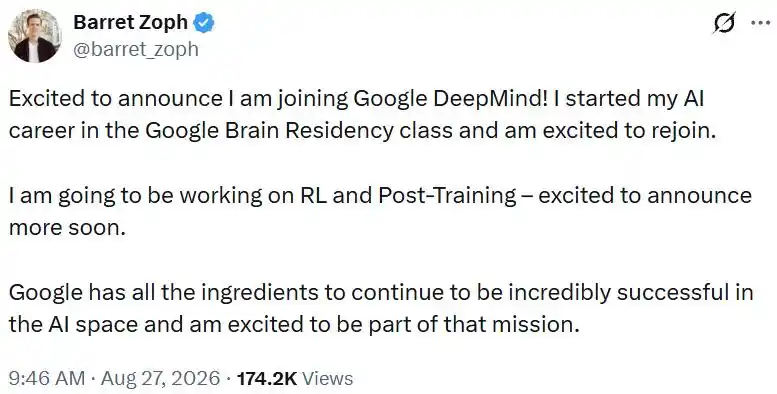
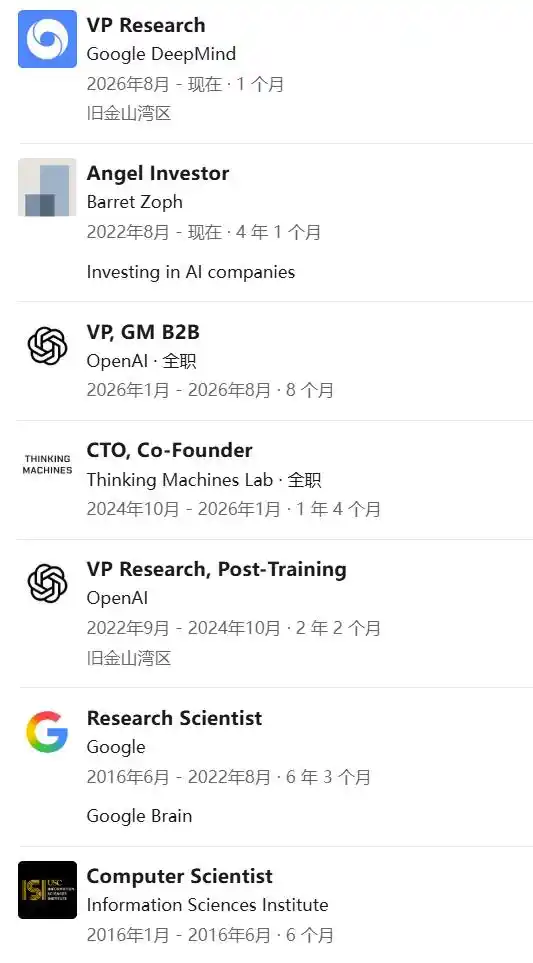
A few hours ago, Barret Zoph posted a tweet on X, saying he will join Google DeepMind. His AI career started with the Residency program at Google Brain, so this marks a return to familiar ground. He will focus on Reinforcement Learning (RL) and Post-Training directions, with more details to be announced later. He added that Google possesses all the elements needed for continued success in the AI field, and he is excited to be part of this mission.
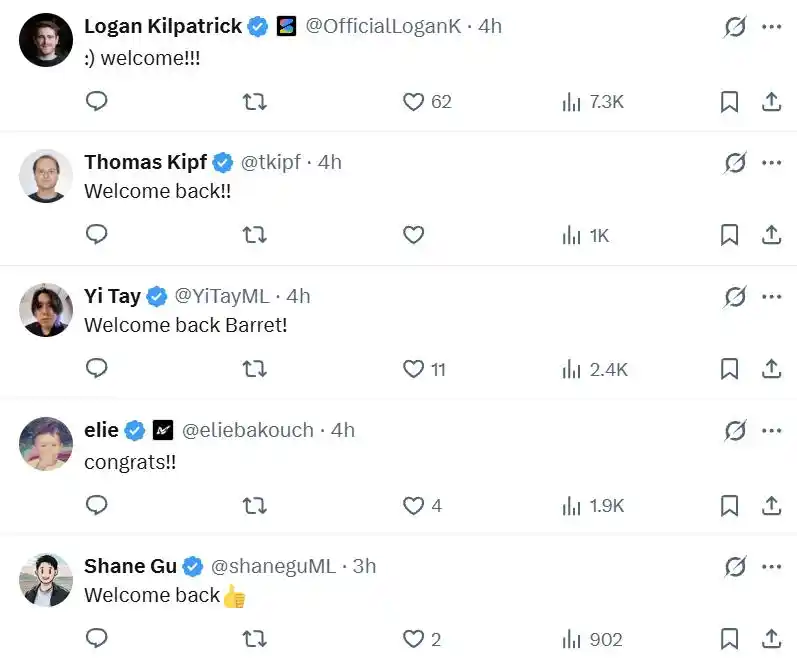
In the comment section, Zoph received a flood of congratulations from major figures, including Jason Wei, the father of Chain-of-Thought; Thang Luong, head of the Superhuman Reasoning team at DeepMind; Logan Kilpatrick, Google AI's Chief Evangelist; Thomas Kipf, the father of Graph Convolutional Networks; Yi Tay, the prolific contributor to large models at Google; and Shane Gu, a key researcher in world models...

The tweet didn't mention what he had experienced over the past 20 months. But for those tracking this round of AI talent movement, this job announcement is the latest chapter in a rather convoluted narrative: sandwiched between a $12 billion-valued star startup, a publicly announced dismissal, a 58-minute rebound to a former employer, and a tenure as head of enterprise business that lasted only a few months.

According to Reuters, Zoph's position at Google DeepMind is Vice President of Research. His previous title at OpenAI was also VP of Research, having gone full circle in between.
A Year and a Half, Three Employers
Laying out the timeline reveals the unusual density of this career path.
Zoph graduated with a bachelor's in Computer Science from the University of Southern California (USC) in 2016. During his undergraduate studies, he conducted research on statistical machine translation at USC's Information Sciences Institute (ISI) under Kevin Knight and others. His first widely cited paper, "Transfer Learning for Low-Resource Neural Machine Translation," was published at EMNLP 2016. After graduation, he joined Google Brain and stayed there for six years.
Those six years yielded two highly cited papers where he was the first author: "Neural Architecture Search with Reinforcement Learning" and "Learning Transferable Architectures for Scalable Image Recognition."
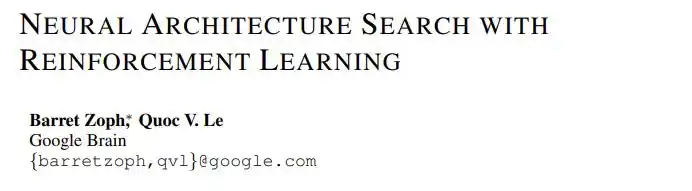
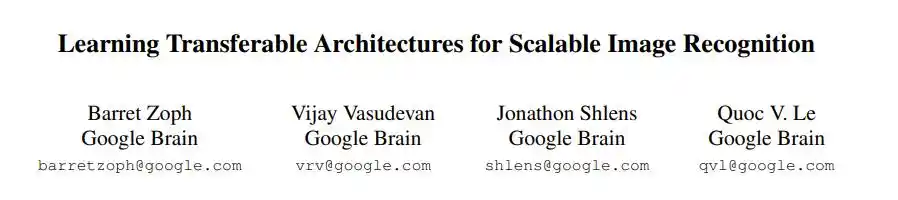
Using reinforcement learning to automatically search for network architectures was one of the starting points of the entire Neural Architecture Search (NAS) subfield. Later, he also contributed to projects like Switch Transformer and other sparse expert models—that model had a total of 1.6 trillion parameters but routed each token to only 1 of 2048 experts, activating fewer than 30 billion parameters, which in hindsight was a rather bold choice.
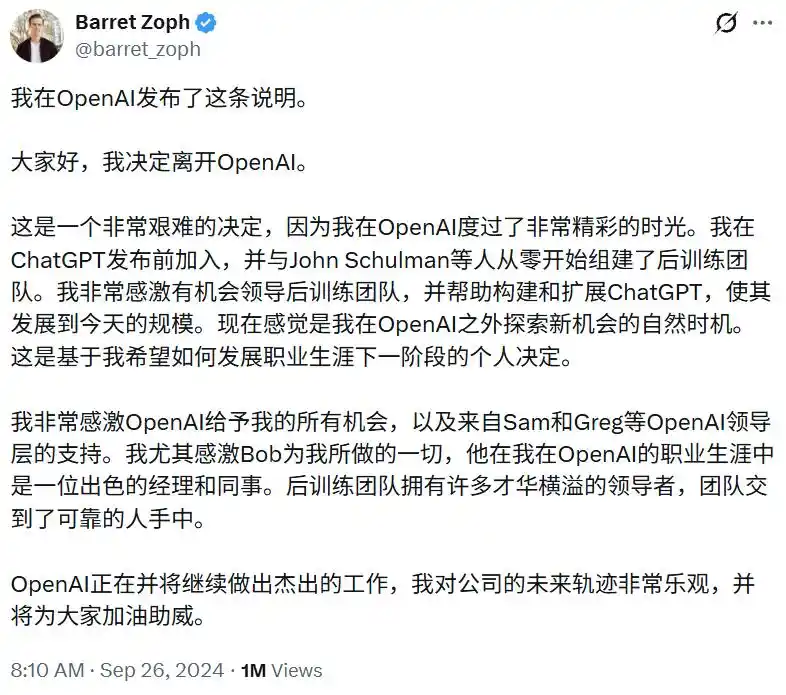
In September 2022, he left Google to join OpenAI, eventually becoming Vice President of Research for Post-Training, with his team responsible for alignment, tool use, evaluation, ChatGPT, search, and multimodality. The post-training system for ChatGPT was built by him and others like John Schulman.
On September 25, 2024, he and Chief Research Officer Bob McGrew announced their departures on the same day, just hours after CTO Mira Murati announced her own departure. The near-simultaneous exit of the three was one of the most glaring scenes in OpenAI's wave of personnel turbulence at the time.
In February 2025, Thinking Machines Lab (TML) was officially established, with Murati as CEO and Zoph as Co-founder and CTO.
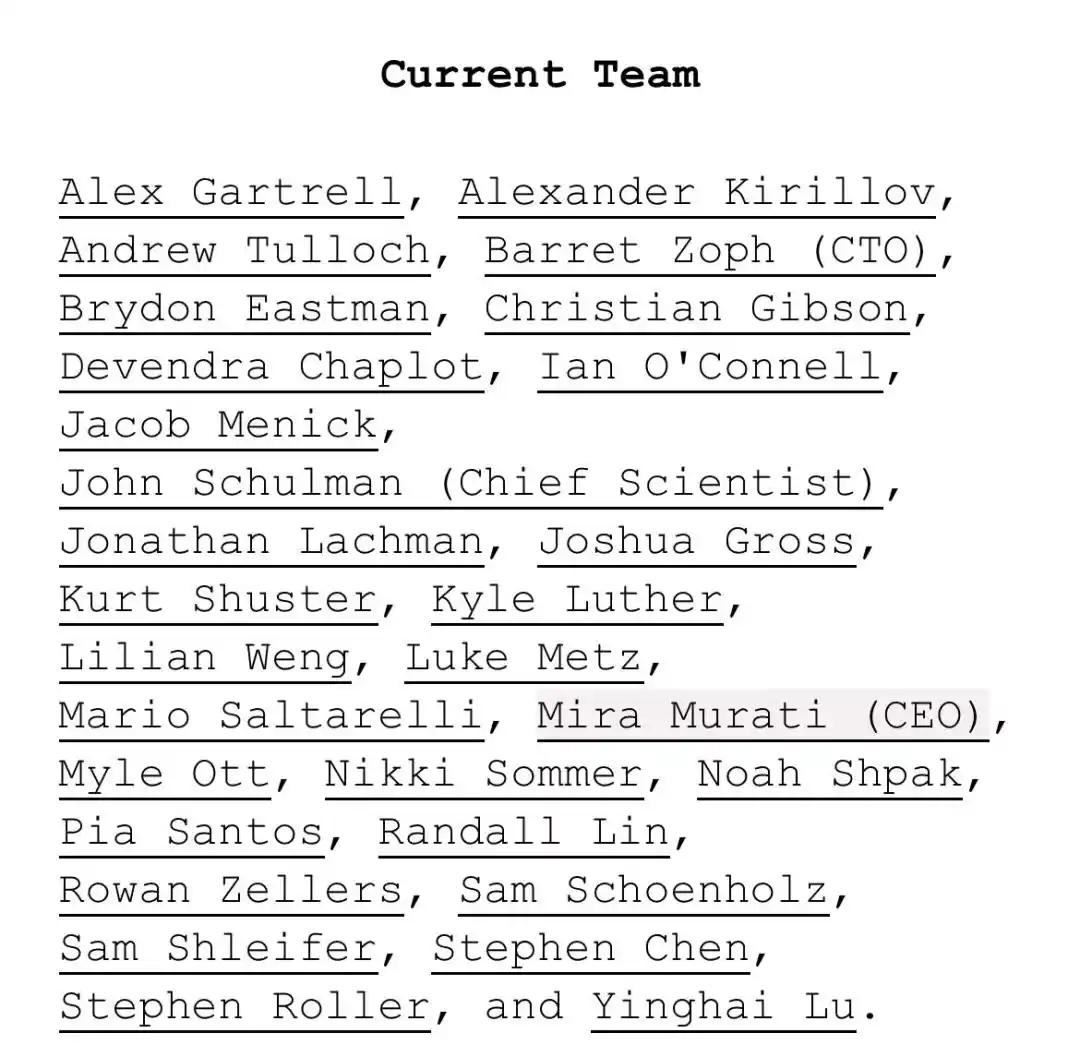
TML's initial team roster
In July of that year, this company without a product yet raised approximately $2 billion in a seed round, with a post-money valuation of $12 billion. Investors included a16z, NVIDIA, AMD, Cisco, Accel, ServiceNow, and Jane Street, making it one of the largest seed rounds in Silicon Valley history. In November, Bloomberg reported that TML was negotiating a new funding round at a valuation of around $50 billion, but follow-up reports indicated these talks ended without success by January 2026.
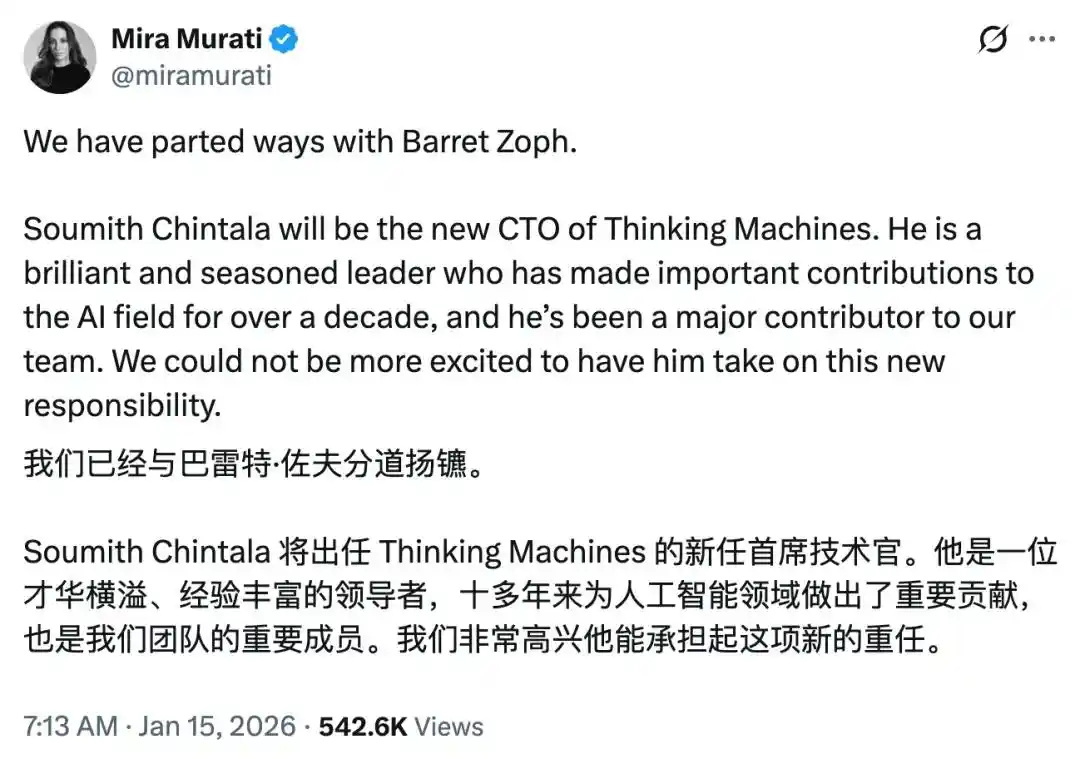
On January 14, 2026, Murati announced parting ways with Zoph and announced that Soumith Chintala, the creator of PyTorch, would take over as CTO.
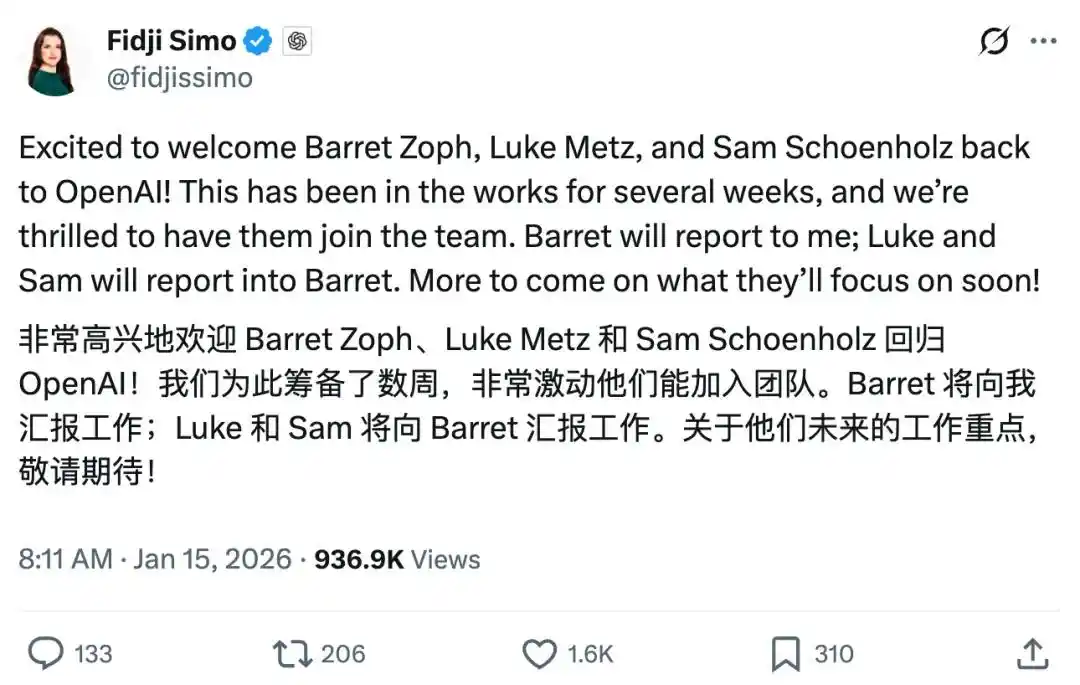
Fifty-eight minutes later, OpenAI's Application Business CEO Fidji Simo announced on X that Zoph, another co-founder Luke Metz, and founding team member Sam Schoenholz were returning to OpenAI, stating that this had "been in the works for weeks."
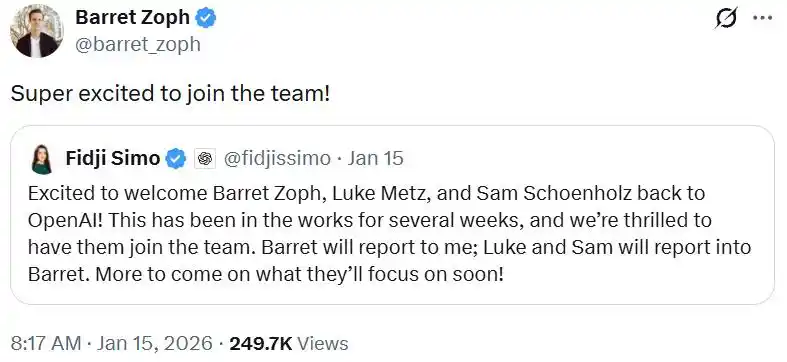
Zoph simply retweeted with the comment "Super excited to join the team."
For details, refer to the report "Internal Turmoil at Mira's Company? CTO Fired, Team Returns to OpenAI, Yann LeCun Comments on X."
Upon returning to OpenAI, he was assigned to lead the enterprise business, with the title Vice President & General Manager of Enterprise Business. Against the backdrop of OpenAI clearly stating its intent to converge "side projects" and focus firepower on the two main revenue lines—enterprise and coding—this was a position of significant weight.
Then, five months later, he left again. On June 19, The Verge reported that OpenAI had confirmed Zoph's departure, with him posting a farewell message in the company's Slack. The reason for leaving? Unclear.

And then, came today's tweet. From TML's establishment to today, it's been a year and a half, with three employers, two of which are places he had left before.
Four Versions of That Dismissal
The circumstances of Zoph's departure from TML still lack a universally accepted version. At least four narratives exist that are not entirely compatible.
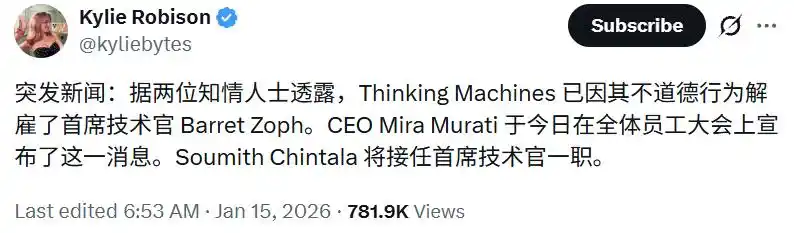
The first came from tech journalist Kylie Robison. On X, citing two informed sources, she reported that TML terminated Zoph's employment due to "unethical conduct," with Murati announcing the news in an all-hands meeting. This was the earliest version to circulate and the most widely spread.
The second came from WIRED. A source close to TML told them that Zoph was accused of sharing confidential company information with a competitor. WIRED explicitly stated it was unable to verify this with Zoph himself. The publication later reported that last summer, TML management had spoken to Zoph about his relationship with another employee, who worked in a different department and held a leadership position. That employee has since left TML, and this relationship was likely the "improper conduct" referenced in previous reports. WIRED claimed that in the months following that conversation, the working relationship among the co-founders gradually deteriorated, and Zoph began engaging with other companies, including Meta's Superintelligence Lab.
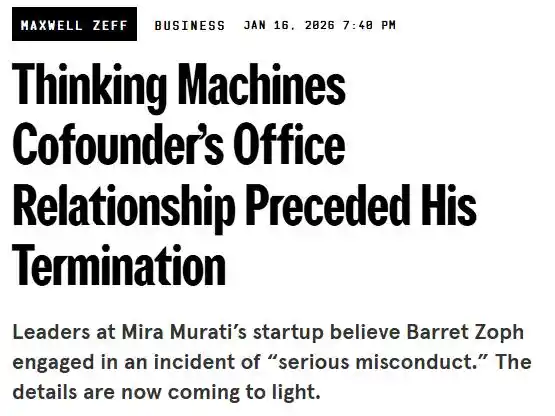
The third came from The Wall Street Journal. Its report stated that Zoph had admitted to Murati that he was in a romantic relationship with a less senior colleague. This relationship began when both were still at OpenAI. Murati had suspected it as early as last summer; Zoph initially denied it but admitted it to Murati weeks later. The report also noted that while this woman held a lower rank than Zoph, she did not report to him. She subsequently left TML and returned to OpenAI. The WSJ also mentioned that during the meeting before his dismissal, Zoph and two others advocated for him to have greater decision-making authority. Murati's response was to question why he hadn't been fulfilling his responsibilities in recent months; he was dismissed two days later.
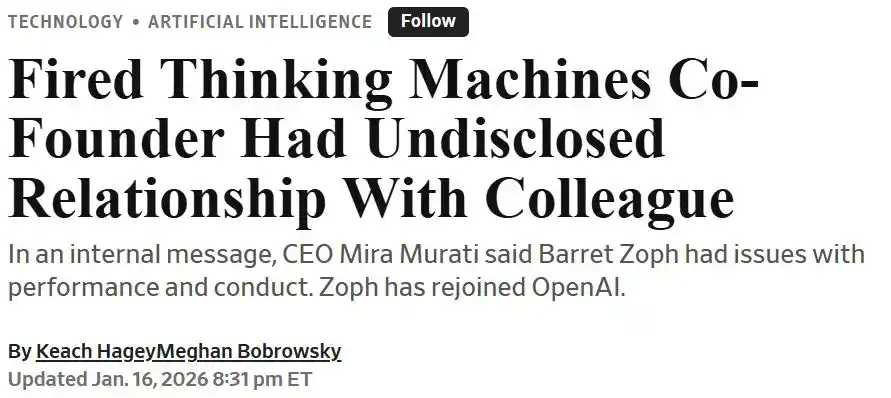
The fourth version came from Zoph himself. He told The Wall Street Journal that TML terminated his employment after learning he was about to leave, "and that's it." He also stated that TML never cited any performance reasons or unethical conduct as grounds for dismissal to him, and any suggestion to the contrary was false and defamatory.
Four versions, pointing to different causal chains: one is "fired due to misconduct," another is "fired because he was planning to leave," with an unverified leak accusation sandwiched in between. TML has not publicly commented on this to date. The public record of this incident remains in a state of contradiction.
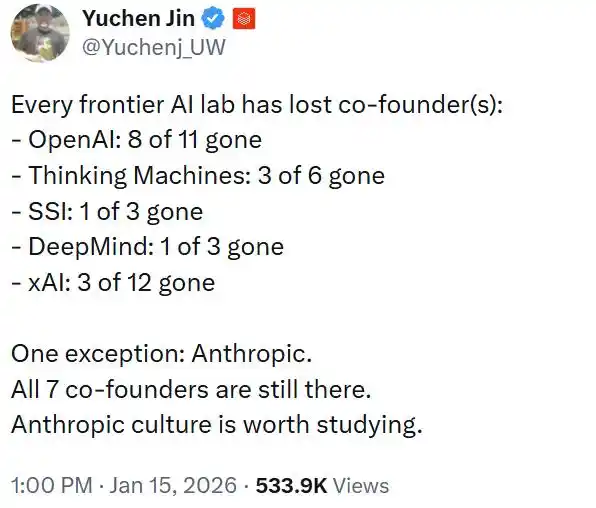
It is worth noting that around the same time, co-founder Andrew Tulloch also left TML (joining Meta in October 2025). At the time, a developer on X compiled a statistic: 8 out of 11 OpenAI co-founders had left, 3 out of 6 Thinking Machines co-founders had left, 1 left from SSI, 1 from DeepMind, and 3 out of 12 from xAI. The only exception was Anthropic—none of its 7 co-founders had left.
The Google He Returns to Is Not the One He Left
Now, let's look at what has happened at Google DeepMind over the past three months that Zoph is returning to.
Starting in mid-June, DeepMind experienced consecutive departures. On June 18, Noam Shazeer, co-lead of the Gemini model and one of the authors of the "Attention Is All You Need" Transformer paper, announced he was joining OpenAI—just two years after Google brought him back via an approximately $2.7 billion licensing deal with Character.AI. Two days later, John Jumper, who shared the 2024 Nobel Prize in Chemistry with Demis Hassabis for AlphaFold, announced he was joining Anthropic, along with AlphaFold paper co-authors Jonas Adler and Alexander Pritzel. Additionally, Denny Zhou had earlier quietly moved to Meta, while early DeepMind employee and prominent figure in reinforcement learning, David Silver, left to start his own company, named Ineffable Intelligence.
On June 22, Alphabet's stock price fell by about 5-6%, with market reports widely linking it to concerns over AI spending and Google's ability to retain top talent. A line in a Fortune report at the time stung: These departures would hurt less if they happened when Google was clearly ahead.
In August, Google underwent a major organizational restructuring. On August 5, Sundar Pichai announced that Hassabis was stepping down as CEO of Google DeepMind, transitioning to Chairman of GDM and Chief Scientist at Alphabet, continuing to helm Isomorphic Labs. The former CTO and Google's Chief AI Architect, Koray Kavukcuoglu, took over day-to-day operations as Senior Vice President, reporting directly to Pichai, responsible for Gemini model development, frontier AI research, and the Gemini Apps & Developer teams.
Chief Scientist Jeff Dean, who had worked at Google for 27 years, announced he was leaving with several colleagues to start a public-benefit company named Discovery Loop, with Google as an investor.
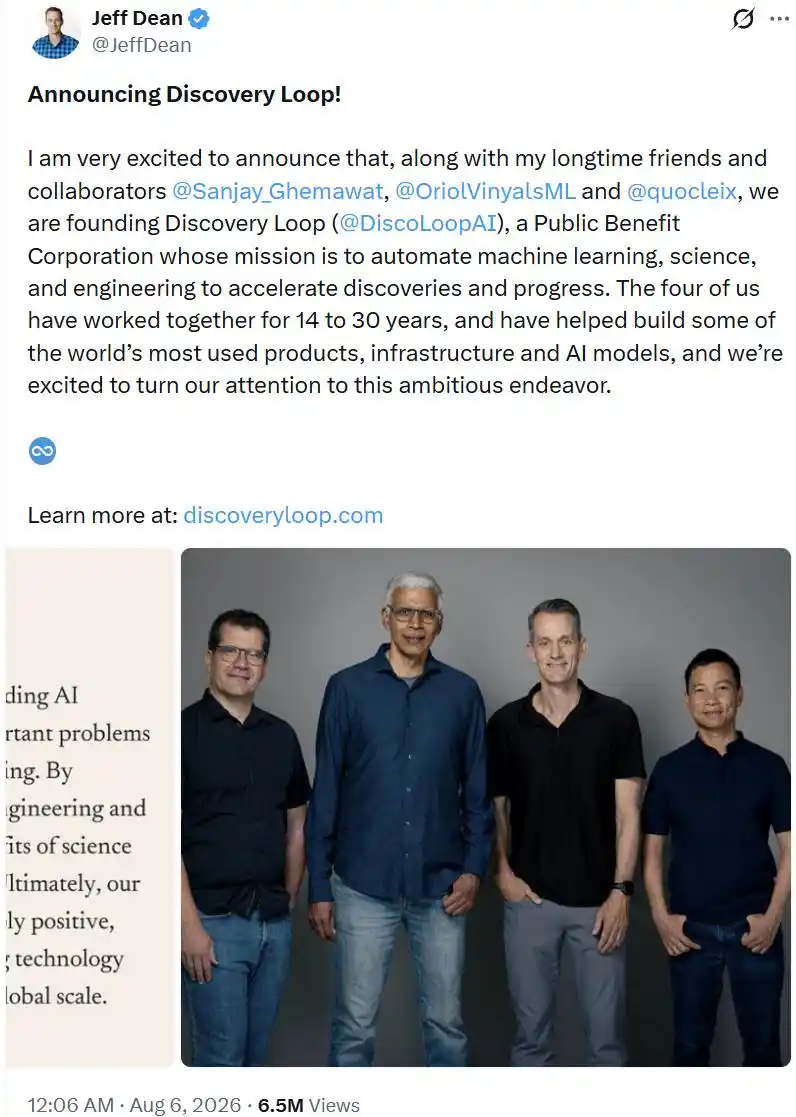
What Kavukcuoglu said upon taking office sounded like a mission statement: The top priority is to ensure the clearest possible path to deliver on the Gemini roadmap. His internal message to employees also mentioned Gemini 4.
Therefore, the timing of Zoph's entry now points clearly: This is the rebuilding period after Koray took over, and what DeepMind needs is someone who can lead the post-training and RL teams. Hence, DeepMind was willing to bring on a senior executive with controversy on his resume at this juncture. On the talent ledger of the past three months, this is probably a rare credit entry for Google.
Details such as who he reports to, his official start date, and whether he will bring people with him are not yet public information.
Conclusion
In the short term, the significance of this news is not hard to judge: DeepMind, after losing a batch of star researchers and undergoing a round of senior management reshuffling, has filled a vacancy with a seasoned leader in post-training and RL. Under the pressure of the Gemini 4 timeline, this addition is likely important.
From another perspective, looking at the entire trajectory—from Murati leaving OpenAI to found TML, to the three co-founders returning to OpenAI, to Zoph moving from OpenAI to DeepMind—the flow of talent has almost completely detached from the unit of "company." Nowadays, even those holding titles like founder or founding team member at AI labs come and go like regular employees.
If a co-founder's departure can be picked up by another company within 58 minutes, what exactly does the identity of "co-founder" anchor in today's AI industry? Equity and non-compete clauses clearly cannot lock down this group of people, and the company vision may not either. What is truly flowing are those few dozen brains that know how to organize billion-dollar-scale experiments, and all labs are bidding for the same set of people.
After all, the most sought-after researchers bring not just technical knowledge from papers and code, but also the judgment of which ideas are worth pursuing, the experience of running hyper-scale experiments, and the ability to recruit other sought-after scientists.
This article is from the WeChat public account "Almost Human" (ID: almosthuman2014), edited by Panda.