DAT Companies Take on Side Businesses

Foresight NewsОпубліковано о 2026-06-18Востаннє оновлено о 2026-06-18

Анотація

The article details the strategic shifts of Digital Asset Treasury (DAT) companies amid a prolonged market downturn. Initially popularized by firms like MicroStrategy, the DAT model—where companies hold cryptocurrencies on their balance sheets—has faced significant pressure as crypto ETFs eroded their investment thesis and bear markets strained finances. Key players are adapting in several ways. Some, like ETHzilla, have abandoned the model entirely. Others are pivoting towards becoming active, revenue-generating participants in the crypto ecosystem rather than passive holders. This evolution is taking two main paths: 1. **Transformation into Institutional Crypto Asset Managers:** Companies like SharpLink Gaming and GameSquare are leveraging their holdings to generate yield, moving beyond simple storage. They employ strategies like 100% ETH staking or using machine learning to optimize DeFi yields, positioning themselves as platforms offering institutional-grade crypto yield products. 2. **Becoming Blockchain Infrastructure Operators:** This is prominent in the Solana ecosystem. Firms like DeFi Development and SOL Strategies are acquiring validator businesses, issuing liquid staking tokens (e.g., dfdvSOL, fwdSOL), and integrating them into DeFi protocols. They generate fee-based revenue from these operations, building network effects. The article notes that successful转型 hinges on building operational expertise and defensible business models around crypto assets, such as ...


Author: Eric, Foresight News


How long has it been since you last heard news about Metaplanet?


In the first quarter of 2026, this company, Japan's and even Asia's largest Bitcoin treasury firm, adjusted its capital strategy. It chose not to dilute equity when its mNAV was less than 1 (meaning the company's market cap to crypto holdings value ratio was below 1), shifting towards strategies including Bitcoin-collateralized financing and share buybacks to maintain its stock price to some extent.


Although the Q1 financial report showed Metaplanet still purchased 5,075 Bitcoins, since the beginning of the second quarter, aside from announcing the acquisition of the Japanese licensed securities firm Siiibo Securities about a week ago to promote Bitcoin-backed bond-like products and explore security tokenization, there has been little other news.


Even Strategy, which guaranteed countless times it would never sell Bitcoin, has experimented with the market impact of selling a small amount of Bitcoin to replenish cash. The once "never sell" vow has become "ensure total holdings increase." When the DAT companies holding the top two positions in Bitcoin reserves are stretched thin, it's not hard to imagine the predicament other companies are currently facing.


In fact, aside from a few companies like Strategy, Metaplanet, and BitMine who are still holding on, most former DAT companies have begun seeking other avenues.


Two Paths to Survival


In the face of an unexpected bear market, many DAT companies have directly chosen to "quit the game."


ETHZilla is a typical example. Backed by Peter Thiel, this company held over 90,000 ETH at its peak in 2025 but sold a total of $115 million worth of ETH twice by the end of that year to repay debt. This year, it has abandoned the DAT model altogether, pivoting to businesses like RWA tokenization.


Bitcoin DAT companies like Prenetics Global and Sequans Communications have also chosen to quit, returning to their core businesses. Many bandwagon altcoin DAT companies are in the same boat, with their stock prices nearing zero and the coins in their hands difficult to liquidate, so they simply give up. Data shows that in July 2025 alone, DAT companies bought approximately $20 billion worth of cryptocurrency, while the total purchase volume in Q1 this year was only about $3.7 billion.


Facing the stalling of their flywheel, aside from quitting or giving up, mid-tier treasury companies have begun a collective strategic pivot, which can roughly be summarized into three directions. They all point to one core proposition: DAT must evolve from a passive balance sheet manager to an active ecosystem participant to truly possess commercial value.


The first direction is repositioning themselves as institutional-grade crypto asset management platforms and yield funds. SharpLink Gaming is a representative of this path. From day one, this company has staked nearly 100% of its ETH holdings and allocated all staking rewards to shareholders without taking any fees. This stands in stark contrast to spot ETH ETFs, which, although granted staking permission by the SEC, can only stake about 50% of their holdings to meet daily liquidity requirements. Building on this, SharpLink partnered with the Wall Street veteran crypto investment bank Galaxy Digital in early 2026 to launch the $125 million "Galaxy Sharplink On-Chain Yield Fund," investing approximately $100 million worth of staked ETH into DeFi liquidity protocols seeking excess returns. This company is transforming from a simple cryptocurrency holding company into a management platform providing institutional clients with access to on-chain yield configurations.


The exploration by GameSquare, which holds about 15,000 ETH, is more radical. This listed company, which owns gaming assets like FaZe Clan, collaborated with crypto asset management firm Dialectic to integrate Dialectic's self-developed Medici platform. This platform uses machine learning models and automated algorithms to dynamically allocate funds across 72 to 250 different DeFi protocols, targeting annualized returns of 8% to 14%, far exceeding the 3% to 4% benchmark of standard Ethereum staking.


The second direction is transforming into blockchain infrastructure operators, which is particularly evident in the Solana ecosystem. DeFi Development is one that has gone the furthest. This company not only purchases large amounts of SOL but also acquired a validator company and launched its own liquid staking token, dfdvSOL. dfdvSOL has been integrated into multiple core Solana DeFi protocols like Kamino, Orca, Drift, and Jupiter Lend, used as lending collateral and liquidity pool assets. DeFi Development earns fee income from every staking operation and protocol integration, building a self-reinforcing network effect loop.


SOL Strategies acquired three validator companies, constructing a complete business line from digital asset holding to infrastructure operation. It manages over 3.4 million SOL in delegated staking, far exceeding its own treasury size, shifting from serving its own balance sheet to providing staking infrastructure for institutional clients across the entire ecosystem.


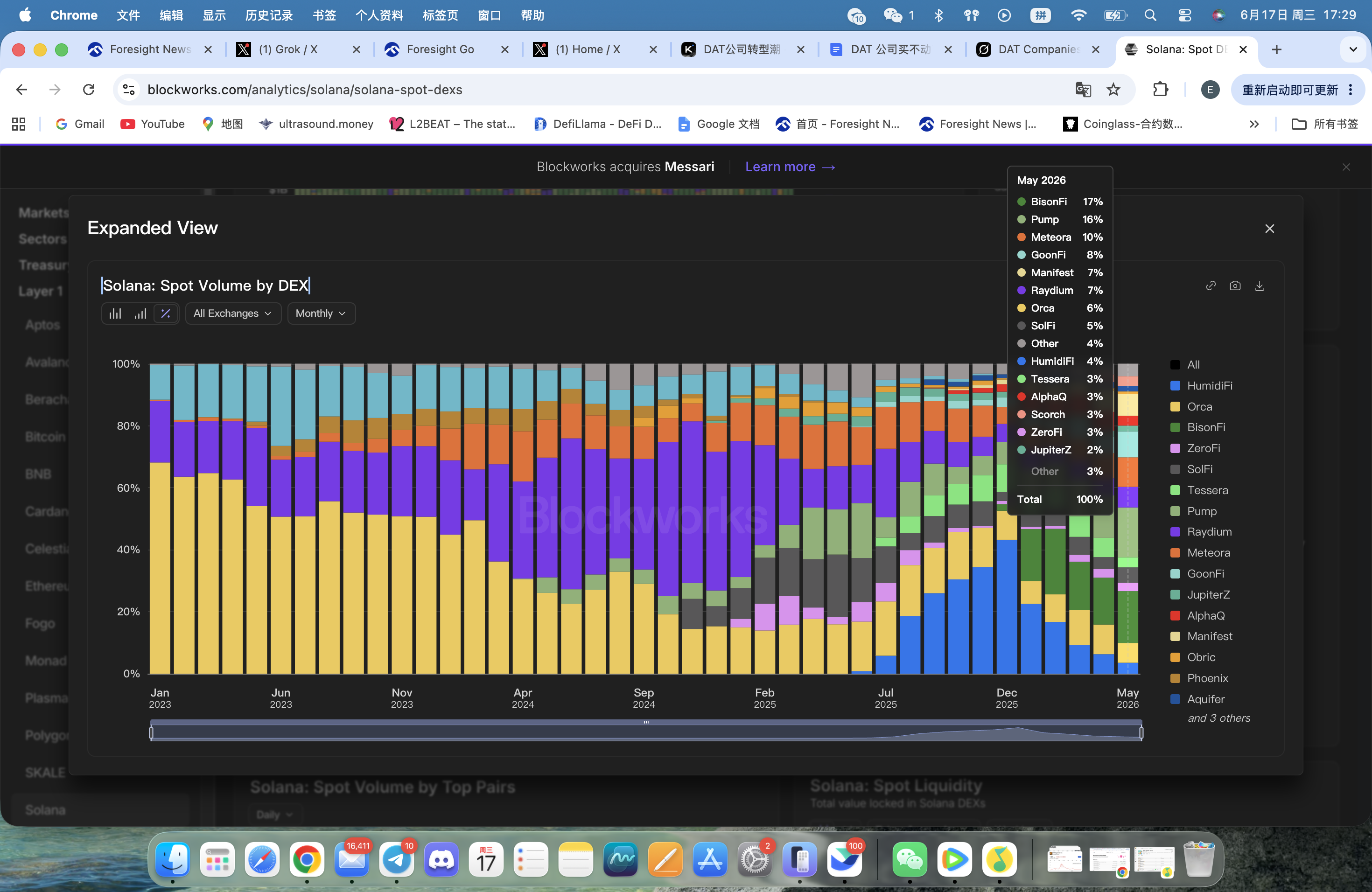
Forward Industries has followed a similar path. Besides launching its liquid staking token fwdSOL, Forward Industries also collaborated with Galaxy Digital and Jump Crypto to launch the propAMM project BisonFi. Since its launch, BisonFi has surged ahead to become the highest volume DEX on Solana, squeezing the once-dominant HumidiFi to less than a 4% market share.


These two routes essentially correspond to the capital market's different attitudes towards Ethereum and Solana. ETH's recognition as an "asset" itself is still higher than SOL's. ETH treasury companies can position themselves as "funds managing ETH," providing institutions with exposure to yield-generating assets. On the other side, Solana's crypto-native attributes are more pronounced. SOL treasury companies need to demonstrate their profitability within this ecosystem, showcasing their value in a logic closer to the "look at the financials" approach of regular listed companies.


Can the Transformation Succeed?


The collective transformation of DAT companies actually reflects a profound cognitive upgrade the entire crypto industry is undergoing. The treasury model initially pioneered by Strategy was essentially a form of financial engineering that leveraged the convenience of public market financing and investor sentiment for capital arbitrage. When participants expanded from a few early adopters to hundreds of companies, and from Bitcoin to various altcoins, scarcity was diluted, and premiums naturally evaporated. The launch of cryptocurrency ETFs further accelerated this process. When investors can purchase ETH ETFs with staking yields directly through traditional brokerage accounts at prices close to net asset value, the logic of holding DAT stocks at a premium is fundamentally shaken.


The answer given by successful transformation cases is operational capability. Whether it's SharpLink's 100% staking strategy and institutional-grade yield fund, DeFi Development's dfdvSOL ecosystem and validator network, or GameSquare's machine-learning-driven yield platform, they are all attempting to build difficult-to-replicate operational barriers around crypto assets. These barriers may stem from technological advantages, network effects, institutional partnerships, or deep participation in the on-chain financial ecosystem.


However, these transformations are not without risks. The 8% to 14% DeFi yield pursued by GameSquare is built on smart contract risks and protocol risks; any major DeFi protocol vulnerability or extreme market event could lead to significant losses. DeFi Development's business model is highly dependent on the healthy development of the Solana network; once the ecosystem cools, its entire business would be impacted.


For the Web3 market, the impact of this transformation is profound and complex. Those DAT companies that have successfully evolved into infrastructure operators and asset management platforms are building bridges between traditional finance and the blockchain ecosystem, promoting the maturation and standardization of institutional-grade services. But the process of the DAT model moving from frenzy to sobriety also sends an important signal to the market: in the crypto space, pure capital games are not for everyone. Entities that truly participate in network building, create actual cash flow, and provide user value possess greater anti-cyclical capabilities.


The DAT movement is entering a stage of sober restructuring from a capital carnival. This might not be bad news. An industry can only truly see who is swimming naked and who is building an ark after the泡沫 recedes. The collective pivot of treasury companies is both a passive response to survival pressure and the inevitable growing pains of a nascent industry maturing.


Пов'язані питання

QAccording to the article, what are the two main survival paths for DAT companies mentioned, and can you give an example of a company for each path?

AThe two main survival paths are: 1) Transforming into an institutional-level crypto asset management platform/yield fund. An example is SharpLink Gaming, which stakes nearly 100% of its ETH and launched a chain-based yield fund with Galaxy Digital. 2) Transforming into a blockchain infrastructure operator, particularly evident in the Solana ecosystem. An example is DeFi Development, which acquired validator firms and launched its own liquid staking token dfdvSOL.

QWhat significant change did Metaplanet make to its capital strategy in Q1 2026, and what recent acquisition did it announce?

AIn Q1 2026, Metaplanet adjusted its capital strategy to avoid diluting equity when its mNAV (market capitalization to crypto holdings ratio) was less than 1. Instead, it turned to strategies like borrowing against Bitcoin and stock buybacks. More recently, it announced the acquisition of the licensed Japanese securities firm Siiibo Securities to promote bond-like products with Bitcoin as the underlying asset and explore tokenization.

QWhy does the article suggest the initial DAT model pioneered by Strategy is losing its appeal?

AThe article suggests the initial DAT model is losing its appeal because its scarcity and premium have been diluted as hundreds of companies adopted it for various cryptocurrencies. Furthermore, the launch of cryptocurrency ETFs (like ETH ETFs) allows investors to buy the asset with yields directly through traditional brokerage accounts at near NAV, fundamentally undermining the logic of paying a premium for DAT company shares.

QWhat are some of the key risks associated with the new strategic directions DAT companies are taking, according to the article?

AKey risks include: For companies like GameSquare pursuing higher DeFi yields (8-14%), there are significant smart contract and protocol risks, where a major exploit or market crash could lead to substantial losses. For infrastructure-focused companies like DeFi Development, their business model is highly dependent on the health of a specific blockchain ecosystem (e.g., Solana), making them vulnerable if that ecosystem declines.

QHow does the article characterize the current phase of the DAT movement and its potential impact on the Web3 market?

AThe article characterizes the current phase as a move from a 'capital frenzy' into a 'cooling reconstruction' phase. It sees this as a necessary growing pain for the industry's maturation. For the Web3 market, successful DAT companies that become infrastructure operators or asset managers can help build bridges between traditional finance and blockchain. The process signals that in crypto, entities that genuinely participate in network building, create cash flow, and provide user value have greater resilience against market cycles than those engaged in pure capital games.

Пов'язані матеріали

Gate Research Institute: Analysis of Chart Patterns and Breakout Trading Strategies

Gate Research Institute: Chart Pattern Analysis and Breakout Trading Strategies Chart patterns are crucial tools in technical analysis for observing market supply and demand shifts, trend continuations, and reversals. This analysis involves a comprehensive evaluation of trend, volume, support/resistance, time cycles, and breakout validity, not just rote pattern recognition. Patterns are broadly categorized into reversal patterns (e.g., Double Tops/Bottoms, Head and Shoulders) and continuation patterns (e.g., Flags, Triangles, Rectangles). An effective breakout, key for trading, requires clear support/resistance, prolonged consolidation, a prevailing trend backdrop, and volume confirmation. However, breakouts are not guaranteed, as false breakouts are common. Risk must be managed through position sizing, stop-loss orders, pullback confirmations, and profit-taking in stages. Key pattern types discussed include: * **Rectangle Patterns:** Indicate market indecision within parallel support and resistance, with breakouts projecting a move equal to the pattern's width. * **Flag & Pennant Patterns:** Short-term continuation patterns following sharp price moves ("flagpoles"). * **Triangle Patterns:** Symmetrical, Ascending (bullish bias), and Descending (bearish bias) triangles, representing consolidation before a directional move. * **Head and Shoulders Patterns:** Major reversal patterns signaling trend exhaustion. The article details breakout trading strategies, defining valid breakouts by price closing beyond a key level with increased volume and minimal immediate re-entry into the prior range. It contrasts range trading with breakout trading and outlines entry methods (immediate entry, pullback entry, scaling in), stop-loss placement (based on pattern failure), and profit-taking techniques (target-based, structure-based, trend-following). It further classifies breakout outcomes: 1. **Valid Breakouts:** Strong, sustained moves in the breakout direction. 2. **Pullback Breakouts:** Price breaks out, retests the breakout level as support/resistance, then resumes the trend—offering a lower-risk entry. 3. **False Breakouts:** Price briefly breaches a level but quickly reverses back into the prior range, a common risk managed by strict stop-losses. Key validation tools for breakouts include volume analysis, the principle of support/resistance role reversal, and momentum indicators like ATR, Moving Averages, Bollinger Bands, and RSI. In conclusion, while chart patterns and breakout analysis provide a structured framework, their effectiveness relies on multiple confirming factors—trend context, volume, and proper risk management. They should be integrated into a broader trading system rather than used as standalone signals.

marsbit16 хв тому

Gate Research Institute: Analysis of Chart Patterns and Breakout Trading Strategies

marsbit16 хв тому

Joseph Chalom: Ethereum is Becoming the "Settlement Layer of Trust" for Global Finance

In a speech titled "The Industrialization of Trust," Sharplink CEO Joseph Chalom (former BlackRock digital assets head) discussed the future transformation of global finance. Drawing from 20 years at BlackRock, where he led the launch of Bitcoin/ETH ETFs and tokenized funds, Chalom highlighted the immense hidden costs of establishing trust in traditional finance—estimated at over $9.3 trillion annually in the US alone due to fragmented systems, multi-day settlements, and countless reconciliations. He argued that Ethereum is emerging as the global financial "settlement layer for trust," with its robust, decentralized infrastructure securing over $300 billion in on-chain assets and most stablecoins and tokenized assets. The future, he stated, will be driven by three accelerating pillars: stablecoins (evolving beyond crypto gateways to become efficient cross-border payment rails), tokenized assets (enabling 24/7 trading and reshaping capital markets), and DeFi (providing automated, accessible financial services). A potential game-changer, Chalom added, is the fourth pillar: "Agentic Finance," where AI agents autonomously execute programmable financial transactions via smart contracts and stablecoins. He envisions individuals soon having AI-powered "CFOs in their pockets" to optimize idle capital and manage tokenized portfolios. This shift, facilitated by Ethereum's trustless settlement, could multiply on-chain transaction volume 1000x within a year, moving finance toward a seamless, digitized future.

marsbit17 хв тому

Joseph Chalom: Ethereum is Becoming the "Settlement Layer of Trust" for Global Finance

marsbit17 хв тому

STRC Severely Unpegged, What Risks Is the Market Pricing In?

The article analyzes the recent significant de-pegging of Strategy's perpetual preferred stock, STRC, whose price fell to approximately $89, far below its $100 face value. This discount has pushed its simple yield to around 12.9%, creating a paradox. The stock was designed as a high-yield instrument trading near par, and Strategy maintains an 11.5% annual dividend, even recently switching to semi-monthly payments to support the price. The author explores several reasons why the high yield hasn't attracted enough buying pressure to restore the par value. A key factor is potential reverse deleveraging from carry trades, where leveraged investors may be forced to sell due to margin calls as the price falls, creating a self-reinforcing downward spiral. Additionally, the tokenization and integration of STRC into DeFi protocols (like Apyx, Saturn, Pendle) have introduced faster, more transparent, and potentially more volatile price adjustment mechanisms through leverage and yield-splitting products. The emergence of a competing product, Strive's SATA, offering a 13% yield with daily dividends, has also changed the yield benchmark, challenging STRC's unique high-yield narrative. Furthermore, the market is questioning the distinction between Strategy's substantial Bitcoin reserves, which provide long-term balance sheet coverage, and the certainty of stable near-term cash flow for dividends. Ultimately, the price dip represents a stress test for this type of BTC-backed, high-yield financing tool. The future path of STRC depends on whether Strategy acts to reinforce the $100 peg (e.g., by adjusting dividends), whether DeFi-related leverage unwinds further, and how investors ultimately price the risks of leverage, competition, and cash flow uncertainty against the offered yield.

marsbit28 хв тому

STRC Severely Unpegged, What Risks Is the Market Pricing In?

marsbit28 хв тому

LIT Token Hits Six-Month High: How Long Can the Buyback Flywheel Keep Burning Fuel?

The LIT token of decentralized perpetual exchange Lighter surged to a six-month high above $1.90 on June 18th, with a market cap of $425 million. After a price correction earlier this year, the recent rebound is attributed to its core "buyback flywheel" mechanism. All protocol fee revenue is used for programmatic, hourly market buybacks of LIT. Since its TGE in December 2025, approximately 15 million LIT (6% of circulating supply) has been repurchased for around $21 million. Additional price support comes from the LLP (Lighter Liquidity Pool), where providers must stake LIT worth 10% of their deposited USDC, locking significant token supply. However, challenges persist. Trading volume has declined amidst a sluggish market, with total volume at $1.68 trillion, significantly lower than leading competitor Hyperliquid's $4.37 trillion. While Lighter focuses on perpetual contracts, RWA, and Pre-IPO markets, Hyperliquid has expanded into prediction markets and boasts a U.S. spot ETF, attracting institutional investment and influencer endorsements like from Arthur Hayes. In contrast, LIT currently lacks similar high-profile backing. With 75% of LIT's total 1 billion supply still locked (team and investor tokens begin a 3-year linear unlock in December 2026), there is no immediate unlock selling pressure. The token's future performance hinges on sustaining trading volume growth, successful product iteration, and executing its transparent buyback strategy against a dominant competitor.

Foresight News47 хв тому

LIT Token Hits Six-Month High: How Long Can the Buyback Flywheel Keep Burning Fuel?

Foresight News47 хв тому

Торгівля

Спот
Ф'ючерси
活动图片