Chip Stocks Lead U.S. Market Decline: Is AI Trading Being Hit by Both Interest Rates and Returns?

marsbitОпубліковано о 2026-06-24Востаннє оновлено о 2026-06-24

Анотація

Chip stocks led a broad decline in US markets, with the Nasdaq dropping 2.2% and the S&P 500 falling 1.4%. This selloff reflects a dual challenge for the once-high-flying AI hardware trade: rising interest rate expectations and growing investor impatience for clear returns from massive AI capital expenditures. The pressure was most acute on hardware leaders. Nvidia fell about 4%, dipping below a $5 trillion market cap, while Micron plunged 13.2% ahead of its earnings report. Declines across memory, storage, AI, and mobile chips indicated a sector-wide retreat. The selloff spread globally, with South Korea's KOSPI index dropping nearly 10% as key suppliers SK Hynix and Samsung recorded double-digit losses. Investors appeared to be taking profits from the most crowded trades first. Macro headwinds intensified as market expectations shifted toward a more aggressive Federal Reserve. Forecasts for multiple rate hikes in 2026 pressured high-valuation tech stocks, which rely on long-term growth projections that become less attractive as discount rates rise. Concurrently, investors are scrutinizing the profit potential of the immense AI spending by cloud giants like Alphabet, Amazon, and Meta. While these expenditures drive demand for chips and hardware, the market is now questioning whether AI services will generate sufficient returns to justify the ongoing costs. This adjustment is not necessarily a bubble burst but a recalibration. AI demand fundamentals remain, but the narrati...

According to an AP report, on June 23rd, U.S. tech stocks and the AI supply chain collectively fell, with the Nasdaq closing down 2.2% and the S&P 500 dropping 1.4%. This pullback was not due to an isolated problem at a single chip company, but rather the simultaneous pressure on two fronts affecting the most crowded AI hardware trades of the past year. The first is a sudden intensification of expectations for Federal Reserve rate hikes, and the second is investors beginning to question when the sustained increase in AI capital expenditures by cloud providers will translate into sufficiently clear profits.
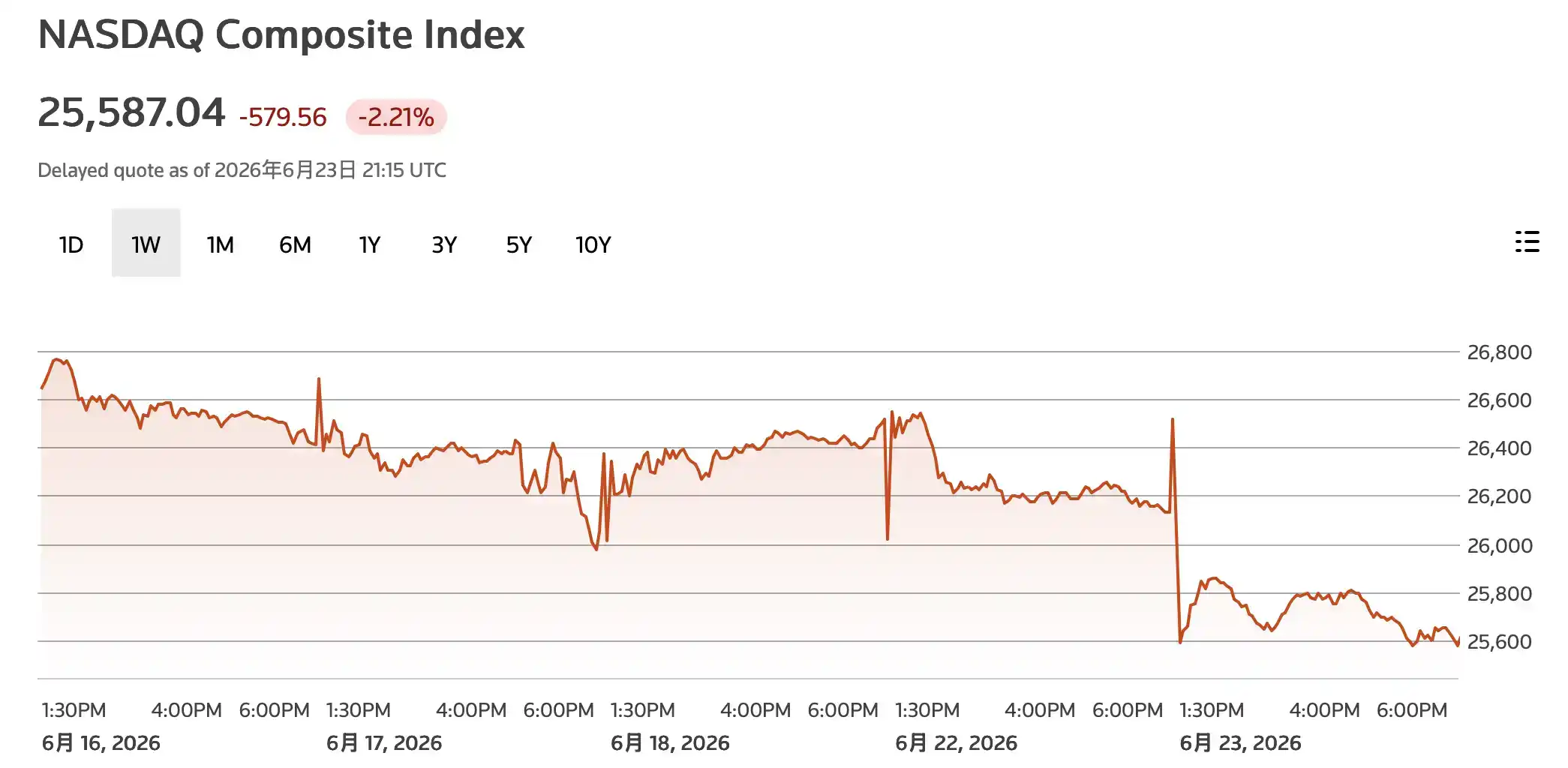
The most direct pressure fell on the hardware supply chain. Market data showed that NVIDIA (NVDA) fell about 4% on Tuesday, with its market cap dropping below $5 trillion. Micron plummeted 13.2%, Qualcomm fell about 8%, and SanDisk and Western Digital also saw significant declines. Weakness in memory, storage, AI chips, and mobile chips together indicates the selling was not confined to a specific subsector.

Asian markets also faced simultaneous pressure. South Korea's KOSPI index fell nearly 10% on June 23rd, with SK Hynix and Samsung Electronics both recording double-digit percentage drops. In recent months, tight supply of HBM and memory chips had been supporting Korean tech stocks, but this time, the market chose to cash in profits first.

AI Hardware Chain Was the First to Be Sold

The sequence of this decline is significant. Investors did not retreat first from software or internet platforms but instead sold off the chip and memory stocks that had benefited most from the AI capital expenditure boom in the past.

NVIDIA remains the core stock of the AI boom. Its GPUs have almost defined this data center expansion cycle and have also become the most concentrated outlet for market risk appetite. Falling below a $5 trillion market cap itself does not change the company's industry position, but from a trading perspective, it is a conspicuous price signal. When both the interest rate and return cycles are being questioned simultaneously, assets with the largest gains and most crowded holdings are often sold first.

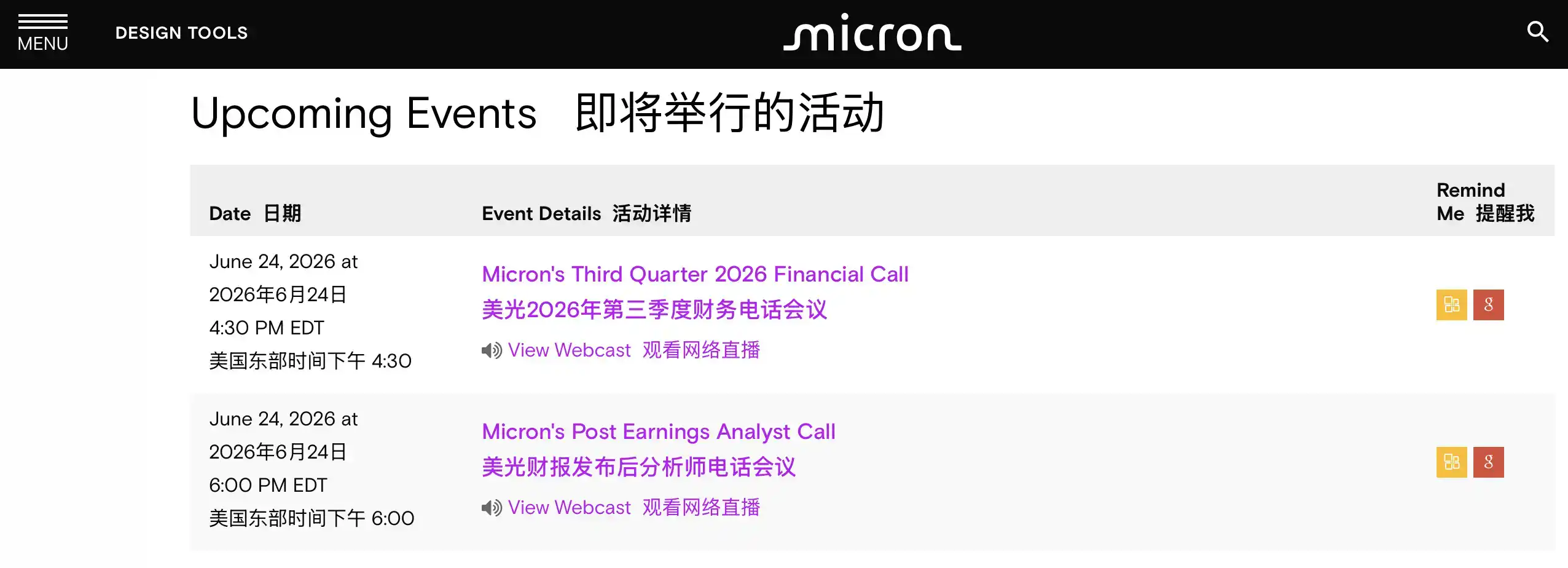
Micron's sharper decline is partly due to its approaching earnings report. The company announced it will report its fiscal 2026 third-quarter results and hold an earnings call on June 24th. The market had previously bet on continued tight demand for high-bandwidth memory driven by AI servers. If the guidance is not strong enough, investors worry the earlier gains lack new earnings catalysts; even if the guidance is strong, it needs to prove that high memory prices and AI demand are not just short-term stockpiling.
The reaction in the South Korean market further amplified these concerns. SK Hynix and Samsung are key companies in the global memory and HBM supply chain. Their double-digit declines indicate this adjustment has spread from U.S. market leaders to the global AI hardware supply chain.

Previously, Broadcom's AI revenue guidance failing to meet the most optimistic expectations had already triggered a round of selling in chip stocks. Tuesday's action was more like a concentrated release of such worries. AI demand still exists, but the market is no longer willing to pay increasingly high prices just for a "huge future."

Turning Hawkish on Rate Hike Expectations, High-Valuation Tech Stocks Under Pressure

The macro trigger came from a shift in Federal Reserve policy expectations.

The Federal Reserve announced that Kevin Warsh was sworn in as its new Chairman on May 22nd. Reuters cited Bank of America forecasts suggesting the Fed could raise rates by 25 basis points each in September, October, and December of 2026, for a cumulative 75 basis points for the year. The reasoning includes labor market resilience and inflation pressures not fully subsiding.

This is particularly unfriendly to tech stocks. Valuations of AI leaders rely on long-term growth expectations. Rising interest rates increase the discounting pressure on future cash flows and make lower-risk assets like U.S. Treasuries attractive again. Recent high U.S. Treasury yields and a noticeable increase in futures market bets on rate hikes this year indicate the market is quickly adjusting its expectations for the policy path.

The market is not suddenly doubting the existence of AI, but is recalculating a more realistic question: If the cost of capital is higher and future profit realization is farther away, what price is one willing to pay for AI assets now?

This is also why the adjustment in chips, memory, and high-growth tech stocks has been so synchronized. They previously benefited together from the combination of "sustained explosion in AI demand" and "interest rates eventually falling." Once one of these pillars loosens, the parts with the biggest gains and highest valuations come under pressure first.

Cloud Providers Are Still Spending, Investors Start Questioning Returns

The other pressure comes from AI capital expenditure itself.

Hyperscale cloud and AI investors like Alphabet, Amazon, and Meta are still maintaining high-intensity data center construction. Over the past year, such spending has been seen by the market as a guarantee of demand for NVIDIA, memory chips, power equipment, and data center assets. As long as cloud providers kept spending, the hardware chain had revenue.

But now the question has become: Can this money ultimately be earned back?

AI model training and inference require massive computing power, electricity, and server investment. Cloud providers can monetize through enterprise customers, advertising tools, developer platforms, and consumer subscriptions, but whether service pricing can cover capital expenditures has not been fully proven. The market is beginning to scrutinize AI product pricing, customer usage intensity, and whether enterprises are willing to pay high fees for generative AI long-term with a more critical eye.

This is also why the "sell the heavy spenders" trade is starting to gain traction. Investors are not just selling chip stocks; they are also becoming more cautious about internet and cloud computing giants that keep increasing their AI budgets. The more aggressive the spending was before, the more likely they are to be questioned about profit margins and free cash flow.

Volatility in high-valuation assets is also amplifying this sentiment. According to an Axios report, SpaceX fell over 16% on Monday after its IPO, losing about $400 billion in market value. It is not the main cause of this chip stock decline, but it shows that strong-narrative, high-valuation assets are facing stricter market scrutiny.

Too Early to Talk About a Bubble Burst, Micron and Inflation Data to Provide Answers

A more accurate description of this adjustment is that after substantial gains, the AI trade is experiencing a concentrated pullback, not that a bubble has definitively burst.

AI hardware demand still exists, and cloud provider capital expenditures have not stopped. The fundamentals of companies like NVIDIA, Micron, and SK Hynix are still closely tied to data center construction, HBM supply, and AI server shipments. The real question is whether current stock prices have already priced in too much good news.

The first validation point is Micron's earnings report. The market will watch three things: whether memory demand driven by AI servers remains strong, whether price increases can be sustained, and whether management's guidance for subsequent quarters is sufficient to support the prior gains. If the report is strong, the chip chain may get a breather; if guidance falls short, selling could continue to spread to more AI supply chain companies.

The second validation point is interest rates. Whether the Fed under Warsh's leadership actually starts hiking in September will depend on inflation, employment, and energy prices. If inflation pressures remain stubborn, growth stock valuations will continue to face pressure; if data cools, the market may again bet on a policy pivot, giving tech stocks room to recover.

The current market divergence is whether this is just a normal profit-taking episode within an AI bull market or the beginning of a shift from "just buy growth" to "must see returns." At the very least, Tuesday's decline shows that while the AI narrative remains powerful, it can no longer alone offset the pressure brought by higher interest rates and a longer profit realization horizon.


Трендові криптовалюти

Пов'язані питання

QAccording to the article, what were the two main pressures that caused the recent decline in US AI hardware stocks?

AThe two main pressures were: 1) A sudden rise in expectations for Federal Reserve interest rate hikes, and 2) Investors beginning to question when the substantial AI capital expenditures by cloud providers will translate into clear and sufficient profits.

QWhy did Micron's stock experience a particularly sharp drop of 13.2%, as mentioned in the article?

AMicron's sharp drop was attributed to its upcoming Q3 FY2026 earnings report scheduled for June 24th. The market was anxious, fearing that if the guidance wasn't strong enough, it would lack a new catalyst for its previous gains. Even with strong guidance, there was concern about proving that high memory prices and AI demand weren't just short-term stocking.

QHow did the market behavior in South Korea on June 23rd relate to the broader AI hardware sell-off?

AThe South Korean market mirrored and amplified the sell-off. The KOSPI index fell nearly 10%, with key AI hardware supply chain companies like SK Hynix and Samsung Electronics both seeing double-digit percentage drops. This indicated the sell-off had spread from US leaders to the global AI hardware supply chain, as investors chose to take profits on stocks previously supported by tight HBM and memory chip supply.

QWhat change in investor focus does the article suggest is putting pressure on cloud and internet giants investing heavily in AI?

AThe article suggests investors are shifting focus from just buying growth to demanding visible returns. They are becoming more cautious about companies with aggressive AI budgets, scrutinizing their profit margins and free cash flow, and questioning whether AI service pricing can ultimately cover the massive capital expenditures on compute, power, and servers.

QWhat are the two key upcoming events or data points the article identifies as critical for determining the next direction for AI-related stocks?

AThe two key upcoming events are: 1) Micron's earnings report, which will provide signals about the strength and sustainability of AI-driven memory demand and pricing. 2) Inflation data and the subsequent Federal Reserve policy decisions under Chairman Kevin Warsh, which will determine the path of interest rates and their pressure on growth stock valuations.

Пов'язані матеріали

Report Analysis: What Is Coherent Planning as CPO Booms?

Title: Report Interpretation: What Moves Is Coherent Making Amid the CPO Boom? Summary: JP Morgan analyst Samik Chatterjee reiterates an Overweight rating on Coherent (COHR), citing undervalued growth potential across three core areas: data center optical transceivers, co-packaged optics (CPO) chips, and industrial lasers/thermal management. COHR's 1.6T data center transceivers are in high demand, with pricing remaining firm. The rise of CPO is seen not as a threat but as a catalyst, creating higher demand for sophisticated optical components, an area where COHR holds a competitive edge with its comprehensive portfolio (lasers, isolators, VCSELs, thermoelectric coolers). Each CPO chip offers significantly greater revenue potential than traditional transceivers. Furthermore, its Optical Circuit Switch (OCS) technology targets a potential $4B market with reliability and power advantages. The company is expanding its InP (Indium Phosphide) device capacity fourfold within two years, securing substrate supply and transitioning to more cost-effective 6-inch wafers. As one of only two major suppliers of high-quality pump lasers—currently in severe shortage—COHR can now move up the value chain from components to complete line cards/systems, boosting ASP over tenfold. Gross margin targets (>42%) may be revised upward due to high-end product premiums, cost improvements from the wafer transition, and contributions from new high-margin products like CPO and OCS. Its efficient thermadite thermal material also offers long-term growth. Industrial segment revenue grows at a steady 5-10%, supported by semiconductor equipment orders. Changes in Apple's Face ID protocol present a re-competition opportunity for 3D sensing. Overall, Coherent is positioned as a key infrastructure provider, with AI-driven compute demand fueling the need for high-speed optical interconnectivity. Growth from CPO/OCS, stable industrial performance, and margin improvement support the bullish thesis. *Disclaimer: This summary interprets a third-party analyst report from JP Morgan. It does not constitute investment advice.*

marsbit3 хв тому

Report Analysis: What Is Coherent Planning as CPO Booms?

marsbit3 хв тому

Dan Koe's New Article: Escape the Fate of the Wage Slave, How to Survive in the Tide of AI Replacement?

Dan Koe's article argues that the real threat in the AI era is not technology itself, but financial dependency on employers. He critiques the "wage slavery" of unfulfilling work and identifies five core skills for resilience: agency, taste, persuasion, persistence, and iteration. These are developed not by consuming content, but by starting your own venture. The key to escaping the "employee mindset" is a radical identity shift. This requires: 1) Drastically changing your environment and daily inputs, 2) Choosing a creative medium (like content or code) that provides real-world feedback through trial and error, and 3) Using that feedback to learn and adapt. Koe strongly advocates for content creation over coding for beginners, as it builds irreplaceable subjective taste and audience connection. The practical starting point is a 15-minute self-inquiry to define your "life's work." Answer: What do you know deeply? What innate abilities do you have? What childhood interests were suppressed? Then, identify your contrarian beliefs—what does the mainstream get wrong in your area? The overlap is your unique direction. The final, non-negotiable step is to publish your first piece of content tomorrow. Embrace that it will be bad; the goal is to enter the feedback loop of creation, learning, and iteration, which is the true path to independence.

marsbit13 хв тому

Dan Koe's New Article: Escape the Fate of the Wage Slave, How to Survive in the Tide of AI Replacement?

marsbit13 хв тому

After Laying Off 20% of Staff, What Are the Key Points of EF's New Structure?

Following the completion of a months-long organizational restructuring, the Ethereum Foundation (EF) announced a 20% workforce reduction (approximately 54 employees) on June 23rd. It reorganized its teams into five new core clusters: Protocol, Access, User, Community, and Institutional (plus Operations/Management support units). Officially, this move implements the EF's 2026 Mandate and 2025 Treasury Management Policy, aiming to create a more focused and "self-sovereign" organization. The restructuring prioritizes the CROPS principles—Censorship Resistance, Openness & Freedom, Privacy, and Security—as foundational organizational tenets. The Protocol cluster will focus on core protocol R&D, including MEV reduction and zkEVM. The Access cluster emphasizes preserving user "zero option" for non-custodial, permissionless interaction. The User, Community, and Institutional clusters will manage external engagement, with the latter handling institutional and regulatory matters. While offering enhanced severance and transition support for affected employees, the EF did not disclose budget allocations or specific KPIs for the new clusters. This has led to market uncertainty about the impact on project funding and development priorities. Analysts note the announcement's positive tone of mission focus contrasts with a backdrop of recent EF leadership changes and broader ecosystem pressures. The true impact—whether this signifies strategic realignment or reactive contraction—will become clearer as the new structure's resource allocation and project prioritization are revealed in the coming months.

marsbit13 хв тому

After Laying Off 20% of Staff, What Are the Key Points of EF's New Structure?

marsbit13 хв тому

Top-Tier MEV Bot Loses $7.5 Million: Is 'Approval' the Most Overlooked Fatal Risk On-Chain?

The article discusses a sophisticated attack on a prominent Ethereum MEV (Miner Extractable Value) bot, Jaredfromsubway.eth, resulting in a loss exceeding $7.5 million. Unlike typical exploits involving key leaks or smart contract bugs, this attack was a carefully orchestrated "reverse hunt." The attacker spent weeks deploying fake tokens and liquidity pools that mimicked legitimate assets like WETH and USDC. These pools were designed to appear as profitable arbitrage opportunities, tricking the automated bot's trading logic. During its normal operation, the bot was induced to grant ERC-20 token approvals to the malicious contracts. Once sufficient permissions were accumulated, the attacker drained the bot's funds by calling these pre-approved allowances. This incident highlights the often-underestimated risks associated with token approvals in Web3. The article explains that approvals are a fundamental mechanism, allowing smart contracts (like DEXs) to move a user's tokens on their behalf. However, risks arise from practices like granting infinite approvals, the persistence of approvals even after disconnecting from a dApp, and the potential for a once-trusted contract to become compromised later. The piece concludes with advice for managing approval risks: users should adopt the principle of least privilege (approving only the needed amount), use separate wallets for storage versus interactions, and regularly audit and revoke unnecessary approvals using tools like Revoke.cash. It also emphasizes the role of wallets like imToken in providing proactive defenses, such as risk warnings and clear, readable transaction signing interfaces, to help users make informed decisions. Ultimately, wallet security must extend beyond private key protection to include active management of token approvals.

marsbit18 хв тому

Top-Tier MEV Bot Loses $7.5 Million: Is 'Approval' the Most Overlooked Fatal Risk On-Chain?

marsbit18 хв тому

Precious Metals Decline Alongside, What Signal is Gold Sending to the Market?

Gold and silver prices have declined recently, moving in tandem with a sell-off in risk assets like South Korean semiconductor stocks. This is unusual, as gold typically rises when equities fall due to its safe-haven status. The synchronized drop signals a shift in market focus: it's not about finding safety, but about the rising cost of holding assets that do not yield interest. This cost is the real interest rate. The key driver is a change in Federal Reserve policy expectations under new Chair Kevin Warsh. Despite holding rates steady, the Fed's rhetoric has turned more hawkish, emphasizing persistent inflation risks. This has led markets to price in a "higher for longer" rate environment, increasing the appeal of cash and bonds while pressuring zero-yield assets like gold and tech stocks with high future cash flow valuations. Technically, gold breached the $4,100/oz support level, approaching the critical $4,000 psychological and technical zone. A break below could trigger accelerated selling from momentum traders and ETFs. While long-term supportive factors like central bank buying and geopolitical risks remain, short-term price action is dominated by liquidity and opportunity cost dynamics. The South Korean market meltdown, driven by crowded AI-trade unwinding, is a symptom—not the cause—of this broader macro repricing. Both markets are reacting to the same pressures: higher real rates and a stronger US dollar. In summary, the concurrent decline in equities and precious metals highlights that diverse assets can share exposure to a common macro variable—the price of money. The near-term path for gold and silver depends primarily on the persistence of Fed hawkishness, dollar strength, and real yields, which currently override their traditional safe-haven narratives.

marsbit28 хв тому

Precious Metals Decline Alongside, What Signal is Gold Sending to the Market?

marsbit28 хв тому

Торгівля

Спот
Ф'ючерси

Популярні статті

Як купити CHIP

Ласкаво просимо до HTX.com! Ми зробили покупку USD.AI (CHIP) простою та зручною. Дотримуйтесь нашої покрокової інструкції, щоб розпочати свою криптовалютну подорож.Крок 1: Створіть обліковий запис на HTXВикористовуйте свою електронну пошту або номер телефону, щоб зареєструвати обліковий запис на HTX безплатно. Пройдіть безпроблемну реєстрацію й отримайте доступ до всіх функцій.ЗареєструватисьКрок 2: Перейдіть до розділу Купити крипту і виберіть спосіб оплатиКредитна/дебетова картка: використовуйте вашу картку Visa або Mastercard, щоб миттєво купити USD.AI (CHIP).Баланс: використовуйте кошти з балансу вашого рахунку HTX для безперешкодної торгівлі.Треті особи: ми додали популярні способи оплати, такі як Google Pay та Apple Pay, щоб підвищити зручність.P2P: Торгуйте безпосередньо з іншими користувачами на HTX.Позабіржова торгівля (OTC): ми пропонуємо індивідуальні послуги та конкурентні обмінні курси для трейдерів.Крок 3: Зберігайте свої USD.AI (CHIP)Після придбання USD.AI (CHIP) збережіть його у своєму обліковому записі на HTX. Крім того, ви можете відправити його в інше місце за допомогою блокчейн-переказу або використовувати його для торгівлі іншими криптовалютами.Крок 4: Торгівля USD.AI (CHIP)Легко торгуйте USD.AI (CHIP) на спотовому ринку HTX. Просто увійдіть до свого облікового запису, виберіть торгову пару, укладайте угоди та спостерігайте за ними в режимі реального часу. Ми пропонуємо зручний досвід як для початківців, так і для досвідчених трейдерів.

392 переглядів усьогоОпубліковано 2026.04.21Оновлено 2026.06.02

Як купити CHIP

Обговорення

Ласкаво просимо до спільноти HTX. Тут ви можете бути в курсі останніх подій розвитку платформи та отримати доступ до професійної ринкової інформації. Нижче представлені думки користувачів щодо ціни CHIP (CHIP).

活动图片