Planck Retracted? The Father of Quantum Tripped by an Algorithm

marsbitОпубліковано о 2026-06-30Востаннє оновлено о 2026-06-30

Анотація

The recent discovery that two articles (published in 1940 and 1942) by Max Planck, the Nobel laureate and founder of quantum theory, are marked as "retracted" on Springer's digital platform highlights a curious clash between historical publishing practices and modern automated systems. An investigation suggests these retractions are algorithmic errors, not due to fraud or misconduct. The papers, philosophical reflections on science published in *Die Naturwissenschaften*, were likely flagged by the platform's systems. One article, a republished lecture, may have been mistaken for duplicate publication. Another, sharing a title with a prior article by a different author (a common practice for continuing debates at the time), may have triggered a similar automated check. The digital versions have even been replaced with blank pages, contrary to normal practice of preserving retracted texts. This incident underscores how contemporary digital infrastructure, built around concepts like "self-plagiarism" and strict copyright, can misclassify and obscure legitimate historical scholarly communication. It serves as a warning that digital archives are not neutral mirrors of the past but are filtered by platform rules, potentially distorting the scientific record. As AI systems increasingly rely on such databases, such erroneous metadata could propagate, affecting how future tools interpret and access historical knowledge.

If one day you were to see the name Max Planck on a retraction list, you'd probably think you'd clicked on some academic parody site.

After all, this is no ordinary author. Planck was the founder of quantum theory, the 1918 Nobel Prize winner in Physics, and one of the most important names in 20th-century scientific history.

But a new paper points out that two of Planck's articles, published in 1940 and 1942, are actually marked as "retracted" on Springer's digital platform.
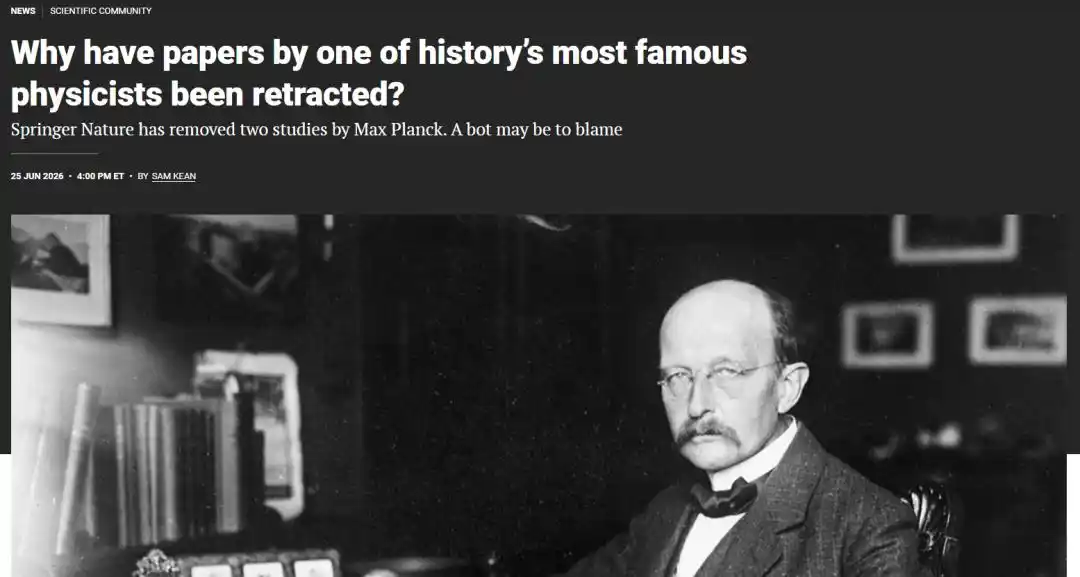
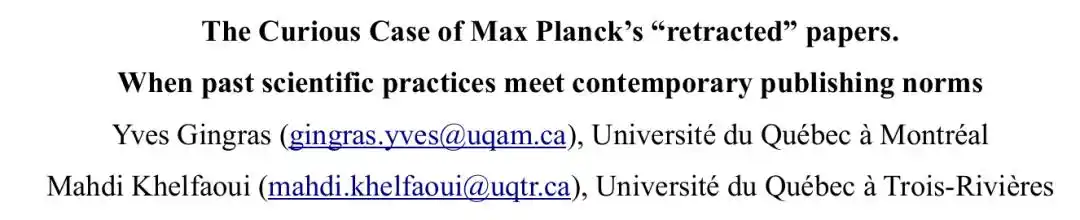
Paper Title: The Curious Case of Max Planck retracted papers. When past scientific practices meet contemporary publishing norms. Paper Address: https://arxiv.org/abs/2605.17534

Amusingly, according to the investigation by the paper's author, these two articles were not retracted due to fabrication, error, or academic misconduct, but were victims of an algorithmic error.

01

The story begins with a "Nobel Laureate Retraction List" from Retraction Watch, a website that tracks issues in academic publishing.

The author, as a researcher in the history of physics, was surprised to see Max Planck on the list because the two articles were published in the German science journal *Die Naturwissenschaften*. By then, Planck was already a world-renowned physicist, and the paper's author found it hard to believe these articles were truly retracted during his lifetime or that there were sufficient grounds for retraction later.
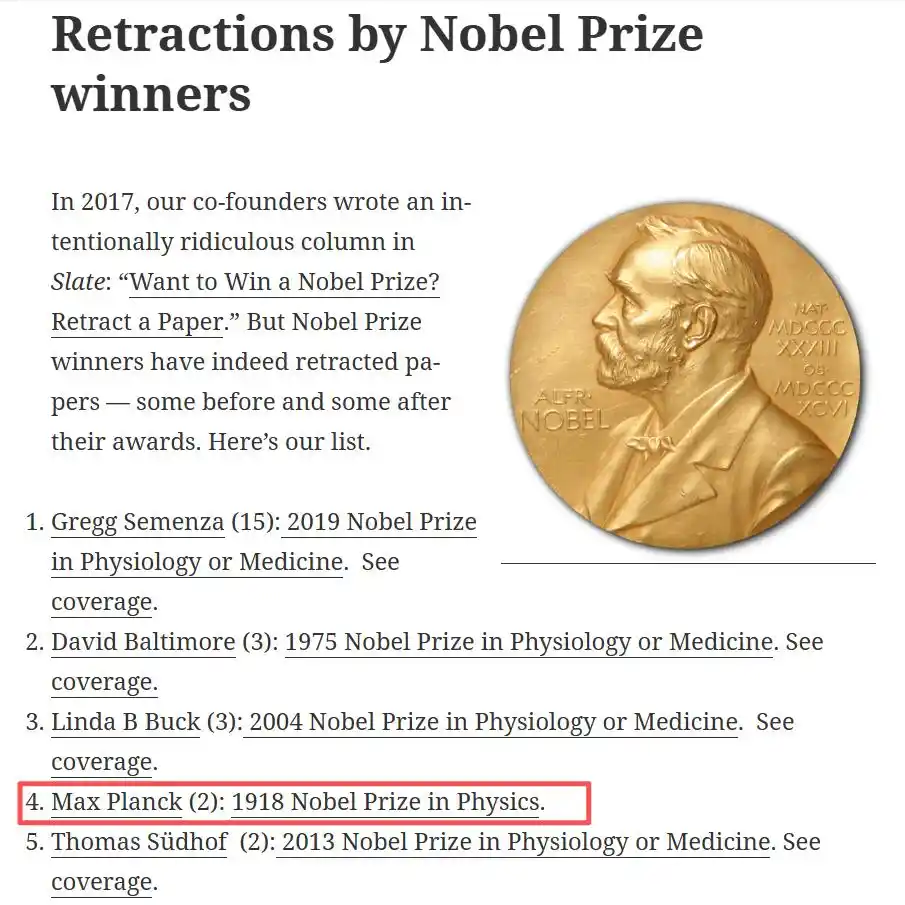
Link: https://retractionwatch.com/retractions-by-nobel-prize-winners/

The explanation given on the Springer platform is rather vague. The page title labels it as a "RETRACTED ARTICLE," but the statement in the PDF says, "This article has been withdrawn due to article violation"; the wording on the webpage is more specific, stating the articles were retracted due to "copyright violation."
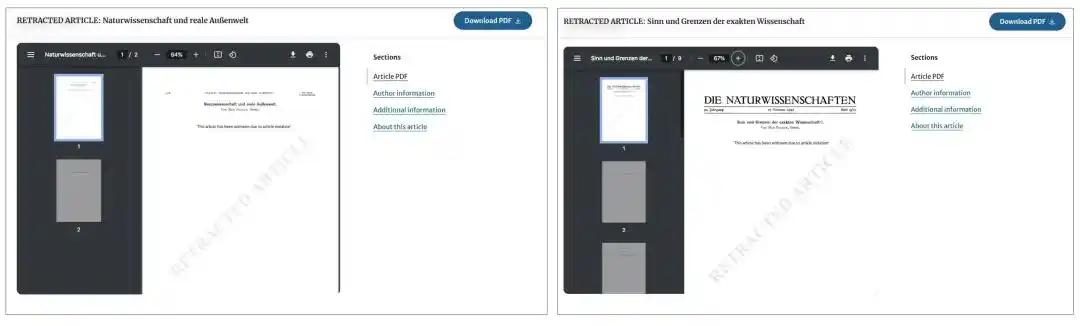
In other words, this is likely an accident manufactured by a combination of copyright, digital archiving, and platform metadata management—these old articles were processed by the system/publisher in modern databases as copyright or duplicate publication issues.

Let's first return to the ecology of scientific publishing in the first half of the 20th century. *Die Naturwissenschaften* was founded in 1913, published by Julius Springer Verlag, and positioned somewhat like the German-language equivalent of *Nature*: it was a comprehensive science weekly covering natural sciences, medicine, and technological advances. It published both technical papers and speeches, conference reports, as well as discussions on the philosophy of science and its cultural significance.

Planck's two articles themselves were not research papers reporting new experiments or theories, but rather philosophical reflections on the nature of scientific knowledge.

The 1942 article, "The Meaning and Limits of Exact Science," is particularly typical. It was originally a lecture Planck gave in 1941 at the Kaiser-Wilhelm-Gesellschaft in Berlin. It later circulated in multiple forms: published as a pamphlet in 1942, also appearing in *Europäische Revue* and *Die Naturwissenschaften*, and was included in a collection of Planck's speeches and essays in 1943.

Today, such a pathway could easily be identified by platforms or copyright systems as "duplicate publication." But at that time, multi-channel circulation—from lectures to journals, from pamphlets to essay collections—was simply part of how scientific ideas spread.

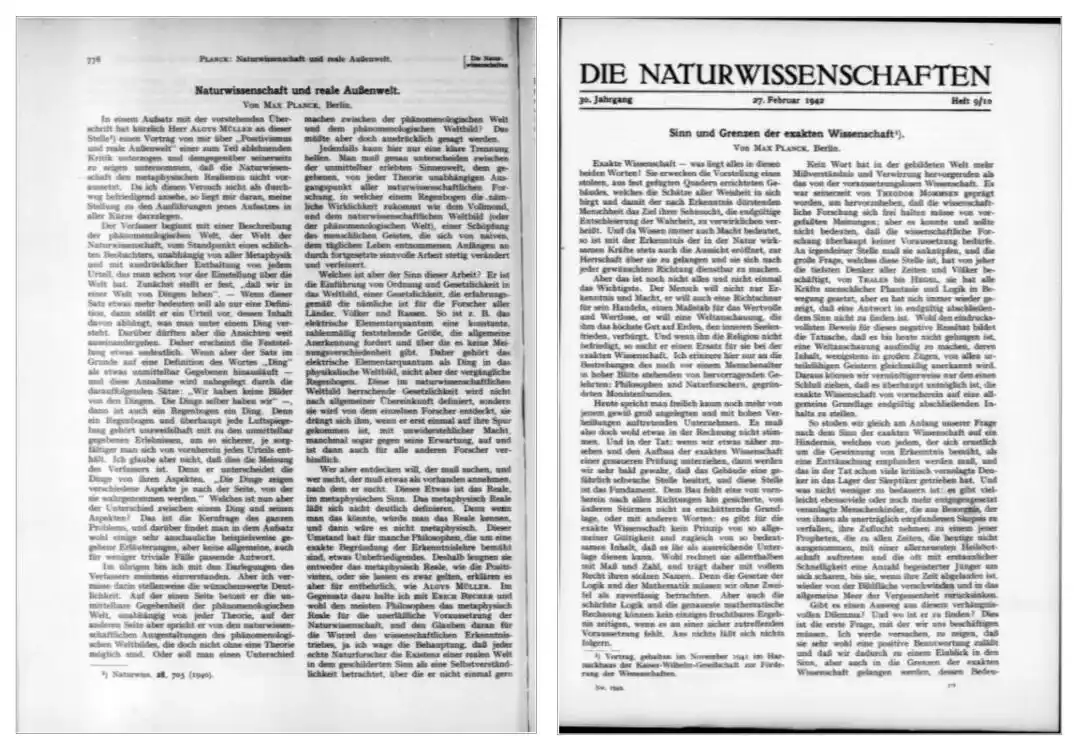
The case of the 1940 article, "Natural Science and the Real External World," is even more peculiar. The paper's author found no evidence of it being published elsewhere as a duplicate. One possible explanation proposed by the author is that a few months earlier in the same journal, another author, Aloys Müller, had published an article with the same title, discussing Planck's philosophical position. Planck then used the same title for a response, engaging in this intellectual debate.

Within the editorial culture of that era, this was clearly not a problem; it was even an explicit gesture of dialogue. But in later digital indexing, copyright management, and metadata systems, two identical titles might be flagged as a suspicious duplicate.

The paper also points out that these two "retracted" articles have even become blank pages on Springer's platform. Normally, even if a paper is retracted, the original text is preserved with a retraction notice added to maintain the integrity of the scientific record. But here, the two-page article from 1940 and the nine-page article from 1942 have both been erased on the digital platform. To read the original today, you can't find it at the original publisher Springer; you have to go to the non-profit Internet Archive.
02

At this point, the matter is no longer just the amusing story of "Planck being mistakenly retracted"; it's a failure of modern academic publishing infrastructure. When historical literature enters modern digital publishing platforms, who has the right to decide what counts as "duplicate publication," what counts as "copyright violation," and what should continue to be seen?

The paper's author argues that concepts like "duplicate publication" and "self-plagiarism" are not eternal, unchanging standards of academic ethics. They are modern categories bound up with bibliometrics, research evaluation, copyright transfer, and commercial publishing platforms from the late 20th century onwards. The paper explicitly states that "self-plagiarism" is a relatively recent concept that has gained prominence with the evaluation systems that measure academic productivity by paper counts since the 1990s.

This is also a point familiar to today's academic system: the issue isn't just "what the content is," but also "how the content is represented by the system."

Once a historical article enters a database, it is broken down into structured objects like DOI, title, author, copyright status, retraction labels, PDF files, citation records, etc. Once platforms process old literature automatically or semi-automatically according to contemporary rules, they may rewrite past normal publishing practices as today's violations.

This mismatch is particularly alarming in the AI era.

When we talk about training data, data cleaning, literature databases, knowledge graphs, and RAG today, we often assume that digital knowledge is stable, retrievable, and callable. But this incident reminds us that digital archives are not a neutral "mirror of the past"; they are a set of filters imbued with commercial logic, legal assumptions, and platform rules. Data can be renamed, re-categorized by platforms, or even replaced with blank pages.

A modern copyright and metrics system retroactively judged normal pre-digital scientific communication practices as suspicious operations. More seriously, this judgment didn't remain at the label level; it directly affected the accessibility of historical literature.

For the knowledge production systems entering the AI era, a wrong label, a missing PDF, or an opaque copyright handling can all be further amplified by models, search engines, and academic tools. Future AI assistants might not know that Planck's articles were "mistakenly retracted"; they might only see the cold, hard "retracted" marker in the database.

When scientific memory is increasingly entrusted to databases, publishers, platform rules, and commercial infrastructure, can we still accurately see science's past?

Reference Link: https://www.science.org/content/article/why-have-papers-one-history-s-most-famous-physicists-been-retracted

This article is from the WeChat public account "Almost Human" (ID: almosthuman2014), author: Focus on Academia


Трендові криптовалюти

Пов'язані питання

QWhat is the main reason Max Planck's articles from 1940 and 1942 were marked as 'retracted' on Springer's platform?

AThe primary reason is believed to be an error caused by automated algorithms or digital platform systems. They likely flagged the articles due to issues such as potential 'duplicate publication' or 'copyright violation' based on modern publishing norms, which misinterpreted the historical publication practices of that era.

QWhat was the original publication context of Max Planck's 1942 article 'The Meaning and Limits of Exact Science'?

AThe 1942 article was originally a lecture delivered by Max Planck in 1941 at the Berlin Kaiser-Wilhelm-Gesellschaft. It was subsequently published in multiple formats, including as a pamphlet, in the journals 'Europäische Revue' and 'Die Naturwissenschaften', and later included in a collection of Planck's speeches and essays. This was a normal method of disseminating scientific ideas at the time.

QWhat unusual outcome occurred for Planck's articles on Springer's platform besides the retraction label?

ABeyond being labeled as 'retracted,' the full texts of the articles were replaced with blank pages on Springer's digital platform. This removal of content is unusual, as standard practice for retracted articles is to keep the original text accessible with a retraction notice to preserve scientific record integrity.

QAccording to the article, why is the concept of 'self-plagiarism' considered a modern construct in relation to this incident?

AThe article argues that concepts like 'self-plagiarism' and 'duplicate publication' are relatively recent constructs tied to late-20th-century academic evaluation systems that emphasize paper counts. Planck's multi-format dissemination of his lecture was standard and acceptable scientific communication in his time but is judged by a different, contemporary set of digital platform rules.

QWhat broader concern does this case raise about digital archives and AI-era knowledge systems?

AThis case highlights that digital archives are not neutral mirrors of the past but are filtered through commercial logic, legal assumptions, and platform rules. An erroneous label or removal can distort the historical record. In the AI era, such errors in databases could be amplified by models, search engines, and tools, potentially leading to the loss or misinterpretation of scientific heritage as AI systems may uncritically accept platform metadata.

Пов'язані матеріали

You Use Claude and Codex Every Day, but Meta Has Restricted Internal Use

In May, Meta imposed internal restrictions on its engineers regarding the use of Claude Code and Codex, two widely used AI programming tools. Despite being a major client, Meta's guidelines, still in effect, prohibit these external models from being used for specific tasks to prevent potential "escalations with partners." The core concern is "distillation"—the risk that outputs from Claude or Codex could inadvertently contaminate the training data and evaluation processes for Meta's in-house AI coding assistant, MetaCode. If MetaCode is trained or evaluated using data generated by these external models, it risks learning their capabilities rather than developing its own, blurring the line of intellectual origin. The restrictions are precise: engineers cannot use the external models to generate test questions, debug source code, or suggest test cases. AI-generated content is also barred from environments accessible to MetaCode. However, AI can still assist with peripheral tasks like workflow setup and code organization, provided all outputs are manually reviewed. This caution reflects a broader industry dilemma. While distillation is a common technique, using a competitor's model output for training raises legal and ethical questions about the ownership of derived capabilities. Contractual terms from companies like OpenAI and Anthropic explicitly forbid using their outputs to build competing products, putting enforcement power in the hands of rivals. The move is also financially motivated, as Meta seeks to reduce its hefty internal AI spending, estimated in the billions this year. Meta's policy illustrates the delicate balance companies must strike: leveraging powerful external AI tools while safeguarding the integrity and independence of their own AI development. As AI systems increasingly help build other AIs, distinguishing the origin of capabilities becomes a fundamental challenge for the entire industry.

marsbit1 год тому

You Use Claude and Codex Every Day, but Meta Has Restricted Internal Use

marsbit1 год тому

Why Do We Need an AI Content Perspective Today?

The article "Why Do We Need an AI Content Perspective Today?" explores the complex and often contentious integration of AI into the cultural and creative industries, particularly film and television. It begins with the cancellation of Amazon's AI-generated animation "Punky Duck," highlighting the ethical debates surrounding AI content. AI's rapid advancement is transforming video production, enabling cost-effective, full-length AI films (e.g., "RAPHAEL," "Dreams of Violets") while sparking industry resistance over issues like "synthetic actors." The core debate has shifted from whether to use AI to how to use it responsibly. The article analyzes why AI's entry into film is uniquely unsettling. It distinguishes between "cultural fast food" (short-form, fast-paced content like micro-dramas) and "cultural main courses" (traditional, long-form film/TV). AI currently excels at the former, matching its fragmented narratives, shallow emotional needs, and free-to-consumer models. However, venturing into the latter challenges the human-centric essence of storytelling—creativity, emotional depth, and the unique value of human labor and experience. While AI can generate massive volumes of content and lower costs, it risks devaluing human creativity, leading to homogenized output, and creating unfair competition through potential intellectual property infringement. Its efficiency also amplifies content safety risks, making preemptive governance crucial. To counter these risks, the article proposes establishing clear boundaries guided by a human-centered AI content perspective. It outlines four principles: 1) Amplify, rather than displace, human creative space; 2) Respect and protect human creative output; 3) Ensure human creative control and responsibility remain paramount; and 4) Guarantee transparency and traceability in AI creation. The conclusion emphasizes that humans must act as the "helmsmen" of technology, steering AI development to enhance, not replace, the core human values at the heart of cultural expression.

marsbit1 год тому

Why Do We Need an AI Content Perspective Today?

marsbit1 год тому

Refunds! Claude 4.8 Sees Overnight Major 'Dumb-Down', GPT-5.6's Computational Power Reportedly 'Halved'

The AI community is currently alarmed by widespread reports of significant performance degradation in two leading models. This article details a "mass self-testing frenzy" triggered by a mysterious prompt designed to detect a hidden "Juice" value, representing a model's reasoning compute budget. On OpenAI's side, users suspect a covert, limited test of a "GPT-5.6-sol" model is underway. When using a specific XML prompt on the Codex platform, a normal "gpt-5.5 xhigh" model reportedly returns a Juice value of 768. However, some users routed to the suspected GPT-5.6 test receive a drastically reduced value of 128—a six-fold decrease. This has sparked debate on whether it signifies a major efficiency leap or a "watered-down, low-cost version" achieved by slashing reasoning depth to save computational expenses. Simultaneously, Anthropic's Claude models, particularly the flagship Opus 4.8 Max, are facing intense user backlash for a perceived "physical brain cut." Users on platforms like Reddit report a dramatic decline in the model's once-impressive reasoning, with complaints of it becoming "absurdly" weakened, performing worse than older, lighter models like Haiku. Specific criticisms include: losing long-context memory, refusing to think deeply even in high-reasoning modes, providing instant incorrect answers, and engaging in unhelpful, argumentative, or "gaslighting" behavior where it contradicts users unnecessarily. The article speculates these "stealth downgrades" might be a calculated corporate strategy. Companies could initially release models with temporarily boosted compute to create an illusion of a major breakthrough, then silently scale back parameters later to manage unsustainable inference costs. A proposed underlying cause is a tightened funding environment, potentially exacerbated by SpaceX's massive IPO soaking up market liquidity, which could delay AI company IPOs and force cost-cutting measures like model "nerfing." The core issue highlighted is the asymmetry of information: subscribers pay for a service that can be silently and fundamentally altered without notification or explanation. The viral "Juice test" resonates because it represents users' desire for transparency about what they are actually paying for.

marsbit2 год тому

Refunds! Claude 4.8 Sees Overnight Major 'Dumb-Down', GPT-5.6's Computational Power Reportedly 'Halved'

marsbit2 год тому

Торгівля

Спот

Популярні статті

Як купити ONE

Ласкаво просимо до HTX.com! Ми зробили покупку Harmony (ONE) простою та зручною. Дотримуйтесь нашої покрокової інструкції, щоб розпочати свою криптовалютну подорож.Крок 1: Створіть обліковий запис на HTXВикористовуйте свою електронну пошту або номер телефону, щоб зареєструвати обліковий запис на HTX безплатно. Пройдіть безпроблемну реєстрацію й отримайте доступ до всіх функцій.ЗареєструватисьКрок 2: Перейдіть до розділу Купити крипту і виберіть спосіб оплатиКредитна/дебетова картка: використовуйте вашу картку Visa або Mastercard, щоб миттєво купити Harmony (ONE).Баланс: використовуйте кошти з балансу вашого рахунку HTX для безперешкодної торгівлі.Треті особи: ми додали популярні способи оплати, такі як Google Pay та Apple Pay, щоб підвищити зручність.P2P: Торгуйте безпосередньо з іншими користувачами на HTX.Позабіржова торгівля (OTC): ми пропонуємо індивідуальні послуги та конкурентні обмінні курси для трейдерів.Крок 3: Зберігайте свої Harmony (ONE)Після придбання Harmony (ONE) збережіть його у своєму обліковому записі на HTX. Крім того, ви можете відправити його в інше місце за допомогою блокчейн-переказу або використовувати його для торгівлі іншими криптовалютами.Крок 4: Торгівля Harmony (ONE)Легко торгуйте Harmony (ONE) на спотовому ринку HTX. Просто увійдіть до свого облікового запису, виберіть торгову пару, укладайте угоди та спостерігайте за ними в режимі реального часу. Ми пропонуємо зручний досвід як для початківців, так і для досвідчених трейдерів.

370 переглядів усьогоОпубліковано 2024.12.12Оновлено 2026.06.02

Як купити ONE

Обговорення

Ласкаво просимо до спільноти HTX. Тут ви можете бути в курсі останніх подій розвитку платформи та отримати доступ до професійної ринкової інформації. Нижче представлені думки користувачів щодо ціни ONE (ONE).

活动图片