Original Author: Liam Akiba Wright
Original Compilation: Luffy, Foresight News
TL;DR:
- According to reports, Standard Chartered Bank has released a research report on Uniswap, setting a $100 price target for the UNI token by 2030.
- Standard Chartered's core logic is that tokenized assets will drive demand for open DeFi liquidity, and Uniswap is expected to capture substantial trading volume and earn fees.
- However, most institutional-grade tokenized products are permissioned. Products like BlackRock's BUIDL demonstrate that access barriers still exist within the DeFi space.
Standard Chartered Bank has set a year-end 2030 price target of $100 for the UNI token. This prediction implies that the price of this leading decentralized exchange governance token will far exceed its current market valuation.
Standard Chartered's argument is that future tokenized assets will require decentralized trading platforms to convert fragmented on-chain financial instruments into tradable liquidity.
Standard Chartered estimates that by 2028, the total size of global tokenized assets could reach $4 trillion; by 2030, the proportion of tokenized assets flowing into the DeFi market is projected to increase from the current ~3.5% to 30%. Based on this estimate, the asset size hosted by the DeFi market in 2030 could exceed $2 trillion.
Currently, banks, asset management firms, transfer agents, and compliance platforms are all entering the asset tokenization space. But if these assets require 24/7 trading, flexible collateralization, and cross-product composability that single institutions' proprietary systems cannot provide, then open, decentralized protocols will capture the liquidity dividend.
Given the current market environment, a core industry question emerges: Will on-chain assets such as tokenized treasuries, funds, stocks, and stablecoins become liquidity assets in open, decentralized markets, or will they remain confined to strictly permissioned, fully controlled closed systems for circulation and settlement?
Growth Prospects Depend on Open Liquidity
Standard Chartered's valuation target is built on layered assumptions: First, the tokenized asset market achieves significant expansion. Second, a considerable portion of tokenized assets evolve beyond merely being compliant, ownership-registered assets sitting on-chain to become actively traded within DeFi markets. Finally, Uniswap can capture enough of the related trading volume, driving up the value of the UNI token. The core of this entire logic shifts the focus from the asset issuance phase to the liquidity trading phase.
Standard Chartered had previously identified asset tokenization as a long-term, major opportunity. In a 2024 report co-published with consultancy Synpulse, it predicted that the global real-world asset tokenization market could reach $30.1 trillion by 2034, with trade finance being a core application area. The report also mentioned that tokenization would spawn new DeFi applications and business models.
Citi's tokenization report from June 2026 had a similar market size projection but also highlighted countervailing factors: its base case forecasted a $5.5 trillion tokenized asset market by 2030, with an optimistic scenario of $8.2 trillion. The report also noted that hybrid models might dominate, with institutions controlling issuance, distribution, and settlement channels.
The divergence between these two paths directly determines Uniswap's growth potential. If the tokenized asset market continues to grow, but value remains locked within bank platforms, transfer agent systems, broker networks, and compliant trading markets, the development space for open DeFi will be very limited.
Conversely, if various tokenized financial instruments, stablecoins, and collateral assets require cross-category free trading, the status of protocols like Uniswap will be greatly elevated.
DeFiLlama data confirms Uniswap's foundational ability to meet this demand. At the time of writing, the protocol's multi-chain total value locked is approximately $2.89 billion, with fee revenue exceeding $50 million over the past 30 days.
Current data only represents the base operational scale but is sufficient to illustrate that Uniswap is positioned as liquidity infrastructure.
For institutions, there is a clear practical difference between the two. Issuing a fund token is one process; building a trading venue that allows that token to be freely exchanged for stablecoins, collateral, and other tokenized assets is a separate, independent business.
The gap between these two processes determines whether automated market makers like Uniswap become essential infrastructure or remain merely peripheral access channels.
This reveals that the choice of trading venue is equally important as asset issuance. Liquidity determines whether tokenized products can form tradable markets, reusable collateral, and settleable assets; otherwise, they remain merely static ownership certificates within compliant systems.
BlackRock's BUIDL: Connecting to DeFi, but Building Access Gates
BlackRock's BUIDL Institutional Digital Liquidity Fund is a current real-world case highlighting this tension. In February this year, Uniswap Labs and compliance platform Securitize jointly announced that BlackRock's USD Institutional Digital Liquidity Fund, BUIDL, was available on the UniswapX trading channel.
This integration uses a request-for-quote (RFQ) mechanism and is open only to whitelisted users and pre-vetted, qualified participants.
Previous CryptoSlate reporting on BUIDL pinpointed the core contradiction: While BUIDL holders can exchange for USDC via UniswapX, trading access has strict eligibility barriers.
The transaction flow relies on DeFi technology, but asset circulation is limited to approved institutional participants.
BlackRock's initial issuance rules for BUIDL fully embody this controlled model: the product is only for accredited investors, with a minimum investment of $5 million; assets can only be transferred to pre-approved parties, and it is not listed for trading on any exchange.
RWA.xyz data shows that as of June 16, BUIDL's total asset size was approximately $2.37 billion, held by only 108 entities.
Combined with the access rules, this paints a picture of the current tokenization industry: large-scale tokenized products can be created on-chain, but participation rights are highly concentrated and subject to full permissioning control.
Standard Chartered's investor roadshow materials from May 2026 also used BUIDL's connection to Uniswap as a case study to argue that decentralized platforms could be used for asset distribution and trading.
Even though the full UNI valuation report hasn't been made public, this roadshow material positions Uniswap as supporting infrastructure for institutional digital assets, which is the foundational support for the $100 price target.
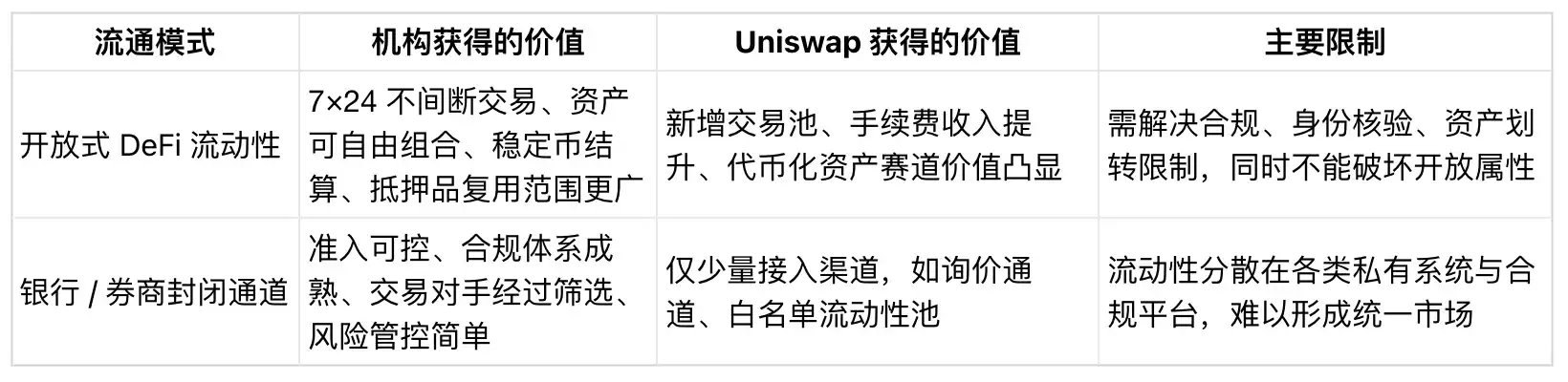
The BlackRock BUIDL model sits between the two extremes, utilizing Uniswap technology at its base but maintaining institutional access controls throughout. This design builds a bridge to DeFi infrastructure without fully immersing tokenized assets into a permissionless, open liquidity pool.
The liquidity solutions acceptable for institutional assets will likely adopt this hybrid model first: leveraging DeFi infrastructure for trading and settlement while imposing hard restrictions on user identity, asset transfers, and counterparties.
UNI Still Lacks a Value Capture Mechanism
Even if Uniswap facilitates more real-world tokenized asset trading, it doesn't guarantee direct benefits for UNI token holders, as the protocol still lacks a stable value capture mechanism.
The UNI tokenomics upgrade proposal passed by the community on the Tally platform previously clarified protocol fee distribution and UNI burn mechanisms while also proposing that Uniswap become the default trading hub for tokenized assets.
This plan provides an implementation path for the valuation logic but hinges on multiple prerequisites: community governance decisions, fee adjustments, institutional commercial partnerships, and real trading volume growth—none of which can be missing.
Standard Chartered's $100 price target not only far exceeds current market levels but even surpasses UNI's all-time high from 2021. This target cannot rely solely on asset issuance growth; it requires real, sustained trading volume, stable fee revenue, and a clear linkage mechanism between protocol development and token value.
The core tension in the institutional tokenization space is that banks and asset managers need decentralized capabilities like on-chain settlement, 24/7 transfers, programmable collateral, and stablecoin payments, yet insist on KYC verification, asset transfer restrictions, designated counterparties, and control over secondary market development.
The Financial Stability Board's research report on tokenization also reflects this cautious stance. It notes that the overall scale of tokenization is still small and that the industry faces multiple issues, including closed access, insufficient cross-platform interoperability, limited settlement assets, and fragmented trading platforms.
These frictions are the core obstacles preventing tokenized assets from becoming general-purpose liquidity assets in DeFi.
If these industry barriers persist long-term, Uniswap will remain merely a peripheral integration channel for institutional tokenization systems. If related pain points gradually ease, the protocol could become a central trading venue for tokenized funds, stablecoins, and native crypto assets.
Ultimately, the core of Standard Chartered's valuation prediction depends on where tokenized liquidity ultimately flows. The $100 target represents significant upside potential, but the more crucial signal is this: a traditional Wall Street investment bank now acknowledges that DeFi protocols have a chance to share in the institutional tokenization wave.
The BlackRock BUIDL case has already proven that asset managers can use DeFi technology while maintaining strict circulation controls; Citi's outlook on tokenization also suggests that Wall Street will likely build hybrid systems, keeping issuance, distribution, and settlement firmly in institutional hands; and the various industry pain points highlighted by the Financial Stability Board emphasize that interoperability and settlement systems remain core industry challenges.
Future market signals will come from more tokenized asset integration cases. If new assets all adopt isolated, whitelisted RFQ channels, open DeFi will only capture a small market share. If cross-asset unified liquidity pools gradually materialize and custom control rules diminish, Uniswap's position in the tokenization space will no longer be confined to native cryptocurrency swaps.