Recent Mass Shutdowns of DeFi Protocols: They All Have One Thing in Common

marsbitОпубліковано о 2026-03-06Востаннє оновлено о 2026-03-06

Анотація

In recent months, multiple DeFi protocols have announced shutdowns, not due to exit scams but because of a lack of users, funding, or both. Projects like Angle Protocol, Polynomial, MilkyWay, and Step Finance—despite having functional products and significant past traction—were unable to sustain operations. Common challenges included an inability to attract liquidity (especially critical in derivatives), failure to achieve product-market fit, and high costs of expanding to new chains or narratives. Many teams pivoted repeatedly to chase trends like restaking or real-world assets but ran out of capital before finding sustainable demand. Others, like ZeroLend, suffered from deploying on smaller blockchains that lost liquidity during market downturns. Despite these failures, the projects shut down responsibly, allowing users to withdraw funds and avoiding reckless token launches—a sign of industry maturation compared to the reckless exits of 2022.

Author: Ignas

Compiled by: Chopper, Foresight News

Over the past two months, at least 10 crypto protocols have announced their closure. Not rug pulls, but due to no users, no money, or both.
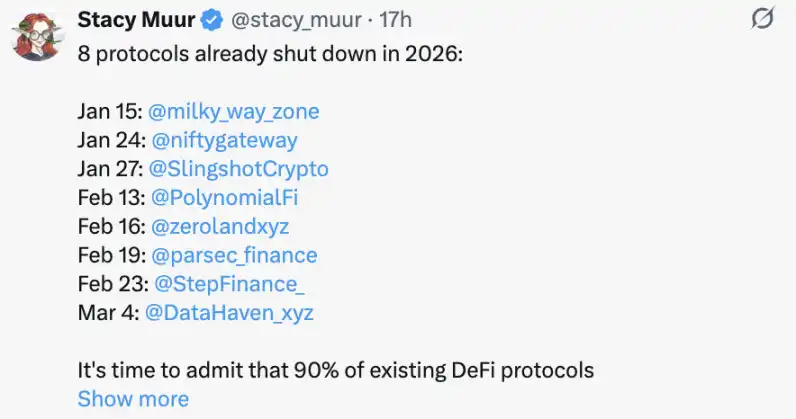
Not to mention mining companies like BlockFills and lending platforms freezing withdrawals. Just yesterday, Angle also announced (https://x.com/AngleProtocol/status/2029161525580112263) the gradual shutdown of its EURA and USDA stablecoins, despite having reached a Total Value Locked (TVL) of $250 million and having strong business partnerships.

Angle stated bluntly in the announcement, "The decentralized stablecoin landscape has completely changed. Yield-bearing stablecoins today are essentially just branded wrappers over existing vaults and lending protocols; there's no longer a need to maintain a separate, independent infrastructure."

These shuttered projects almost all had functional products:

  • Polynomial processed a cumulative trading volume of $4 billion across 70 markets
  • MilkyWay's TVL once reached $250 million
  • Step Finance had a peak of 300,000 monthly active users

I've used, or at least tried, these products. The technology wasn't the issue, but no one was willing to pay the fees needed for the projects to survive.

MilkyWay is a typical example: four pivots in less than two years. Starting with Celestia liquid staking, then moving to restaking, RWA tokenization, and crypto debit cards for rent payments... each pivot chased the hype of the moment.

Their description of the restaking pivot is poignant: "We identified the restaking opportunity early, designed the system, TVL to $250M, completed security audits, and were ready to launch. But the market moved on from restaking faster than anyone anticipated."

In the end, they had to admit the funding wouldn't last long enough to find product-market fit.

The Polynomial team was brutally honest about the reason for failure, offering a lesson for all perpetual contract projects: "In derivatives, good tech is useless. We improved execution speed, optimized UX, built innovative infrastructure, but none of it mattered. Traders go where the liquidity is. We didn't have it. Everything else is just a nice-to-have feature."

The conclusion is even harsher: "Liquidity is the only moat in derivatives. You can't beat liquidity with innovation, you can't beat it with marketing, you can't beat it with development."

ZeroLend's shutdown sounds a warning bell for dApps trying to launch on multiple blockchains. They bet on supporting projects on niche chains like Manta, Zircuit, and Xlayer, but when the market turned bearish, liquidity on these chains dried up, and oracle providers stopped their services.

Ultimately, operating at a long-term loss was unsustainable.

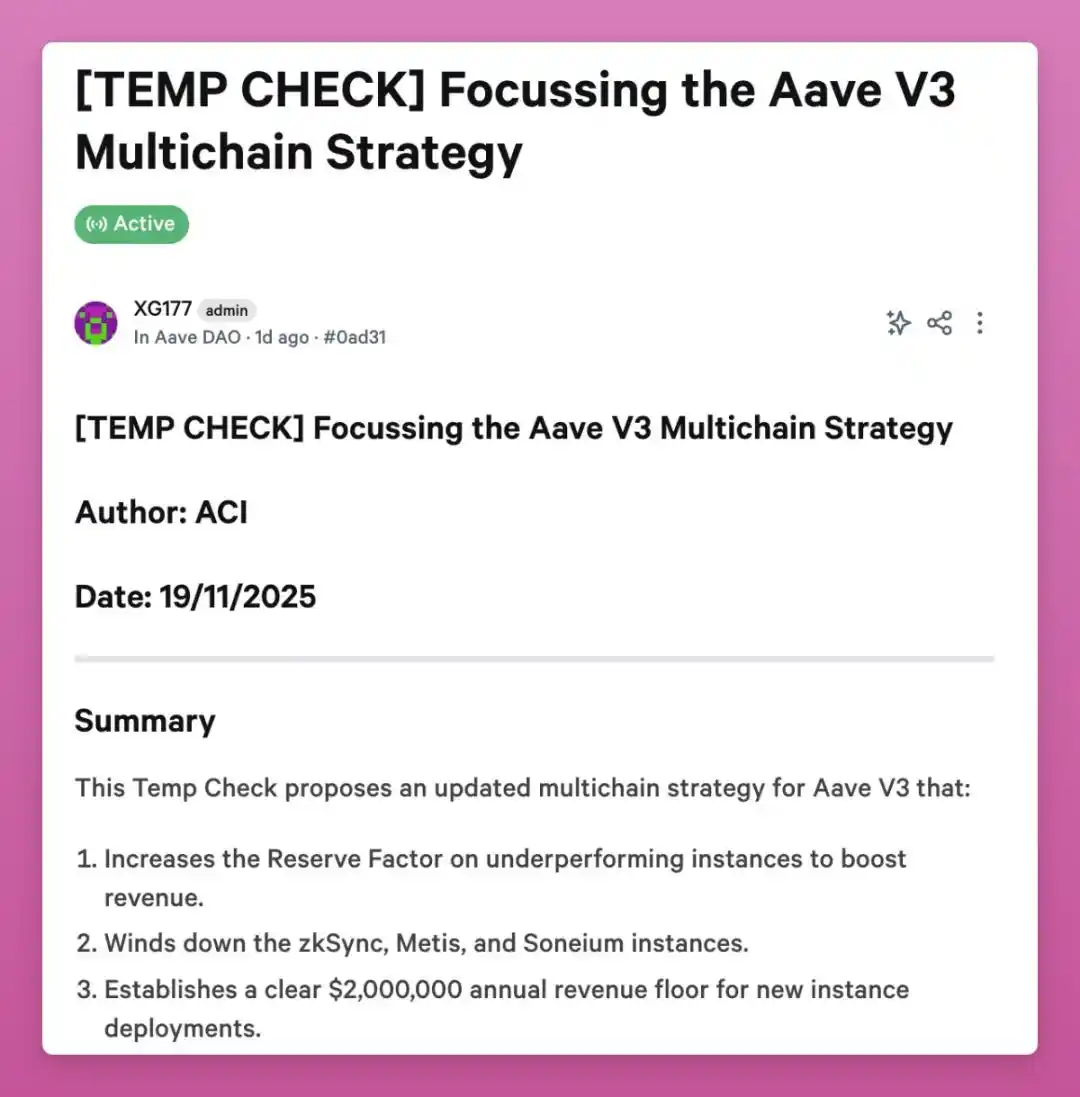
Aave recently also voted to shut down services on several chains, citing the same reason of unprofitable operation.
Then there's Parsec, once a legendary tool in the circle used to track Terra, 3AC, and the stETH depeg. But the team admitted, "After the FTX collapse, DeFi spot trading, lending, and leverage never returned to their former state. The market changed, on-chain behavior changed, and we didn't truly understand it."

Simply put, the market moved on, and we were left behind. The market is cruel.

Slingshot was acquired and completely shut down. Eden cut 80% of its unprofitable products, keeping only the core business.

As they said, "The 80/20 rule became a reality; the products that cost us 80% of our expenses brought in only 20% of the revenue."

Finally, Step Finance's case is more unique: it was hacked for $26 million on January 31st, which was a death sentence. "We tried fundraising, acquisition, nothing worked."

What's the common thread among these deceased projects? They failed to adapt to the ever-changing market and lacked sufficient capital to pivot again.

Each team bet on a particular ecosystem experiencing explosive growth, but the growth either wasn't fast enough or didn't happen at all. Celestia DeFi never truly took off, on-chain derivatives struggled to compete with Hyperliquid, and even established platforms like dYdX and GMX are having a hard time.

And expanding into new chains and narrative areas is costly.

For players like me, moving funds from one platform to another is effortless and cheap. But applications need to invest significant time and financial resources to prepare for potential new user bases.

The good news is, these were all "dignified deaths." All projects gave users time to withdraw funds; the teams didn't run away or issue tokens to cash out. Compared to the outright rug pulls of 2022, the industry has indeed learned to die responsibly.

Пов'язані питання

QWhat is the common reason behind the recent shutdowns of multiple DeFi protocols?

AThe common reason is that these protocols failed to adapt to the rapidly changing market conditions and lacked sufficient funding to pivot or sustain operations, despite having functional products.

QAccording to Angle Protocol, why did they decide to shut down their stablecoin operations?

AAngle Protocol stated that the decentralized stablecoin landscape has fundamentally changed, and yield-bearing stablecoins are now essentially just branded wrappers over existing vaults and lending protocols, making it unnecessary to maintain independent infrastructure.

QWhat did Polynomial identify as the only moat in the derivatives space?

APolynomial identified liquidity as the only moat in the derivatives space, emphasizing that innovation, marketing, or development cannot overcome the advantage of liquidity.

QWhat lesson did ZeroLend's shutdown provide for decentralized applications?

AZeroLend's shutdown served as a warning for dApps launching on multiple blockchains, as betting on smaller chains like Manta and Xlayer led to liquidity drying up and oracle services halting when the bear market hit.

QHow did the shutdowns of these protocols demonstrate responsible behavior compared to past incidents?

AThese protocols allowed users time to withdraw funds, did not engage in exit scams, and avoided issuing worthless tokens, showing that the industry has learned to 'die responsibly' compared to the outright fraud seen in 2022.

Пов'язані матеріали

First Batch of Keynote Speakers and Partners Announced! Web2+3 Summit: Defining the Next Generation of Digital Economy

Web2+3 Summit: Defining the Next Generation of Digital Economy The 6th BEYOND International Technology Innovation Expo (BEYOND Expo 2026), Asia's largest tech and ecosystem exhibition, is launching a dedicated Web2+3 stage for the first time. Co-hosted by BEYOND Expo and ChainNeXT Group, the Web3 Summit will take place from May 28–30, 2026. Against the backdrop of accelerating global tech integration, the boundaries between Web2 and Web3 are rapidly blurring. With clearer global regulations for blockchain-driven internet (Web3) and the special issuance of a Hong Kong dollar stable币 license by the Hong Kong SAR government on April 10, 2026, Web3's decentralized principles are quickly merging with traditional industries (Web2) such as e-commerce, finance, and artificial intelligence. Focused on blockchain-driven digital economy elements, the summit will center on three core principles—implementability, commercial viability, and compliance. It will bring together top Web3 experts to discuss key integration areas like stablecoin payment finance (PayFi), real-world asset tokenization (RWA), and decentralized AI (DeAI), unveiling new opportunities for industrial innovation. The first wave of confirmed speakers includes Jack Kong (Director of Hong Kong Cyberport, Chairman of Nano Labs), Yat Siu (Chairman of Animoca Brands), Michael Wu (Co-founder & CEO of Amber Group), Michael Heinrich (Co-founder & CEO of 0G), and Art Abal (Co-founder of Vana). More Web3 ecosystem pioneers, AI, and fintech experts will be announced soon. Core forum topics include: - Web2+DeAI: New AI Paradigms Driven by Decentralized Infrastructure - Web2+RWA: Real-World Asset Tokenization and Global Liquidity - Web2+PayFi: Cross-Border Payments and Financial Innovation Powered by Crypto Infrastructure - Web2+3 AI: Autonomous Agents and the Crypto Economy - Web2+3 Wealth: On-Chain and Off-Chain Integrated Investment Ecosystems - Web2+3 Commerce: A New Landscape for Global Trade Driven by Stablecoins Additional agenda details will be released in the near future.

marsbit4 год тому

First Batch of Keynote Speakers and Partners Announced! Web2+3 Summit: Defining the Next Generation of Digital Economy

marsbit4 год тому

Торгівля

Спот
Ф'ючерси

Популярні статті

Як купити ONE

Ласкаво просимо до HTX.com! Ми зробили покупку Harmony (ONE) простою та зручною. Дотримуйтесь нашої покрокової інструкції, щоб розпочати свою криптовалютну подорож.Крок 1: Створіть обліковий запис на HTXВикористовуйте свою електронну пошту або номер телефону, щоб зареєструвати обліковий запис на HTX безплатно. Пройдіть безпроблемну реєстрацію й отримайте доступ до всіх функцій.ЗареєструватисьКрок 2: Перейдіть до розділу Купити крипту і виберіть спосіб оплатиКредитна/дебетова картка: використовуйте вашу картку Visa або Mastercard, щоб миттєво купити Harmony (ONE).Баланс: використовуйте кошти з балансу вашого рахунку HTX для безперешкодної торгівлі.Треті особи: ми додали популярні способи оплати, такі як Google Pay та Apple Pay, щоб підвищити зручність.P2P: Торгуйте безпосередньо з іншими користувачами на HTX.Позабіржова торгівля (OTC): ми пропонуємо індивідуальні послуги та конкурентні обмінні курси для трейдерів.Крок 3: Зберігайте свої Harmony (ONE)Після придбання Harmony (ONE) збережіть його у своєму обліковому записі на HTX. Крім того, ви можете відправити його в інше місце за допомогою блокчейн-переказу або використовувати його для торгівлі іншими криптовалютами.Крок 4: Торгівля Harmony (ONE)Легко торгуйте Harmony (ONE) на спотовому ринку HTX. Просто увійдіть до свого облікового запису, виберіть торгову пару, укладайте угоди та спостерігайте за ними в режимі реального часу. Ми пропонуємо зручний досвід як для початківців, так і для досвідчених трейдерів.

260 переглядів усьогоОпубліковано 2024.12.12Оновлено 2025.03.21

Як купити ONE

Обговорення

Ласкаво просимо до спільноти HTX. Тут ви можете бути в курсі останніх подій розвитку платформи та отримати доступ до професійної ринкової інформації. Нижче представлені думки користувачів щодо ціни ONE (ONE).

活动图片