‘Elite’ traders hunt dopamine-seeking retail on prediction markets: 10x Research

cointelegraphОпубліковано о 2025-12-09Востаннє оновлено о 2025-12-09

Анотація

Prediction markets are becoming a new arena in crypto where elite, well-equipped traders are systematically profiting from retail participants who often treat trading like gambling, driven by dopamine and narratives rather than discipline. According to 10x Research, a small, informed minority accurately prices probabilities and hedges exposure to extract value from retail-driven longshots. Data shows that on Polymarket, only 16.7% of wallets are profitable, while 83% have lost money. Concerns about insider trading are growing, with some users showing near-perfect win rates. Additionally, a bug was discovered that double-counts trading volume on third-party dashboards, though this is due to data errors rather than illegal wash trading.

Prediction markets are emerging as a new battleground in the crypto economy, where the best-informed traders are competing against casual retail bettors for profits.

Most users are behaving more like sports bettors than disciplined traders, according to a Tuesday report from research firm 10x Research, which said they are trading “dopamine and narrative for discipline and edge.” “Accuracy and profit are driven not by the crowd, but by a tiny, informed elite who price probability, hedge exposure, and extract premium from retail-driven longshots.”

The rising liquidity and retail participation are incentivizing professional trading desks to increase their prediction market activity and capture the spread and “misinformation asymmetry” arising from this market structure, 10x added.
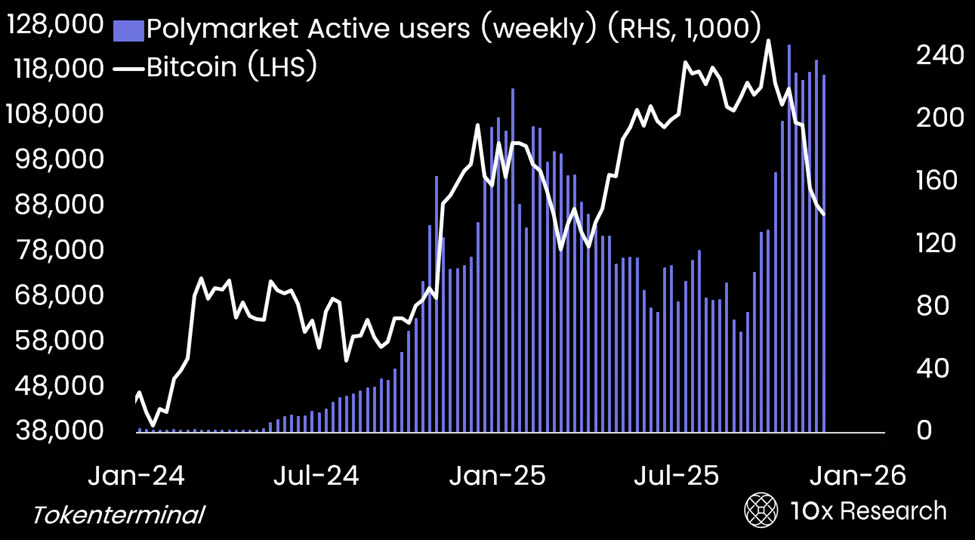
Polymarket active users, weekly, Bitcoin left-hand-side price, year-to-date chart. Source: 10x Research

Related: Bitcoin now settles Visa-scale volumes, but most is for wholesale, not coffee

The report is a concerning sign for casual traders looking to make easy money on prediction markets, as blockchain data suggests that most users lose their initial investment.
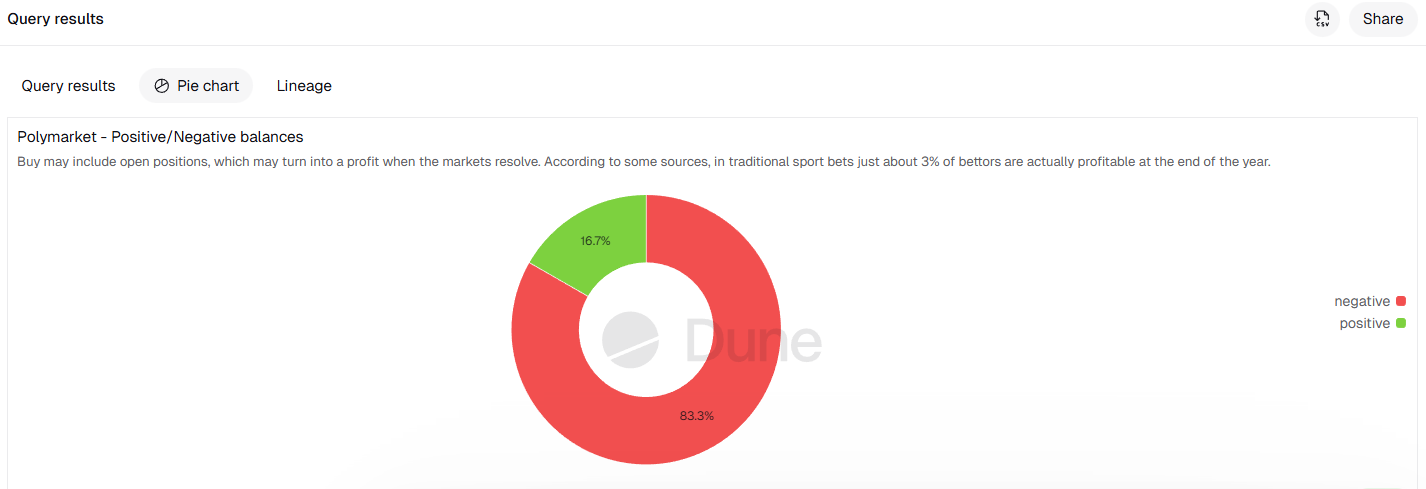
Polymarket, positive/negative wallet balances. Source: Dune.com

Only about 16.7% of wallets on Polymarket are in profit, while the remaining 83% have incurred losses, according to blockchain data from Dune.

Related: Prediction markets emerge as speculative ‘arbitrage arena’ for crypto traders

Perfect win rates fuel insider concerns

The flawless track record of some prediction market accounts is stoking concerns about possible insider trading, as certain users appear to win every time.

Polymarket user “pony-pony” boasts a 100% win rate with over $77,000 in realized profit by betting on events related to the artificial intelligence development company, OpenAI, prediction market data aggregator Polymarket Money said in a Monday X post.

Another user, “AlphaRaccoon,” also triggered insider allegations after generating over $1 million in a single day by successfully winning 22 out of 23 bets related to Google search trends.
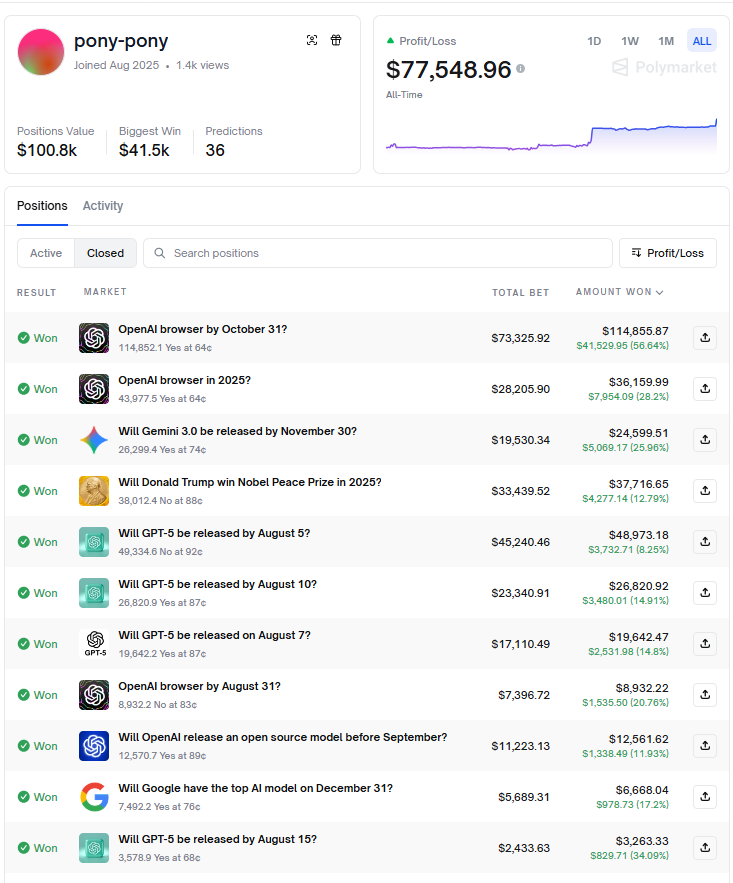
Source: Polymarket Money

Meanwhile, concerns are brewing over the reliability of Polymarket data on third-party data dashboards after a Paradigm researcher discovered a bug that double-counts the prediction market’s trading volume, Cointelegraph reported earlier on Tuesday.

The bug is inflating the primary volume metrics used to gauge prediction market activity, including the notional volume, which counts the number of contracts traded, and the cashflow volume, which measures the dollar value traded at the time of each trade, wrote Paradigm researcher Storm in a Tuesday X post.

However, the inflated volumes on data dashboards are due to errors in data interpretation, not wash trading, which is a deceptive and illegal practice in which entities buy and trade the same instrument to create a false impression of growing market activity.

Paradigm’s newly discovered bug was “validated” by multiple data dashboards, including AlliumLabs and DefiLlama, which are now updating their Polymarket dashboards to eliminate the double-counting error.

Magazine: Train AI agents to make better predictions... for token rewards

Пов'язані матеріали

U.S. Stablecoin Regulatory Framework Finalized, Global Crypto Finance Enters New Institutionalized Phase

The United States has enacted its first federal regulatory framework for stablecoins, marking a pivotal moment for the global cryptocurrency industry. This framework transitions stablecoins from a state of fragmented oversight to a unified federal system, establishing clear legal definitions and operational standards for dollar-pegged payment stablecoins. Key provisions mandate that stablecoin issuers must hold high-quality liquid assets—such as cash and short-term U.S. Treasury securities—as reserves. They are also required to comply with strict auditing, transparency, risk management, and consumer protection rules. The regulatory structure adopts a dual approach: larger issuers will be overseen at the federal level, while smaller ones may fall under state jurisdiction. This development is expected to significantly enhance the role of stablecoins like USDC and USDT as critical infrastructure for cross-border payments, settlements, and decentralized finance (DeFi). By providing legal certainty, the framework is likely to encourage greater adoption by traditional financial institutions, payment companies, and fintech firms, integrating stablecoins more deeply into the mainstream financial system. However, the new rules also present challenges. Higher compliance costs and operational requirements may pressure smaller issuers and could lead to industry consolidation. The shift emphasizes regulatory-driven competition over innovation-driven growth. Furthermore, global regulatory disparities remain, as jurisdictions worldwide have differing definitions and standards for stablecoins, potentially creating friction in international flows. Overall, this U.S. regulatory move signals a structural shift from an enforcement-led approach to a rules-based system for digital assets. It is seen as a maturation of the industry, setting the stage for stablecoins to evolve from crypto trading tools into foundational components of the future digital financial ecosystem, including in cross-border trade, retail payments, and financial market settlements.

cointelegraph_中文9 хв тому

U.S. Stablecoin Regulatory Framework Finalized, Global Crypto Finance Enters New Institutionalized Phase

cointelegraph_中文9 хв тому

Securities or Commodities? A Decade-Long Tug-of-War Ends as the 'Crypto Market Structure Act' Races to the Senate

The "Cryptocurrency Market Structure Act" (CLARITY Act) is advancing to the U.S. Senate for final review after passing the House with strong support. The bill aims to resolve the long-standing regulatory debate over whether cryptocurrencies are classified as securities or commodities. It introduces a clear framework: tokens on decentralized blockchains are defined as "digital commodities" under CFTC oversight, while those meeting the Howey test remain securities regulated by the SEC. Key provisions include a "mature blockchain" exemption for highly decentralized networks like Bitcoin and Ethereum, a 360-day temporary registration pathway for trading platforms, and a fundraising exemption of up to $75 million for certain token offerings with enhanced disclosure. The bill also establishes a joint advisory committee to improve coordination between the CFTC and SEC and explicitly exempts non-custodial DeFi actors from broker-dealer regulations. This legislative effort aligns with the Trump administration's pro-crypto stance, including the appointment of industry-friendly leaders at key agencies like the SEC and CFTC, and recent moves to allow regulated spot crypto trading on CFTC-approved exchanges. If enacted, the law would provide regulatory clarity, encourage institutional adoption, and position the U.S. as a leader in the digital asset space.

Odaily星球日报23 хв тому

Securities or Commodities? A Decade-Long Tug-of-War Ends as the 'Crypto Market Structure Act' Races to the Senate

Odaily星球日报23 хв тому

Торгівля

Спот
Ф'ючерси
活动图片