Original | Odaily Planet Daily (@OdailyChina)
Author | Ethan(@ethanzhang_web3)
In 2025, the prediction market has maintained its hot streak throughout the year, with continuous growth. Leading platforms like Polymarket and Kalshi have seen their valuations climb with funding rounds, and trading volumes have repeatedly hit new highs, leading the industry.
Accompanying the market explosion, the surrounding tool ecosystem has rapidly emerged. Beyond the auxiliary tools previously introduced, a low-key yet rapidly evolving area is becoming a new focus for professional players—prediction market aggregators (Recommended reading:"Odaily Picks: Deploying in the Prediction Market, These Tools Can Double Your Trading Win Rate").
"Prediction market aggregators" are not merely simple summaries of order book information. The new generation of tools has integrated advanced DeFi玩法: supporting whale monitoring, copy trading, lightning-fast orders, cross-chain liquidity pools, and even introducing common CEX features like take-profit and stop-loss, significantly enhancing trading efficiency and strategic possibilities.
In this赛道, product forms are diverse: some focus on liquidity routing, aiming to become the "1inch" of prediction markets; others break tradition,重构 the "winner-takes-all" type of pooled betting logic. Odaily Planet Daily will盘点 6 distinctive prediction market aggregators to help readers find more "handy" profit-making tools than native platforms.
TradeFox (formerly factCheck)
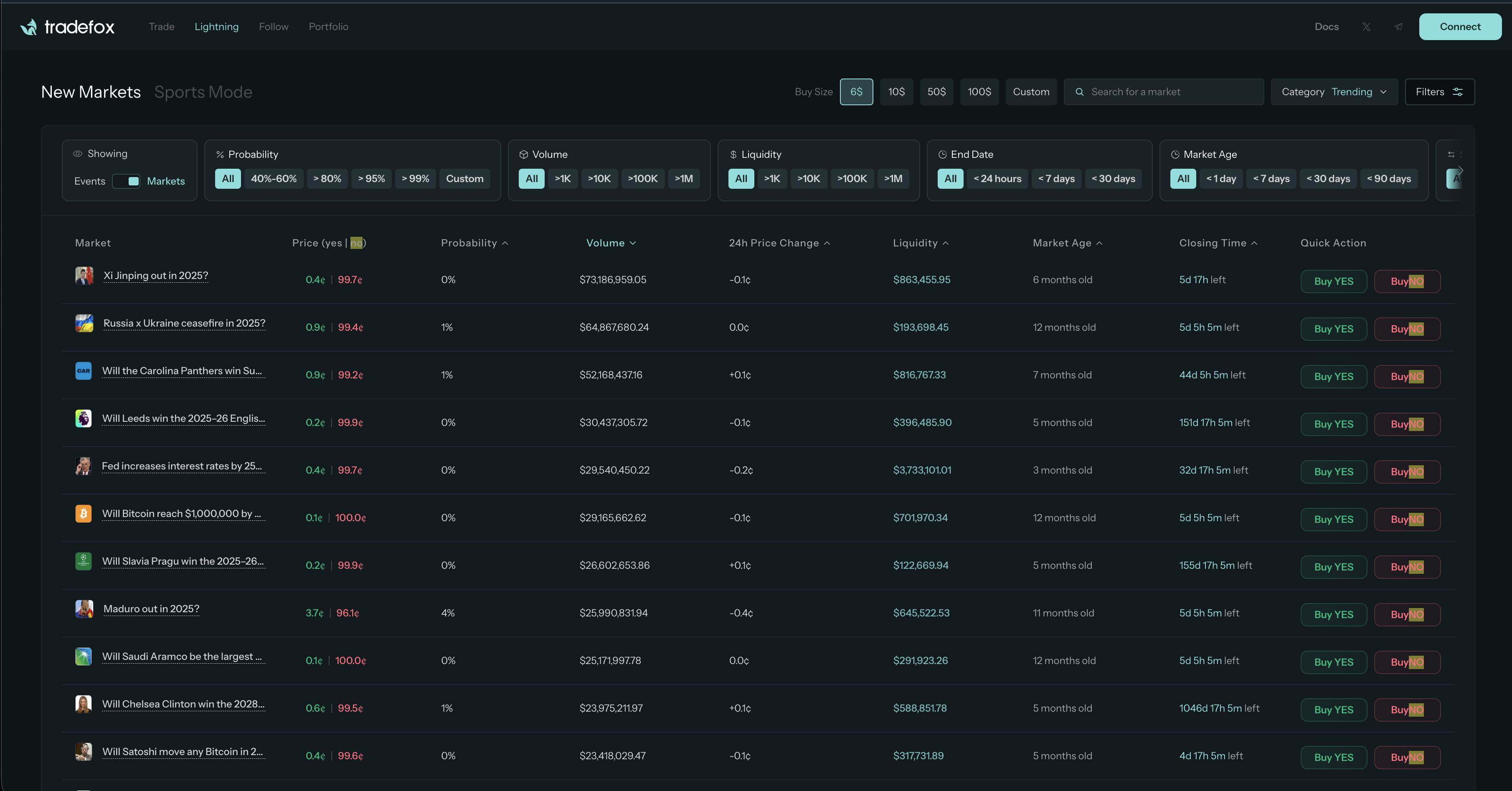
Tradefox can be seen as an "advanced aggregation terminal" or "professional辅助 tool" in the prediction market field. Although Polymarket receives much attention, for high-frequency traders, its native experience suffers from less-than-ideal smoothness and单一 functionality. After receiving investment from top institutions like CMT Digital and Alliance, Tradefox aims to solve these pain points. Its core idea is not to build a new trading platform but, like a universal adapter, to integrate Polymarket, Kalshi, and even the sports betting platform SxBet together, allowing users to participate in popular market trades across the entire network on a single page. (Currently, only the Polymarket market is integrated;接入 of other markets is still pending.)
For ordinary users, Tradefox offers significant advantages: low barrier to entry and strong tooling. In terms of lowering the usage threshold, it leverages technology from Stripe's Privy to enable convenient operations without real-name verification. Users don't need to handle complex cross-chain processes; they can directly deposit their BTC or SOL, and the system will automatically convert it into usable funds. In terms of trading tools, Tradefox prepares two major "利器" for users: first, a "copy trading function" for users who prefer simple operations, where, after setting risk control safety lines, the function can automatically replicate every move of large players; second, a "lightning buy" function for high-end traders, used to buy in with one click the moment breaking news erupts. Importantly, when trading on this platform, users can not only retain the original airdrop rewards from Polymarket but also accumulate Tradefox points (not yet launched),可谓 "using better tools to obtain double rewards"—highly recommended.
Converge
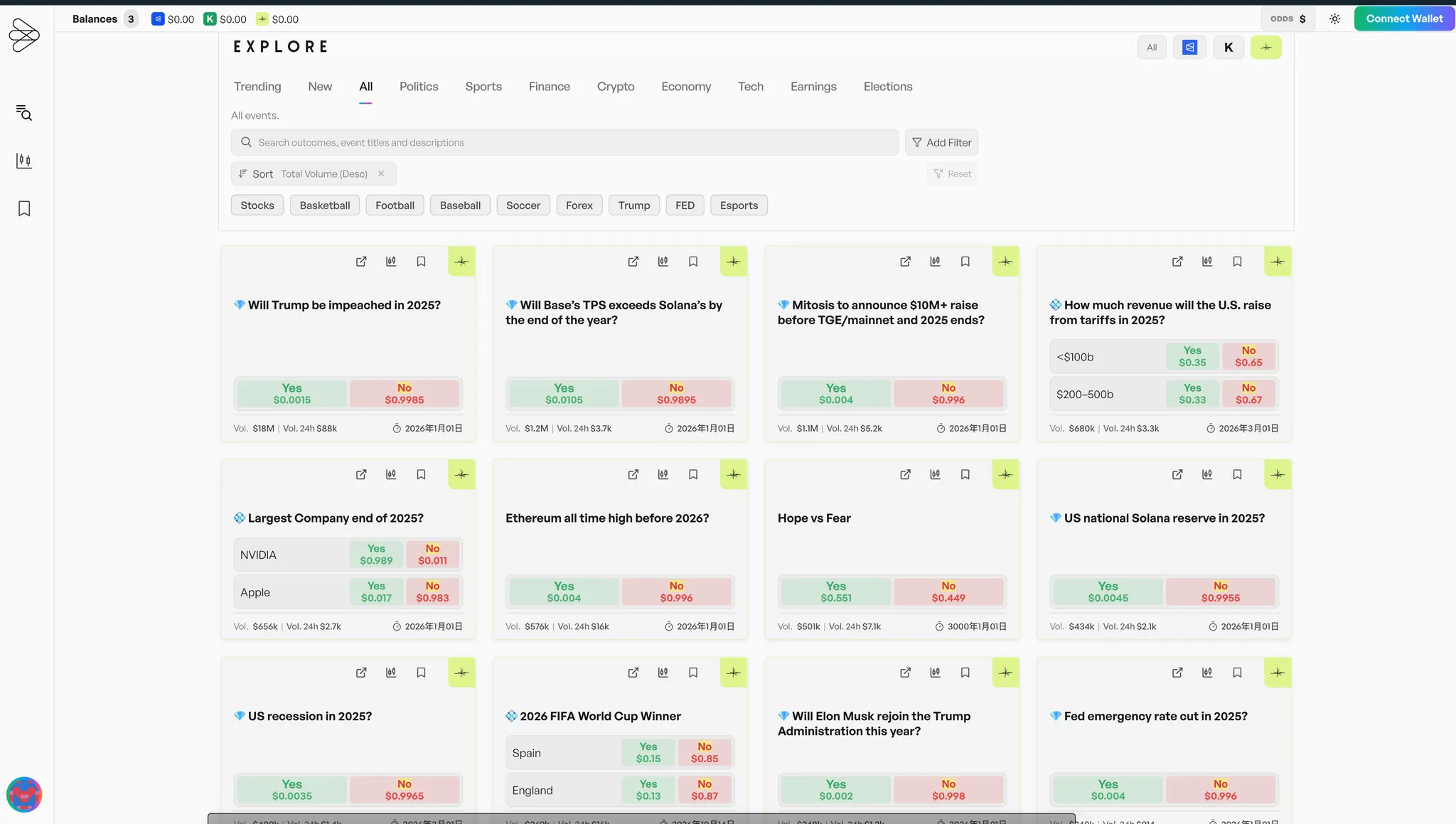
Converge is an aggregator and trading terminal for prediction markets and betting platforms. It compares real-time odds across different platforms, supports free trading, and provides professional tools like filters, charts, position tracking, and arbitrage insights. (The tool is currently in internal testing, and obtaining a whitelist is relatively easy.)
Compared to Tradefox's rich variety of tools, Converge focuses more on information aggregation. For example, users can add a specific market to a watchlist for quick access. During trading, users can use the order book ladder and recent trade data to assess liquidity and slippage, and can pre-set slippage before trading to reduce potential losses.
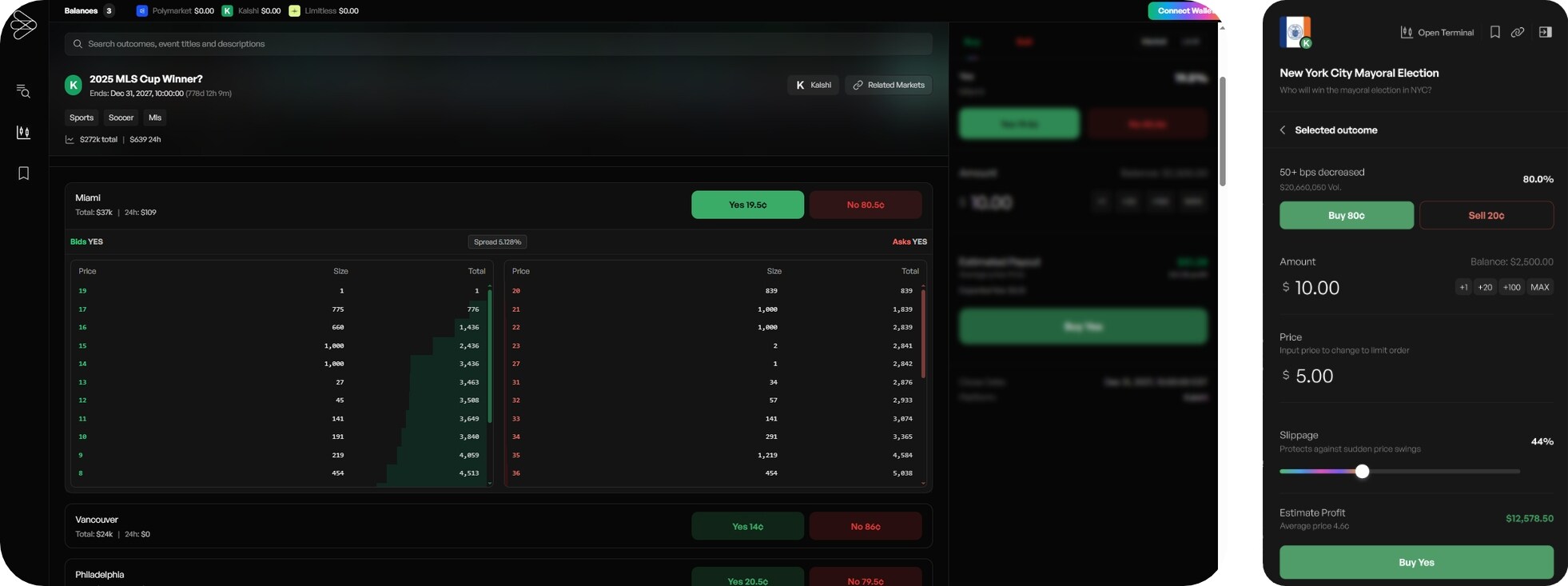
Currently, the platform has integrated three mainstream trading platforms: Polymarket, Kalshi, and Limitless. Notably, Converge does not have a unified funding account but instead configures separate wallets for the three platforms and conducts bridged transactions directly with the corresponding platforms, making the trading experience close to operating on the original platform. User funds do not pass through the Converge platform itself but are traded directly on the corresponding platforms.
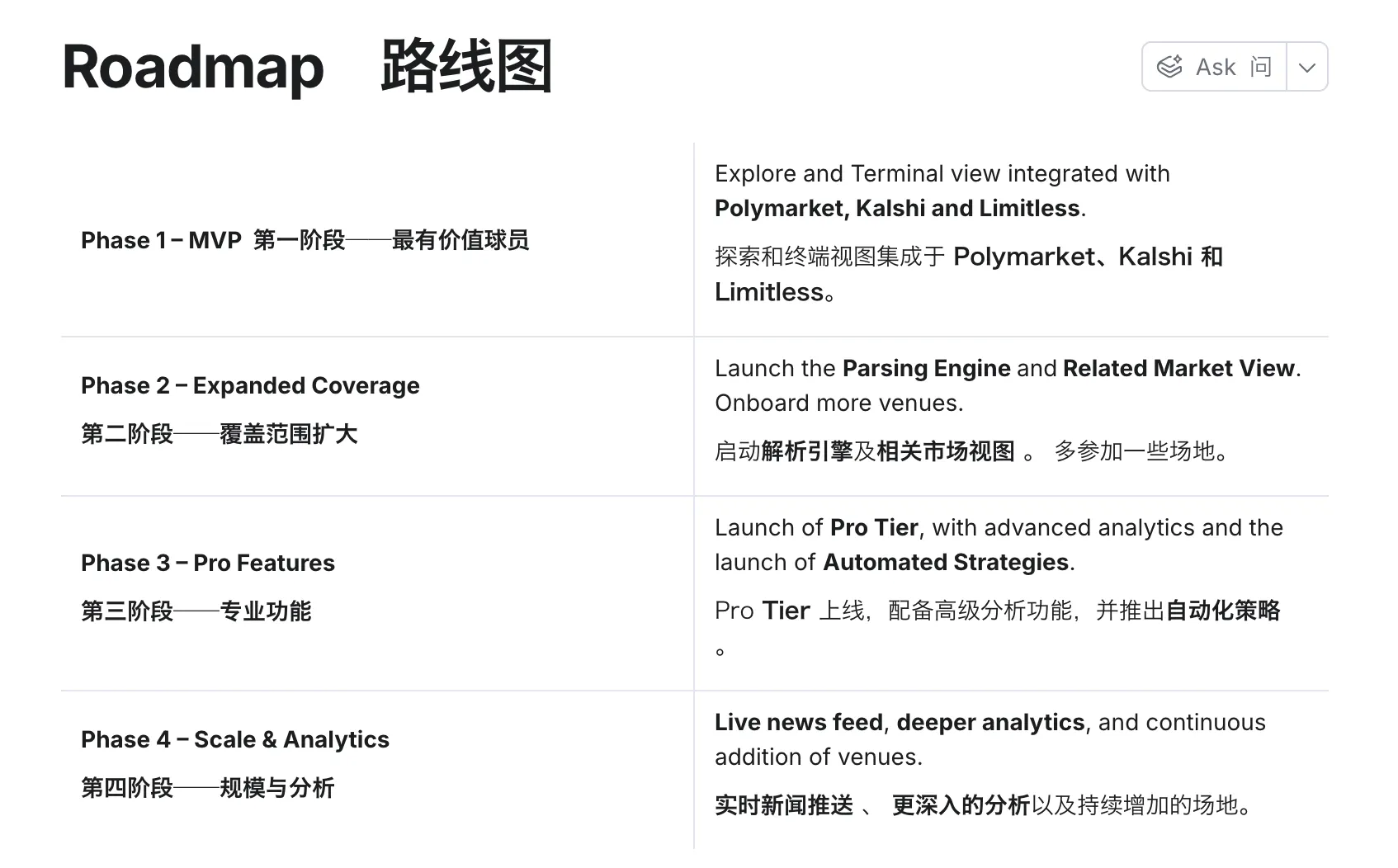
Roadmap (Judging from the roadmap, the product is currently in the MVP stage):
Predictefy (Not the TG Bot)
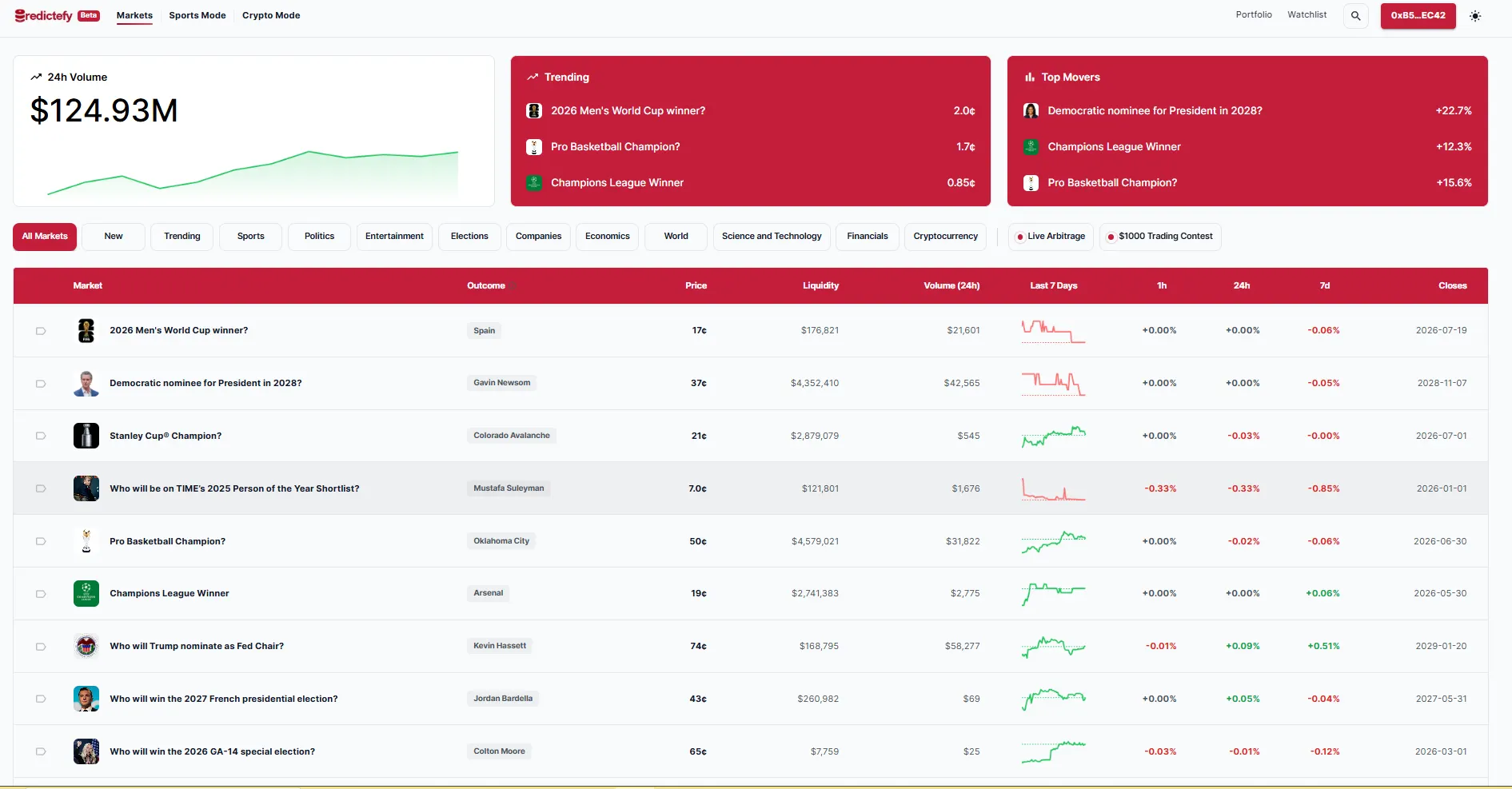
There is a prediction market tool with the same name on the market (a TG Bot), but the Predictefy introduced here is not a bot but a trading terminal. According to the limited information currently disclosed by the official, this terminal is already in the internal testing stage, with some whitelisted internal test users正在 using it. It currently has functions to find value, compare odds, discover mispricing, and reveal arbitrage opportunities, all for one purpose: to汇聚 all prediction markets on one platform, providing actionable data and analysis.
Predictefy is committed to building a comprehensive platform similar to a "Bloomberg prediction market terminal," integrating market intelligence, arbitrage tools, and trading competitions, aiming to provide prediction market traders with richer information than普通 frontends.
Upon entering the main interface, users are greeted with a highly visual intelligence center. Switching between "Sports" and "Crypto" modes can meet the needs of players in different fields. A specially set red board is very eye-catching, pushing real-time "全网热门" (trending across the network) and "最大涨幅" (biggest gainers) lists. The upper right corner of the interface features a trading topic leaderboard,方便 users quickly locate markets with active capital. When selecting trading标的, Predictefy's data presentation is extremely细腻: the list page directly displays liquidity depth, 24-hour trading volume, and微观 price charts for the past 7 days, allowing traders to quickly scan and judge market trends without clicking into them.

Predictefy's core competitiveness is reflected in the deep aggregation capability of the single-asset detail page. It整合 the price trends of prediction markets (currently only Polymarket and Kalshi are integrated) on the same K-line chart. Through comparison, price divergences can be intuitively discovered, and the system automatically calculates an "advantage" ratio, clearly提示 arbitrage opportunities. To assist users in making better decisions, the platform has set up a dashboard-style "prediction rating," providing buy/sell suggestions and equipped with a "quick buy" button. Users can smoothly complete the entire process from discovering price differences, analyzing, to快速下单 on this page.
The platform is currently accepting whitelist applications and is worth trying.
Synthesis
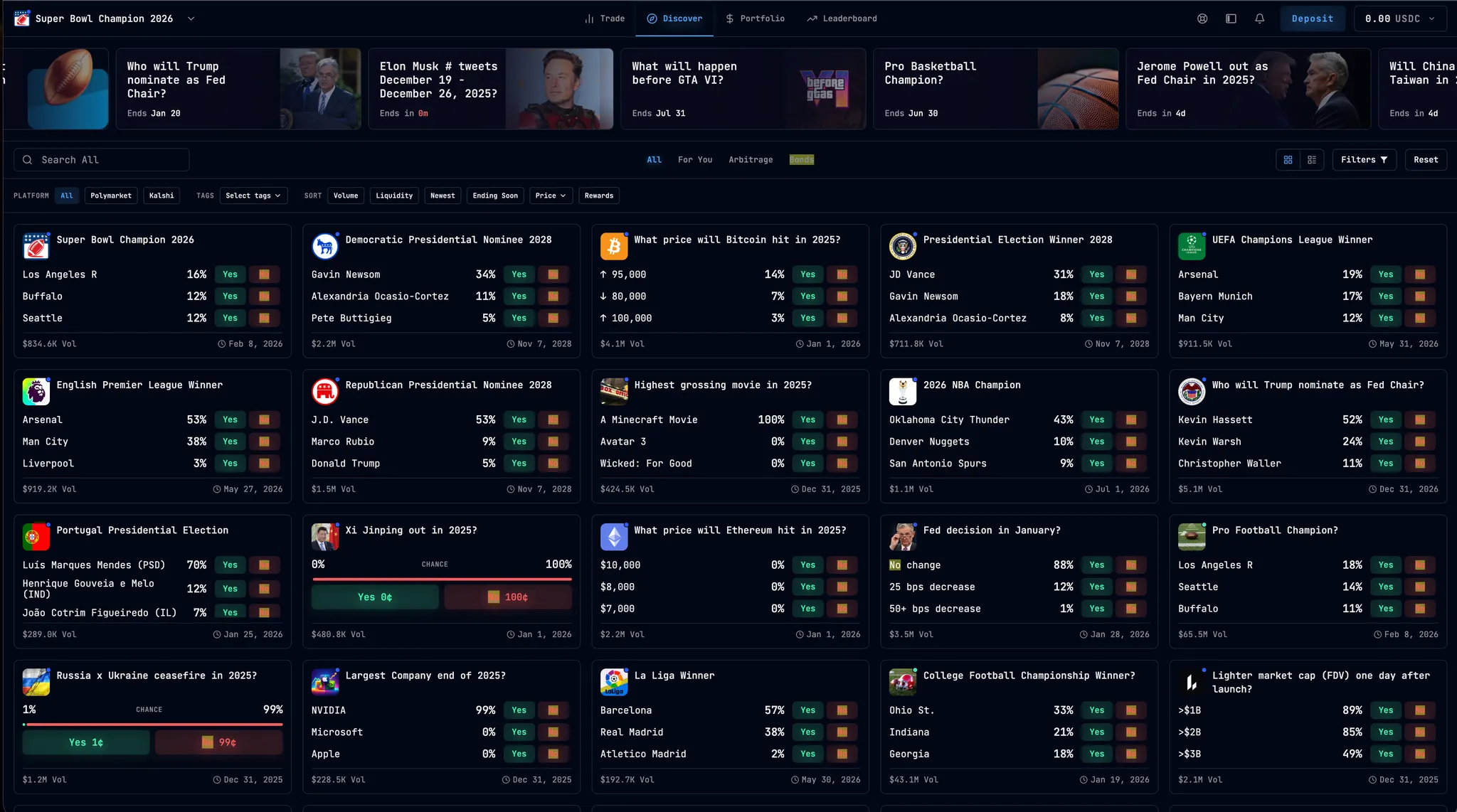
This aggregator can be called the most comprehensive terminal product in the current prediction market赛道. It not only integrates multi-dimensional market screening, whale movement monitoring, and customizable top trader panels on the front end, but its core competitiveness lies in building a set of unified self-custody fund account system.
As is well known, Polymarket, Kalshi, or other mainstream prediction markets are often deployed on different blockchain networks (such as Polygon, Solana, etc.), leading to different standards and circulation paths for USDC. To solve this pain point of fragmented liquidity, the team cleverly introduced the dflow protocol as the underlying "bridge": when users operate in the unified account, the protocol automatically seamlessly converts the user's USDC into the required on-chain fund form for the corresponding target market in the background, thus achieving true "single account buying across the entire network." Meanwhile, Synthesis supports depositing USDC, USDC.E, USDT, and ETH on Polygon, BSC, Ethereum, Solana, Tron, Optimism, Arbitrum, and Base chains.
On this solid technical foundation, the tool has deeply optimized the trading experience. Especially for professional traders, it supports limit order functions often unavailable on native frontends, effectively avoiding high slippage wear and tear when large funds enter or exit positions; the built-in arbitrage monitoring system can capture pricing deviations across markets in real-time,直观展示 potential profits. In exchanges with the official team, we also learned that top prediction markets are highly open to this kind of aggregated liquidity, more markets are being integrated, and this entire suite of aggregated services covering professional trading, copy trading systems, and dflow fund bridging is currently completely free, making it an excellent window for users to seize early红利.
Verso Trading
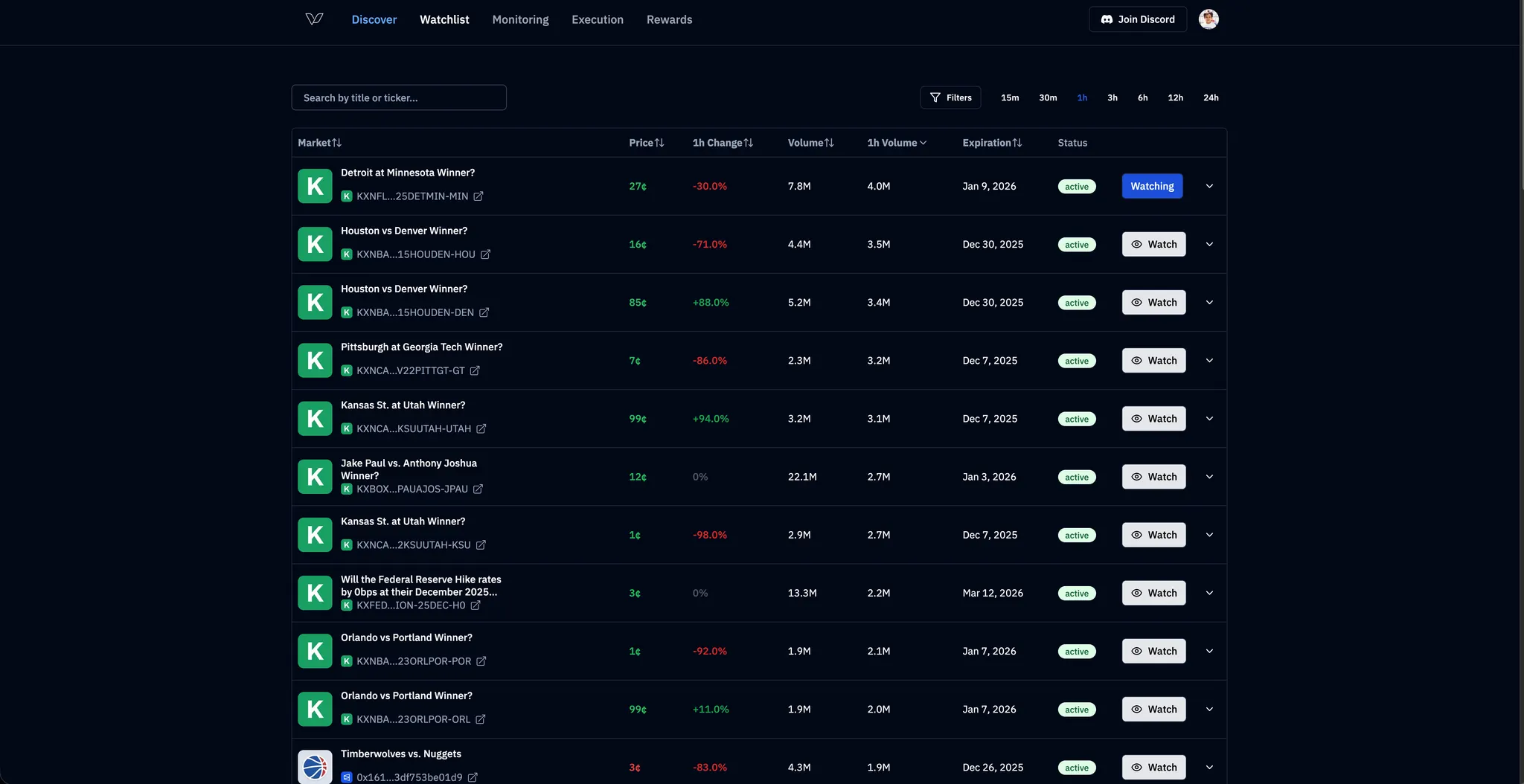
In the current landscape where everyone is competing to pile on features, Verso Trading, developed by the 16-year-old engineer @agpkeleta, appears quite "Buddhist."
It does not pile on complex functions but focuses on the data panel, aggregating all markets on Kalshi and Polymarket, and on this basis, adds filter functions. It allows for free selection of topics within corresponding odds ranges, can target topic categories, and can also perform more detailed screening based on various dimensions such as price fluctuations of any option within a topic for certain time periods (selectable 15min, 30min, 1h, 3h, etc.), topic market capitalization, changes in topic market cap幅度, market creation time, market closing time, and current market activity status (active, finalizing, closed, etc.), to precisely locate the领域 you want or are more擅长 in.
Not only that, you can also add topics to your watchlist for easy finding next time. The above are the existing functions of Verso Trading. Combined with the prompt information on the official website, more functions such as monitoring, execution, and reward mechanisms are likely to be updated next.
Currently, the basic functions of Verso Trading are free, but there is also an entry for a paid version (located in the account management section). Although the details of the paid functions have not been fully disclosed, for players who like minimalist style and are good at data mining, its free version is already sufficiently useful.
Rocket

To be precise, Rocket, which recently successfully completed a $1.5 million Pre-seed funding round, is an innovative prediction market aggregator. Unlike all the trading models above, it does not rely on order books or AMM market makers but is built on three core concepts (the product is not yet launched, the following is based on official预设功能):
- Based on prediction market outcomes: Redefining propositions, eliminating the impact of slippage, making trading results more purely based on market predictions.
- Round结算 every 5 seconds: Through this high-frequency settlement method, it effectively reduces jump losses, making trading risks more controllable.
- Unified margin account: Allows users to use the same account funds across multiple predictions, greatly improving capital utilization and operational convenience.
In an environment without庄家 intervention, winners can continuously profit from the pool of funds gathered by erroneous views. Rocket is essentially a redistribution market, specifically designed for real-time prediction of various price dynamics. It tangibly solves some long-standing难题 in traditional prediction markets and Meme coin markets.
Traditional prediction markets often have users bet on a fixed future moment, like "Will X happen in six months?" This approach completely ignores the market changes during those six months. The market is complex and ever-changing;只盯着 the final outcome is like只看 the finish line without watching the process,很容易 missing a lot of important information. As for the Meme coin market, although it attracts many investors through attention-grabbing, it also ends up holding many垃圾币 that can't be sold. Investors in this market have to face various uncontrollable risks, like project cancellations, supply changes, developers abandoning the project, etc. Moreover, time costs and the垃圾币 problem have always plagued investors, like two甩不掉的 burdens.
Rocket creatively吸取 advantages from different markets. It separates signal and risk, carefully analyzing each prediction based on outcome-related index prices of tokens or stocks, successfully eliminating waiting costs and inventory speculation issues. Specifically, it obtains fair pricing of reality from prediction markets, like finding a fair value scale; learns the quick-reaction characteristics of the Meme coin market, able to respond rapidly to market changes; and also introduces the连贯, non-expiring, non-fragmented特性 of perpetual contracts, making trading more stable and continuous.
On the Rocket platform, the trading range is particularly wide. Whether it's sports odds, stock prices, cryptocurrency exchange rates, prediction market probabilities, or social platform metrics—as long as there is a price, it can become a trading market to buy and sell its trends. The way users invest is also quite interesting: not placing large bets all at once, but automatically dividing them into continuous 5-second small rounds. For example, if you invest $100 for 1 hour, you are actually participating in 720 rounds of 5-second小额投注. Doing this has many benefits: it avoids losing everything at once, allows learning to judge market trends gradually through numerous small transactions, and with结算 every 5 seconds, you don't have to wait long, resulting in a better investment experience.
Rocket also has a very practical goal: to establish a unified margin account. This way, multiple investment projects of a user can share one margin. When the market fluctuates, profits and losses between different projects can offset each other, allowing users to express complex investment ideas in many markets simultaneously without adding additional funds.
But the product has not yet officially launched, so we need to wait patiently for a while to experience it,憾也.
Conclusion: New Species Flattening Arbitrage
Reviewing the above six products, it is not difficult to find that the emergence of prediction market aggregators is upgrading the originally分散, primitive "betting" experience into a professional, efficient "trading" experience.
But as considered at the beginning, the current aggregator赛道似乎 still has regrets: the普遍缺失 of native high-leverage functionality, and the deep integration of all long-tail prediction protocols across the entire network has not yet been fully achieved. The reasons behind this include the objective reality of underlying liquidity fragmentation and the棘手难题 of compliance and risk control. (Regarding the leverage难题, recommended reading Azuma's in-depth compiled article:"After Researching How to Add Leverage to Prediction Markets, I Found This Problem Almost Unsolvable")
However, this "imperfection"恰恰 reflects that the prediction market is in a critical window of transition from "gamblingization" to "financialization." Whether it is TradeFox's attempt to build a "prime broker" narrative, synthesis.trade's dedication to solving cross-chain fund unification, or Rocket's underlying重构 of the game mechanism, what we see is not just the piling up of tools but the self-evolution of infrastructure.
At the end of writing this article, I had an interesting discussion with Teacher Fangzhou, who raised a soul-searching question: "For ordinary traders, are aggregators really a rigid demand? We don't need to compare prices across the entire network when buying BTC on Binance, so why do prediction markets need it?" The answer to this question恰恰 reveals the underlying logic of the existence of prediction market aggregators and defines their industry role as "new species flattening arbitrage".
Current prediction markets have an essential阶段性差异 from mature crypto asset markets (like BTC). Bitcoin's liquidity has long been globally贯通, and the market is extremely efficient; whereas prediction markets are still in an "era of群雄割据"—isolated islands—with Polymarket confined to the chain, Kalshi walled within compliance, and Limitless tucked away on Base. Facing the same event (like election odds), there are often huge price differences and liquidity断层 between different platforms. In such a non-standard and fragmented market environment, aggregators play an indispensable "dual identity":
- For arbitrageurs, it is a "shovel": Tools like Predictefy and Converge, through visual spread monitoring, allow arbitrageurs to quickly discover and flatten pricing deviations between different markets like hunters. It is these arbitrage behaviors that objectively help the entire prediction market complete price discovery and liquidity bridging.
- For ordinary users, it is a "ladder over the wall": Terminals like TradeFox and synthesis.trade, through underlying cross-chain protocols and seamless account systems, help novice users抹平 the headache-inducing technical thresholds and compliance barriers.
Therefore, prediction market aggregators are not simple "information yellow pages"; they are the bridges connecting these liquidity isolated islands and the accelerators促使 the industry from "rough arbitrage" to "efficient pricing".
Future prediction market aggregators are highly likely to evolve into entities similar to 1inch or Blur in the DeFi field. They will no longer be just price comparison boards but the ultimate入口 for liquidity. When leverage, lending, portfolio management, and risk control are集成大成 on these terminals, prediction markets might才算 truly complete their transformation from "after-dinner conversation topics" to "global information pricing centers".
For traders in the midst of this wave, mastering these tools proficiently might be the first step to outperforming the majority in this emerging market.