OpenAI's "Most Open" Move: Codex No Longer Exclusively Favors GPT

marsbitОпубліковано о 2026-06-22Востаннє оновлено о 2026-06-22

Анотація

OpenAI has significantly opened up its Codex programming agent by introducing a "model provider" configuration layer that allows users to connect it with various open-source models, not just its proprietary GPT. Through a configuration file or a simple `--oss` command-line flag, Codex can now route requests to local services like Ollama or LM Studio, or to third-party APIs such as Mistral or DeepSeek. This move is seen as one of OpenAI's most "open" steps, potentially lowering costs and enhancing privacy for developers who can run code generation offline. However, integration isn't seamless for all models. Codex primarily uses OpenAI's newer Responses API, while many open-source models rely on the older Chat Completions interface. This creates compatibility issues, especially for advanced features like function calling. The developer community is already building "routing" or adapter layers (e.g., CC Switch, LiteLLM) to translate between these protocols, enabling hybrid setups where GPT handles planning and open-source models handle execution. Analysts interpret this as a strategic shift for OpenAI: from competing solely on model superiority to controlling the platform and interface standards. By making Codex a flexible, pluggable entry point for AI-assisted programming, OpenAI aims to become the central hub in the developer toolchain ecosystem, even as users gain the freedom to switch underlying models.

Some cheered, calling this OpenAI's "most open" move. By equipping Codex with a plug socket for freely swappable models, they essentially filled the moat protecting their own models. What's their motive?

Overnight, OpenAI's coding agent Codex stopped recognizing only its own GPT models and opened up to all open-source models.

The developer community was the first to notice this signal.

A developer discovered a strange "open-source mode" (OSS mode) in Codex's command-line interface (CLI) and software development kit (SDK) configuration, officially referred to as "local providers."
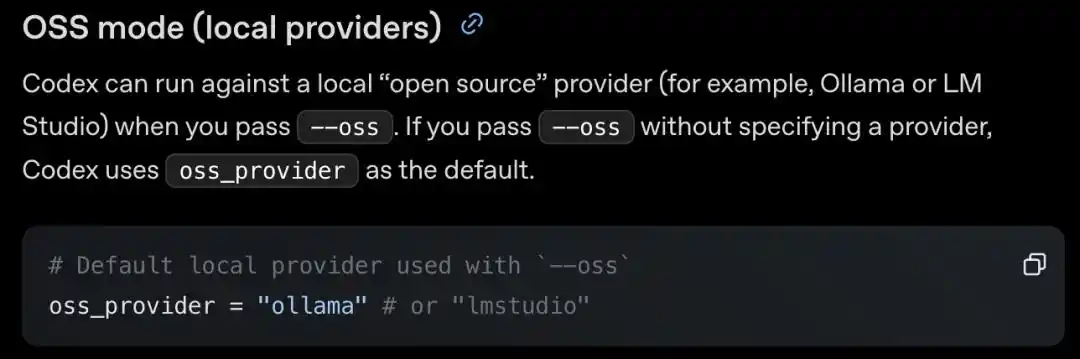
By adding a --oss flag in the command line, it can run open-source models locally; to connect to others, just change one field.

In the past, OpenAI was almost synonymous with "closed source," with Codex exclusively recognizing OpenAI's own GPT.

But now it's different. With just a single line of configuration, you can switch to local model services like Ollama and LM Studio.

This news quickly exploded within developer circles.

Tibo, the lead of the OpenAI Codex team, personally reminded everyone on X:

Codex's App, CLI, and SDK can be used with any open-source model, not just OpenAI's own.
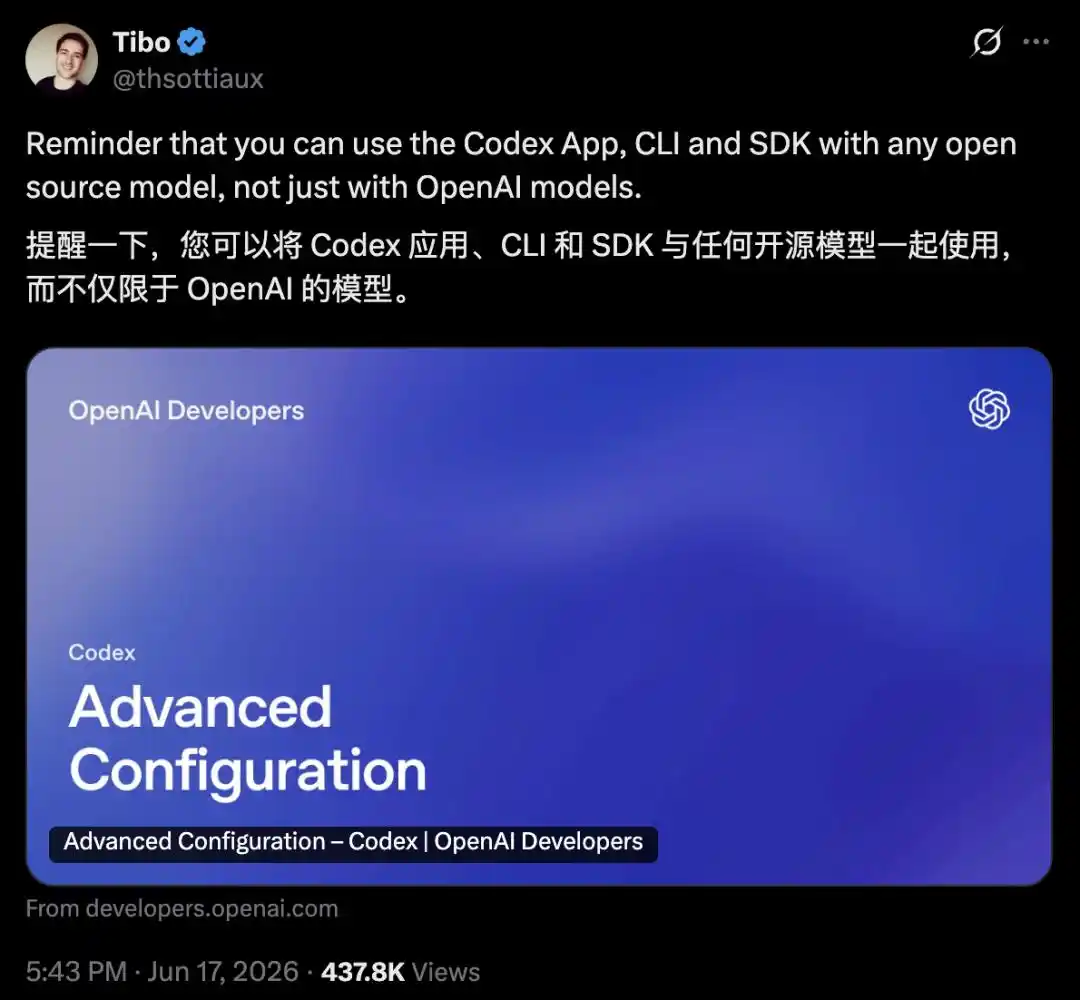
This reminder was quickly retweeted by Thomas Wolf, co-founder of Hugging Face, who added: "Just learned today that Codex can actually use open-source models now."

Some netizens exclaimed that this might be the most "open" move ever by OpenAI, a remarkable event.
The community moved even faster.

As soon as the official documentation was released, developers immediately tried integrating some open-source models and casually discussed more token-efficient hybrid solutions.

But some hit a wall quickly.

Developer Filip Baturan wanted to set up a hybrid solution in Codex: let GPT handle planning and let an open-source model act as the executor.

After testing, he found that Codex requires connected models to also use the same tool calling protocol, which open-source models might not have.
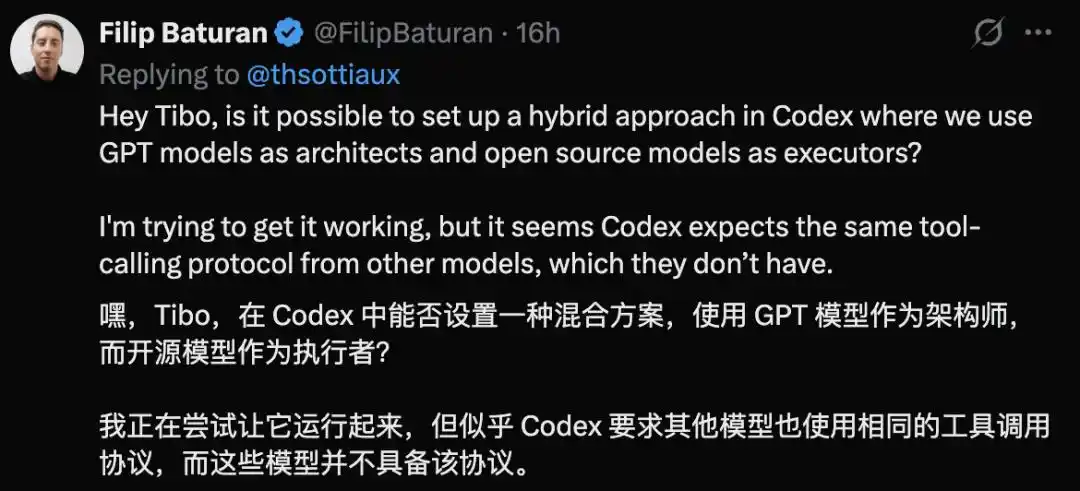
On one side, cheers for the "most open ever" move; on the other, protocol incompatibility preventing integration.

How far has OpenAI truly opened up this time?

How Are Open-Source Models Integrated into Codex?

OpenAI's opening of Codex this time is essentially not about opening the model itself but about opening the "model integration layer."

In other words, it hasn't opened the GPT model but has added a "pluggable model interface layer" to Codex.

This capability is accomplished through a configuration called "model_providers."

Developers can register multiple "model providers" in the configuration file, each containing four types of information:

Access address (base_url), communication protocol (wire_api), authentication method (env_key), and model mapping (model).

When Codex starts, it selects the corresponding model provider based on the configuration, routing requests to different model services, including OpenAI's own models, local Ollama models, or third-party APIs like DeepSeek.
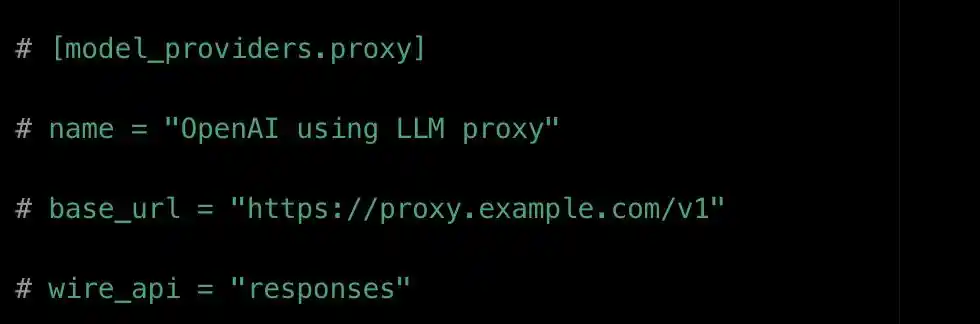
Example of Codex's model_providers configuration. base_url is the model address, and the protocol field wire_api only recognizes one value: 'responses'.

Mistral, company self-built proxies, third-party gateways—all can be integrated into Codex this way.

A netizen summarized the highlights of this capability as: "Not locked to one vendor, switchable on demand, with privacy and costs under your own control."

More conveniently, you can save all these settings as "configuration profiles." When debugging, just click its name in the command line to switch.

Compared to manual configuration above, there's an even more direct switch: --oss. Adding this parameter makes Codex directly connect to local open-source model services.

By default, there are two: Ollama and LM Studio. The former is the most popular tool for running large models locally, and the latter is a desktop alternative with a graphical interface.
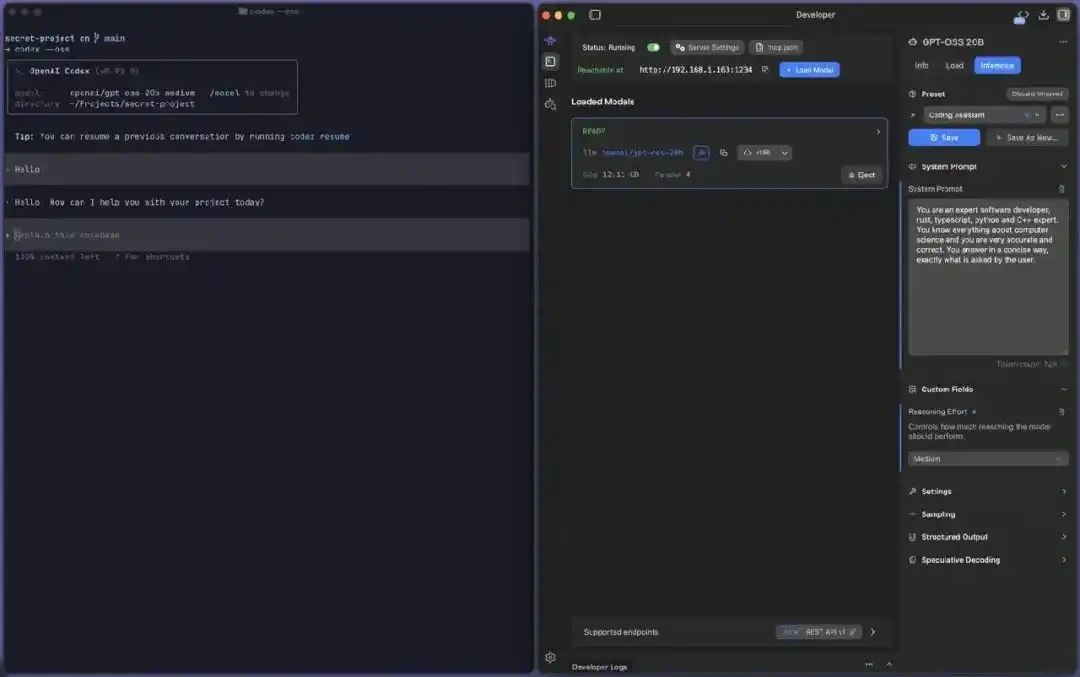
Practical screenshot of Codex --oss connecting to local models: On the left, Codex CLI (v0.92.0) uses --oss to call a local model. On the right, LM Studio loads openai/gpt-oss-20b (12.11GB) on the local machine's port 1234 to provide services. The entire process is offline and local.

This means that through local model services and network permission configuration, you can have Codex perform code generation and inference on your machine, achieving a degree of offline operation and local processing.
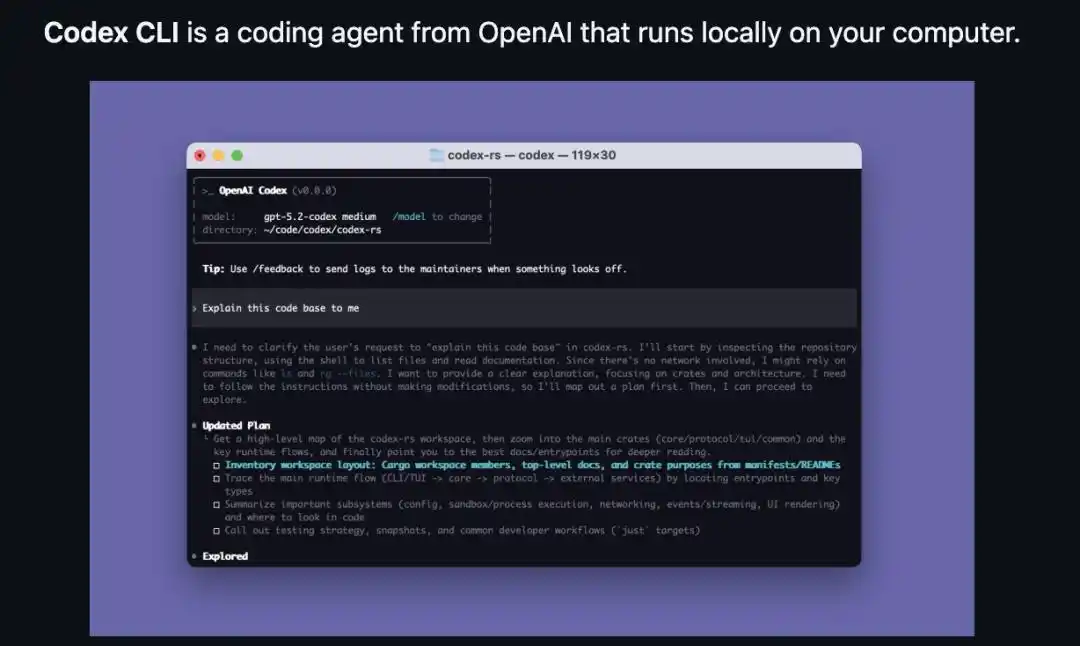
Codex CLI interface: The startup information shows the current model (gpt-5.2-codex) in the 'model' line, followed by "/model to change." A single command can switch models, with the entire agent running locally on the machine.

However, just because a socket is installed doesn't mean any appliance plugged in will work.

Integrated models typically need to be compatible with the Chat Completions interface format. As for whether more complex capabilities like function calling can fully work, OpenAI hasn't guaranteed it—you'll have to test them one by one.

It's precisely because protocols often don't align perfectly that the community has to write their own routing tools for translation in the middle. These are solutions currently explored by the community, not yet endorsed by OpenAI.

When GPT and Open-Source Models Mix

Working Together in Codex

While OpenAI just opened a crack, the community is already having a blast.

The reason is simple: Codex is good, but using OpenAI's models with token-based billing is too expensive.

Thus, many developers have turned their attention to open-source models.

DeepSeek is one of the most familiar open-source models for many Chinese developers. A natural question is: Can Codex directly use DeepSeek?

The answer from CC Switch is: Yes, but not directly; it needs an extra layer of "gateway."
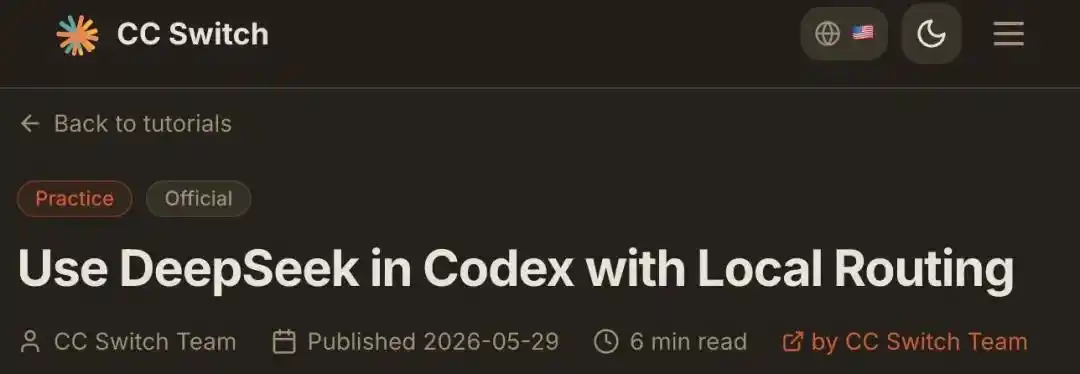
CC Switch community tutorial: "Running DeepSeek with Local Routing in Codex"

Their community tutorial "Running DeepSeek with Local Routing in Codex" points out that the reason is the new version of Codex is mainly based on OpenAI's Responses API, while DeepSeek and most open-source model interfaces are still based on Chat Completions.

The two interface sets are not entirely consistent in request structure, streaming output methods, and function calling mechanisms.

So directly entering DeepSeek's address into Codex doesn't work smoothly. Common situations include mismatched request parameters or unparseable return results, leading to call failures or abnormal outputs, not just simple "connection failure."

The community's solution is to add a local "routing layer" or "protocol converter" in the middle.

The basic process is as follows:

1. Codex sends requests according to the Responses API;

2. The routing layer converts it to Chat Completions format;

3. Forwards it to open-source models like DeepSeek;

4. Converts the returned results back to the Responses format recognizable by Codex.

Similar capabilities aren't offered only by CC Switch.

LiteLLM, claude-code-router, and various proxy services built by developers essentially solve the same problem: enabling interaction between different models through a unified interface standard.

OpenAI opened a crack this time, but true implementation still requires the community to "add bricks and tiles."

Behind all this is a hybrid routing approach.

For example, let GPT handle planning: decomposing tasks, designing architecture, figuring out what needs to be done. Let open-source models handle execution: turning solutions into runnable code, batch editing files.

Through such mixing, for the same task, costs might be slashed by more than half.

Besides being more cost-effective, pairing Codex with local open-source models means not a single line of code leaves your own computer.

For individual developers who don't want to upload private projects to the cloud or keep paying API fees, this temptation is no small matter.

The Model War is Over

The Interface War Has Begun

For the past few years, everyone thought the moat was the model. Whoever had the largest model parameters, highest benchmark scores, and smartest answers would win.

But this time, OpenAI made Codex into a pluggable interface layer, and the value it provides is shifting towards an ecosystem gateway.

OpenAI's plan is likely to pivot from being a model-selling vendor to becoming a platform and framework player: you can swap models as you like, but the tools must be mine.

Whoever occupies the entry point developers open every day holds the distribution and sits at the core of the ecosystem.

This isn't the first time OpenAI has made moves in the open-source ecosystem.

Although it hadn't released open-weight large language models for a long time since GPT-2 in 2019, under the rapid development of the open-source ecosystem (models like Llama, DeepSeek), it re-launched the gpt-oss series of open-weight models in August 2025.
These models were quickly integrated and supported by community toolchains (like Ollama, LM Studio), precisely what Codex --oss now connects to by default.

At the configuration layer, OpenAI indeed opened the model integration capability, allowing third-party models to connect through the model provider abstraction layer. However, not any model can be used directly; it must comply with their interface protocol or be converted through an adaptation layer.

At the protocol layer, it retains a key constraint: using the Responses API as the main interaction standard while allowing support for other model interfaces like Chat Completions through compatibility layers.

In other words, regardless of which model is integrated, it must align with the request and response structure defined by OpenAI. Its ultimate goal is to keep the interface standard in its own hands.

From this perspective, this previously easily overlooked interface protocol is becoming a new competitive focus.

Perhaps, this time OpenAI wants to use an inconspicuous configuration switch to start an entry-point war for AI programming, making its next phase of competition with Anthropic not about models.

For developers who open Codex every day, this is real convenience: able to run open-source models, save on tokens, and work locally offline.

But the more smoothly you use it, the deeper you delve, the harder it becomes to leave this gateway.

References:

https://x.com/thsottiaux/status/2067181377028538431

https://developers.openai.com/codex/config-advanced#oss-mode-local-providers

https://www.ccswitch.io/en/tutorials/codex-deepseek-routing-guide

This article is from the WeChat public account "New Zhiyuan," author: ASI Apocalypse, editor: Yuanyu

Трендові криптовалюти

Пов'язані питання

QWhat is the major change OpenAI has made to its Codex agent regarding model usage?

AOpenAI has opened up its Codex agent to work with open-source models, not just its own GPT models. This is done through a configurable 'model providers' layer and a new 'OSS mode' (or local providers) that allows developers to switch the underlying model powering Codex, such as to local models served by Ollama or LM Studio.

QWhat are the two primary methods mentioned for configuring Codex to use non-OpenAI models?

A1. Using the `--oss` flag in the CLI, which automatically connects Codex to default local model services like Ollama and LM Studio. 2. Manually configuring a 'model_providers' section in the settings file, where developers can specify the base URL, protocol, authentication, and model mapping for their chosen model provider (e.g., Mistral, DeepSeek, or custom endpoints).

QWhat is a key technical challenge developers face when trying to integrate models like DeepSeek into Codex, and what is the common community solution?

AA key challenge is protocol incompatibility. Newer Codex versions primarily use OpenAI's 'Responses API' format, while most open-source models (like DeepSeek) use the 'Chat Completions' API. The common community solution is to add a local routing or protocol conversion layer (e.g., using tools like CC Switch or LiteLLM) that translates requests and responses between the two formats.

QAccording to the article, what strategic shift might OpenAI be attempting with this move, moving beyond just selling models?

AThe article suggests OpenAI is shifting from being primarily a model vendor to becoming a platform and framework provider. By making Codex's interface 'pluggable', OpenAI aims to make its tool the essential daily entry point for developers. Even if developers use different models, they do so through Codex, allowing OpenAI to control the interface standard and become the central hub of the development ecosystem.

QWhat are two main practical benefits for developers in using open-source models with Codex, as highlighted in the article?

A1. **Cost Reduction:** Using local or cheaper open-source models can significantly lower costs compared to paying per token for OpenAI's API. 2. **Privacy & Offline Capability:** Running models locally means code generation and reasoning can happen entirely on the developer's machine, keeping proprietary code private and enabling a degree of offline operation.

Пов'язані матеріали

Beyond the Model Lies the Harness: Deepseek Enters the Arena, Why Has the Main Battlefield of China's AI Competition Shifted?

In mid-to-late May 2026, Deepseek internally established a new Harness team focused on code agent products, internally benchmarked against Anthropic's Claude Code. This move, marked by the formula "Model + Harness = Agent" in their job postings, signals a major shift in China's AI competition: the main battlefield is transitioning from developing large models to building toolchains and achieving workplace integration. Deepseek's direct involvement in Harness development aims to secure control over interface design and training data feedback loops, moving beyond open-sourcing powerful models. Harness, the runtime infrastructure for AI agents, handles everything beyond model reasoning—task orchestration, tool calling, context management, safety checks, and error recovery. It is crucial because agent products are not just outputs of model capability but also training grounds for it. Real-world task failures recorded by Harness can feed back into model training, creating a flywheel effect. Engineering Harness is more critical than optimizing prompts, as poor context management or error handling can drastically reduce agent success rates in multi-step, real-world scenarios. This shift is not isolated. Other major Chinese tech companies are also pursuing differentiated toolchain strategies. Tencent leverages its enterprise ecosystem (WeChat Work, Tencent Cloud) to build connectors for organizational-level AI collaboration and complex task delivery. Alibaba focuses on lowering automation barriers on the web with a front-end, browser-based GUI Agent framework, PageAgent. This diversification shows the industry recognizes that success lies not in a perfect general agent, but in vertically focused solutions built with robust engineering. The trend is validated by overseas success, such as Poland's Viktor, an AI coworker on Slack achieving $20M ARR by autonomously executing complex, multi-step tasks. This proves a shift in enterprise willingness to pay—from "AI-assisted generation" to "AI-autonomous execution." As Harness matures to provide safety guards and reliability, AI transitions from a human-supervised intern to an independent outsourcer. The competition now faces key engineering challenges: preventing "token explosion" through intelligent context compression, and building "thick frameworks" with features like sandbox isolation and checkpoint recovery for enterprise-grade stability. Geopolitical restrictions on tools like Claude Code further create a significant market vacuum for domestic solutions like Deepseek's Harness. For enterprises and developers, the focus must shift from comparing model benchmarks to evaluating a vendor's engineering capabilities, error recovery mechanisms, context management, and ecosystem compatibility when choosing AI products and platforms.

marsbit52 хв тому

Beyond the Model Lies the Harness: Deepseek Enters the Arena, Why Has the Main Battlefield of China's AI Competition Shifted?

marsbit52 хв тому

Soaring Export Data for Memory Chips, Market Is Redefining the Valuation Anchor for Memory Stocks

Korean storage export data for the first 20 days of June shows substantial year-on-year increases in both value and price-per-kilogram for categories like DRAM, NAND, and SSDs. This signals a potential shift beyond simple demand recovery, indicating rising prices and a product mix shift towards higher-value items, possibly influenced by AI infrastructure needs. A key point is that the surge in price-per-kilogram is not simply a uniform chip price hike. It reflects a combination of actual price increases and, more importantly, an export structure increasingly dominated by high-value-density products like HBM (High-Bandwidth Memory) and advanced DRAM, which are critical for AI servers. This suggests AI-driven demand may be spilling over from just HBM into broader memory markets. SK Hynix stands to benefit directly due to its leading HBM position. For Samsung and Micron, the implication is potential for greater margin elasticity if the tightness in high-end memory spreads to enterprise SSD and NAND prices. However, the storage sector remains cyclical. Risks include supply expansion, inventory changes, and potential slowdowns in broader AI capital expenditure. Ultimately, while the strong export data supports upward revisions for storage company earnings and fuels discussion of an "AI infrastructure bottleneck premium," a definitive valuation shift from a cyclical to a structural story depends on upcoming quarterly reports. Investors need confirmation from SK Hynix, Samsung, and Micron that improvements in average selling prices, product mix, and, crucially,毛利率 are sustained over multiple quarters.

marsbit2 год тому

Soaring Export Data for Memory Chips, Market Is Redefining the Valuation Anchor for Memory Stocks

marsbit2 год тому

Торгівля

Спот
Ф'ючерси

Популярні статті

Як купити MOVE

Ласкаво просимо до HTX.com! Ми зробили покупку Movement (MOVE) простою та зручною. Дотримуйтесь нашої покрокової інструкції, щоб розпочати свою криптовалютну подорож.Крок 1: Створіть обліковий запис на HTXВикористовуйте свою електронну пошту або номер телефону, щоб зареєструвати обліковий запис на HTX безплатно. Пройдіть безпроблемну реєстрацію й отримайте доступ до всіх функцій.ЗареєструватисьКрок 2: Перейдіть до розділу Купити крипту і виберіть спосіб оплатиКредитна/дебетова картка: використовуйте вашу картку Visa або Mastercard, щоб миттєво купити Movement (MOVE).Баланс: використовуйте кошти з балансу вашого рахунку HTX для безперешкодної торгівлі.Треті особи: ми додали популярні способи оплати, такі як Google Pay та Apple Pay, щоб підвищити зручність.P2P: Торгуйте безпосередньо з іншими користувачами на HTX.Позабіржова торгівля (OTC): ми пропонуємо індивідуальні послуги та конкурентні обмінні курси для трейдерів.Крок 3: Зберігайте свої Movement (MOVE)Після придбання Movement (MOVE) збережіть його у своєму обліковому записі на HTX. Крім того, ви можете відправити його в інше місце за допомогою блокчейн-переказу або використовувати його для торгівлі іншими криптовалютами.Крок 4: Торгівля Movement (MOVE)Легко торгуйте Movement (MOVE) на спотовому ринку HTX. Просто увійдіть до свого облікового запису, виберіть торгову пару, укладайте угоди та спостерігайте за ними в режимі реального часу. Ми пропонуємо зручний досвід як для початківців, так і для досвідчених трейдерів.

338 переглядів усьогоОпубліковано 2024.12.13Оновлено 2026.06.02

Як купити MOVE

Обговорення

Ласкаво просимо до спільноти HTX. Тут ви можете бути в курсі останніх подій розвитку платформи та отримати доступ до професійної ринкової інформації. Нижче представлені думки користувачів щодо ціни MOVE (MOVE).

活动图片