Having Raised $37 Million with a16z's Backing, Why Did Goldfinch Ultimately Fail?

Foresight NewsОпубліковано о 2026-06-23Востаннє оновлено о 2026-06-23

Анотація

The decentralized credit protocol Goldfinch, which raised $37.7 million in funding led by Andreessen Horowitz (a16z), is officially entering a shutdown process. After six years of operation and issuing approximately $100 million in loans, it faces widespread borrower defaults and frozen depositor funds. Depositors report an estimated actual loss rate of around 70%, with the protocol's governance token GFI having plummeted 99.8% from its all-time high. The current proposal involves winding down operations, halting new development, and establishing a trust to manage loan recovery over an estimated two-plus years. Founded by ex-Coinbase employees, Goldfinch aimed to channel crypto capital into loans for emerging markets via local lenders. However, it suffered significant defaults from major borrowers like Tugende Kenya, Stratos, and Lend East, leading to over $18 million in losses. The failure highlights the core challenge for DeFi-based Real-World Asset (RWA) lending: while blockchain technology improves capital fluidity, it cannot replace the critical offline components of credit underwriting, collateral management, and legal enforcement, especially in high-risk jurisdictions.


Written by: ChandlerZ, Foresight News


The decentralized credit protocol Goldfinch, which secured a total of $37.7 million in funding across two rounds led by Andreessen Horowitz (a16z), has officially entered the shutdown process.


The core development team, Warbler Labs, posted GIP-87 on the governance forum, proposing to "approve the operational maintenance of Goldfinch and the orderly liquidation of Goldfinch Prime," to shut down its product Goldfinch Prime in an orderly manner and transition the protocol into a maintenance mode retaining only collection functions. The Snapshot vote will close on June 23, and as of writing, it has received 100% approval (over 1.1 million GFI votes, far exceeding the 250,000 threshold).


After six years of operation and issuing approximately $100 million in loans, this protocol, which promised to transform emerging market credit with DeFi, ended with widespread borrower defaults and frozen depositor funds.


Depositor's Dilemma: 70% Actual Loss Rate, Token Down 99.8%


On June 19, a depositor named Edward Morra posted on X, stating that among the 8 borrowers in the protocol's loan book, 2 had defaulted and 6 were in restructuring, with funds essentially unrecoverable. This post received over 800 likes and 165 replies.


Morra said his first deposit was in September 2021, followed by two more deposits in 2022. After five years, he still hasn't recovered the full amount (and never will), let alone the promised 10% APY. Since requesting a withdrawal in August 2023, the user has only recovered 30% of the principal, with the best-case scenario being a possible recovery of 10% in the next 1 to 2 years.


He estimates the actual loss rate to be around 70%, far higher than the 20% displayed on the protocol dashboard.
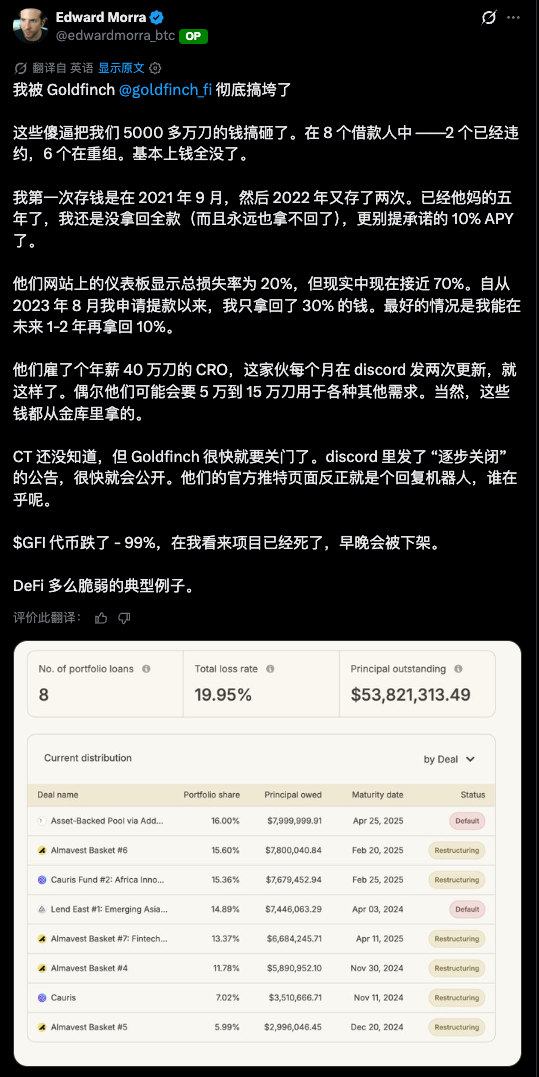


DefiLlama shows that Goldfinch still has $56.15 million in outstanding loaned capital, while the TVL on Ethereum is only $1.63 million, with almost all deposit funds locked in loans and unavailable for withdrawal.


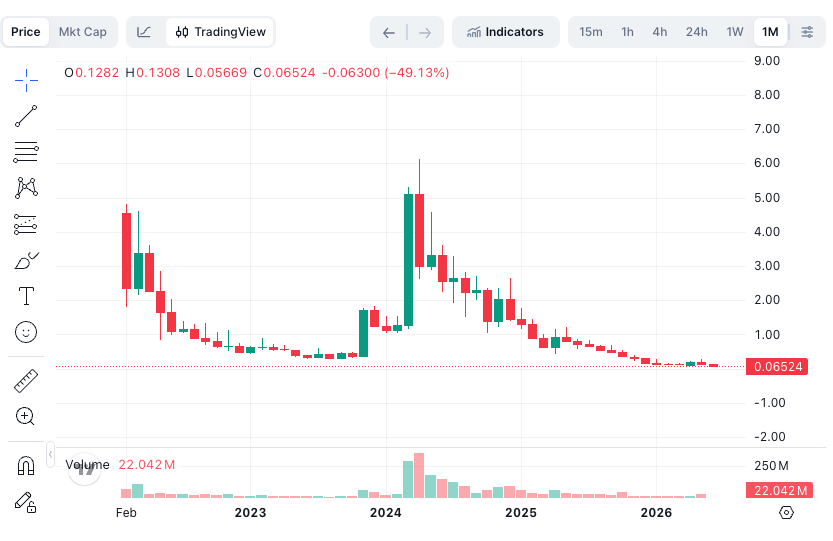
The protocol's governance token, GFI, has also suffered a severe decline. After reaching an all-time high of $32.94 on January 11, 2022, GFI is currently priced at $0.06524, a drop of 99.8%. Its market capitalization has shrunk from over $180 million in April 2024 to $5.7 million.


Shutdown Plan: Establish a Trust, Collection for at Least Two Years


The GIP-87 proposal was jointly signed by Mike Sall and Blake West of Warbler Labs. The core arrangements of the shutdown plan include: Warbler Labs immediately halting all new product development, growth initiatives, and marketing campaigns. The protocol will establish a new US trust entity, with the current Chief Restructuring Officer, Ted Gavin, serving as trustee, dedicated to collecting remaining borrower debts. Warbler Labs receives a $150,000 shutdown service fee ($100,000 from the DAO treasury, $50,000 transferred from existing operational budget). Legacy applications will be retained for at least 6 months after the final borrower repayment, allowing depositors to claim recoveries. The estimated recovery period is over 2 years.


Blake West responded to the community's anger in a Discord post on June 14, stating that the team spent six years from 2020 trying various on-chain private credit solutions but never found sustainable demand. The latest product, Goldfinch Prime, shifted towards tokenizing institutional-grade private credit funds (with partners including Apollo, Ares, KKR, etc., institutions managing over a trillion dollars in assets), launched on three chains, and partnered with Plume and R2 for promotion, but response was lukewarm, with no viable path to recovery within the existing financial runway.


West denied allegations of fraud, emphasizing that Warbler Labs contributed $7 million from its own pocket to repay depositors, returned over $1 million in revenue for repayments, and sold over $2 million worth of GFI for the same purpose. He stated that he personally lost money in V1 stage trades and emphasized that "average crypto investors don't actually want private credit products."


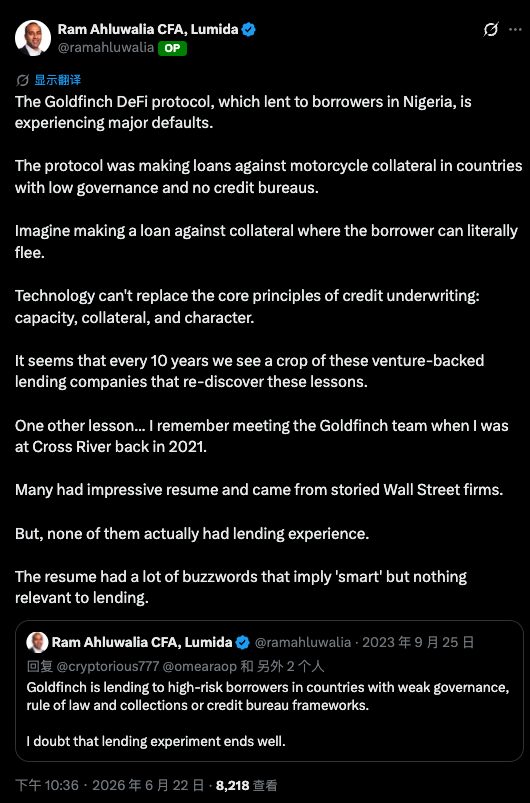
Regarding this project, former Cross River Bank employee Ramneek Ahluwalia offered his assessment, stating that Goldfinch essentially issued loans against physical assets like motorcycles in countries with weak governance and no credit systems. The team had impressive resumes but lacked actual lending experience. Technology cannot replace the core judgment in credit assessment regarding repayment ability, collateral, and borrower quality. He had issued the same warning as early as October 2023.


Starting from Coinbase, Using DeFi to Lend in Emerging Markets


Goldfinch was founded by Mike Sall and Blake West in 2020, both with backgrounds at Coinbase. Sall previously worked on data science at Coinbase and Earn.com, while West was part of the engineering team at Coinbase. The two left Coinbase at the end of 2019, subsequently established the development company Warbler Labs to incubate the Goldfinch protocol, which officially launched in 2021.


The protocol's core model was to channel crypto capital (USDC) through a two-tier structure of Backers and the Senior Pool to off-chain credit companies, which then issued real loans to small businesses and consumers in 18 countries like Nigeria, Kenya, and Southeast Asia. Collateral was held offline by borrowers locally, and the protocol promised depositors around 10% APY. This narrative was highly attractive in 2021, aiming to serve markets underserved by traditional banks using on-chain transparency and global liquidity.


In terms of funding, Goldfinch completed three rounds totaling $37.7 million. In February 2021, it completed an undisclosed amount seed round. In June of the same year, a16z led an $11 million Series A. In January 2022, a16z led another $25 million follow-on financing round, with participation from hedge fund manager Bill Ackman, Coinbase Ventures, BlockTower, Kingsway Capital, SV Angel, and Bain Capital. a16z general partner Arianna Simpson emphasized in the investment announcement that Goldfinch's outstanding loans had reached $38 million at the time, highlighting the enormous global demand for capital.


$100 Million in Loans, Three Major Defaults


Since launch, the protocol has issued approximately $100 million in loans, covering over 200,000 borrowers. However, starting in the second half of 2021, default events occurred one after another.


  • Tugende Kenya, a Kenyan motorcycle taxi financing company, received a $5 million loan from Goldfinch in October 2021 but later transferred $1.9 million of it to its struggling Ugandan parent company without authorization, constituting a contract breach. The loan was written down, with partial recovery after restructuring.


  • Stratos, a US credit fund, received a $20 million funding facility. According to a governance forum update in October 2023, among Stratos's three underlying investments, real estate tech company REZI and blockchain project POKT were highly likely to be worthless, resulting in approximately $7 million in impairments. Warbler Labs committed to covering these losses for Senior Pool investors.


  • Lend East, a Singapore-based borrower, received a loan of $10.15 million. In April 2024, Lend East informed Warbler Labs that it could only repay $4.25 million, with the remaining $5.9 million in default, representing a 58% principal loss rate. Sall stated in the governance forum that this shortfall was inconsistent with all prior communications from the borrower and far exceeded expectations.


The three major defaults resulted in cumulative losses exceeding $18 million.


The Dilemma of the RWA Credit Sector


Goldfinch's failure is not an isolated case. Between 2021 and 2022, a batch of RWA lending protocols, with the core thesis that DeFi could scale the intermediation of real-world credit, attracted significant crypto capital.


A common weakness of this model is that while the transparency and programmability of on-chain capital address liquidity issues, the core risks of credit business lie off-chain, including borrower qualification assessment, collateral valuation, and legal recourse after default. In emerging markets with weak legal systems and difficult asset recovery, these off-chain risks are further amplified. In a similar case, Centrifuge encountered about $5.8 million in loan delinquencies in 2023, primarily concentrated in a French consumer microloan pool, ultimately resolved through liquidation and litigation.


For RWA credit projects still in operation, the key lesson from the Goldfinch case is that on-chain tools can reduce the cost of capital pooling and distribution but cannot replace professional credit underwriting, offline due diligence, and legal enforcement capabilities. When these elements are missing, the technological infrastructure itself cannot prevent loans from turning into bad debt.


Трендові криптовалюти

Пов'язані питання

QWhat is the main reason for the failure of the DeFi credit protocol Goldfinch, which secured $37.7 million in funding from a16z?

AThe primary reason for Goldfinch's failure is the breakdown of its core business model. Despite raising significant funds, the protocol could not overcome the inherent risks of real-world lending. Key issues include a high volume of borrower defaults (including three major ones totaling over $18 million), inaccurate risk assessment, and the inability to recover funds effectively in emerging markets with weak legal systems. The core team ultimately concluded they could not find a sustainable product-market fit for on-chain private credit.

QWhat was the financial impact on Goldfinch depositors, and what is the status of their funds?

ADepositors in Goldfinch have suffered significant financial losses. According to a major depositor's estimate, the actual loss rate is around 70%, much higher than the protocol's displayed 20%. Most depositor funds are locked in outstanding loans (approximately $56.15 million) and are largely unrecoverable, with only $1.63 million remaining in the protocol's on-chain TVL for withdrawals. Many depositors have only recovered a fraction of their principal since initiating withdrawals in 2023.

QWhat is the proposed shutdown plan for Goldfinch as outlined in GIP-87?

AThe shutdown plan in GIP-87 proposes an orderly wind-down. Warbler Labs will halt all new product development and marketing. A new US-based trust entity will be established, with the current Chief Restructuring Officer acting as trustee to manage the collection of remaining borrower repayments. The existing applications will be maintained for at least six months after the final borrower repayment. The entire recovery process is estimated to take two or more years.

QWhat underlying flaw did critics identify in Goldfinch's lending model?

ACritics identified a fundamental flaw: the team's strong technical and crypto backgrounds from Coinbase did not translate into real-world lending expertise. The protocol attempted to lend in high-risk emerging markets (e.g., for motorcycle assets) without robust local credit assessment systems, proper due diligence, or strong legal recourse for defaults. Technology could not replace the core judgments of credit underwriting, collateral valuation, and borrower quality assessment, which are critical offline components of lending.

QHow does Goldfinch's failure reflect broader challenges in the RWA (Real World Asset) DeFi lending sector?

AGoldfinch's failure highlights a systemic challenge in RWA lending: the decoupling of capital sourcing from risk management. While DeFi protocols excel at aggregating transparent, global capital cheaply, they often lack the specialized, localized expertise needed for credit underwriting, collateral management, and legal enforcement in the real world. Technology infrastructure reduces distribution costs but cannot prevent bad debt if these offline risk controls are missing, as seen in similar cases like Centrifuge.

Пов'язані матеріали

Ethlabs Founded, Treasury Companies to Fund Ethereum Post-EF

Former Ethereum Foundation (EF) core researchers Ansgar Dietrichs, Barnabé Monnot, Caspar Schwarz-Schilling, Josh Rudolf, and Julian Ma announced the launch of Ethlabs, an independent non-profit R&D lab focused on Ethereum core protocol research and institutional-grade infrastructure. The initiative, backed by over 50 community participants including ETH treasury companies BitMine and Sharplink, Joseph Lubin, Hayden Adams, and Jesse Pollak, aims to make Ethereum the global economic settlement layer. This move comes amidst significant pressure on the EF, which has seen key departures and a strategic narrowing of its focus. A critical funding gap of approximately $30 million annually for core client development, following the expiration of the client incentive program, poses a near-term risk to the network's development. The context includes the evolution of ETH's value narrative. While mechanisms like EIP-1559 and the Merge previously supported the "ultrasound money" thesis, the success of L2 scaling via EIP-4844 has drastically reduced L1 fee revenue, leading to net ETH issuance and challenging that narrative. Ethlabs has listed ETH monetary economics as a primary research focus. Backing from corporate ETH treasuries like BitMine and Sharplink represents a strategic alignment, as these entities' asset values are directly tied to Ethereum's health and adoption. Their support is an investment rather than a pure donation. Ethereum's governance is shifting from a centralized EF model to a distributed network of specialized "manager nodes," including Ethlabs and a streamlined EF. While this promotes efficiency and reduces single-point failure risk, it introduces new challenges in coordination, priority alignment, and filling critical funding gaps across the decentralized ecosystem.

Foresight News4 хв тому

Ethlabs Founded, Treasury Companies to Fund Ethereum Post-EF

Foresight News4 хв тому

From Logo to Bo Niu: TRON Further Perfects Its Brand Visual Assets

On June 23rd, TRON completed a significant upgrade to its official mascot, Bo Niu. The revamped character features larger, brighter eyes, more expressive facial details, and a clearer "T" structural motif, while retaining its signature red-and-white color scheme and horned design. This refresh aims to enhance Bo Niu's approachability, emotional range, and versatility for use across social media, community interactions, offline events, and branded merchandise. The redesign focuses on creating a stronger first impression. A more open facial structure with distinct, expressive eyes and the addition of a mouth with a small fang make the character friendlier and more suitable for dynamic content like animations and emojis. Subtle brand elements are integrated, such as stylized cheek lines inspired by "signal" icons, referencing the "wave" in "TRON," and a "T" shape formed by its smile and chest markings. Bo Niu has also been given a more defined personality as "TRON's Chief Luck Officer," with traits like being playful and sweet. This persona provides a more accessible and emotionally resonant entry point to the TRON brand, contrasting with often technical Web3 narratives. This mascot upgrade is part of TRON's ongoing effort to build a comprehensive and extensible visual identity system, following its recent logo refresh. Bo Niu is positioned as a key asset to connect with users, foster community, and convey brand warmth in everyday contexts.

marsbit8 хв тому

From Logo to Bo Niu: TRON Further Perfects Its Brand Visual Assets

marsbit8 хв тому

TRON Refreshes the Bull Image, Creating a More Approachable Brand Character

TRON's official mascot "BONiu" (Wave Bull) has received a comprehensive visual upgrade. Retaining its core red-and-white color scheme, horned silhouette, and brand DNA, the refreshed character features larger, brighter eyes, more expressive facial details including a mouth with a small fang, and enhanced emotive capabilities. The redesign aims to strengthen the mascot's亲和力, emotional expressiveness, and adaptability across various scenarios. Key updates include a clearer facial structure for instant recognition, a simplified and more intuitive五官 design, and the integration of subtle brand language. The cheek blushes are now inspired by a "signal" icon, while the smile and chest lines form a stable "T" structure, creating a cohesive超级符号 for the brand. The character has also been equipped with a 12-phoneme lip-sync system to support future动画 and interactive content. Beyond its visual role, BONiu's persona has been enriched. Now titled "TRON's Chief Luck Officer," it carries playful personality tags like "foodie enthusiast" and "full-of-tricks," allowing it to engage with the community in a more approachable and relatable manner. This update provides a lower-barrier, emotionally warm entry point for users amidst the often technical and abstract narratives of Web3. This mascot revamp is part of TRON's ongoing effort to refine its visual asset system, following the earlier logo update. By evolving from a static visual into a dynamic, expressive brand角色, the new BONiu is positioned to become a key asset for connecting with users, building brand记忆, and conveying TRON's personality across社交传播, community互动,线下活动, and merchandise.

链捕手24 хв тому

TRON Refreshes the Bull Image, Creating a More Approachable Brand Character

链捕手24 хв тому

With Labour Changing Leaders, Is the Long-Suppressed UK Crypto Market About to Turn Around?

Labour leader change: Hope for UK crypto market? With Keir Starmer's resignation as Prime Minister and Labour leader, a leadership contest has begun. Andy Burnham, the former Mayor of Greater Manchester and now the overwhelming favourite to succeed, has sparked cautious optimism within the UK cryptocurrency industry. Industry figures hope Burnham, seen as more receptive to digital assets than much of the Labour establishment, could shift the party's traditionally harder line. The leadership transition is expected to be swift, with prediction markets like Polymarket assigning a 97% probability to Burnham becoming the next Prime Minister. However, this political shift comes as a comprehensive regulatory framework for crypto, established by law earlier this year, is in its final implementation phase. The Financial Conduct Authority (FCA) is finalizing detailed rules covering trading, custody, stablecoins, and market abuse, with the full regime set to go live in October 2027. While a new Prime Minister can reshuffle ministers and adjust policy priorities, the core regulatory architecture is now law and unlikely to be fundamentally overturned without significant, deliberate government intervention. The main industry hope is that a Burnham government, focusing on economic growth, will ensure the FCA's implementation is pragmatic and growth-oriented. Industry advocates seek proportionate capital requirements, a streamlined licensing process, and clear rules for staking and stablecoins. They argue that embracing the crypto sector could attract investment and listings to London's struggling markets. Despite the optimism, concerns remain that regulatory implementation may still be influenced by more sceptical factions within the Labour party.

Foresight News53 хв тому

With Labour Changing Leaders, Is the Long-Suppressed UK Crypto Market About to Turn Around?

Foresight News53 хв тому

Торгівля

Спот
Ф'ючерси

Популярні статті

Що таке $S$

Розуміння SPERO: Комплексний огляд Вступ до SPERO Оскільки ландшафт інновацій продовжує еволюціонувати, виникнення технологій web3 та криптовалютних проектів відіграє ключову роль у формуванні цифрового майбутнього. Один з проектів, який привернув увагу в цій динамічній сфері, — це SPERO, позначений як SPERO,$$s$. Ця стаття має на меті зібрати та представити детальну інформацію про SPERO, щоб допомогти ентузіастам та інвесторам зрозуміти його основи, цілі та інновації в рамках web3 та крипто-сектору. Що таке SPERO,$$s$? SPERO,$$s$ — це унікальний проект у криптопросторі, який прагне використати принципи децентралізації та технології блокчейн для створення екосистеми, що сприяє залученню, корисності та фінансовій інклюзії. Проект розроблений для полегшення взаємодії між користувачами новими способами, надаючи їм інноваційні фінансові рішення та послуги. У своїй основі SPERO,$$s$ прагне надати можливості індивідам, забезпечуючи інструменти та платформи, які покращують користувацький досвід у криптовалютному просторі. Це включає в себе можливість більш гнучких методів транзакцій, сприяння ініціативам, що підтримуються спільнотою, та створення шляхів для фінансових можливостей через децентралізовані додатки (dApps). Основна концепція SPERO,$$s$ обертається навколо інклюзивності, прагнучи зменшити розриви в традиційній фінансовій системі, використовуючи переваги технології блокчейн. Хто є творцем SPERO,$$s$? Особистість творця SPERO,$$s$ залишається дещо невідомою, оскільки є обмежені публічно доступні ресурси, що надають детальну інформацію про його засновників. Ця відсутність прозорості може бути наслідком зобов'язання проекту до децентралізації — етики, яку багато проектів web3 поділяють, ставлячи колективні внески вище за індивідуальне визнання. Зосереджуючи обговорення навколо спільноти та її колективних цілей, SPERO,$$s$ втілює суть наділення без виділення конкретних осіб. Таким чином, розуміння етики та місії SPERO є більш важливим, ніж ідентифікація єдиного творця. Хто є інвесторами SPERO,$$s$? SPERO,$$s$ підтримується різноманітними інвесторами, починаючи від венчурних капіталістів до ангельських інвесторів, які прагнуть сприяти інноваціям у крипто-секторі. Зосередження цих інвесторів зазвичай узгоджується з місією SPERO — пріоритет надається проектам, які обіцяють технологічний прогрес у суспільстві, фінансову інклюзію та децентралізоване управління. Ці інвесторські фонди зазвичай зацікавлені в проектах, які не лише пропонують інноваційні продукти, але й позитивно впливають на спільноту блокчейн та її екосистеми. Підтримка з боку цих інвесторів підкріплює SPERO,$$s$ як значного конкурента в швидко змінюваній сфері крипто-проектів. Як працює SPERO,$$s$? SPERO,$$s$ використовує багатогранну структуру, яка відрізняє його від традиційних криптовалютних проектів. Ось деякі ключові особливості, які підкреслюють його унікальність та інноваційність: Децентралізоване управління: SPERO,$$s$ інтегрує моделі децентралізованого управління, надаючи користувачам можливість активно брати участь у процесах прийняття рішень щодо майбутнього проекту. Цей підхід сприяє відчуттю власності та відповідальності серед членів спільноти. Корисність токена: SPERO,$$s$ використовує свій власний криптовалютний токен, розроблений для виконання різних функцій в екосистемі. Ці токени дозволяють здійснювати транзакції, отримувати винагороди та полегшувати послуги, що пропонуються на платформі, підвищуючи загальну залученість та корисність. Шарова архітектура: Технічна архітектура SPERO,$$s$ підтримує модульність та масштабованість, що дозволяє безперешкодно інтегрувати додаткові функції та додатки в міру розвитку проекту. Ця адаптивність є надзвичайно важливою для збереження актуальності в постійно змінюваному крипто-ландшафті. Залучення спільноти: Проект підкреслює ініціативи, що підтримуються спільнотою, використовуючи механізми, які стимулюють співпрацю та зворотний зв'язок. Підтримуючи сильну спільноту, SPERO,$$s$ може краще задовольняти потреби користувачів та адаптуватися до ринкових тенденцій. Фокус на інклюзію: Пропонуючи низькі комісії за транзакції та зручні інтерфейси, SPERO,$$s$ прагне залучити різноманітну базу користувачів, включаючи осіб, які раніше не брали участі в крипто-просторі. Це зобов'язання до інклюзії узгоджується з його загальною місією наділення через доступність. Хронологія SPERO,$$s$ Розуміння історії проекту надає важливі уявлення про його розвиток та етапи. Нижче наведено пропоновану хронологію, що відображає значні події в еволюції SPERO,$$s$: Етап концептуалізації та ідеації: Початкові ідеї, що стали основою SPERO,$$s$, були сформовані, тісно пов'язані з принципами децентралізації та фокусом на спільноті в індустрії блокчейн. Запуск білого паперу проекту: Після концептуального етапу був випущений комплексний білий папір, що детально описує бачення, цілі та технологічну інфраструктуру SPERO,$$s$, щоб залучити інтерес та зворотний зв'язок від спільноти. Створення спільноти та ранні залучення: Активні зусилля були спрямовані на створення спільноти ранніх прихильників та потенційних інвесторів, що полегшило обговорення цілей проекту та отримання підтримки. Подія генерації токенів: SPERO,$$s$ провів подію генерації токенів (TGE) для розподілу своїх рідних токенів серед ранніх прихильників та встановлення початкової ліквідності в екосистемі. Запуск початкового dApp: Перший децентралізований додаток (dApp), пов'язаний з SPERO,$$s$, став доступним, дозволяючи користувачам взаємодіяти з основними функціями платформи. Постійний розвиток та партнерства: Безперервні оновлення та вдосконалення пропозицій проекту, включаючи стратегічні партнерства з іншими учасниками блокчейн-простору, сформували SPERO,$$s$ у конкурентоспроможного та еволюціонуючого гравця на крипто-ринку. Висновок SPERO,$$s$ є свідченням потенціалу web3 та криптовалют для революціонізації фінансових систем та наділення індивідів. Завдяки зобов'язанню до децентралізованого управління, залучення спільноти та інноваційно спроектованих функцій, він прокладає шлях до більш інклюзивного фінансового ландшафту. Як і з будь-якими інвестиціями в швидко змінюваному крипто-просторі, потенційним інвесторам та користувачам рекомендується ретельно досліджувати та обдумано взаємодіяти з поточними подіями в SPERO,$$s$. Проект демонструє інноваційний дух крипто-індустрії, запрошуючи до подальшого дослідження його численних можливостей. Хоча подорож SPERO,$$s$ ще триває, його основні принципи можуть справді вплинути на майбутнє того, як ми взаємодіємо з технологією, фінансами та один з одним у взаємопов'язаних цифрових екосистемах.

81 переглядів усьогоОпубліковано 2024.12.17Оновлено 2024.12.17

Що таке $S$

Що таке AGENT S

Агент S: Майбутнє автономної взаємодії в Web3 Вступ У постійно змінюваному ландшафті Web3 та криптовалюти інновації постійно переосмислюють, як люди взаємодіють з цифровими платформами. Один з таких новаторських проектів, Агент S, обіцяє революціонізувати взаємодію людини з комп'ютером через свою відкриту агентну структуру. Прокладаючи шлях для автономних взаємодій, Агент S прагне спростити складні завдання, пропонуючи трансформаційні застосування в штучному інтелекті (ШІ). Це детальне дослідження заглиблюється в складності проекту, його унікальні особливості та наслідки для сфери криптовалюти. Що таке Агент S? Агент S є революційною відкритою агентною структурою, спеціально розробленою для вирішення трьох основних викликів в автоматизації комп'ютерних завдань: Набуття специфічних знань у галузі: Структура інтелектуально навчається з різних зовнішніх джерел знань та внутрішнього досвіду. Цей подвійний підхід дозволяє їй створити багатий репозиторій специфічних знань у галузі, покращуючи її продуктивність у виконанні завдань. Планування на довгих горизонтах завдань: Агент S використовує планування з підкріпленням досвіду, стратегічний підхід, який полегшує ефективний розподіл та виконання складних завдань. Ця функція значно підвищує її здатність ефективно та результативно управляти кількома підзавданнями. Обробка динамічних, неоднорідних інтерфейсів: Проект представляє Інтерфейс Агент-Комп'ютер (ACI), інноваційне рішення, яке покращує взаємодію між агентами та користувачами. Використовуючи багатомодальні великі мовні моделі (MLLMs), Агент S може безперешкодно орієнтуватися та маніпулювати різноманітними графічними інтерфейсами користувача. Завдяки цим новаторським функціям Агент S надає надійну структуру, яка вирішує складнощі, пов'язані з автоматизацією людської взаємодії з машинами, прокладаючи шлях для численних застосувань у ШІ та за його межами. Хто є творцем Агент S? Хоча концепція Агент S є фундаментально новаторською, конкретна інформація про його творця залишається невідомою. Творець наразі невідомий, що підкреслює або початкову стадію проекту, або стратегічний вибір зберегти засновників у таємниці. Незважаючи на анонімність, акцент залишається на можливостях та потенціалі структури. Хто є інвесторами Агент S? Оскільки Агент S є відносно новим у криптографічній екосистемі, детальна інформація про його інвесторів та фінансових спонсорів не задокументована. Відсутність публічно доступних відомостей про інвестиційні фонди або організації, що підтримують проект, викликає питання щодо його фінансової структури та дорожньої карти розвитку. Розуміння підтримки є критично важливим для оцінки стійкості проекту та потенційного впливу на ринок. Як працює Агент S? В основі Агент S лежить передова технологія, яка дозволяє йому ефективно функціонувати в різних умовах. Його операційна модель побудована навколо кількох ключових функцій: Взаємодія з комп'ютером, подібна до людської: Структура пропонує розширене планування ШІ, прагнучи зробити взаємодії з комп'ютерами більш інтуїтивними. Імітуючи людську поведінку при виконанні завдань, вона обіцяє підвищити досвід користувачів. Наративна пам'ять: Використовується для використання високорівневого досвіду, Агент S використовує наративну пам'ять для відстеження історій завдань, тим самим покращуючи свої процеси прийняття рішень. Епізодична пам'ять: Ця функція надає користувачам покрокові інструкції, дозволяючи структурі пропонувати контекстуальну підтримку в міру виконання завдань. Підтримка OpenACI: Завдяки можливості працювати локально, Агент S дозволяє користувачам зберігати контроль над своїми взаємодіями та робочими процесами, узгоджуючи з децентралізованою етикою Web3. Легка інтеграція з зовнішніми API: Його універсальність і сумісність з різними платформами ШІ забезпечують те, що Агент S може безперешкодно вписатися в існуючі технологічні екосистеми, роблячи його привабливим вибором для розробників та організацій. Ці функціональні можливості колективно сприяють унікальному положенню Агент S у крипто-просторі, оскільки він автоматизує складні, багатоступеневі завдання з мінімальним втручанням людини. У міру розвитку проекту його потенційні застосування в Web3 можуть переосмислити, як відбуваються цифрові взаємодії. Хронологія Агент S Розробка та етапи Агент S можуть бути узагальнені в хронології, яка підкреслює його значні події: 27 вересня 2024 року: Концепція Агент S була представлена в комплексній науковій статті під назвою “Відкрита агентна структура, яка використовує комп'ютери як людина”, що демонструє основи проекту. 10 жовтня 2024 року: Наукова стаття була опублікована на arXiv, пропонуючи детальне дослідження структури та її оцінки продуктивності на основі бенчмарку OSWorld. 12 жовтня 2024 року: Було випущено відеопрезентацію, що надає візуальне уявлення про можливості та особливості Агент S, ще більше залучаючи потенційних користувачів та інвесторів. Ці маркери в хронології не лише ілюструють прогрес Агент S, але й вказують на його прихильність до прозорості та залучення громади. Ключові моменти про Агент S У міру розвитку структури Агент S кілька ключових характеристик виділяються, підкреслюючи її новаторський характер та потенціал: Інноваційна структура: Розроблена для забезпечення інтуїтивного використання комп'ютерів, подібного до людської взаємодії, Агент S пропонує новий підхід до автоматизації завдань. Автономна взаємодія: Здатність автономно взаємодіяти з комп'ютерами через GUI означає стрибок до більш інтелектуальних та ефективних обчислювальних рішень. Автоматизація складних завдань: Завдяки своїй надійній методології він може автоматизувати складні, багатоступеневі завдання, роблячи процеси швидшими та менш схильними до помилок. Безперервне вдосконалення: Механізми навчання дозволяють Агенту S покращуватися на основі минулого досвіду, постійно підвищуючи свою продуктивність та ефективність. Універсальність: Його адаптивність до різних операційних середовищ, таких як OSWorld та WindowsAgentArena, забезпечує його здатність служити широкому спектру застосувань. Оскільки Агент S займає своє місце в ландшафті Web3 та криптовалюти, його потенціал покращити можливості взаємодії та автоматизувати процеси означає значний прогрес у технологіях ШІ. Завдяки своїй інноваційній структурі Агент S є прикладом майбутнього цифрових взаємодій, обіцяючи більш безперешкодний та ефективний досвід для користувачів у різних галузях. Висновок Агент S представляє собою сміливий крок вперед у поєднанні ШІ та Web3, з можливістю переосмислити, як ми взаємодіємо з технологією. Хоча проект все ще на ранніх стадіях, можливості для його застосування є величезними та переконливими. Завдяки своїй комплексній структурі, що вирішує критичні виклики, Агент S прагне вивести автономні взаємодії на передній план цифрового досвіду. У міру того, як ми заглиблюємося в сфери криптовалюти та децентралізації, проекти, подібні до Агент S, безсумнівно, відіграватимуть ключову роль у формуванні майбутнього технологій та співпраці людини з комп'ютером.

706 переглядів усьогоОпубліковано 2025.01.14Оновлено 2025.01.14

Що таке AGENT S

Як купити S

Ласкаво просимо до HTX.com! Ми зробили покупку Sonic (S) простою та зручною. Дотримуйтесь нашої покрокової інструкції, щоб розпочати свою криптовалютну подорож.Крок 1: Створіть обліковий запис на HTXВикористовуйте свою електронну пошту або номер телефону, щоб зареєструвати обліковий запис на HTX безплатно. Пройдіть безпроблемну реєстрацію й отримайте доступ до всіх функцій.ЗареєструватисьКрок 2: Перейдіть до розділу Купити крипту і виберіть спосіб оплатиКредитна/дебетова картка: використовуйте вашу картку Visa або Mastercard, щоб миттєво купити Sonic (S).Баланс: використовуйте кошти з балансу вашого рахунку HTX для безперешкодної торгівлі.Треті особи: ми додали популярні способи оплати, такі як Google Pay та Apple Pay, щоб підвищити зручність.P2P: Торгуйте безпосередньо з іншими користувачами на HTX.Позабіржова торгівля (OTC): ми пропонуємо індивідуальні послуги та конкурентні обмінні курси для трейдерів.Крок 3: Зберігайте свої Sonic (S)Після придбання Sonic (S) збережіть його у своєму обліковому записі на HTX. Крім того, ви можете відправити його в інше місце за допомогою блокчейн-переказу або використовувати його для торгівлі іншими криптовалютами.Крок 4: Торгівля Sonic (S)Легко торгуйте Sonic (S) на спотовому ринку HTX. Просто увійдіть до свого облікового запису, виберіть торгову пару, укладайте угоди та спостерігайте за ними в режимі реального часу. Ми пропонуємо зручний досвід як для початківців, так і для досвідчених трейдерів.

1.6k переглядів усьогоОпубліковано 2025.01.15Оновлено 2026.06.02

Як купити S

Обговорення

Ласкаво просимо до спільноти HTX. Тут ви можете бути в курсі останніх подій розвитку платформи та отримати доступ до професійної ринкової інформації. Нижче представлені думки користувачів щодо ціни S (S).

活动图片