Author: Claude, Shenchao TechFlow
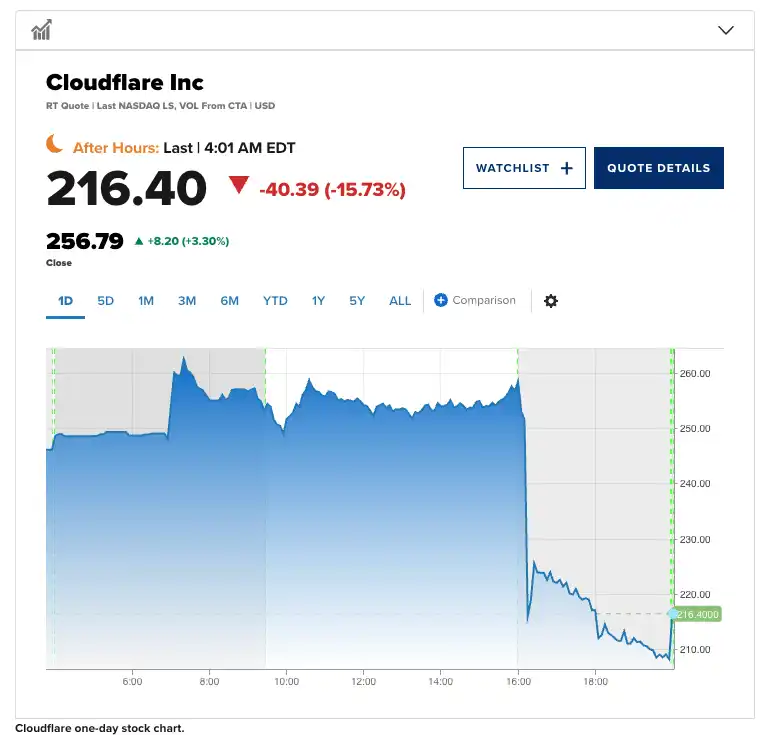
Shenchao TechFlow Introduction: On the same day it reported better-than-expected quarterly earnings, Cloudflare announced a reduction of approximately 20% of its workforce (over 1,100 employees). CEO Matthew Prince framed the move as a comprehensive restructuring for the "era of AI agents" rather than a cost-cutting measure. The company's AI usage surged over 600% in the past three months, with 97% of engineers already using AI coding tools. Following the news, the stock plummeted over 14% in after-hours trading. The restructuring is expected to incur $140 million to $150 million in charges.
Cybersecurity and cloud services giant Cloudflare accomplished two things on May 7th: delivering a quarterly earnings report that exceeded expectations across the board, and announcing the layoff of one-fifth of its employees.
According to Cloudflare's official blog, CEO Matthew Prince and President & COO Michelle Zatlyn sent an internal email to all employees that day, announcing a global reduction of over 1,100 positions. The email's subject line was "Building for the Future." A few hours after the layoff notice was sent, the company released its Q1 2026 earnings report.
Prince stated on the subsequent earnings call: "We discovered some roles at Cloudflare that are no longer needed for our future. Just because you're fit doesn't mean you can't be more fit."
Earnings Beat Expectations, Yet Stock Plunges
Cloudflare's Q1 revenue was $639.8 million, a 34% year-over-year increase, beating Wall Street's expectation of $620.9 million by approximately 3%. Adjusted earnings per share were $0.25, higher than the analyst consensus of $0.23. Non-GAAP operating profit was $73.1 million, with an operating margin of 11.4%. Free cash flow was $84.1 million.
The company also raised its full-year guidance: projecting 2026 full-year revenue between $2.805 billion and $2.813 billion (previously $2.785 billion to $2.795 billion), and adjusted EPS between $1.19 and $1.20 (previously $1.11 to $1.12), both exceeding market consensus expectations.
However, investors were clearly more concerned about the layoffs and the slightly below-expectations Q2 guidance. The company forecasts Q2 revenue between $664 million and $665 million, narrowly below the analyst consensus of $665.34 million. According to CNBC, Cloudflare's stock plunged over 18% in after-hours trading, hitting a low of around $212. As of the end of 2025, the company had 5,156 full-time employees.
Restructuring for the "AI Agent Era": 600% Surge in Usage, Roles Redefined
In the internal email, Prince and Zatlyn attributed the layoffs not to poor performance but to the fundamental shift AI is bringing to the company's operational methods.
The email stated that Cloudflare's AI usage grew over 600% in the past three months. Employees across all departments, from engineering to HR, finance, and marketing, run thousands of AI agent sessions daily to complete their work. According to Prism News, 97% of the company's engineers are already using AI coding tools.
Prince further explained on the earnings call: "Over the last six months, the productivity increase for people directly talking to customers and directly writing code has been phenomenal. And many of the supporting roles behind them will not be the roles driving the company's future forward."
He expects Cloudflare's total headcount in 2027 will exceed any point in 2026, "but the types of roles are changing dramatically, and you have to do something dramatic to drive that change." He emphasized this is not about cutting costs but about "getting the right people into the right roles."
According to Cloudflare's SEC filing, this restructuring is expected to generate $140 million to $150 million in charges, with $105 million to $110 million in cash expenses (including severance, notice period, and benefits) and $35 million to $40 million in non-cash stock-based compensation expenses, primarily concentrated in Q2 and Q3.
Severance Package: Pay Until Year-End, Stock Vesting Extended to August
Regarding severance terms, Cloudflare offered relatively generous conditions. Laid-off employees will receive a severance package equivalent to their full base salary through the end of 2026. US employees' medical insurance coverage will also continue through year-end. Equity vesting is extended to August 15th. For employees who have not yet met their one-year vesting cliff, the company will waive the restriction and grant prorated vesting through August.
Prince and Zatlyn stated in the email they hope this layoff only needs to be executed once. "Small, repeated layoffs or reorganizations dragged out over quarters only create ongoing emotional uncertainty for employees and slow down the speed at which we can build."
Last Year's High-Profile Announcement to Hire 1,111 Interns, This Year Layoffs of 1,100 Employees
According to Cloudflare's official blog, in September 2025 (during its birthday week activities), the company high-profile announced plans to hire up to 1,111 interns in 2026, a number derived from its signature product, the 1.1.1.1 public DNS resolver. The blog post at the time claimed this exemplified the company's culture of "long-term investment in talent."
Less than eight months later, the company laid off almost the same number of full-time employees. According to Prism News, this contrast sparked significant discussion on social media.
AI-Led Layoff Wave Spreads: Coinbase, PayPal Announce Major Job Cuts Same Week
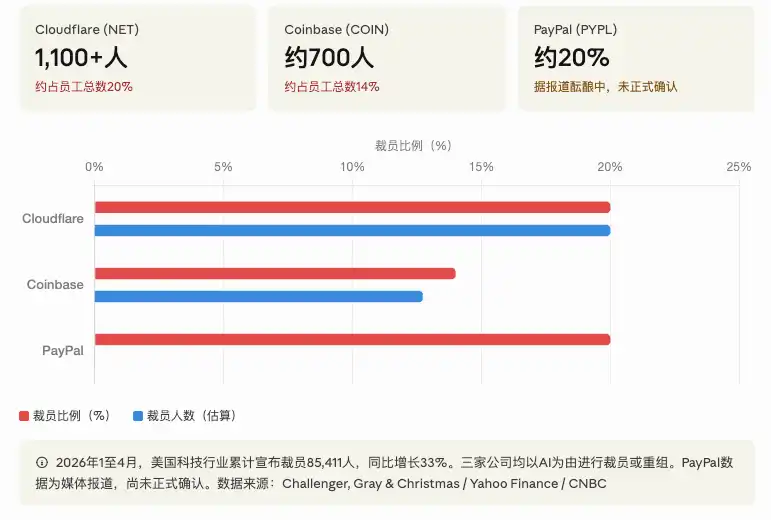
Cloudflare is not alone. According to Yahoo Finance, within the same week, Coinbase announced cutting approximately 14% of its workforce (about 700 employees), and PayPal was reportedly planning layoffs of about 20%. From January to April this year, the US tech industry announced 85,411 layoffs, a 33% increase compared to the same period last year.
Citing AI as a reason for layoffs is becoming a collective narrative for tech companies. The Register, in its reporting, directly headlined the layoffs as "jobs just aren't AI enough." Prince called AI the "single biggest tailwind Cloudflare has ever seen" on the earnings call.
For the employees who remain and those who were laid off, this "tailwind" is blowing in opposite directions.