$40B Crypto Crash: Jane Street Sued Over Terra Insider Trading

bitcoinistОпубліковано о 2026-02-24Востаннє оновлено о 2026-02-24

Анотація

Crypto firm Terraform Labs' wind-down administrator, Todd R. Snyder, has sued trading firm Jane Street and several individuals, including Bryce Pratt, for alleged insider trading, fraud, and market manipulation. The complaint, filed in Manhattan federal court, centers on trading activity around the May 2022 collapse of TerraUSD (UST) and Luna. It alleges Pratt, who moved from a Terraform internship to Jane Street, maintained a confidential back channel with Terraform insiders and shared material non-public information. The suit claims a specific 85 million UST trade by Jane Street "precipitated a steep sell off" and helped trigger the broader $40 billion ecosystem collapse. It cites private messages to argue Jane Street had an informational edge and was in direct contact with Terraform leadership during the crisis. Jane Street is expected to contest the allegations.

Crypto firm Terraform Labs’ wind-down administrator has sued Jane Street in Manhattan federal court, alleging the trading firm used material non-public information from Terraform insiders to trade around the May 2022 collapse of TerraUSD (UST) and Luna.

The complaint was filed by Todd R. Snyder, the administrator overseeing recoveries tied to Terraform’s bankruptcy wind-down. It names Jane Street entities and several individuals, including Bryce Pratt, and accuses the defendants of insider trading, fraud, and market manipulation tied to trading during the depeg crisis. The suit seeks damages and disgorgement, with any recovery intended to support creditor distributions.

Did Jane Street Cause The $40 Billion Crypto Crash?

A central part of the case is the role of Pratt, who allegedly moved from an internship at Terraform to a position at Jane Street while maintaining contact with Terraform personnel. The complaint claims he kept a confidential back channel with Terraform’s head of research and passed along sensitive information.

The filing quotes messages that, according to the plaintiff, show both the existence of confidential communications and an understanding that the information should not be shared. One message allegedly included the phrase “don’t share pls.” The complaint also claims Terraform personnel asked Pratt what Jane Street was discussing internally.

That point is critical to the plaintiff’s theory. The case is not framed as Jane Street simply trading aggressively during a volatile market event. It is framed as a claim that Jane Street had a private informational edge at a moment when the market was relying on public signals and deteriorating liquidity.

The lawsuit’s market narrative centers on the early phase of the UST depeg and liquidity movements on Curve. Snyder alleges that after Terraform adjusted liquidity in Curve’s 3pool, a Jane Street-linked 85 million UST trade hit the pool and became “the largest single swap on the Curve 3pool.”

The complaint goes further, alleging that this trade “precipitated a steep sell off in UST” and helped trigger the broader collapse of the Terra ecosystem. It also describes how conditions worsened over May 8 and 9, with UST trading volume surging and the token falling below $0.80 as Terraform attempted to defend the peg.

This sequence matters because the plaintiff is trying to connect alleged access to non-public information with a specific trading action and then link that action to damages suffered during the unwind.

The suit also cites direct communications during the meltdown. In one May 9 message referenced in the complaint, Pratt allegedly wrote to Do Kwon: “Hey Do Kwon, just wanted to express our interest in bidding on either BTC or LUNA.”

According to the filing, Kwon responded that “Bill from Jump” should have contacted Jane Street regarding a Terraform fundraise. The plaintiff uses that exchange to argue that Jane Street was not just an outside trading firm reacting to market prices, but was in direct communication with Terraform leadership while emergency options were being discussed.

Jane Street has pushed back on the allegations and is expected to contest the claims aggressively. As in other post-Terra litigation, key issues will likely include whether the information was truly material and non-public, whether the trades were causally connected to the collapse, and whether the plaintiff can prove intent.

At press time, the total crypto market cap stood at $2.17 trillion.
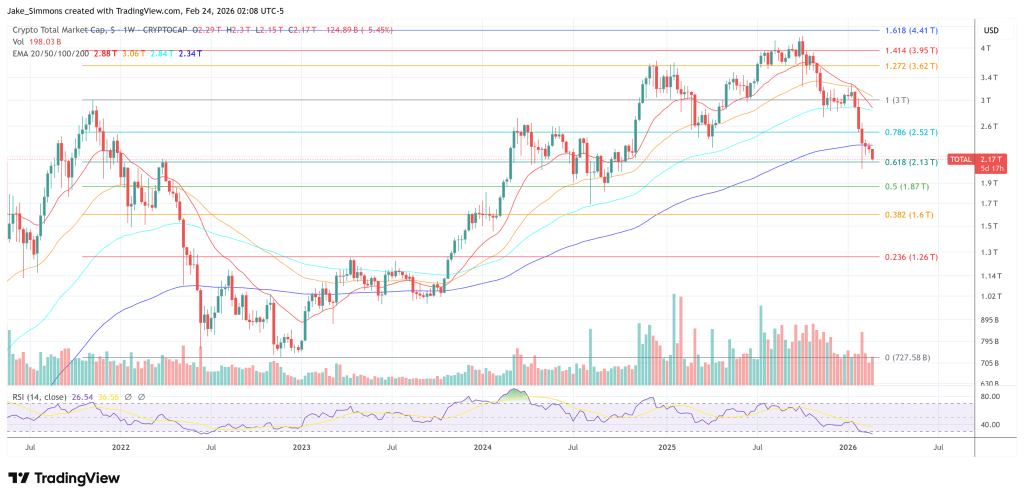
Total crypto market cap falls below the 200-week EMA, 1-week chart | Source: TOTAL on TradingView.com

Пов'язані питання

QWhat is the main allegation against Jane Street in the lawsuit filed by Terraform Labs' wind-down administrator?

AThe lawsuit alleges that Jane Street used material non-public information from Terraform insiders to trade around the May 2022 collapse of TerraUSD (UST) and Luna, engaging in insider trading, fraud, and market manipulation.

QWho is Bryce Pratt and what role does he allegedly play in this case?

ABryce Pratt is an individual named in the complaint who allegedly moved from an internship at Terraform to a position at Jane Street while maintaining a confidential back channel with Terraform's head of research and passing along sensitive, non-public information.

QWhat specific trade is alleged to have 'precipitated a steep sell off in UST' and where did it occur?

AThe complaint alleges that a Jane Street-linked 85 million UST trade on the Curve's 3pool liquidity pool was 'the largest single swap on the Curve 3pool' and that it precipitated a steep sell off in UST.

QWhat key piece of evidence is cited to show Jane Street was in direct communication with Terraform leadership during the crisis?

AThe complaint cites a May 9 message where Bryce Pratt allegedly wrote to Terraform co-founder Do Kwon expressing interest in bidding on BTC or LUNA, and Kwon's response referencing 'Bill from Jump' contacting them about a fundraise.

QWhat are some of the key legal defenses Jane Street is expected to raise against these allegations?

AJane Street is expected to contest the claims by challenging whether the information was truly material and non-public, whether their trades were causally connected to the collapse, and whether the plaintiff can prove intent.

Пов'язані матеріали

Why Do You Always Lose Money on Polymarket? Because You're Betting on News, While the Pros Read the Rules

Why do you always lose money on Polymarket? Because you bet on news, while the pros study the rules. This article explains how top traders ("che tou") profit by meticulously analyzing market rules, not just predicting events. Polymarket, a prediction market platform, often sees disputes over event outcomes due to ambiguous rule wording. For instance, a market asking "Who will be the leader of Venezuela by the end of 2026?" was misinterpreted by many who bet on Delcy Rodríguez, assuming she held power. However, the rules specified "officially holds" as the formally appointed, sworn-in individual. Since Nicolás Maduro was still recognized as president officially, he won the market—even being in prison. To resolve such disputes, Polymarket uses a decentralized arbitration system via UMA protocol. The process involves: 1. Proposal: Anyone can propose a market outcome by staking 750 USDC, earning 5 USDC if unchallenged. 2. Dispute: A 2-hour window allows challenges with a 750 USDC stake; successful challengers earn 250 USDC. 3. Discussion: A 48-hour period on UMA Discord for evidence and debate. 4. Voting: UMA token holders vote in two 24-hour phases (blind then public). Outcomes require >65% consensus and 5M tokens voted; otherwise, four re-votes occur before Polymarket intervention. 5. Settlement: Results are final and automatic. Unlike traditional courts, Polymarket’s system lacks separation between arbitrators and stakeholders—voters often hold market positions, creating conflicts of interest. This leads to herd mentality in discussions and non-transparent outcomes without explanatory rulings, preventing precedent formation. Thus, success on Polymarket hinges on deep rule interpretation, not just event prediction, exploiting gaps between reality and contractual wording.

marsbit1 год тому

Why Do You Always Lose Money on Polymarket? Because You're Betting on News, While the Pros Read the Rules

marsbit1 год тому

DeepSeek Funding: Liang Wenfeng's 'Realist' Pivot

DeepSeek, a leading Chinese AI company, has initiated its first external funding round, aiming to raise at least $300 million at a valuation of no less than $10 billion. This move marks a significant shift from its founder Liang Wenfeng’s previous idealistic stance of rejecting external capital to maintain independence. Despite strong financial backing from its parent company, quantitative trading firm幻方量化 (Huanfang Quant), which provided an estimated $700 million in revenue in 2025 alone, DeepSeek faces mounting challenges. Key issues include a 15-month gap in major model updates, delays in its flagship V4 release, and the loss of several core researchers to competitors offering significantly higher compensation. The company is also undergoing a strategic pivot by migrating its infrastructure from NVIDIA’s CUDA to Huawei’s Ascend platform, a move aligned with China’s push for technological self-reliance amid U.S. export controls. However, DeepSeek lags behind rivals like智谱AI and MiniMax—both now publicly listed—in areas such as product ecosystem, multimodal capabilities, and commercialization. The funding round, though relatively small in scale, is seen as a way to establish a market-validated valuation anchor, making employee stock options more competitive and facilitating talent retention. It also signals DeepSeek’s transition from a pure research-oriented organization to a commercially-driven player in the global AI ecosystem.

marsbit1 год тому

DeepSeek Funding: Liang Wenfeng's 'Realist' Pivot

marsbit1 год тому

Торгівля

Спот
Ф'ючерси
活动图片