Hardcore First Look | Ocean Embodied Intelligence Company 'Shihang Intelligence' Secures Record-Breaking 1 Billion in Funding, Zhu Xiaohu, Temasek Place Bets

marsbitОпубліковано о 2026-06-15Востаннє оновлено о 2026-06-15

Анотація

Breaking News | Ocean Embodied Intelligence company "Shihang Intelligent" secures a record-breaking 1 billion RMB (approximately 10 billion yuan) in Series A financing, with investment from Zhu Xiaohu and Temasek. Author: Qiu Xiaofen | Editor: Yuan Silai Ocean Embodied Intelligence company "Shihang Intelligent" has completed its Series A funding round, raising over 1 billion RMB. This marks the largest single funding round in the global marine robotics field to date. Investors include upstream momentum funds from chip companies "Moore Thread" and "Kunlunxin," Singapore's state-owned investment platform Vertex Growth, and listed company Dyneo, among others. Existing investors like GSR Ventures (whose founder Zhu Xiaohu has invested for the fifth time), Vertex Ventures China, Hua Ying Capital, and Long Capital also significantly increased their investments. Founder and CEO Chen Xiaobo, a 1989-born alumnus of Harbin Engineering University, is a long-time expert in underwater robotics. He received the National Defense Science and Technology Progress Award at age 28 (the youngest recipient) and led the development of China's first commercial underwater cleaning robot. The funds will be used for core technology R&D, global market expansion, and building the industry chain ecosystem to scale the application of marine robots in complex underwater scenarios. The ocean is considered one of the most challenging environments for robotics due to low light, high turbidity, complex curre...

Author | Qiu Xiaofen

Editor | Yuan Silai

Hardcore learned that the ocean embodied intelligence company 'Shihang Intelligence' has completed its Series A financing round, raising over 1 billion RMB, marking the largest single round of financing in the global marine robotics field to date. This round was funded by industry investors including Shanghe Momentum Fund from chip companies 'Moore Thread' and 'Kunlun Core', Singapore's state-owned investment platform Vertex Growth, and listed company Dayang Motor, among others.

Additionally, Jinshajiang Venture Capital also participated in this round, marking the fifth investment round by its founder Zhu Xiaohu in 'Shihang Intelligence'. Existing shareholders such as Vertex China, China Growth Capital, and Changshi Capital all made significant follow-on investments.

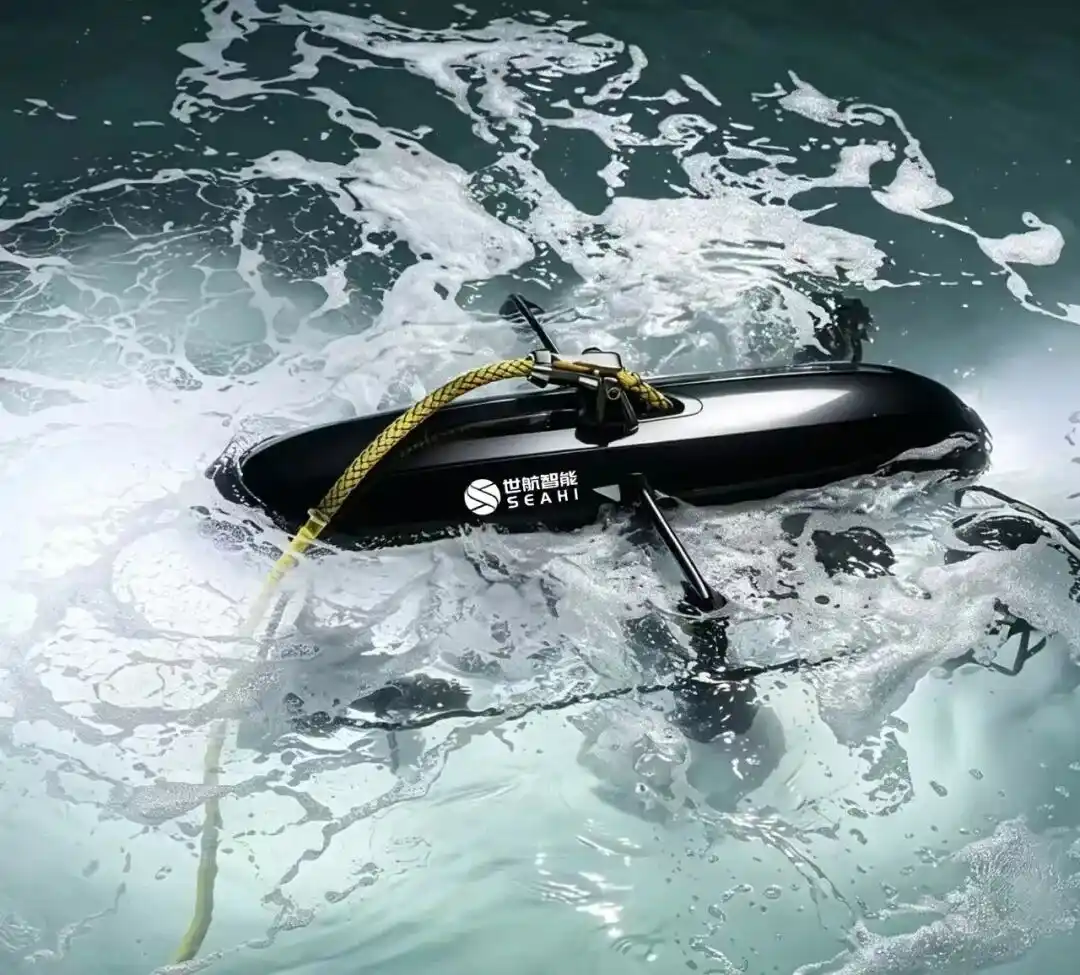
Chen Xiaobo, founder and CEO of 'Shihang Intelligence', is a 1989-born alumnus of Harbin Engineering University. He has long been dedicated to the field of underwater robotics. At the age of 28, he received the First Prize of National Defense Science and Technology Progress Award, becoming the youngest recipient of this award, and led the development of China's first commercial underwater cleaning robot.
(Source / Company)

'Shihang Intelligence' revealed to Hardcore that this round of financing will primarily be used for core technology R&D, global market expansion, and industrial chain ecosystem development, further promoting the large-scale application of marine robots in complex underwater scenarios.

Unlike relatively standardized environments such as factories and warehouses, the ocean has long been considered one of the most challenging scenarios for robotics applications.

In underwater environments, robots must simultaneously face multiple challenges such as low light, high turbidity, complex currents, limited communication, high pressure, and corrosion. This means marine robots not only need stable mechanical structures and motion control capabilities but also must perform perception, judgment, and autonomous operations in complex environments.

In the past, a large amount of underwater work still heavily relied on professional divers and large-scale equipment, leading to issues such as high costs, significant risks, and limited efficiency.

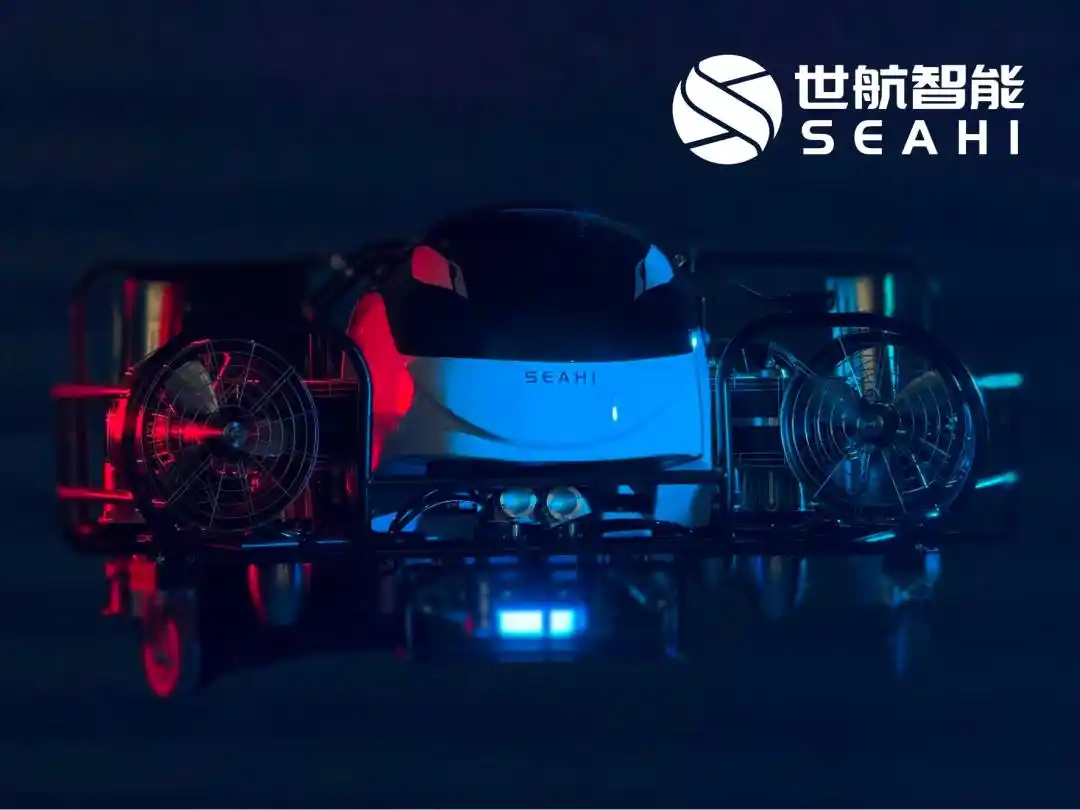
According to 'Shihang Intelligence' introduction, the company has long focused on independent R&D of the underlying capabilities of marine robots. Its core technologies cover six major systems: power, control, sensing, navigation, sealing, and deployment.
(Source / Company)

It is understood that 'Shihang Intelligence' robots have full-depth operational capability from 0 meters to 10,000 meters and full degrees of freedom, allowing complex movements like forward, backward, lateral shift, and rotation in three-dimensional underwater space. They also support autonomous navigation, multi-robot collaborative operations, and other functions. To date, 'Shihang Intelligence' robots have achieved application in scenarios including ship cleaning, underwater security, offshore wind power, marine ranching, and subsea inspection.

The company revealed that in the first half of 2026 alone, 'Shihang Intelligence' secured orders amounting to over 1 billion RMB.

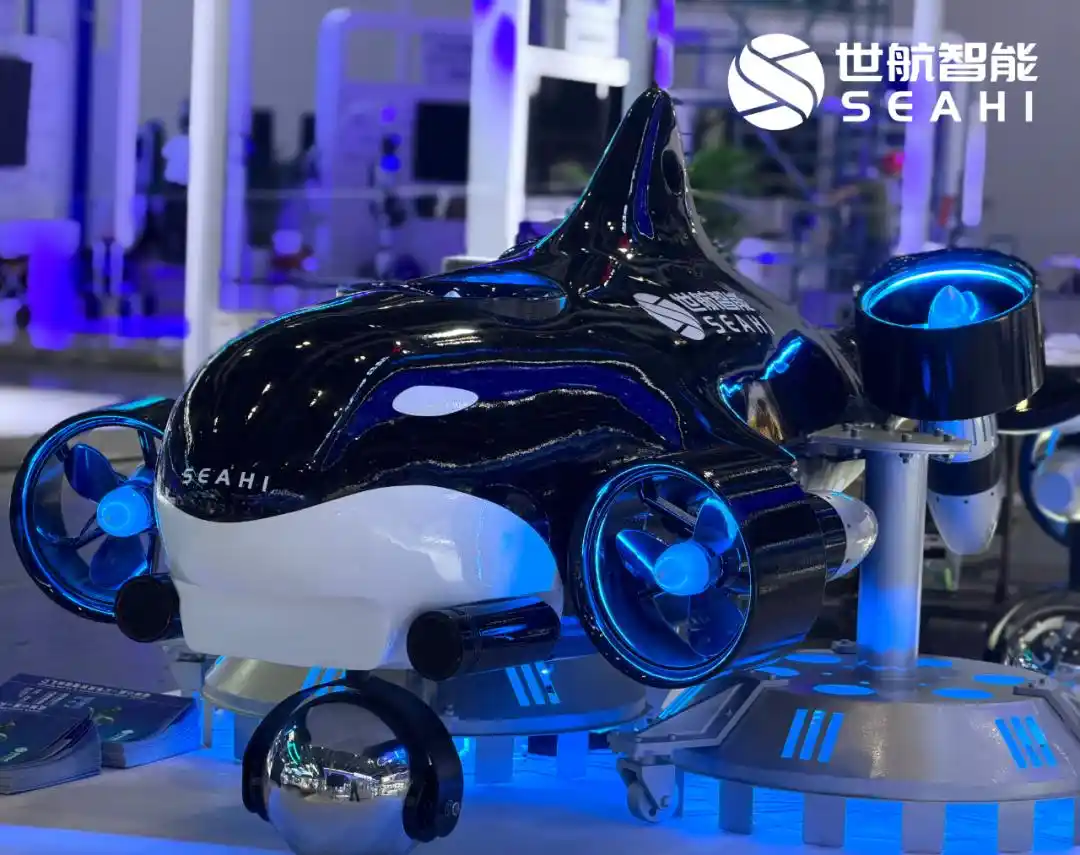
Among them, the 'Orca Robot' from 'Shihang Intelligence' has been deployed by leading shipping enterprises like China Merchants Energy Shipping and COSCO Bulk Shipping. It has cumulatively completed maintenance operations on over a thousand large vessels. It previously also spearheaded the formulation of China's first 'Underwater Cleaning Robot Operating Procedures' standard and won the First Prize of China Navigation Society Science and Technology Progress Award in 2025.

Beyond commercial deployment, 'Shihang Intelligence' continues to advance its core technology. In April this year, 'Shihang Intelligence' released the Ocean Embodied Large Model 'Cangqiong CEORION'— unlike traditional underwater robots that rely on manual remote control or preset programs, Cangqiong aims to equip robots with perception, understanding, and autonomous execution capabilities.

Chen Xiaobo, founder and CEO of 'Shihang Intelligence', told Hardcore that 'Cangqiong CEORION' adopts a unified end-to-end architecture, integrating environmental perception, task understanding, and action generation into a single model. It is trained using a combination of real operational data and simulation data. Currently, based on millions of hours of commercial operational data, 'Cangqiong CEORION' has constructed an ocean world model and is continuously optimized through real-world tasks.

This means that marine robots equipped with 'Cangqiong CEORION' no longer need to switch between multiple models for different tasks. They can cover 12 major categories of underwater operations, including inspection, detection, cleaning, grasping, cutting, welding, exploration, search and rescue, and emergency response.

In simulation tests, 'Cangqiong CEORION' achieved a task success rate exceeding 90% and a fine-control positioning and grasping success rate exceeding 90%—matching the operational level of professional divers. Additionally, when faced with entirely new marine environments, water quality conditions, lighting changes, and different robot platforms, 'Cangqiong CEORION's model exhibited a zero-shot adaptation capability exceeding 70%.

Furthermore, a major difference between marine and terrestrial scenarios lies in the difficulty of inference—visual information is often affected by water turbidity, light attenuation, and suspended particles. Therefore, the model needs to simultaneously integrate various sensory information and possess complex physical reasoning capabilities to complete operational decisions.

In the large model architecture of 'Cangqiong CEORION', 'Shihang Intelligence' embedded a physical reasoning module, enabling the model to predict potential risks and optimize decisions before action execution, reducing collision accident rates by 80%—this means that even in weak or non-existent communication environments, robots can still autonomously complete task planning and execution.
(Source / Company)

In the first half of this year, Shihang Intelligence was also selected as the core technology partner for the Singapore Maritime and Port Authority's National Underwater Hull Inspection and Cleaning Plan, joining this national-level project.

These implementation milestones indicate that marine robots are transitioning from single-point project validation to large-scale application. Real operational scenarios not only bring order revenue to companies but also continuously accumulate high-value operational data, driving continuous improvement of robot capabilities in the cycle of 'operation—data—model'.

Chen Xiaobo, founder and CEO of 'Shihang Intelligence', told Hardcore that the company will continue to invest in core marine robot technology, ocean embodied intelligence models, and global application scenarios, promoting the application of marine robots in more high-risk, high-difficulty, and high-value underwater operations.

Homepage Image Source | Company provided

Layout | Fan Xinya

Welcome to communicate

Пов'язані питання

QWhat is the total amount of Series A financing raised by Shihang Intelligence, and why is this round notable?

AShihang Intelligence has raised over 1 billion yuan (10 billion) in its Series A financing round. This round is notable as it represents the largest single funding round to date in the global marine robotics field.

QWho are the key investors involved in Shihang Intelligence's Series A funding round?

AKey investors include the industrial investment arms of chip companies Moore Threads and Kunlunxin—specifically the Shanghe Momentum Fund—along with Singapore's state-owned investment platform Vertex Growth, the listed company Dayang Motor, and existing investors such as Jinshajiang Venture Capital (which participated for the fifth time), Xiangfeng China, Huaying Capital, and Changshi Capital, all of whom increased their investments.

QWhat are the core technical capabilities and application scenarios of Shihang Intelligence's marine robots?

AShihang Intelligence's marine robots possess full-ocean-depth (0 to 10,000 meters) and full-degree-of-freedom operational capabilities. They can perform complex movements and support autonomous navigation and multi-robot collaboration. Their application scenarios include ship cleaning, underwater security, offshore wind power, marine ranching, and seabed inspection. By the first half of 2026, the company had secured orders exceeding 1 billion yuan.

QWhat is the 'Cangqiong CEORION' model, and what are its key features and performance metrics?

A'Cangqiong CEORION' is Shihang Intelligence's marine embodied large model. It features an end-to-end architecture integrating environmental perception, task understanding, and action generation. It is trained on millions of hours of commercial operation data and simulation data. Key performance metrics include a task success rate of over 90% in simulation tests, a fine control positioning and grasping success rate exceeding 90% (matching professional diver levels), and a zero-shot adaptation capability of over 70% for unfamiliar marine environments. It also includes a built-in physical reasoning module that reduces collision incidents by 80%.

QWhat is the background of Shihang Intelligence's founder and CEO, Chen Xiaobo?

AChen Xiaobo, born in 1989, is an alumnus of Harbin Engineering University. He has long been dedicated to the field of underwater robotics. At the age of 28, he received the National Defense Science and Technology Progress Award (First Class), becoming the youngest recipient of this award. He also led the development of China's first commercial underwater cleaning robot.

Пов'язані матеріали

Microsoft Announces Commercial-Grade Quantum Computer to be Completed in Three Years: Will the Boots Land?

Microsoft announces plans to build a commercially viable quantum computer by 2029, a significant acceleration from the previous industry consensus of a decade. The breakthrough is fueled by their new Majorana 2 quantum chip, which boasts a record-breaking average qubit lifetime of 20 seconds—a 1,000-fold reliability improvement over its predecessor. This leap was achieved by leveraging topological qubits, a theoretically more stable technology using Majorana zero modes, and switching the core superconducting material from aluminum to lead. Crucially, Microsoft's "Discovery" agentic AI platform accelerated the R&D process. AI agents autonomously analyzed vast experimental data, optimized manufacturing parameters (like the lead alloy composition), and solved issues like "ghost noise," dramatically speeding up experimentation. While the 20-second coherence time is a landmark, challenges remain: scaling from 12 qubits to the millions needed for practical applications, managing compilation costs, and verifying quantum results. Skeptics call for peer-reviewed data, and questions persist about whether even 20 seconds is sufficient for complex algorithms like breaking RSA encryption. The race is on with other approaches (superconducting, trapped ions), but Microsoft's confidence in its topological roadmap signals a potential shortcut to a scalable quantum future.

marsbit13 хв тому

Microsoft Announces Commercial-Grade Quantum Computer to be Completed in Three Years: Will the Boots Land?

marsbit13 хв тому

Is There Really a "World Cup Curse" in the Market?

Is there really a "World Cup Curse" affecting markets? Historical data shows global equity markets often underperform during the tournament. The S&P 500 has averaged negative returns of -1.5% to -2.11% across 19 World Cups since 1950, with declines in 58% of events. China's Shanghai Composite fell in 71% of tournaments since 1994. Studies confirm reduced trading activity during matches, with volumes dropping significantly, especially when a home nation plays. A team's loss can also lead to negative sentiment and selling pressure in its domestic market the next day. However, the "curse" may be partly attributed to seasonal weakness. Many tournaments are held in June-July, a historically weaker period for stocks ("Sell in May and go away"). The 2022 Qatar World Cup, held in November-December, saw a smaller drop in trading volume compared to summer events, suggesting timing plays a role. The cryptocurrency market's performance during World Cups has been mixed and largely driven by its own major catalysts (e.g., Mt. Gox hack, FTX collapse, halving cycles) rather than the tournament. Investment opportunities have shifted over time. Traditional beneficiaries like TV manufacturers have seen fading returns as streaming platforms become the core viewing channel. Classic consumer plays like beer and sportswear face challenges from changing consumption trends. Newer digital assets, like fractionalized collectible player cards on blockchain, have seen explosive growth. While gambling is a traditional sector, prediction markets are emerging. In conclusion, while a statistical correlation exists, the World Cup's direct impact on markets is likely limited and intertwined with seasonal patterns. With lower liquidity during the event, the simplest strategy for many might be to step back from trading and enjoy the games.

marsbit20 хв тому

Is There Really a "World Cup Curse" in the Market?

marsbit20 хв тому

Why 'AI Service Subscription' Is Destined to Die Out?

"Why 'AI Service Subscription Models' Are Doomed to Disappear" The article argues that the flat-rate subscription model for AI services is fundamentally unsustainable. It points to recent industry shifts, such as Anthropic limiting access to its flagship Claude Fable 5 model for subscribers after just 14 days, and GitHub and OpenAI moving towards credit-based or usage-based billing. The core problem is that subscription models rely on a capped human consumption limit—like watching videos or listening to music—which keeps costs predictable. However, the rise of autonomous AI agents shatters this premise. Agents can consume 5 to 30 times more computing resources (tokens) than a human chatting, and they operate continuously without user presence. This removes the natural usage cap, making fixed-price plans financially unviable as heavy users incur massive costs. Attempts to patch the model with higher tiers or usage caps have failed, often leading to "adverse selection" where only the heaviest users subscribe. The industry's solution is to hollow out subscriptions, replacing "unlimited" access with prepaid credits charged per token, akin to a utility meter. While chat-based subscriptions may linger, the real value and revenue are shifting to pay-as-you-go models. The current period represents a final, heavily subsidized phase for users. The conclusion is that the soul of subscription—a fixed price for worry-free use—is dying, soon to be replaced by pure usage-based pricing where everyone pays for their own "electricity meter."

marsbit20 хв тому

Why 'AI Service Subscription' Is Destined to Die Out?

marsbit20 хв тому

Торгівля

Спот
Ф'ючерси
活动图片