Either Go Full-Stack or Get Out: The Calculations Behind xAI's $60 Billion Acquisition of Cursor

marsbitОпубліковано о 2026-06-18Востаннє оновлено о 2026-06-18

Анотація

The article discusses xAI's $60 billion stock acquisition of Anysphere, the parent company of the AI coding tool Cursor, arguing that the core motivation is not market share but access to high-quality training data from its 7 million daily developers. It posits that to become a major AI player, a company must build a full-stack encompassing compute, model, and application layers. This thesis is illustrated by Anthropic's 540x revenue growth in 28 months, largely driven by its coding product, Claude Code, which captured 54% of the enterprise AI programming market. The author, a VC, contends that full-stack integration creates sustainable unit economics for model training and provides proprietary data for defensible competitive advantages, predicting a wave of model companies aggressively building or acquiring application-layer products. The central takeaway is that in an era where building products is 10x easier, ambition must be 10x greater to succeed.

Author: Tara Tan

Translation: Deep Tide TechFlow

Source: The Strange Review

Deep Tide Introduction: xAI, under SpaceX, acquired Anysphere, Cursor's parent company, for $60 billion in stock—not for market share, but for the high-quality training data generated by 7 million developers writing code every day. Strange Ventures partner Tara Tan uses this deal to put forward a judgment: to be a major AI player, you must integrate the entire stack of compute, models, and applications. This short review breaks down Anthropic's path to a 540-fold revenue increase in 28 months and explains why model companies will aggressively acquire into the application layer next. Note the author's identity as a VC, and full-stack is precisely her own investment thesis.

Code generation is by far the strongest killer application for large language models, bar none.
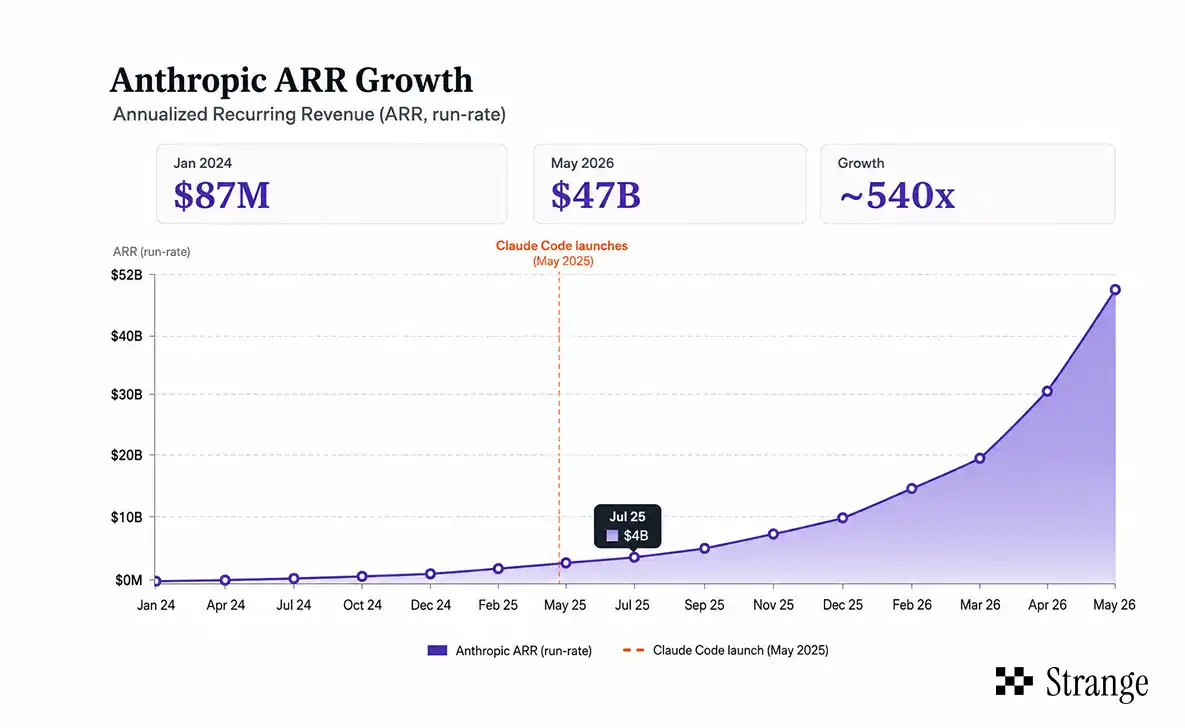
Anthropic's revenue grew from an annualized rate of $87 million in January 2024 to $47 billion in May 2026, an approximately 540-fold increase in 28 months. This growth was driven by two engines firing simultaneously: top-down enterprise partnerships (Claude is the only frontier model available on all three major cloud platforms) and bottom-up developer penetration, powered by Claude Code. This product is the fastest-growing in the company's history, going from zero to $2.5 billion in annualized revenue in 9 months. Anthropic now holds 54% of the enterprise AI programming market.

Cursor is the same bet SpaceX is making.

Yesterday, SpaceX announced the acquisition of Anysphere, the company behind Cursor, for $60 billion in stock. This AI programming tool is used daily by 7 million developers. Incubated at MIT four years ago, its annualized revenue has surged to $2 billion, making it the highest-revenue AI programming tool in its category. Over the past year, its market share has been declining, from 41% to 26%, as Claude Code gained ground. But xAI isn't buying market share.

xAI already has the full stack: Colossus for compute, Grok for the model, and X for the application. The problem is that X is for browsing, while Cursor is for writing code. The data generated by developers writing code is arguably the highest-signal training data in the AI field, and that's precisely what Grok lacks to complete its competitive edge.

This confirms a thought I've been pondering since the OpenAI-NVIDIA deal last September:

To be a major AI player, you must go full-stack.
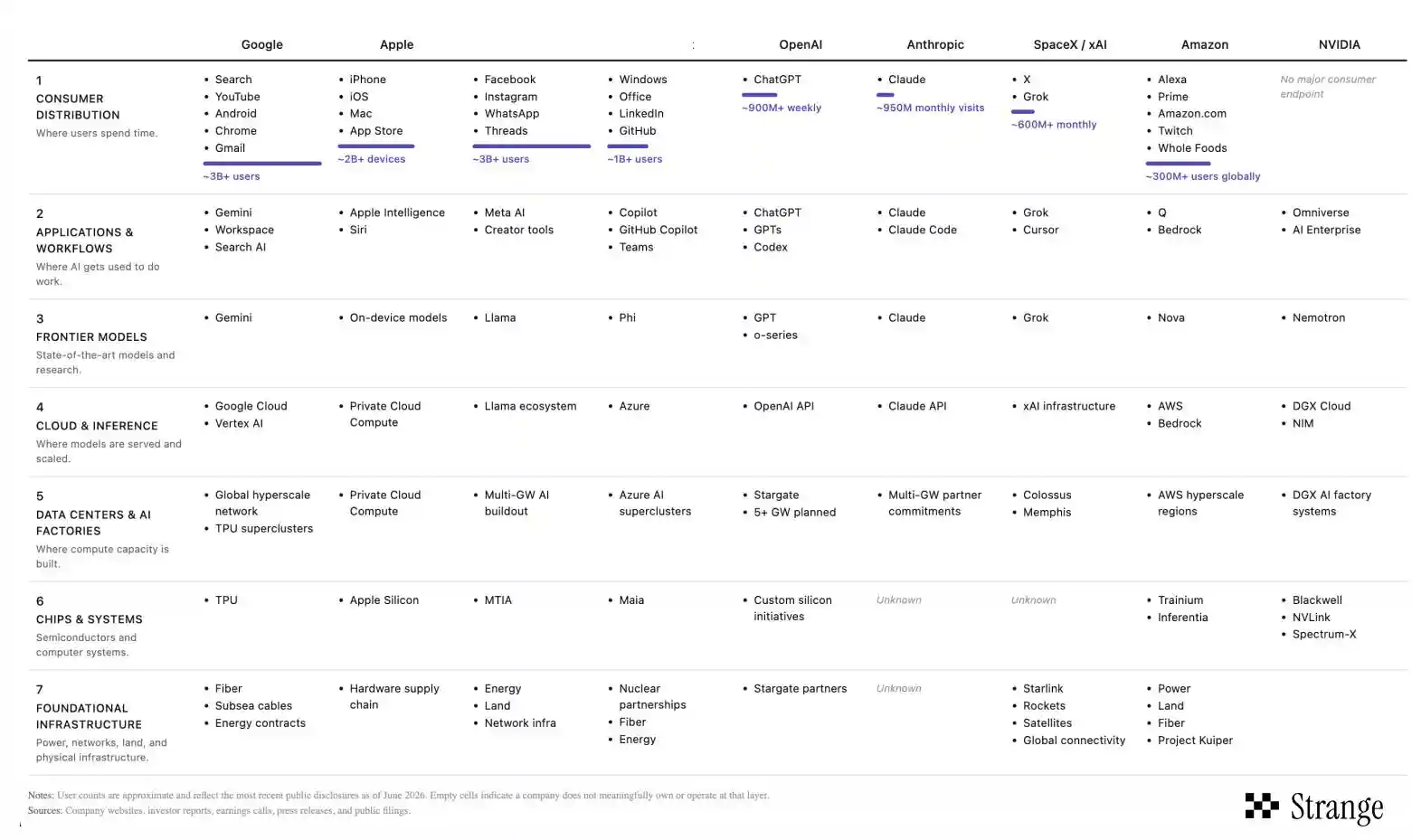
The logic is becoming increasingly clear. Better products lead to better infrastructure (more data), and better infrastructure, in turn, leads to a better experience. This has always been the core investment logic at Strange.
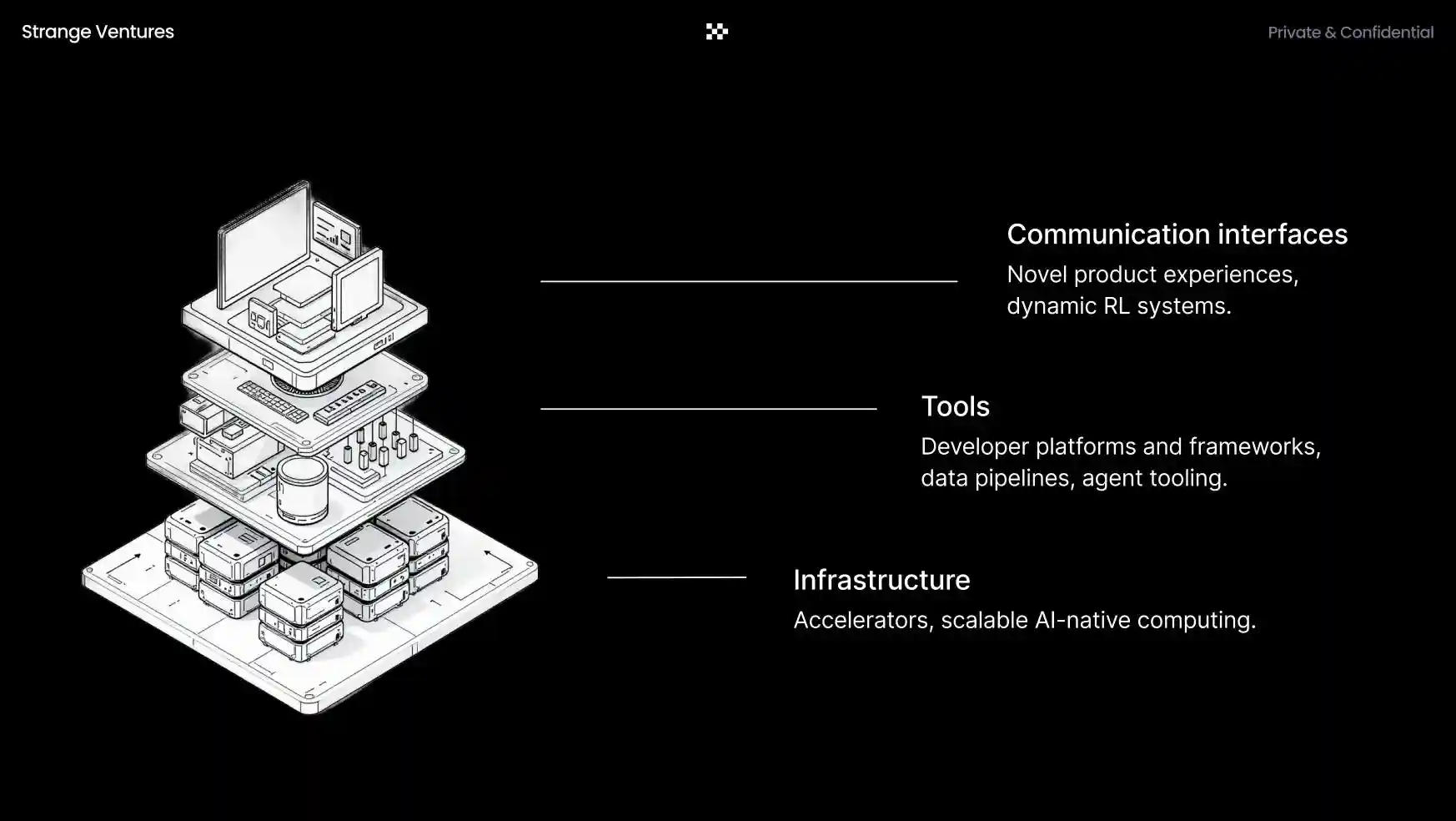
Caption: The author's team's investment logic diagram on "Full-Stack Flywheel"

Going full-stack achieves two things:

First, the unit economics of building and training models become sustainable.

Second, you gain proprietary training data from the application layer, differentiating yourself from other model vendors. User data and workflow lock-in then form a solid moat.

The next few years will likely see actions like these: model companies either internally develop applications or aggressively acquire upward, directly swallowing the application layer.

A popular saying among entrepreneurs now is: Because building products is 10 times easier than before, companies need to be 10 times more ambitious to succeed. Currently, this seems to be holding true across various sectors.

——Tara

Пов'язані питання

QAccording to the article, what is the primary reason behind xAI's acquisition of Anysphere (Cursor's parent company)?

AThe primary reason is to gain access to the high-quality training data generated by Cursor's 7 million daily developers writing code, which is considered some of the strongest signal data in AI for enhancing xAI's model, Grok. It is not about acquiring market share.

QWhat key concept does the author propose is essential for a company to become a major AI player?

AThe author proposes that to become a major AI player, a company must achieve a 'full-stack' approach, integrating and controlling the entire pipeline from computing power (infrastructure) and models to the end-user applications.

QWhat two main benefits does building a full-stack AI company provide, as outlined in the article?

AFirst, it makes the unit economics of building and training models sustainable. Second, it provides access to proprietary training data from the application layer, creating differentiation from other model companies and forming a strong competitive moat through user data and workflow lock-in.

QHow did Anthropic's revenue change from January 2024 to May 2026, and what were the two key drivers of this growth?

AAnthropic's revenue grew approximately 540 times in 28 months, from an annualized $87 million in January 2024 to $47 billion in May 2026. The two key drivers were top-down enterprise partnerships (Claude being available on all three major cloud platforms) and bottom-up developer adoption fueled by its product, Claude Code.

QWhat trend does the author predict for AI model companies in the coming years based on the full-stack thesis?

AThe author predicts that in the coming years, model companies will increasingly either build applications internally or aggressively acquire and integrate companies at the application layer through M&A (mergers and acquisitions).

Пов'язані матеріали

Dylan Patel: Founder of SemiAnalysis, Praised by Jensen Huang, is a 'Beekeeper' and 'Forum Enthusiast'

Dylan Patel, founder of the independent research firm SemiAnalysis, has an unconventional background. A former beekeeper from rural Georgia, he entered the semiconductor world as a self-taught "forum warrior," discussing chip technology anonymously online from a young age. He launched the SemiAnalysis blog in May 2020, which later transitioned to a paid subscription model. The firm has grown from a one-person operation to a global team of around 60, with a dedicated teardown lab. Its detailed, technically-focused analysis on semiconductor supply chains, AI infrastructure, and products has earned significant industry recognition. Notably, NVIDIA founder Jensen Huang has publicly cited their reports. In a landmark case, a critical 2024 report on AMD's MI300X GPU software stack led to a 90-minute call with AMD CEO Lisa Su, who thanked him for the constructive feedback. SemiAnalysis later acknowledged AMD's improvements. The firm's influence on markets was seen when a report on NVIDIA's Rubin memory configuration was partially shared, affecting memory stock prices. Dylan Patel emphasized the importance of context, contrasting the shared excerpt with the report's actual title. SemiAnalysis, now a multi-faceted consultancy with revenue projected to reach $100 million, is known for its deep technical insights that influence major industry players and investment decisions.

marsbit42 хв тому

Dylan Patel: Founder of SemiAnalysis, Praised by Jensen Huang, is a 'Beekeeper' and 'Forum Enthusiast'

marsbit42 хв тому

Dylan Patel: SemiAnalysis, Praised by Jensen Huang, is Founded by a 'Beekeeper and Forum Warrior'

Dylan Patel, founder of the independent research firm SemiAnalysis, has an unconventional background. Growing up in rural Georgia, he later worked as a beekeeper in Minnesota. His entry into semiconductors began as a self-taught "forum warrior," engaging anonymously in online tech communities from a young age. In May 2020, he started the SemiAnalysis blog on WordPress, later moving it to Substack as a paid subscription service. The firm has since evolved from a one-person operation into a global company with around 60 employees, featuring a dedicated chip teardown lab. Its revenue, reaching $20 million last year, is projected to surpass $100 million this year. SemiAnalysis is highly regarded in the AI and semiconductor industry for its deep technical analysis. NVIDIA founder Jensen Huang has publicly praised its reports. In a notable instance, a critical report on AMD's MI300X GPU software shortcomings prompted a 90-minute call with CEO Lisa Su, who thanked Patel for the "constructive feedback." A later report acknowledged AMD's subsequent improvements. The firm's analyses have significant market impact. For example, a June report discussing potential memory configuration changes in NVIDIA's next-generation servers was cited as a factor in pressure on memory-related stocks. Patel plans to establish a venture capital firm, having already made personal investments in about 20 startups. SemiAnalysis combines roles as a consultancy, model platform, and tech lab, focusing on the practical bottlenecks in AI infrastructure.

Odaily星球日报47 хв тому

Dylan Patel: SemiAnalysis, Praised by Jensen Huang, is Founded by a 'Beekeeper and Forum Warrior'

Odaily星球日报47 хв тому

Ethereum Q1 Report: On-chain Activity Hits Record High, Tokenized Assets Lead the Industry

Ethereum Q1 2026 Report: On-chain activity hits record high, tokenized assets lead the industry. In Q1 2026, Ethereum's network experienced a unique divergence: on-chain activity soared while USD-denominated metrics declined. Monthly active users reached 13.2 million, transactions hit 200.4 million, and TPS averaged 25.78, all setting new highs. However, total value locked (TVL) fell 11.0% to $316.2B, DEX volume dropped 24.0% to $134.5B, and ETH's fully diluted market cap fell 30.3% to $290B. A key driver was the Blob Parameter Fork (BPO#2) in January, which increased data capacity and caused a sharp 47.9% drop in layer-1 transaction fees despite higher usage. Etherean's tokenized asset market cap reached $203.4B, up 42.9% year-over-year. While stablecoins ($178.9B) saw a slight dip, tokenized funds ($19.4B, +73.1% YoY), commodities ($4.7B, +325.9% YoY), and stocks ($365.1M) grew strongly. Ethereum dominates cross-chain comparisons, holding 71% of TVL, 79.2% of active loans, 61.8% of stablecoins, and 73% of tokenized funds among top chains. The report highlights a "Jevons Paradox" scenario: network expansion reduces per-transaction costs but unleashes latent demand, driving long-term growth. Ethereum's strategy mirrors Amazon's early focus on scale over profit. Its open, neutral foundation is seen as critical for institutional adoption, as evidenced by growing activity from firms like BlackRock and JPMorgan. The roadmap targets further scalability, aiming for thousands of TPS by 2029 to solidify its role as a global financial settlement layer.

marsbit50 хв тому

Ethereum Q1 Report: On-chain Activity Hits Record High, Tokenized Assets Lead the Industry

marsbit50 хв тому

Торгівля

Спот
Ф'ючерси
活动图片