
GPT-5.6 Countdown: Abandon the Illusion of a Single API, Computational Iteration Can't Outpace a Single Page of Compliance

marsbitОпубліковано о 2026-06-21Востаннє оновлено о 2026-06-21

Анотація

In mid-June, three seemingly independent industry events—the compliance-driven throttling of Fable 5, the open-sourcing of GLM-5.2, and the leaked release timeline for GPT-5.6—are pushing the global AI industry toward a watershed moment. These shifts signal a fundamental restructuring of the industry's underlying logic. First, **"usability" has substantially overtaken "advanced capabilities"** as the primary weight, pushing the global large language model (LLM) supply chain into a "dual-track" phase of controlled closed-source and local open-source coexistence. Second, **the competitive moats of closed-source giants are shifting**. Their technical focus is moving from "language intelligence" toward "spatial intelligence (world models)"—a domain heavily reliant on computing power. Third, faced with常态化 transnational compliance risks, **a "model-agnostic" decoupled design has become a survival necessity for application-layer developers to maintain business continuity.** The article details how Anthropic's Fable 5, despite its advanced engineering feats, was restricted for non-U.S. citizens within 72 hours of launch, highlighting how geopolitical compliance can instantly limit even the most advanced models. In response, the open-source camp, exemplified by Zhipu AI's MIT-licensed GLM-5.2, is gaining market share by offering stable performance improvements and significant cost advantages (up to 70% savings for enterprises), while achieving full adaptation with domestic semico...

In mid-June, three seemingly independent industry events—Fable 5 facing compliance throttling, the open-source release of GLM-5.2, and the leaked release timeline for GPT-5.6—are pushing the global AI industry towards a watershed moment. A closer look at these three shifts reveals a fundamental restructuring of the industry's underlying operational logic:

First, "usability" has substantially surpassed "advancement" in importance, signaling that the global large model supply chain has officially entered a "dual-track" phase of controlled closed-source and localized open-source coexistence.

Second, the competitive moats of closed-source giants are shifting, with the technological focus moving from "linguistic intelligence" towards "spatial intelligence (world models)" heavily reliant on computational power.

Third, in the face of normalized cross-border compliance risks, a "model-agnostic" decoupled design has become the survival baseline for application-layer developers to maintain business continuity.

Fable 5 Withdrawal

On June 18th, it was disclosed that local regulators and Anthropic have begun drafting a joint risk framework. Concurrently, at the recently concluded G7 summit in Évian-les-Bains, France, discussions were held on establishing a transnational technology whitelist mechanism. Following Canadian Prime Minister Mark Carney's warnings to G7 members about the "systemic risk of over-reliance on AI suppliers from a single region," the core agenda of this meeting focused on ensuring stable access to underlying AI models for multinational corporations amid tightening technology export compliance.

The direct catalyst for this diplomatic and compliance-level discussion was the model Claude Fable 5, which faced regulatory restrictions within 72 hours of its launch.

As Anthropic's first product to publicly release "Mythos-level" frontier capabilities, Fable 5 demonstrated significant engineering benchmarks upon its June 9th release. In a Stripe-conducted engineering test, the model seamlessly migrated a 50-million-line Ruby codebase in one day (a task previously requiring a full engineering team over two months). In multimodal vision blind tests, it cleared "Pokémon FireRed" using only gameplay screenshots, without relying on game state data. Its pricing was set at $50 per million output tokens, more than halving costs compared to previous versions.

However, just 72 hours after launch, the U.S. Department of Commerce issued directives based on export control regulations, requiring restrictions on access to the model for any foreign users and non-U.S. citizens. Currently, this AI company valued at $965 billion has implemented product access restrictions, with its senior engineering and executive teams scheduled to meet with regulators in Washington D.C. on June 22nd.

Looking at the specific restriction details, regulators did not demand a full product rollback but explicitly limited access for "non-U.S. citizens." This indicates the core of administrative intervention is not traditional software patching, but technology non-proliferation—preventing external actors from obtaining frontier models via reverse engineering if safety guardrails fail during widespread usage.

This move establishes a new reality: under the current compliance framework, growth in technological capability carries an equivalent degree of regulatory risk, where the technical advancement of a foundational model can be restricted at any time due to geopolitical or commercial compliance requirements.

The Open-Source Camp's Supply Chain Hedge

At a moment when closed-source models face access vacuums due to compliance demands, the open-source camp is expanding market share with stable performance improvements and clear cost advantages.

On June 17th, Zhipu AI announced the official open-source release of GLM-5.2 under the MIT license. The model scored 51 points in the Artificial Analysis comprehensive evaluation and supports a usable context window of 1 million tokens. In the Code Arena blind testing system with over 1 million participants, GLM-5.2's performance on various long-horizon tasks (Agentic Tasks) and the SWE-Marathon extended coding benchmark has approached that of traditional flagship models like Claude Opus 4.8.

Regarding underlying computing power, GLM-5.2 has achieved full compatibility with mainstream domestic computing platforms like PingTouGe, Cambricon, and Hygon, demonstrating the feasibility of continuously iterating on frontier large models independent of the overseas semiconductor ecosystem.
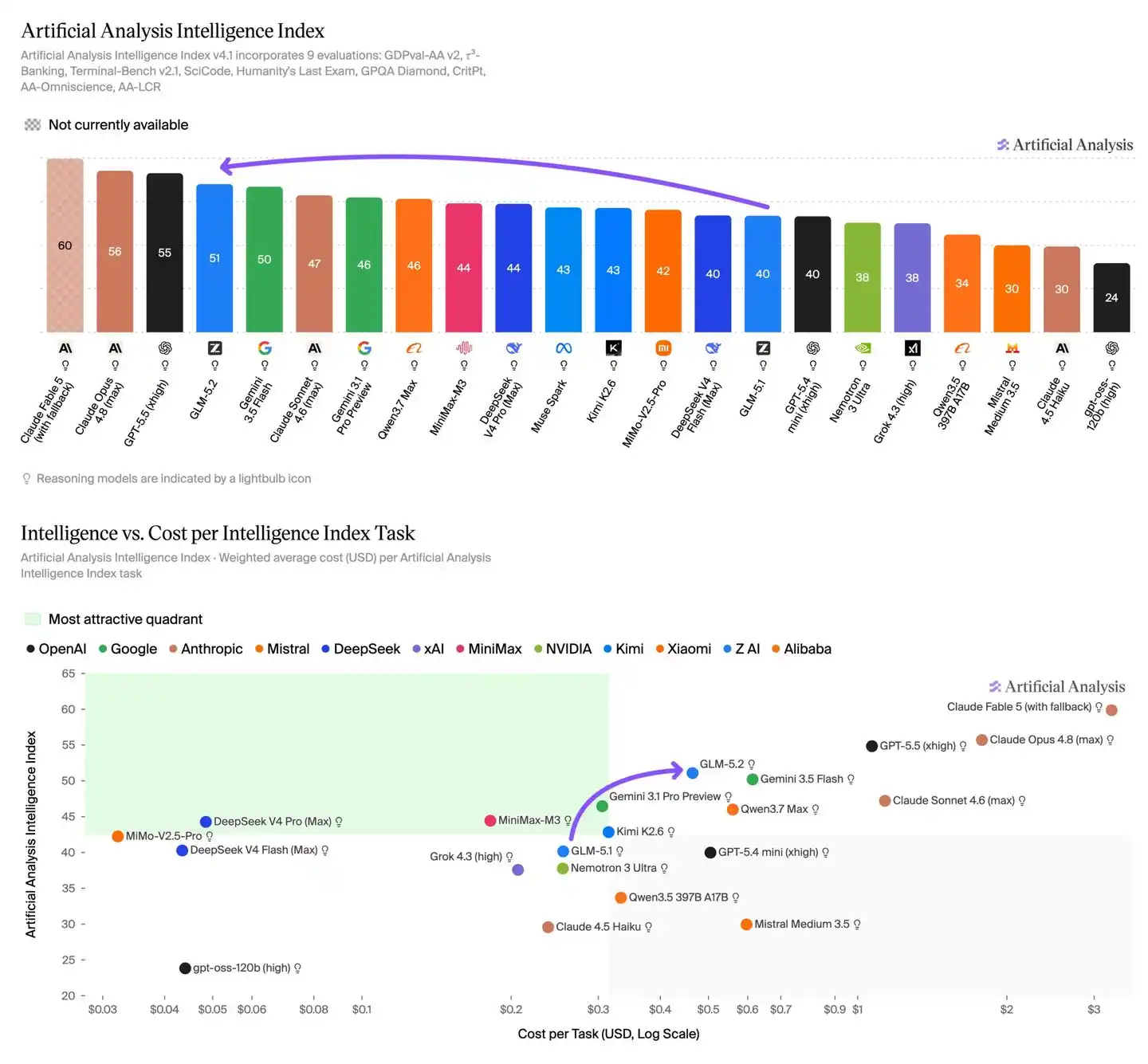
At the business model level, this generation of open-source models is driving a cost-driven demand restructuring. A joint 2026 research report from MIT Sloan and Haas Business School indicated that the "optimal demand redistribution" from closed-source APIs to open-source models could, on average, reduce AI inference costs for multinational corporations by over 70%, saving the global AI economy approximately $25 billion annually. Looking at the technological evolution slope, the benchmark performance gap between open-source and closed-source models was close to 18 percentage points by the end of 2023. By 2026, open-source models like Qwen 3.5 scored 88.4 on the scientific reasoning benchmark (GPQA Diamond), nearing the level of many closed-source options.

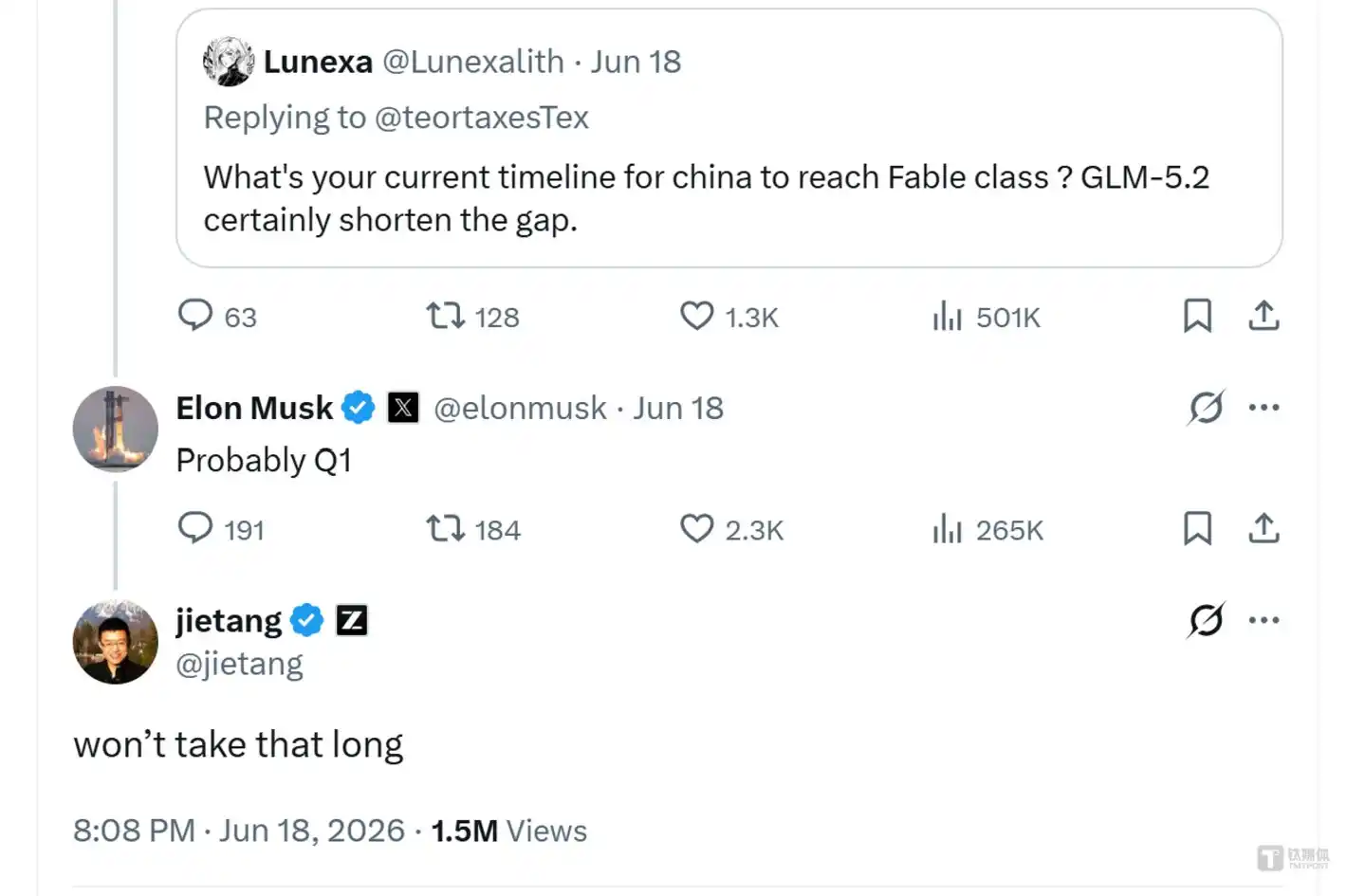
When the performance gap narrows to within 10% while costs drop to one-tenth, commercial substitution logic begins to take effect. For globalized enterprises, open-source models like GLM-5.2 that support localized private deployment are not just technological alternatives but also redundant backups in managing cross-border trade compliance risks. When Musk predicted on platform X that Chinese AI would catch up to Fable-level capabilities by Q1 2027, Zhipu CEO Tang Jie's brief response "not that long" was based precisely on this engineering-level progress towards an industrial closed loop.
GPT-5.6's Shift in Focus

To counter the convergence of open-source models in language and coding capabilities, the closed-source camp is accelerating efforts to rebuild its technological moats.

Several developers have extracted mapping entries pointing to "gpt-5.6" from OpenAI's Codex routing logs. This pattern accurately predicted the release timelines for both GPT-5.4 and GPT-5.5 prior to their launches. On the Polymarket prediction market, the contract probability for "GPT-5.6 launching before June 30th" currently hovers between 80% and 89%, with capital flow data suggesting the market expects its release schedule won't be substantially delayed by recent regulatory turmoil.

Leaked technical details indicate that GPT-5.6's upgrade focus has shifted from traditional "linguistic intelligence" to "spatial intelligence (world models)." OpenAI reportedly increased its internal reasoning parameter "Juice Value" from 768 to 960, sacrificing single-response speed to achieve higher output accuracy by extending internal reasoning chains. Simultaneously, its context window expanded from 1 million to 1.5 million tokens, increasing the processing capacity for Agentic multi-step workflows by 50%.

More indicative of commercial strategic direction are its capabilities in 3D spatial understanding, scene generation, physics animation, and SVG code generation. Test feedback suggests GPT-5.6 Pro's performance on physics simulation tasks and WebGL renderer creation is approaching that of the restricted Fable 5.

The strategic intent of this technological roadmap is clear: as the technical barriers in text and general coding are gradually eroded by the open-source camp, closed-source giants are moving the main battlefield to the domain of "world models"—requiring massive computational consumption, highly complex multimodal alignment, and simulation of physical space. By establishing a new generational gap in industrial simulation, robotics training, and 3D design scenarios, they aim to revalidate the commercial premium of closed-source APIs.

The underlying logic of the large model supply chain completed its transformation in the summer of 2026. The yardstick for enterprises evaluating underlying infrastructure is evolving from a singular metric of technical performance to a comprehensive assessment of performance coupled with policy compliance.

Closed-source giants are leveraging world models and spatial intelligence to redraw technological boundaries, attempting to build new generational advantages in industrial and robotics fields. However, the case of Fable 5 proves that regardless of technological evolution, product usability can still be restricted in the face of normalized administrative compliance constraints. Technological leadership is no longer the sole guarantee for sustaining a business; compliance and access stability have become equally critical prerequisites.

For AI application-layer developers and entrepreneurs, tightly coupling core business workflows to the closed-source API of a single model vendor means exposing the business to extremely high external, uncontrollable risks. Implementing a thoroughly "model-agnostic" decoupled design at the system's foundational architectural level—ensuring the business can seamlessly switch from a compliance-restricted solution to a controllable, locally-deployed open-source alternative within a short timeframe—is no longer mere architectural theory. It has become the most basic baseline for enterprises to maintain business continuity in the current landscape. (This article was first published on TMTPost APP, Author | AGI-Signal, Editor | Qin Conghui)


Пов'язані питання

QWhat is the main theme of the article regarding the future of the global AI industry?

AThe article's main theme is that the AI industry is shifting from a focus on technological advancement to a prioritization of 'usability' and compliance, leading to a 'dual-track' system of controlled closed-source models and local open-source alternatives. Technical superiority is no longer the sole guarantee for business continuity, as regulatory compliance and access stability have become equally critical.

QAccording to the article, what was the primary reason for the restriction of Anthropic's Fable 5 model?

AThe primary reason for restricting access to Anthropic's Fable 5 was not a technical issue but a regulatory compliance action. The U.S. Department of Commerce issued an order to limit access for non-U.S. citizens to prevent the potential reverse engineering and proliferation of the model's advanced capabilities, highlighting the growing influence of geopolitical and export control regulations on AI availability.

QWhat significant advantage does the open-source model GLM-5.2 offer to multinational enterprises, as highlighted in the article?

AThe open-source model GLM-5.2 offers multinational enterprises the significant advantage of drastically reducing AI inference costs (by over 70% according to the article) while providing a stable, locally deployable alternative. This serves as a risk management tool against the compliance and access instability associated with closed-source APIs, ensuring business continuity.

QWhat new technical focus is OpenAI's GPT-5.6 shifting towards, and why?

AOpenAI's GPT-5.6 is shifting its technical focus from traditional 'language intelligence' to 'spatial intelligence' or 'world models'. This includes advanced capabilities in 3D spatial understanding, scene generation, physical simulation, and SVG code generation. The strategic intent is to build a new technological moat in areas that are computationally intensive and complex, aiming to re-establish a commercial premium for closed-source APIs as the performance gap in language and code narrows with open-source models.

QWhat is the critical strategic recommendation for AI application developers and entrepreneurs mentioned in the conclusion?

AThe critical strategic recommendation is for developers and entrepreneurs to implement a thoroughly 'model-agnostic' or decoupled design in their core system architecture. This means not binding their core business logic to a single closed-source API. Instead, they must ensure the ability to seamlessly switch to alternative, locally deployable open-source models to mitigate the high risk of external, uncontrollable factors like regulatory compliance actions that can disrupt service availability.

Пов'язані матеріали

Vitalik's Algorithmic Stablecoin Vision: Interpreting the Mechanism and Challenges from an Options Perspective

Vitalik Buterin's recent algorithmic stablecoin proposal envisions using an option-like mechanism to create a stablecoin without the liquidation risks inherent in traditional collateralized debt position (CDP) models. The design splits one unit of ETH into two components: a 'stable' leg (P) that maintains value up to a certain strike price, and an 'upside' leg (N) that captures any appreciation above that price. Together, they always sum to one ETH, eliminating the need for debt or liquidation mechanisms. From an options perspective, the stable leg essentially functions as a synthetic, covered call position. However, significant challenges exist. For the stable asset to maintain its peg, it must continuously roll deep in-the-money call options, leading to potential rollover slippage, predictable trading paths vulnerable to front-running, and liquidity issues. Crucially, the system's scalability depends on a constant demand for the upside leg—a form of leveraged ETH long position without funding rates or liquidation risk. It's unclear if such persistent, specific demand will materialize from speculators or market makers who have simpler alternatives like perpetual swaps. The author, drawing from experience with Rysk, argues that DeFi options have struggled as standalone trading products due to complexity and fragmented liquidity. Their potential lies instead as foundational infrastructure underpinning more complex financial primitives like stablecoins, structured yields, or index products—transforming from a direct product into a core pricing and risk distribution engine for the next generation of on-chain finance.

marsbit37 хв тому

Vitalik's Algorithmic Stablecoin Vision: Interpreting the Mechanism and Challenges from an Options Perspective

marsbit37 хв тому

Is the 'Token Subsidy War' Among AI Giants Almost Over?

The article discusses the ongoing "token subsidy war" among AI giants like OpenAI and Anthropic, questioning whether it's nearing its end. It reveals that current AI subscription prices are heavily subsidized, with some plans offering tokens at up to 70 times the actual cost to attract and retain heavy users, especially developers and enterprises. This strategy mirrors past internet-era subsidy battles, but with a key difference: AI tokens lack "lock-in" effects. Unlike ride-hailing or food delivery apps, users can easily switch between AI providers as APIs become standardized, making it difficult for companies to raise prices post-subsidy. The piece highlights a structural asymmetry in the competition. Giants like Google, with massive advertising revenue, can afford to subsidize tokens indefinitely, akin to using "tokens as a weapon." In contrast, venture-backed companies like OpenAI and Anthropic face pressure to become profitable, especially as they approach IPO. The article cites Google Ventures founder Bill Maris, who suggests Google could slash token prices by 80%, putting immense pressure on competitors. Two potential endgames are presented: the "internet service" model (subsidize, monopolize, then raise prices) and the "utility" model (tokens become a standardized, low-margin commodity like electricity). Given the low switching costs, the latter seems more likely. The competition may not have a single winner but could instead accelerate AI's evolution into a foundational, infrastructure-level technology, akin to a public utility. For now, users continue to benefit from heavily subsidized token costs.

marsbit3 год тому

Is the 'Token Subsidy War' Among AI Giants Almost Over?

marsbit3 год тому

Beyond the Stadium: The Profitable Games Surrounding the World Cup

"Beyond the Pitch: The Profit Game Around the World Cup" The FIFA World Cup transcends being a sporting spectacle, evolving into a massive global arena for speculation and profit-seeking. The 2026 tournament has amplified this dynamic, creating a multi-layered ecosystem of financial opportunism alongside the football. **Prediction markets** have surged into the mainstream. Platforms like Polymarket and Kalshi saw trading volumes for World Cup contracts soar, attracting new users with their financial trading model and high-profile, chain-based wealth stories that overshadow traditional sports betting in terms of growth and narrative. However, **traditional sportsbooks** remain the dominant force, leveraging established user habits, legal markets, and comprehensive product offerings to handle the vast majority of speculative wagers, with projections suggesting record-breaking betting volumes. Capital markets also react. **"Concept stocks"** in countries like South Korea and Japan experience volatile price swings based on team performance and anticipated fan spending on items like chicken, beer, and viewing parties, effectively becoming a stock market reflecting fan sentiment. The **ticket resale market** has become a sophisticated arena for arbitrage. Prices fluctuate wildly based on team draws and star power, with sellers sometimes listing tickets they don't yet own in a practice akin to short-selling, while FIFA's own "Right to Buy" tokens add another layer of speculative trading. **Collectibles and merchandise** offer another avenue. Panini sticker albums, with their inherent scarcity and nostalgic value, can become high-value collectibles. Limited-edition or locally themed jerseys command significant premiums on secondary markets, and even counterfeit vendors profit from fans' desire for affordable match-day identity. The **cryptocurrency** space has seen a frenzy of speculative, unauthorized World Cup-themed meme coins on chains like Solana. These tokens, often exploiting team names and player imagery, experience extreme pump-and-dump cycles, creating stories of massive gains for a few early entrants and steep losses for many others. Finally, an entire industry thrives on **providing information and tools** to other speculators. Developers create platforms like SeatSidekick to track ticket inventory and prices, while paid Telegram groups and subscriptions sell betting tips and predictions, monetizing the widespread desire for an informational edge. In essence, the World Cup has become a compressed, global laboratory for speculation. While the games determine champions on the field, a parallel, complex network of financial transactions—spanning prediction contracts, bets, stocks, tickets, collectibles, crypto, and information services—settles its own scores in the global market.

marsbit4 год тому

Beyond the Stadium: The Profitable Games Surrounding the World Cup

marsbit4 год тому

Торгівля

Спот
Ф'ючерси
活动图片