From ZEC's Surge to Vitalik's Support: Will the Privacy Narrative Resurface?

marsbitОпубліковано о 2026-05-27Востаннє оновлено о 2026-05-27

Анотація

From ZEC's surge to Vitalik's endorsement, is privacy making a comeback? The recent rally in ZEC has refocused attention on the crypto privacy sector. This resurgence stems from a growing market realization: while blockchain transparency builds trust, full exposure of user balances, trading strategies, and risk positions can become a vulnerability, especially for large traders and institutions on platforms like Hyperliquid. The privacy landscape has evolved beyond classic anonymity coins like ZEC, XMR, and DASH. It now encompasses privacy infrastructure projects such as Railgun (bringing privacy to DeFi) and Aztec (a privacy-focused L2), as well as newer entrants like Genius Terminal, SilentSwap, and 0xBow that emphasize transaction privacy while attempting to balance compliance. Industry trends confirm privacy is becoming integrated, not a niche feature. Perp DEX Aster has introduced a "Shield Mode," and Vitalik has discussed the need for native privacy at the Ethereum protocol level, including proposals like EIP-8182 for standardized private transfers. In conclusion, this revival is more than a simple sector rotation. It reflects a critical reassessment of transparency's limits. As on-chain finance matures, the challenge is finding a sustainable balance between necessary transparency for trust and essential privacy for protecting assets and strategies, making privacy a potential cornerstone of next-generation infrastructure.

Author: Changan I Biteye Content Team

A strong rally in ZEC has brought the long-dormant privacy sector back to the center of market attention.

Beyond the price increase, more importantly, it has reignited market discussion about the privacy narrative: In today's world of increasingly transparent on-chain data and easily traceable transactions, is privacy still a niche demand?

In the past, privacy was often understood as the anonymity needs of a few users. But as more funds, transactions, and strategies move on-chain, privacy is becoming a more realistic problem: If all behaviors are visible, will on-chain finance truly be safer?

Starting from ZEC's current price action, let's examine what the market is actually discussing behind the renewed focus on the privacy sector.

I. Full On-Chain Transparency: From Cornerstone of Trust to a Targeted Weakness

The open-book risk brought by on-chain transparency first appeared in lending liquidation scenarios.

As early as the last cycle, when institutions or large holders engaged in on-chain lending, their collateral, debt size, health factor, and liquidation prices were almost all publicly visible. By monitoring these addresses, one could clearly see their risk positions.

When a large holder's liquidation price is visible to everyone, other traders might trade around that liquidation line. The price could be pushed into the liquidation range, triggering a margin call, followed by a quick rebound.

Such cases made many realize for the first time that completely public on-chain data also means being targetable.

This issue has become even more pronounced in the current cycle.

With the popularity of on-chain derivatives platforms like Hyperliquid, more whales are opening positions on-chain. Large positions, trade direction, margin changes, and liquidation prices could all be monitored by the market.

  • For ordinary users, transparency might just mean information disclosure.

  • But for large-scale traders, transparency sometimes means exposing their trading intentions and risk positions to all counterparties.

Therefore, the renewed focus on the privacy sector is not just due to the rise of certain tokens, nor is it merely a rotation among legacy privacy coins.

The deeper issue is: Can a fully transparent on-chain environment continue to support larger-scale, more professional on-chain financial activities?

Users need transparency to build trust, but they also need privacy to protect assets, strategies, and trading security.

II. Overview of the Three Core Segments in the Privacy Sector

Judging from this cycle's market action, the privacy sector is no longer just about legacy anonymous coins. It can be roughly divided into three categories: one includes legacy privacy assets like ZEC and XMR; another includes privacy infrastructure represented by Railgun and Aztec; and a third includes projects like Genius, SilentSwap, and 0xBow, which emphasize transaction privacy and compliance.
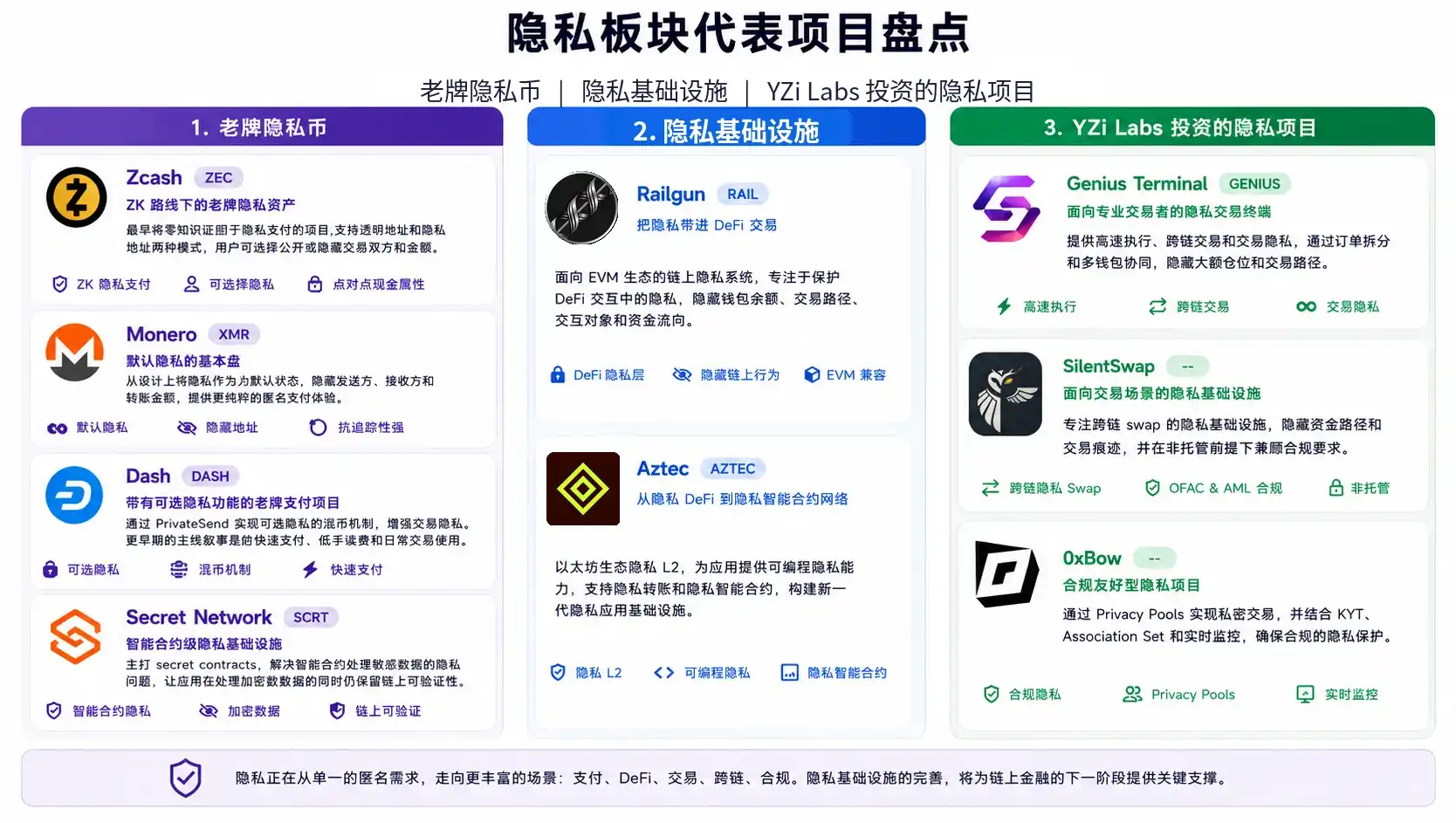
1. Legacy Privacy Coins: Asset and Payment Properties

Zcash (ZEC): Legacy Privacy Asset on the ZK Path

X: @zcash | XHunt Ranking: 13364

Zcash is a representative legacy privacy coin and one of the earliest crypto projects to use zero-knowledge proofs for private payments. Unlike regular public chains where all transactions are publicly viewable, Zcash supports both transparent and shielded (private) addresses.

Users can make public transfers like they would with Bitcoin, or they can hide the sender, receiver, and amount through shielded transactions.

Zcash's official definition is "encrypted electronic cash," emphasizing its properties for private peer-to-peer payments.

💰 Token Performance:

Naval Ravikant once stated on X: If Bitcoin is insurance against fiat currency risk, then Zcash is insurance against Bitcoin's transparency risk.

In terms of price performance, ZEC has been one of the most prominent primary assets in this cycle's privacy sector, rising from around $200 in March to $620.

Monero (XMR): The Default Privacy Baseline

X:@monero|XHunt Ranking: 4812

Monero is another highly representative project among legacy privacy coins, with its core positioning being default-private payments.

Unlike Zcash's optional privacy, Monero is designed with privacy as the default state from the ground up; transactions hide the sender, receiver, and amount.

Default privacy makes it more purist in the direction of anonymous payments, but it also subjects it to long-term higher regulatory pressure and exchange liquidity pressure.

💰 Token Performance:

However, judging from this cycle's market action, XMR's price performance hasn't been particularly outstanding. Although the broader market environment itself isn't strong, compared to ZEC, XMR clearly lacks elasticity.

Dash (DASH): Legacy Payment Project with Optional Privacy Features

X:@Dashpay|XHunt Ranking: 11376

Dash is an early entrant into the market, a legacy crypto project focused on payments. Dash's privacy features are optional, primarily implemented through PrivateSend.

The core idea of PrivateSend is to enhance transaction privacy through a coin mixing mechanism, allowing users to hide fund sources and transaction paths when needed. However, in terms of positioning, Dash is not a pure privacy coin; its earlier main narratives were actually fast payments, low fees, and everyday transactional use.

💰 Token Performance:

From this cycle's action, DASH has seen periodic rebounds, but its overall performance is not as prominent as ZEC's. Its current price is around 43 USDT. While it still carries the labels of a legacy payment project and optional privacy, the market's pricing of it seems more driven by sector rotation rather than a re-pricing of a primary privacy asset.

Secret Network (SCRT): Smart Contract-Level Privacy Infrastructure

X:@SecretNetwork|XHunt Ranking: 3677

Secret Network is an early public chain project focused on smart contract-level privacy, with its core feature being secret contracts. Unlike traditional privacy coins that focus on transfer privacy, it aims to solve data privacy problems at the application layer: Can smart contracts process sensitive data during execution without exposing everything on the public chain?

Secret Network's advantage lies in bringing privacy capabilities to the application layer. For applications like DeFi, NFTs, gaming, identity, and data markets, many scenarios are not suitable for completely public user data. The significance of secret contracts is enabling applications to process encrypted data while retaining on-chain verifiability.

💰 Token Performance:

In terms of price performance, SCRT hasn't clearly benefited from this round of privacy narrative resurgence. Its current price is around $0.08, still in a long-term low range.

2. New-Generation Privacy Infrastructure: Empowering the Application Layer

Railgun (RAIL): Bringing Privacy into DeFi Trading

X:@RAILGUN_Project|XHunt Ranking: 4099

Railgun is an on-chain privacy system for the EVM ecosystem, primarily serving DeFi scenarios. It doesn't aim to create a new privacy payment asset; rather, it hopes to bring privacy features into DeFi trading.

On public chains, users' wallet balances, transaction paths, counterparties, and fund flows can all be traced.

  • For ordinary users, this means asset exposure.

  • For traders, it means strategies could be copied or even targeted.

This is the problem Railgun aims to solve: allowing users to hide their on-chain behavior while participating in DeFi.

It's worth noting that Vitalik recently discussed the underlying problems faced by privacy protocols when talking about the Ethereum Foundation's future direction. He believes that protocols like smart contract wallets and Railgun still need intermediaries to submit transactions to the chain, which itself is a vulnerability.

💰 Token Performance:

RAIL has also clearly benefited from the recent warming of the privacy sector. The RAIL token's market cap has risen from 60M in April to 240M currently.

Compared to high-market-cap primary assets like ZEC, RAIL resembles more of a high-beta play within the privacy sector—easier to rally quickly when the narrative heats up, but with more pronounced liquidity and volatility.

Aztec (AZTEC): From Private DeFi to Private Smart Contract Network

X:@aztecnetwork|XHunt Ranking: 760

Aztec is a privacy L2 in the Ethereum ecosystem, positioned to provide programmable privacy for applications.

It's not a new project. Aztec initially launched zk.money and Aztec Connect, providing Ethereum users with private transfers and private DeFi entry points. However, in 2023, the team chose to shut down Aztec Connect and shift focus to a new private smart contract network.

In late 2025, AZTEC held a public token sale using a Continuous Clearing Auction mechanism, with the public sale price around $0.047.

💰 Token Performance:

From its secondary market performance, AZTEC's overall performance since listing hasn't been particularly strong. Its current price is around $0.025, still below the public sale cost. However, with the resurgence of the privacy sector, AZTEC has also seen a noticeable rebound recently.

3. YZi Labs' Investment Portfolio: Focusing on the Balance Between Transaction Privacy and Compliance

Genius Terminal (GENIUS): Privacy Trading Terminal for Professional Traders

X:@GeniusTerminal|XHunt Ranking: 7845

Genius Terminal is an on-chain trading terminal for professional DeFi users, emphasizing high-speed execution, cross-chain trading, and transaction privacy.

Genius can help users hide large positions and trading paths through order splitting and multi-wallet coordination. Users can complete cross-chain trades within one terminal without frequently switching wallets, bridges, and DEXs.

In January 2026, YZi Labs announced an investment in Genius, calling it a "private high-velocity on-chain trading terminal."

YZi Labs mentioned that Genius's goal is to provide an experience close to that of centralized exchanges in terms of speed, liquidity, and privacy, without sacrificing user ownership and decentralization.

💰 Token Performance:

In terms of secondary market performance, GENIUS has shown obvious short-term elasticity recently. Its current price is around $0.73.

SilentSwap: Privacy Infrastructure for Trading Scenarios

X:@SilentSwap|XHunt Ranking: 78144

SilentSwap is a privacy infrastructure for cross-chain trading scenarios, focusing on private cross-chain swaps. It aims to allow users to hide their fund paths and transaction traces when performing cross-chain swaps, transfers, and bridging assets.

On public chains, cross-chain transactions often expose a lot of information: which chain a user came from, what assets were swapped, the final destination of funds, and whether different addresses are associated. SilentSwap aims to solve this type of privacy leakage in cross-chain transactions.

Another feature of SilentSwap is that it doesn't just emphasize privacy; it also puts compliance among its product selling points. Its website explicitly lists "OFAC & AML Compliant" and states that it holds two legal opinions in the US. This sets it apart from traditional privacy projects that "only emphasize anonymity": it attempts to find a balance between non-custodial, cross-chain privacy, and compliance.

0xBow: Compliance-Friendly Privacy Project

X:@0xbowio|XHunt Ranking: 9376

0xBow is an infrastructure project for on-chain privacy and compliance scenarios, with its core direction being compliant onchain privacy.

Unlike traditional privacy projects emphasizing "untraceability," 0xBow is more concerned with: Can users prove their funds are not mixed with illicit activities while protecting their transaction privacy?

Its core product is Privacy Pools. Privacy Pools support peer-to-peer private transactions while avoiding users' funds mixing with illegal funds. 0xBow monitors deposits entering Privacy Pools and filters them through a Know Your Transaction mechanism. Only funds meeting the criteria enter the Association Set.

Behind this lies 0xBow's Association Set Provider (ASP). ASPs continuously monitor transactions within Privacy Pools, identify suspicious patterns, and support Proof of Association, real-time transaction monitoring, programmable compliance, and modular deployment.

In other words, 0xBow isn't simply creating an anonymous pool; it attempts to make private transactions operate within a compliance framework.

III. Industry Consensus: Privacy is No Longer an "Isolated Narrative"

Aster: Perp DEXs Also Begin Introducing Transaction Privacy

Aster itself is a Perp DEX, but its Shield Mode has already integrated privacy into the derivatives trading experience.

This indicates that privacy needs no longer exist only in transfer scenarios. For on-chain traders, what is truly sensitive is often trade direction, position size, transaction paths, and fund intentions.

Especially in Perp DEXs, if large trades and position changes are exposed in a public environment, they are prone to being copied, targeted, or even front-run.

Therefore, Aster's Shield Mode is essentially not a traditional privacy coin feature; it embeds transaction privacy into the Perp DEX product itself. It reflects a more specific trend: If on-chain derivatives want to continue attracting more professional trading demand, they may need to address not just liquidity and fees but also the issue of exposed trading intent.

Vitalik: Ethereum Also Needs Native Privacy

It's not just the application layer that is starting to value privacy; the Ethereum core roadmap is also beginning to revisit this issue.

Recently, Vitalik also mentioned Ethereum's lack of native privacy capabilities and proposed a set of short-term privacy improvement directions, including Account Abstraction, FOCIL, keyed nonces, and access-layer privacy work like Kohaku. These correspond to censorship resistance, transaction unlinkability, and privacy protection in wallets and chain-reading processes, respectively.

This shows that privacy is no longer just an add-on feature for external applications; it is also being discussed within wallet designs, transaction structures, access layers, and protocol design.

EIP-8182: Ethereum Also Discusses Native Private Transfers

EIP-8182 proposes introducing a standardized private transfer system for Ethereum. Through a shared shielded pool, system contracts, and ZK verification precompiles, it aims to give ETH and ERC-20 transfers native privacy capabilities.

Simply put, it asks: Can private transfers no longer rely on fragmented third-party applications but instead become shared infrastructure at the Ethereum protocol layer?

In the past, privacy on Ethereum was often fragmented. Different protocols had different privacy pools, different entry points, and different anonymity sets, resulting in a non-uniform user experience and diluted privacy effects.

EIP-8182 attempts to push this issue toward the protocol layer: If ETH and ERC-20s can share a common private transfer infrastructure, wallets, applications, and users can all more easily access privacy capabilities.

This also illustrates that privacy is no longer just the narrative of a few specific privacy projects. Whether it's Aster embedding privacy into its Perp DEX or EIP-8182 pushing private transfers toward the Ethereum protocol layer, they essentially point to the same thing:

The more mature the on-chain world becomes, the less privacy resembles a niche feature and the more it resembles part of the next stage of infrastructure.

IV. Conclusion: Finding the Balance Between Transparency and Protection

The privacy sector's return to the market spotlight this cycle appears, on the surface, to be a sector rotation play. However, if we only interpret it as "privacy coins are hot again," we might underestimate the significance of this change. What has truly changed is that the market is beginning to re-examine the boundaries of on-chain transparency.

In the past, the crypto industry often equated transparency with trust, believing that as long as all information is public, the system is more trustworthy. But transparency does not mean all financial behavior should be exposed without reservation. Users' asset balances, transaction paths, position changes, liquidation prices, and strategic intentions are essentially sensitive information. When this information is completely public, transparency can transform from a trust mechanism into a new source of risk.

Therefore, privacy is not the opposite of transparency; it is answering a more practical question: For on-chain finance to continue expanding, what information should be public, and what information should be protected? What will truly matter in the future may not be who can achieve the most complete anonymity, but who can find the balance between transparency, privacy, compliance, and usability.

When on-chain finance was still in the small-scale experimental stage, complete transparency might have sufficed. But if it is to carry larger funds, more complex trades, and more professional participants, privacy ceases to be merely a niche demand and becomes part of the infrastructure for the next stage.


Пов'язані питання

QWhat is the main reason behind the renewed interest in the privacy sector, beyond the rise in ZEC's price?

AThe deeper reason is market concern over whether a fully transparent on-chain environment can continue to support larger-scale, more professional on-chain financial activities. Users need transparency for trust but also need privacy to protect assets, strategies, and trading safety from risks like front-running and targeted attacks.

QAccording to the article, how is the modern privacy sector categorized?

AThe modern privacy sector is categorized into three main groups: 1) Legacy privacy assets like ZEC and XMR, focusing on private payments. 2) Next-generation privacy infrastructure like Railgun and Aztec, focusing on application-layer privacy (e.g., for DeFi). 3) Projects focusing on a balance between transaction privacy and compliance, like Genius, SilentSwap, and 0xBow, which are associated with YZi Labs' investments.

QWhat is the key difference between Zcash (ZEC) and Monero (XMR) regarding privacy?

AZcash offers optional privacy, allowing users to choose between transparent (public) addresses and shielded (private) addresses for transactions. Monero, in contrast, has privacy as its default state, where all transactions automatically hide the sender, receiver, and transaction amount by design.

QWhat point did Vitalik Buterin make about the current state of privacy protocols on Ethereum?

AVitalik pointed out that current privacy protocols, like those using smart contract wallets or Railgun, still have a vulnerability: they require an intermediary to submit transactions to the chain. He also discussed Ethereum's need for native privacy improvements, mentioning directions like Account Abstraction, FOCIL, and keyed nonces to address censorship resistance and transaction unlinkability.

QWhat is the core idea behind EIP-8182 for Ethereum?

AEIP-8182 proposes introducing a standardized private transfer system at the protocol level for Ethereum. It aims to enable native privacy for ETH and ERC-20 transfers by creating shared infrastructure like a shielded pool, system contracts, and ZK verification precompiles, moving away from fragmented, application-specific privacy solutions.

Пов'язані матеріали

Retail Investors' 'Lead Brother' Serenity vs. Newly Minted Stock God Leopold: How Are the Two Top Hunters Mining AI's 'Physical Limits'?

The article profiles two prominent figures, Serenity and Leopold Aschenbrenner, who are gaining attention for their unconventional investment strategies focused on the physical constraints of the AI boom, moving beyond mainstream software narratives. Serenity, an anonymous online trader, advocates a "shiso leaf" theory. He targets small-cap companies with monopolies on critical, overlooked components in the AI hardware supply chain, such as specific semiconductor materials. His deep, technical analysis of bottlenecks in areas like co-packaged optics (CPO) has reportedly yielded massive returns, though his anonymity and focus on illiquid micro-cap stocks pose significant risks for followers. Leopold Aschenbrenner, a former OpenAI researcher, founded a multi-billion dollar hedge fund. His macro thesis argues that physical infrastructure—power grids, land, data centers—is the true bottleneck for AI growth, lagging far behind chip production. Consequently, his fund employs an infrastructure arbitrage strategy: heavily investing in storage and compute infrastructure companies while placing massive bearish bets (put options) against major semiconductor stocks, betting their valuations will correct as physical constraints become apparent. While their methods differ—Serenity drills into microscopic supply chain details, while Leopold takes a macroscopic, infrastructure-focused view—both share a core belief: the real power and investment alpha in the AI era lie in controlling scarce physical resources, not just software. The article concludes by noting the inherent risks in both approaches, such as liquidity issues for micro-caps and timing risks for macro bets, but suggests they signal a broader market re-evaluation of AI's foundational assets.

marsbit2 год тому

Retail Investors' 'Lead Brother' Serenity vs. Newly Minted Stock God Leopold: How Are the Two Top Hunters Mining AI's 'Physical Limits'?

marsbit2 год тому

Who Will Make Money in the Age of Agents?

In the Agents era of blockchain, traditional value capture theories face challenges. The "Fat Protocol" theory, dominant since 2016, suggested protocols capture most value as their tokens are essential for network use. However, the proliferation of interchangeable L1s, L2s, and modular layers has eroded protocol scarcity and pricing power. Conversely, the "Fat App" theory posits that applications capturing user relationships (like wallets and exchanges) become the primary value layer by controlling distribution and transaction flows. This aligns with the current "Great Repricing" cycle. Agents disrupt this logic. As software users, they lack brand loyalty, prioritize cost and efficiency, and switch between platforms seamlessly. This undermines the front-end UX moats that "Fat Apps" rely on. The article explores several potential futures: 1. **Headless Applications:** Current leading apps could strip their front-ends and become backend API infrastructure for Agents, preserving their role. 2. **Protocol Resurgence:** If integration becomes trivial, Agents might bypass aggregators and interact directly with protocols, reviving "Fat Protocol" dynamics. 3. **Pricing Power Collapse:** Agents' rational, frictionless routing could commoditize the entire stack, compressing margins toward cost and leaving little profit for intermediaries. 4. **Unprecedented Activity:** Agents may enable new, high-frequency, machine-to-machine economic activities, expanding the total value pie even if margins are thin. 5. **A New, Unnamed Model:** Historically, major tech shifts (like the internet's attention economy) create unforeseen business models. The Agents era may spawn entirely new ways to capture value. The most likely outcome is a coexistence where "Fat Apps" continue to serve human users valuing UX, while a separate, Agent-driven economy emerges governed by different rules—where loyalty is based on factors like liquidity, latency, and settlement guarantees rather than brand.

marsbit4 год тому

Who Will Make Money in the Age of Agents?

marsbit4 год тому

Торгівля

Спот
Ф'ючерси

Популярні статті

Що таке $S$

Розуміння SPERO: Комплексний огляд Вступ до SPERO Оскільки ландшафт інновацій продовжує еволюціонувати, виникнення технологій web3 та криптовалютних проектів відіграє ключову роль у формуванні цифрового майбутнього. Один з проектів, який привернув увагу в цій динамічній сфері, — це SPERO, позначений як SPERO,$$s$. Ця стаття має на меті зібрати та представити детальну інформацію про SPERO, щоб допомогти ентузіастам та інвесторам зрозуміти його основи, цілі та інновації в рамках web3 та крипто-сектору. Що таке SPERO,$$s$? SPERO,$$s$ — це унікальний проект у криптопросторі, який прагне використати принципи децентралізації та технології блокчейн для створення екосистеми, що сприяє залученню, корисності та фінансовій інклюзії. Проект розроблений для полегшення взаємодії між користувачами новими способами, надаючи їм інноваційні фінансові рішення та послуги. У своїй основі SPERO,$$s$ прагне надати можливості індивідам, забезпечуючи інструменти та платформи, які покращують користувацький досвід у криптовалютному просторі. Це включає в себе можливість більш гнучких методів транзакцій, сприяння ініціативам, що підтримуються спільнотою, та створення шляхів для фінансових можливостей через децентралізовані додатки (dApps). Основна концепція SPERO,$$s$ обертається навколо інклюзивності, прагнучи зменшити розриви в традиційній фінансовій системі, використовуючи переваги технології блокчейн. Хто є творцем SPERO,$$s$? Особистість творця SPERO,$$s$ залишається дещо невідомою, оскільки є обмежені публічно доступні ресурси, що надають детальну інформацію про його засновників. Ця відсутність прозорості може бути наслідком зобов'язання проекту до децентралізації — етики, яку багато проектів web3 поділяють, ставлячи колективні внески вище за індивідуальне визнання. Зосереджуючи обговорення навколо спільноти та її колективних цілей, SPERO,$$s$ втілює суть наділення без виділення конкретних осіб. Таким чином, розуміння етики та місії SPERO є більш важливим, ніж ідентифікація єдиного творця. Хто є інвесторами SPERO,$$s$? SPERO,$$s$ підтримується різноманітними інвесторами, починаючи від венчурних капіталістів до ангельських інвесторів, які прагнуть сприяти інноваціям у крипто-секторі. Зосередження цих інвесторів зазвичай узгоджується з місією SPERO — пріоритет надається проектам, які обіцяють технологічний прогрес у суспільстві, фінансову інклюзію та децентралізоване управління. Ці інвесторські фонди зазвичай зацікавлені в проектах, які не лише пропонують інноваційні продукти, але й позитивно впливають на спільноту блокчейн та її екосистеми. Підтримка з боку цих інвесторів підкріплює SPERO,$$s$ як значного конкурента в швидко змінюваній сфері крипто-проектів. Як працює SPERO,$$s$? SPERO,$$s$ використовує багатогранну структуру, яка відрізняє його від традиційних криптовалютних проектів. Ось деякі ключові особливості, які підкреслюють його унікальність та інноваційність: Децентралізоване управління: SPERO,$$s$ інтегрує моделі децентралізованого управління, надаючи користувачам можливість активно брати участь у процесах прийняття рішень щодо майбутнього проекту. Цей підхід сприяє відчуттю власності та відповідальності серед членів спільноти. Корисність токена: SPERO,$$s$ використовує свій власний криптовалютний токен, розроблений для виконання різних функцій в екосистемі. Ці токени дозволяють здійснювати транзакції, отримувати винагороди та полегшувати послуги, що пропонуються на платформі, підвищуючи загальну залученість та корисність. Шарова архітектура: Технічна архітектура SPERO,$$s$ підтримує модульність та масштабованість, що дозволяє безперешкодно інтегрувати додаткові функції та додатки в міру розвитку проекту. Ця адаптивність є надзвичайно важливою для збереження актуальності в постійно змінюваному крипто-ландшафті. Залучення спільноти: Проект підкреслює ініціативи, що підтримуються спільнотою, використовуючи механізми, які стимулюють співпрацю та зворотний зв'язок. Підтримуючи сильну спільноту, SPERO,$$s$ може краще задовольняти потреби користувачів та адаптуватися до ринкових тенденцій. Фокус на інклюзію: Пропонуючи низькі комісії за транзакції та зручні інтерфейси, SPERO,$$s$ прагне залучити різноманітну базу користувачів, включаючи осіб, які раніше не брали участі в крипто-просторі. Це зобов'язання до інклюзії узгоджується з його загальною місією наділення через доступність. Хронологія SPERO,$$s$ Розуміння історії проекту надає важливі уявлення про його розвиток та етапи. Нижче наведено пропоновану хронологію, що відображає значні події в еволюції SPERO,$$s$: Етап концептуалізації та ідеації: Початкові ідеї, що стали основою SPERO,$$s$, були сформовані, тісно пов'язані з принципами децентралізації та фокусом на спільноті в індустрії блокчейн. Запуск білого паперу проекту: Після концептуального етапу був випущений комплексний білий папір, що детально описує бачення, цілі та технологічну інфраструктуру SPERO,$$s$, щоб залучити інтерес та зворотний зв'язок від спільноти. Створення спільноти та ранні залучення: Активні зусилля були спрямовані на створення спільноти ранніх прихильників та потенційних інвесторів, що полегшило обговорення цілей проекту та отримання підтримки. Подія генерації токенів: SPERO,$$s$ провів подію генерації токенів (TGE) для розподілу своїх рідних токенів серед ранніх прихильників та встановлення початкової ліквідності в екосистемі. Запуск початкового dApp: Перший децентралізований додаток (dApp), пов'язаний з SPERO,$$s$, став доступним, дозволяючи користувачам взаємодіяти з основними функціями платформи. Постійний розвиток та партнерства: Безперервні оновлення та вдосконалення пропозицій проекту, включаючи стратегічні партнерства з іншими учасниками блокчейн-простору, сформували SPERO,$$s$ у конкурентоспроможного та еволюціонуючого гравця на крипто-ринку. Висновок SPERO,$$s$ є свідченням потенціалу web3 та криптовалют для революціонізації фінансових систем та наділення індивідів. Завдяки зобов'язанню до децентралізованого управління, залучення спільноти та інноваційно спроектованих функцій, він прокладає шлях до більш інклюзивного фінансового ландшафту. Як і з будь-якими інвестиціями в швидко змінюваному крипто-просторі, потенційним інвесторам та користувачам рекомендується ретельно досліджувати та обдумано взаємодіяти з поточними подіями в SPERO,$$s$. Проект демонструє інноваційний дух крипто-індустрії, запрошуючи до подальшого дослідження його численних можливостей. Хоча подорож SPERO,$$s$ ще триває, його основні принципи можуть справді вплинути на майбутнє того, як ми взаємодіємо з технологією, фінансами та один з одним у взаємопов'язаних цифрових екосистемах.

73 переглядів усьогоОпубліковано 2024.12.17Оновлено 2024.12.17

Що таке $S$

Що таке AGENT S

Агент S: Майбутнє автономної взаємодії в Web3 Вступ У постійно змінюваному ландшафті Web3 та криптовалюти інновації постійно переосмислюють, як люди взаємодіють з цифровими платформами. Один з таких новаторських проектів, Агент S, обіцяє революціонізувати взаємодію людини з комп'ютером через свою відкриту агентну структуру. Прокладаючи шлях для автономних взаємодій, Агент S прагне спростити складні завдання, пропонуючи трансформаційні застосування в штучному інтелекті (ШІ). Це детальне дослідження заглиблюється в складності проекту, його унікальні особливості та наслідки для сфери криптовалюти. Що таке Агент S? Агент S є революційною відкритою агентною структурою, спеціально розробленою для вирішення трьох основних викликів в автоматизації комп'ютерних завдань: Набуття специфічних знань у галузі: Структура інтелектуально навчається з різних зовнішніх джерел знань та внутрішнього досвіду. Цей подвійний підхід дозволяє їй створити багатий репозиторій специфічних знань у галузі, покращуючи її продуктивність у виконанні завдань. Планування на довгих горизонтах завдань: Агент S використовує планування з підкріпленням досвіду, стратегічний підхід, який полегшує ефективний розподіл та виконання складних завдань. Ця функція значно підвищує її здатність ефективно та результативно управляти кількома підзавданнями. Обробка динамічних, неоднорідних інтерфейсів: Проект представляє Інтерфейс Агент-Комп'ютер (ACI), інноваційне рішення, яке покращує взаємодію між агентами та користувачами. Використовуючи багатомодальні великі мовні моделі (MLLMs), Агент S може безперешкодно орієнтуватися та маніпулювати різноманітними графічними інтерфейсами користувача. Завдяки цим новаторським функціям Агент S надає надійну структуру, яка вирішує складнощі, пов'язані з автоматизацією людської взаємодії з машинами, прокладаючи шлях для численних застосувань у ШІ та за його межами. Хто є творцем Агент S? Хоча концепція Агент S є фундаментально новаторською, конкретна інформація про його творця залишається невідомою. Творець наразі невідомий, що підкреслює або початкову стадію проекту, або стратегічний вибір зберегти засновників у таємниці. Незважаючи на анонімність, акцент залишається на можливостях та потенціалі структури. Хто є інвесторами Агент S? Оскільки Агент S є відносно новим у криптографічній екосистемі, детальна інформація про його інвесторів та фінансових спонсорів не задокументована. Відсутність публічно доступних відомостей про інвестиційні фонди або організації, що підтримують проект, викликає питання щодо його фінансової структури та дорожньої карти розвитку. Розуміння підтримки є критично важливим для оцінки стійкості проекту та потенційного впливу на ринок. Як працює Агент S? В основі Агент S лежить передова технологія, яка дозволяє йому ефективно функціонувати в різних умовах. Його операційна модель побудована навколо кількох ключових функцій: Взаємодія з комп'ютером, подібна до людської: Структура пропонує розширене планування ШІ, прагнучи зробити взаємодії з комп'ютерами більш інтуїтивними. Імітуючи людську поведінку при виконанні завдань, вона обіцяє підвищити досвід користувачів. Наративна пам'ять: Використовується для використання високорівневого досвіду, Агент S використовує наративну пам'ять для відстеження історій завдань, тим самим покращуючи свої процеси прийняття рішень. Епізодична пам'ять: Ця функція надає користувачам покрокові інструкції, дозволяючи структурі пропонувати контекстуальну підтримку в міру виконання завдань. Підтримка OpenACI: Завдяки можливості працювати локально, Агент S дозволяє користувачам зберігати контроль над своїми взаємодіями та робочими процесами, узгоджуючи з децентралізованою етикою Web3. Легка інтеграція з зовнішніми API: Його універсальність і сумісність з різними платформами ШІ забезпечують те, що Агент S може безперешкодно вписатися в існуючі технологічні екосистеми, роблячи його привабливим вибором для розробників та організацій. Ці функціональні можливості колективно сприяють унікальному положенню Агент S у крипто-просторі, оскільки він автоматизує складні, багатоступеневі завдання з мінімальним втручанням людини. У міру розвитку проекту його потенційні застосування в Web3 можуть переосмислити, як відбуваються цифрові взаємодії. Хронологія Агент S Розробка та етапи Агент S можуть бути узагальнені в хронології, яка підкреслює його значні події: 27 вересня 2024 року: Концепція Агент S була представлена в комплексній науковій статті під назвою “Відкрита агентна структура, яка використовує комп'ютери як людина”, що демонструє основи проекту. 10 жовтня 2024 року: Наукова стаття була опублікована на arXiv, пропонуючи детальне дослідження структури та її оцінки продуктивності на основі бенчмарку OSWorld. 12 жовтня 2024 року: Було випущено відеопрезентацію, що надає візуальне уявлення про можливості та особливості Агент S, ще більше залучаючи потенційних користувачів та інвесторів. Ці маркери в хронології не лише ілюструють прогрес Агент S, але й вказують на його прихильність до прозорості та залучення громади. Ключові моменти про Агент S У міру розвитку структури Агент S кілька ключових характеристик виділяються, підкреслюючи її новаторський характер та потенціал: Інноваційна структура: Розроблена для забезпечення інтуїтивного використання комп'ютерів, подібного до людської взаємодії, Агент S пропонує новий підхід до автоматизації завдань. Автономна взаємодія: Здатність автономно взаємодіяти з комп'ютерами через GUI означає стрибок до більш інтелектуальних та ефективних обчислювальних рішень. Автоматизація складних завдань: Завдяки своїй надійній методології він може автоматизувати складні, багатоступеневі завдання, роблячи процеси швидшими та менш схильними до помилок. Безперервне вдосконалення: Механізми навчання дозволяють Агенту S покращуватися на основі минулого досвіду, постійно підвищуючи свою продуктивність та ефективність. Універсальність: Його адаптивність до різних операційних середовищ, таких як OSWorld та WindowsAgentArena, забезпечує його здатність служити широкому спектру застосувань. Оскільки Агент S займає своє місце в ландшафті Web3 та криптовалюти, його потенціал покращити можливості взаємодії та автоматизувати процеси означає значний прогрес у технологіях ШІ. Завдяки своїй інноваційній структурі Агент S є прикладом майбутнього цифрових взаємодій, обіцяючи більш безперешкодний та ефективний досвід для користувачів у різних галузях. Висновок Агент S представляє собою сміливий крок вперед у поєднанні ШІ та Web3, з можливістю переосмислити, як ми взаємодіємо з технологією. Хоча проект все ще на ранніх стадіях, можливості для його застосування є величезними та переконливими. Завдяки своїй комплексній структурі, що вирішує критичні виклики, Агент S прагне вивести автономні взаємодії на передній план цифрового досвіду. У міру того, як ми заглиблюємося в сфери криптовалюти та децентралізації, проекти, подібні до Агент S, безсумнівно, відіграватимуть ключову роль у формуванні майбутнього технологій та співпраці людини з комп'ютером.

661 переглядів усьогоОпубліковано 2025.01.14Оновлено 2025.01.14

Що таке AGENT S

Як купити S

Ласкаво просимо до HTX.com! Ми зробили покупку Sonic (S) простою та зручною. Дотримуйтесь нашої покрокової інструкції, щоб розпочати свою криптовалютну подорож.Крок 1: Створіть обліковий запис на HTXВикористовуйте свою електронну пошту або номер телефону, щоб зареєструвати обліковий запис на HTX безплатно. Пройдіть безпроблемну реєстрацію й отримайте доступ до всіх функцій.ЗареєструватисьКрок 2: Перейдіть до розділу Купити крипту і виберіть спосіб оплатиКредитна/дебетова картка: використовуйте вашу картку Visa або Mastercard, щоб миттєво купити Sonic (S).Баланс: використовуйте кошти з балансу вашого рахунку HTX для безперешкодної торгівлі.Треті особи: ми додали популярні способи оплати, такі як Google Pay та Apple Pay, щоб підвищити зручність.P2P: Торгуйте безпосередньо з іншими користувачами на HTX.Позабіржова торгівля (OTC): ми пропонуємо індивідуальні послуги та конкурентні обмінні курси для трейдерів.Крок 3: Зберігайте свої Sonic (S)Після придбання Sonic (S) збережіть його у своєму обліковому записі на HTX. Крім того, ви можете відправити його в інше місце за допомогою блокчейн-переказу або використовувати його для торгівлі іншими криптовалютами.Крок 4: Торгівля Sonic (S)Легко торгуйте Sonic (S) на спотовому ринку HTX. Просто увійдіть до свого облікового запису, виберіть торгову пару, укладайте угоди та спостерігайте за ними в режимі реального часу. Ми пропонуємо зручний досвід як для початківців, так і для досвідчених трейдерів.

1.5k переглядів усьогоОпубліковано 2025.01.15Оновлено 2025.03.21

Як купити S

Обговорення

Ласкаво просимо до спільноти HTX. Тут ви можете бути в курсі останніх подій розвитку платформи та отримати доступ до професійної ринкової інформації. Нижче представлені думки користувачів щодо ціни S (S).

活动图片