Author: Dong Jing, Wall Street Insights
The global sovereign bond market is experiencing its most intense selling wave in decades, with long-end yields climbing relentlessly under the triple pressure of inflation concerns, fiscal expansion, and structurally shrinking demand, leading to a sharp increase in governments' financing costs.
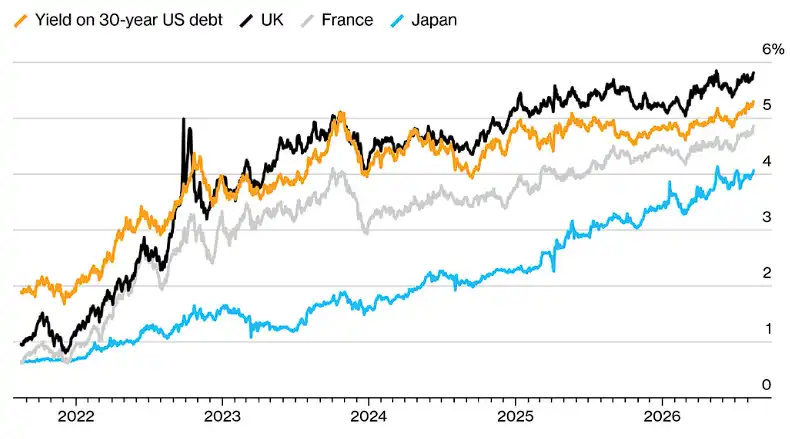
The yield on the US 30-year Treasury note touched 5.33% this week, its highest level since 2007; the yield on the same-maturity French government bond rose to a peak not seen since 2008; the German 30-year bond yield returned to its 2011 level; the UK's equivalent gilt yield approached 6%; while Japan's 30-year government bond yield climbed to its highest since 1999.
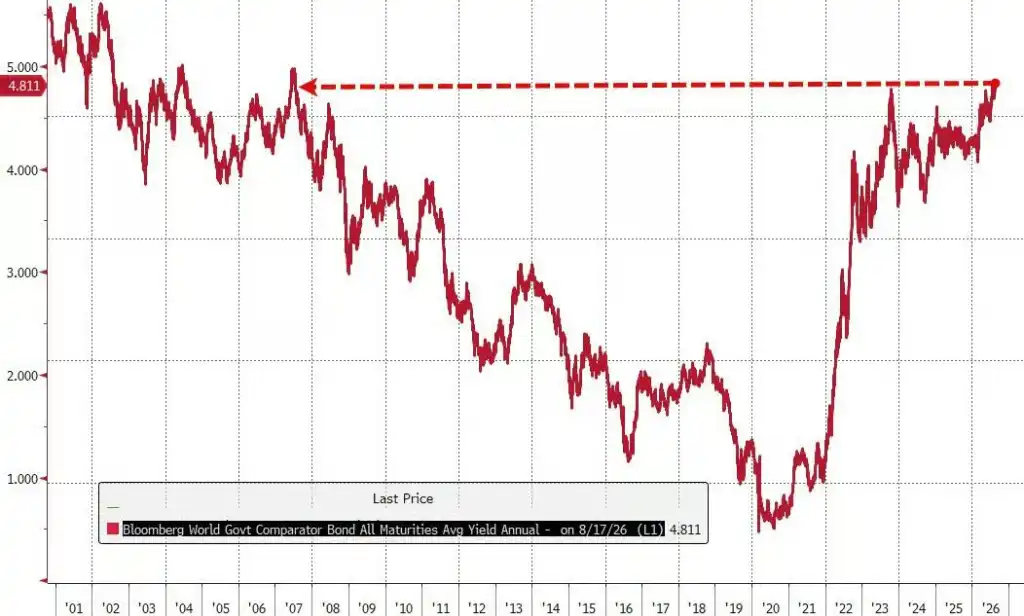
As reported by Wall Street Insights, the composite yield for global government bonds has returned to 2007 levels. Additionally, data compiled by Bloomberg shows that the average yield of a benchmark portfolio of investment-grade sovereign bonds has soared to around 4.5%, the highest since records began in 2015.
This wave of selling is not an isolated event in a single market but is driven by global structural forces—persistent geopolitical turmoil exacerbating supply shocks and inflation risks, lax fiscal discipline among governments, and a systematic shrinkage in demand from traditional long-term bond buyers. Analysis indicates that this signals a rewriting of the pricing logic for long-term fixed-income assets; for the Trump administration, the high financing costs have already become a political pressure point ahead of the midterm elections.
US Treasury Yields Surge Across the Curve, Long End Bears the Brunt
The epicenter of this bond market storm lies at the long end. Since the end of June, the yield on the US 30-year Treasury has risen by nearly 40 basis points cumulatively. After touching 5.33% during Tuesday's session, it retreated slightly to 5.28%, but remains near its highest level in nearly two decades.
Long-dated bonds are leading the decline due to their higher sensitivity to risk factors such as inflation. Justin Onuekwusi, Chief Investment Officer at St. James's Place, stated:
"The signal the market is sending is: we expect inflation to be higher in the future, or at least more uncertain, therefore we require a higher yield to hold long-term bonds."
Skylar Montgomery Koning, a Bloomberg macro strategist, pointed out a key difference in this structural rise in yields: deficit expansion is occurring against a backdrop where the economy is not significantly weakening.
"Typically, deficit widening coincides with a softening economy, leading policy rates lower and providing a cushion for the bond market. However, pro-cyclical fiscal expansion now means governments are borrowing more when rates are already elevated, pushing yields even higher."
Europe and Japan Under Simultaneous Pressure, Financing Costs Hit Multi-year Highs in Multiple Countries
European bond markets are similarly affected. The yield on France's 30-year government bond has risen to its highest since 2008, with investors eyeing political uncertainties stemming from the 2027 budget negotiations and next year's presidential election.
According to a Bloomberg report, people familiar with the matter said Germany sold 30-year bonds via a syndicate on Tuesday, paying its highest rate in 15 years.
In Japan, although absolute yield levels remain lower than other major markets, the upward momentum for the 30-year government bond yield is equally persistent and strong, having climbed to its highest since 1999.
Faced with the sharp rise in long-term financing costs, some countries have begun adjusting their bond issuance strategies, shifting towards shorter maturities.
UK authorities have suspended most of their planned long-dated bond issuance. However, governments have limited room to maneuver—in the new environment where they can no longer lock in financing costs for decades at ultra-low rates, policy options have significantly narrowed.
For the Trump administration, the persistent rise in long-term bond yields is no longer just a market issue but a political liability. The high government financing costs are transmitting to corporate loans and consumer credit, creating noticeable pressure ahead of the midterm elections.
Interest payments on US public debt have consistently been a core driver of budget deficit expansion. So far this fiscal year, interest expense has totaled $1.17 trillion, a 15% year-on-year increase, partly due to the rise in Treasury yields. The US annual deficit is approaching $2 trillion, with the national debt total nearing the $40 trillion mark.
Chris Iggo, formerly Chief Investment Officer at AXA IM Core and now at BNP Paribas Asset Management, stated:
"The November election may bring more policy risks and will keep markets highly focused on fiscal issues ahead of the usual budget season. Ideally, no one wants to face rising mortgage rates just before an important election cycle, even if current rates remain below their 2023 levels."
Led by Ed Yardeni, the strategist team at Yardeni Research said on Tuesday there's no reason to panic about the US bond market yet, "We're not pushing the panic button, but we are watching closely to see if the bond vigilantes will."
Dual Supply-Demand Imbalance, Real Yields Become Main Driver
It is noteworthy that although inflation concerns are an important backdrop to this sell-off, the long-end breakeven inflation rates—market indicators for future inflation expectations—in most major markets have remained relatively stable overall. The rise in yields has been primarily driven by real yields, the additional return investors demand above inflation compensation for holding the bonds.
On the supply side, long-term bond issuance by technology companies to finance artificial intelligence investments has further exacerbated long-end supply pressure. A recent example is Alphabet Inc., Google's parent company, deciding to issue its first-ever A$5 billion (approximately $3.6 billion) bond in the Australian bond market.
On the demand side, traditional long-term bond buyers are systematically retreating. Institutions such as pension funds have historically been a stable source of demand for long-term bonds, but this demand pillar is eroding as defined-benefit pension plans decline and regulatory policies steer more capital toward stocks. Meanwhile, governments are expanding their bond issuance, increasingly relying on price-sensitive private investors to absorb the supply.
The minutes from the Federal Reserve's June meeting show officials have discussed changes in the ownership structure of Treasury securities—ownership is shifting from "official sectors that are relatively price-insensitive" to "private investors that are more price-sensitive," a shift that could push up term premiums. Anshul Pradhan, Head of US Rates Strategy at Barclays, noted that this change in buyer structure over the past decade has contributed to an increase of about 90 basis points in the term premium of 30-year US Treasuries.
Faced with the ongoing rise in yields, institutional investors hold differing views on the market outlook.
Kelsey Berro, a Portfolio Manager at J.P. Morgan Asset Management, believes the current repricing offers a potentially attractive entry window for new capital. "We see more value at the long end, particularly in real yields," she said.
However, AXA's Iggo is more cautious:
"It's hard to judge what level yields need to reach to truly improve the total return outlook for long-duration fixed-income assets. The only thing that could change this picture is a sudden deterioration in economic data or some external shock—and the latter seems more likely than the former."