Author: Jae, PANews
Flowing narratives, steadfast Near. From a high-performance public chain and sharding for scalability, to chain abstraction and Intents, and now to the hottest topic of AI Agent, Near has hardly missed any major narrative throughout several past crypto cycles.
Backed by Illia Polosukhin, co-author of the classic Transformer AI paper and hailed as "the one who understands AI best in Web3," Near has delivered surprisingly impressive results even during the bear market. Today, Near is a cross-chain infrastructure giant that has processed over $20 billion in cumulative cross-chain transaction volume and generated over $34 million in fee revenue.
However, few know that Near's birth wasn't born from a grand blockchain ideal, but rather from a somewhat awkward practical dilemma: the inability to pay cross-border salaries. Eight years ago, to solve the problem of paying its global developers, the AI startup co-founded by Illia Polosukhin was forced to pause its AI dream and pivot to building a public chain.
Now, as the AI wave sweeps the globe, this public chain, born from AI and once sidetracked for AI, has returned to where the story began.
Payroll Problem Unexpectedly Gives Birth to a Public Chain, Now Returning to the AI Track
History sometimes comes full circle in a remarkable way. Nine years ago, Illia Polosukhin was not yet one of the crypto founders most associated with AI.
Near was founded in 2017 by Illia Polosukhin, co-author of the Transformer paper and former Google machine learning researcher, and Alexander Skidanov, a distributed systems expert.
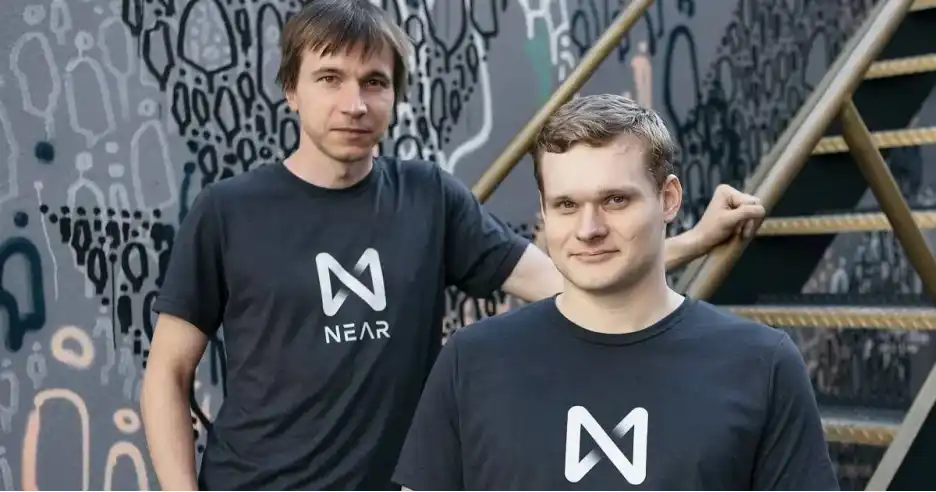
Near was initially an artificial intelligence startup focused on the field of "Program Synthesis," essentially "teaching machines to write code" to automate software development. Its concept was similar to later projects like OpenAI's CodeX, Anthropic's Claude Code, and Cursor.
To train algorithms and models, the team recruited computer science students worldwide to remotely write code snippets. However, how to pay developers distributed across the globe became a major hurdle.
Cross-border payment systems at the time were far less mature than today. Mainstream tools like PayPal and Wise faced severe limitations in Eastern Europe and the Asia-Pacific region, plagued by delayed settlements and exchange rate losses. Interestingly, when the two founders tried using early public chains for cross-border payments, they found that high Gas fees and low settlement efficiency made it impossible to distribute payments cost-effectively in batches.
For a resource-limited AI startup, this was almost an unsolvable problem. Ultimately, the two founders, with backgrounds in large-scale distributed systems, made a surprising decision: to shelve AI model development and instead build a highly scalable, low-fee, and user-friendly public chain themselves.
This passive pivot, triggered by the inability to "pay salaries," led to the birth of the "Near Protocol" in 2018.
However, the early transition path was not smooth. After leaving the AI track, Near shifted to developing a high-performance public chain focused on sharding technology to solve blockchain's scalability challenges.
With solid technical prowess, the Near Protocol secured over $500 million in cumulative funding during this period. Yet, in the fierce competition of the public chain arena, Near neither formed a landmark application nor managed to attract large-scale developer adoption. Sparse ecosystem applications, stagnant user growth, and low market attention meant that even with an advanced sharding architecture, Near's attention was often diverted by other hot public chains in the crowded "Ethereum killer" environment. The protocol once fell into a quiet period of "critical acclaim but poor sales."
During the 2020-2021 bull market, Near caught the cross-chain trend, with the launch of the Rainbow Bridge becoming a key catalyst for its ecosystem explosion and token price surge.
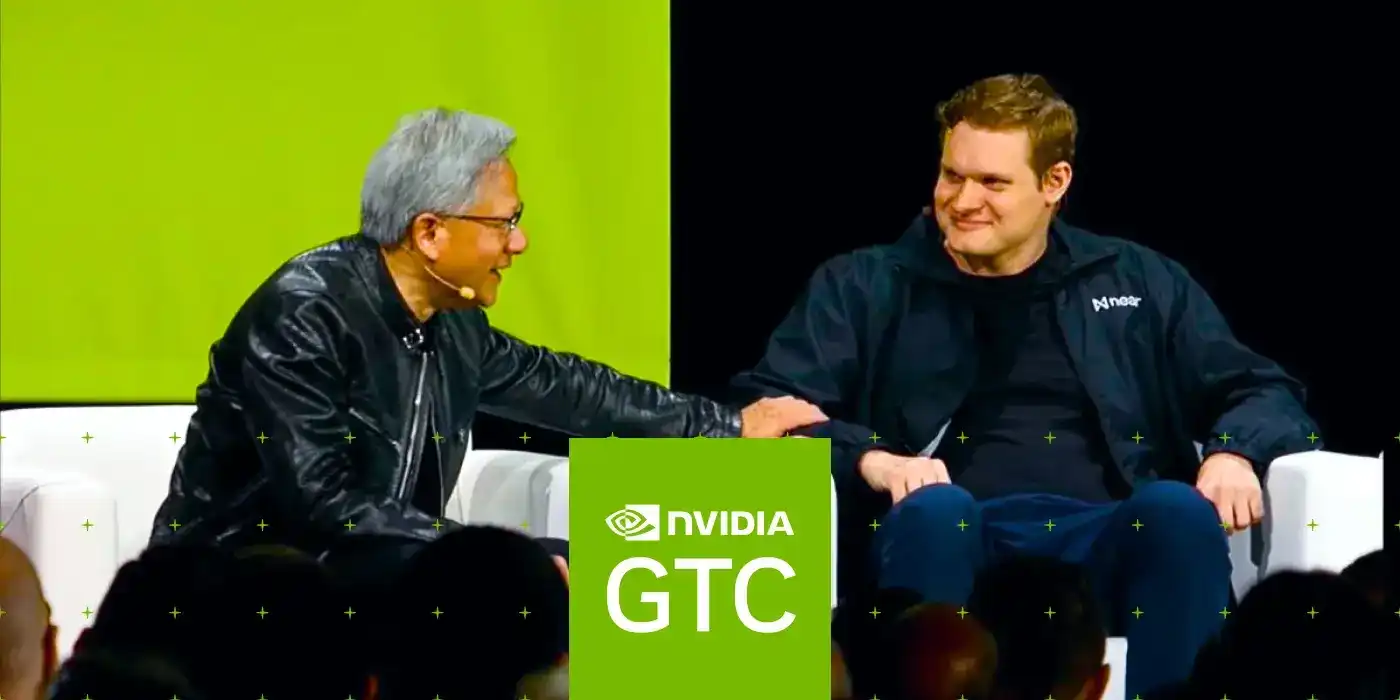
The outbreak of the AI boom brought a turning point for Near's destiny. In March 2024, at the GTC global developer conference, NVIDIA founder and CEO Jensen Huang invited Illia Polosukhin and six other co-authors of the Transformer paper for a stage discussion.
Jensen Huang praised the paper as having "changed the world," emphasizing that the Transformer architecture is the foundation of all AI industry achievements, reshaping the global technology, content, and financial landscape. This spotlight moment allowed Illia Polosukhin, as a co-creator, and Near, with its interrupted AI dream, to once again attract the crypto market's attention with the legitimate status of "AI lineage."
Returning to the battlefield with a new posture, Near's unique "technical core" was further activated. Seizing this opportunity, the protocol pivoted towards Near Intents and confidential transactions, laying a solid foundation amid the trend of multi-chain intent and Agent Economy convergence.
The intent transaction layer significantly lowered the interaction barrier for AI Agents, enabling Agents like Venice AI deployed in confidential hardware TEEs (Trusted Execution Environments) to autonomously, securely, and cost-effectively transfer funds across multiple chains.
Near Intents Becomes New Growth Line, Amassing $20 Billion in Trading Volume
Near Intents redefines the cross-chain trading experience. In the traditional multi-chain environment, users need to manually operate cross-chain bridges, prepare different Gas tokens on source and destination chains, and constantly watch out for slippage and friction costs for a single cross-chain asset swap.
Near uses an intent mechanism to abstract the entire process. Users only need to express their trading needs, such as "swap BTC on the source chain for ETH on the destination chain," without understanding the cross-chain path and Gas costs. This is the interaction experience ordinary users, and even future AI Agents, seek.
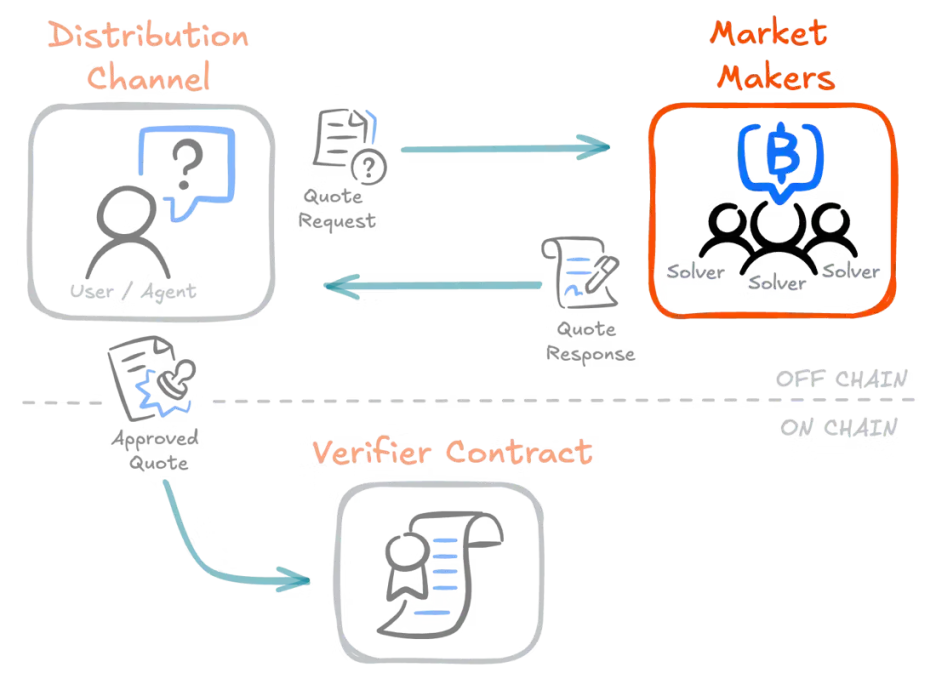
The execution of cross-chain transactions relies on an off-chain Solver network's bidding mechanism.
-
When a user submits an intent request, the Solver network bids via the Solver Bus, automatically finding and calculating the optimal execution route and quote.
-
Once the user signs the quote, the intent is submitted to the Verifier smart contract on the Near chain for final settlement.
Throughout this process, Gas fees are deducted seamlessly in the background, allowing users to pay without noticing, effectively unleashing the vitality of DeFi cross-chain trading. The significant optimization of user experience led to widespread integration of Near by traffic gateways like Ledger.
However, the potential centralization of the Solver network is a significant risk. As solvers require ample liquidity for market-making and complex algorithm optimization, trading APIs like 1Click typically rely on trusted swap aggregators and leading market makers. This could lead to oligopoly in the solver market, weakening the price advantages originally brought by the bidding mechanism.
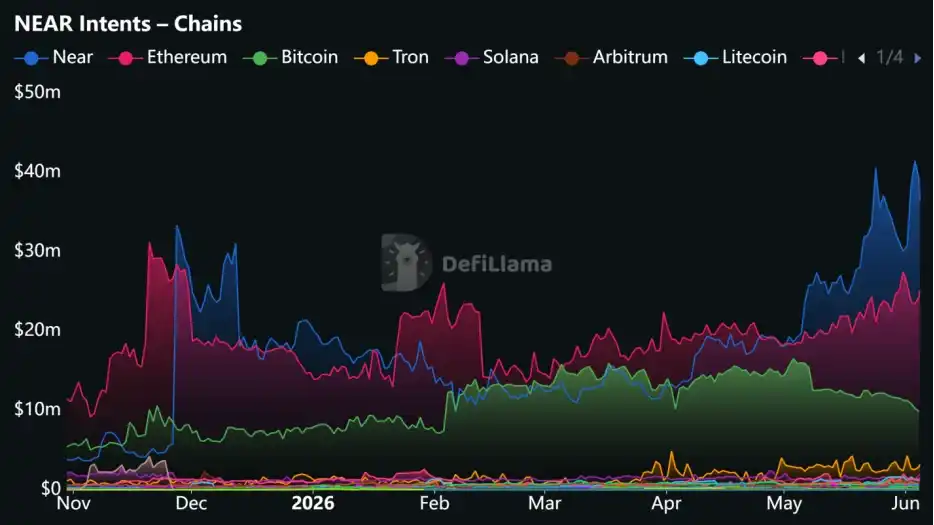
Data from DeFi Llama shows Near Intents is deployed across 25 public chains, covering the major settlement networks of the crypto market.
The protocol's TVL (Total Value Locked) exceeds $85 million. It not only retains $36.5 million in funds on the Near chain but also establishes deep liquidity on chains like Ethereum, Bitcoin, and Tron through chain abstraction mechanisms. This breadth of the cross-chain ecosystem is key to Near Intents surpassing the $20 billion mark in cumulative trading volume.
From a profitability perspective, since the launch of Near Intents, the protocol has generated over $33 million in fees. More than 70% of this revenue came from the last two quarters. This indicates that as the multi-chain ecosystem continues to expand, the protocol's profitability is also showing a growth trend.
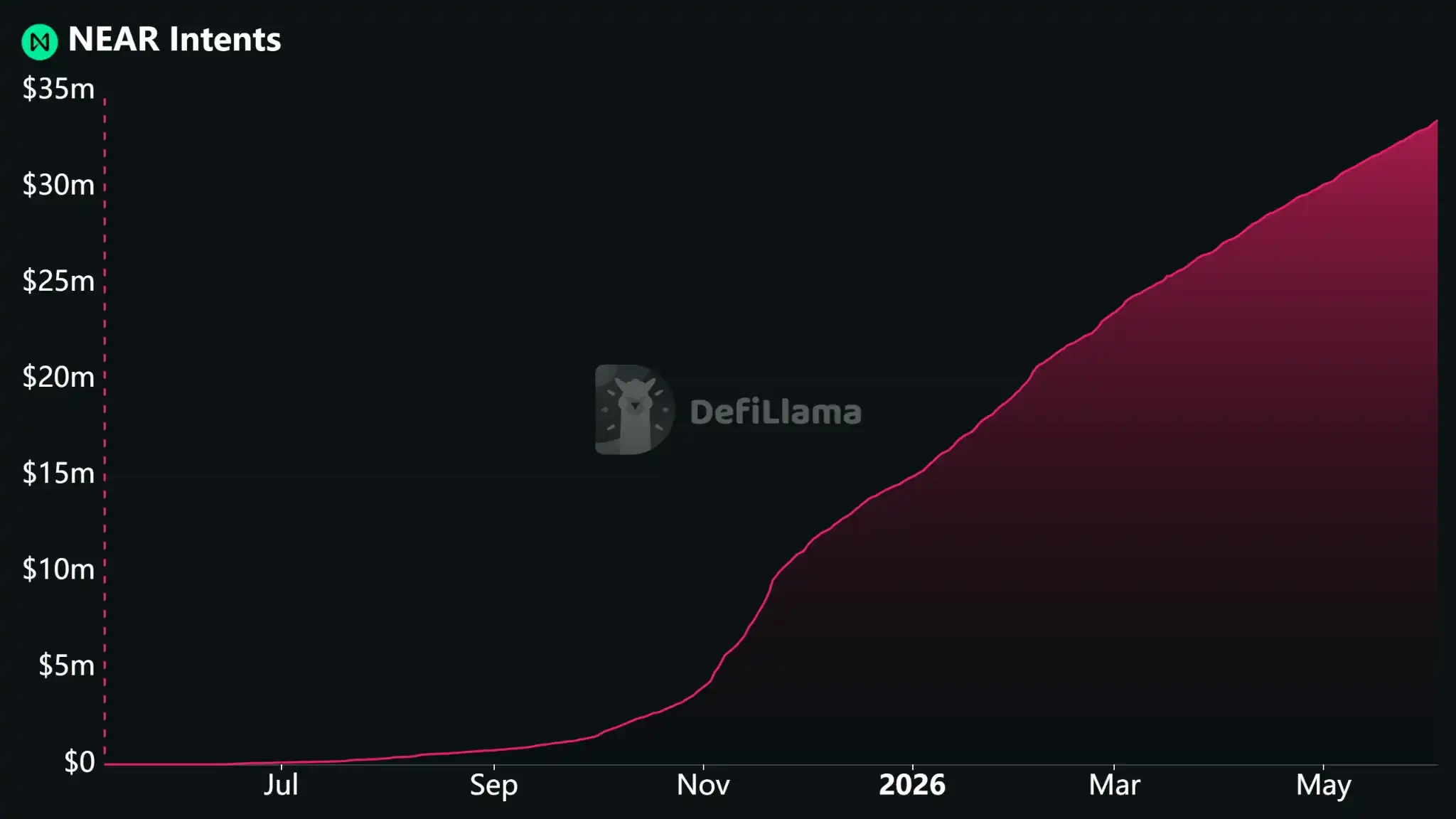
The gradually increasing fee revenue will establish a positive feedback mechanism for NEAR at the economic level. The vast majority of network fees are burned, injecting deflationary pressure into the NEAR token and further enhancing its value capture capability.
Confidential Transactions Swallow 40% of Volume: Growth Engine or Regulatory Hazard?
Currently, as on-chain activity grows, privacy needs are no longer a niche demand in the crypto market, and this has become Near's differentiating advantage.
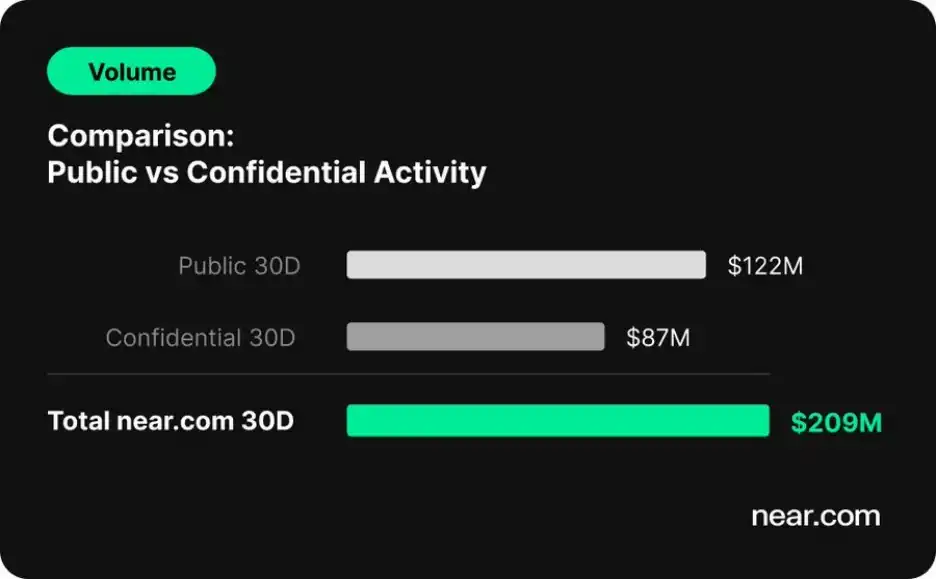
Since launching "Confidential Intents" and "Confidential Swaps" features in the first quarter of this year, their adoption rate has risen rapidly. Over the past 30 days, the total trading volume on the Near chain was $209 million, with confidential swap volume reaching $87 million, accounting for 41.63%. This data reflects not just product adoption but the genuine existence of market demand.
Behind this business explosion is Near addressing a long-standing structural pain point in the DeFi market: the highly transparent on-chain ledger exposes the positions and intentions of large traders. This leads to severe sandwich attacks (MEV), significant slippage, and strategy leakage when institutions or whales execute large trades.
The Confidential Intents feature, by introducing programmable privacy technology, allows users to seamlessly switch to "confidential mode" on the frontend interface. In this mode: the transaction amount, direction, and position are completely hidden from the outside world during execution, with only verifiable encrypted accounting performed on-chain at settlement.
Bots' sandwich attacks fail, and traders' business secrets are protected. The Confidential Swaps feature will open a relatively safe DeFi channel for institutional capital, reducing trading friction and facilitating the integration of on-chain ecosystems with mainstream finance.
However, the other side of the coin cannot be ignored. A privacy transaction share exceeding 40% proves the existence of real demand but may also attract regulatory scrutiny. Global regulatory pressure on privacy protocols like Tornado Cash has never eased. Anonymous large-scale fund flows are more likely to trigger regulatory enforcement. If regulators deem the "Confidential Swaps" model to pose money laundering risks, Near may inevitably fall under regulatory scrutiny, potentially becoming its biggest future uncertainty.
Looking back on its nine-year journey, Near's growth script shows a highly dramatic trajectory. Despite experiencing public chain competition, market cycles, and narrative shifts, it has continuously adjusted its development direction.
Today, chain abstraction, Intents, and confidential transactions have become Near's new exploration focus. The AI boom has prompted the market to re-examine this public chain's unique background. However, whether these attempts can help Near build a more solid ecosystem moat still requires more time to observe.