Author: Bitpush
Leonardo DiCaprio invested, Barack Obama and Tim Cook scrambled to wear them, Emma Watson actively endorsed them...
Yet, this "middle-class top trend" is no longer selling.

On April 15, 2026, the American internet-famous sneaker brand Allbirds issued a major announcement: the company will completely abandon its shoe manufacturing business, fully pivot to artificial intelligence computing infrastructure, and rebrand as "NewBird AI".
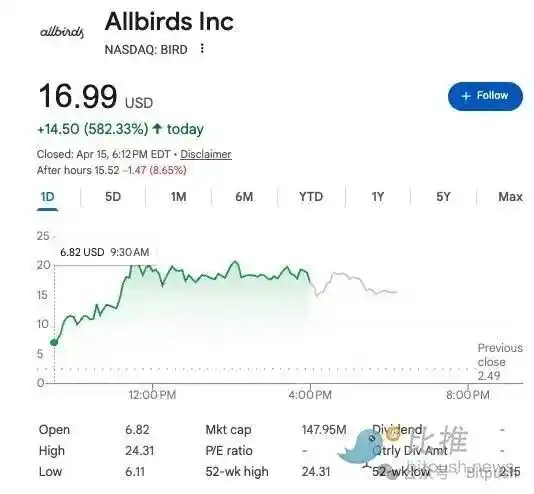
Upon the news, the stock price soared from under $3 to a session high of over $24, with a single-day surge exceeding 800% at one point.
Just half a month prior, this once-star brand had just sold off all its intellectual property and footwear assets for a mere $39 million — only one percent of its peak market valuation of $4.1 billion.
From wool shoes on the feet of Silicon Valley elites to a shell company turning around to deal in GPU computing power — the story of Allbirds is more than just the rise and fall of a startup; it lets us see the madness of today's capital markets: AI is the cure-all.
The Rise and Fall of the "Silicon Valley Miracle Shoe"
In 2015, former New Zealand professional soccer player Tim Brown and renewable materials expert Joey Zwillinger founded Allbirds in San Francisco. Their vision was simple and clear: use natural materials like merino wool and eucalyptus fiber to create a comfortable shoe that doesn't rely on petroleum-based ingredients.
In 2016, the first product, the Wool Runner, was launched and quickly became a hit in the Silicon Valley tech circle. Google co-founder Larry Page, Apple CEO Tim Cook, and even former U.S. President Barack Obama became devotees of these wool shoes.

Allbirds caught two perfect tailwinds. The first was the golden age of the DTC (Direct-to-Consumer) model — bypassing traditional retail channels to reach consumers directly through its website, controlling complete user data and brand narrative. The second was the ethical awakening of "sustainable consumption" — in the context of environmental protection becoming a global consensus, a shoe with a "zero carbon footprint" was itself a statement of values.
When these two narratives fermented in the soil of an economic upswing, Allbirds rapidly grew from a Kickstarter crowdfunding project to a publicly listed company valued at over $4 billion.
But Allbirds' fall was almost as rapid as its rise.
Its commercial collapse followed a classic DTC script: a single hit product supporting the entire brand, rushing to expand into apparel and physical retail before the foundation was solid, overextending its reach and causing a loss of brand focus.
As more and more brands began talking about sustainability, and as competitors like Hoka and On Running surpassed it in performance and design, Allbirds' sustainability narrative was quickly diluted.
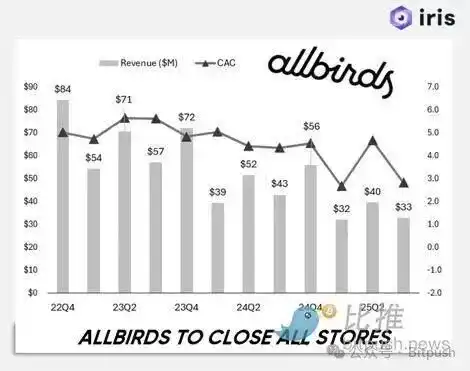
In 2022, the company's revenue reached a historical peak of $298 million; thereafter, it declined all the way, dropping to $152 million by 2025, nearly halved. Over the past five years, despite cumulative sales of approximately $1.2 billion, total losses reached a staggering $419 million.
In 2024, the company received a delisting warning from Nasdaq for its stock price trading below $1 for 30 consecutive days, and later maintained its listing status through a reverse stock split.

In February 2026, Allbirds announced the closure of all its full-price retail stores in the United States.
On March 30, 2026, Allbirds signed an agreement with the brand management company American Exchange Group to sell its intellectual property and related assets for $39 million. The buyer, which owns brands like Aerosoles and Ed Hardy, will continue to sell footwear products under the Allbirds name.
The price has also been slashed. Checking the website today, shoes that once cost over a hundred dollars are now on sale for around thirty-something dollars...

The listed company's "shell" was waiting for its next fate — and this answer came faster than anyone imagined.
From Selling Shoes to Buying GPUs
The April 15th announcement was one of the most unexpected transformations in business history. Allbirds announced it had entered into a convertible note financing agreement with an institutional investor for up to $50 million. The funds will be used to acquire high-performance GPU hardware and provide computing power access services to customers through a long-term leasing model. The company plans to rename itself "NewBird AI," with a long-term vision of becoming a "fully integrated GPU-as-a-Service (GPUaaS) and AI-native cloud solutions provider."
The market reaction was近乎疯狂 (nearly insane). At the close on April 14th, Allbirds' market capitalization was only about $21 million; after the announcement, the stock price一度触及 (once touched) $24.31, inflating the market cap to approximately $165 million. On Fidelity's trading heat list, Allbirds became one of the most active stocks of the day, showing the enthusiasm of retail traders.
This疯狂的市场反应 (crazy market reaction) is less about pricing the fundamentals of NewBird AI and more about pricing the "AI" label itself.
Allbirds' transformation announcement did not reveal any specific information about customer resources, technical team, or data center deployment plans — just the $50 million on its books and a vague blueprint of "buy GPUs and lease them out."
Independent consultant Bruce Winder commented: "I don't think Allbirds brings anything substantive to the table, aside from the brand awareness itself."
Notably, while pivoting to AI, Allbirds also requested shareholder approval in an SEC filing to amend its corporate charter, removing language about "serving the public interest" —这意味着 (this means) that this company, once proud of its B Corp certification, is actively shedding the environmental mission it was famous for. From "saving the planet" to "selling computing power," Allbirds' value shift is perhaps more symbolic than the business transformation itself.
The AI Narrative Remains the Most Powerful Business Magic
Allbirds is not the first to do this, and it certainly won't be the last. Over the past 18 months, from fast fashion to fresh food e-commerce, from logistics companies to home furnishing brands, a large number of traditional companies have rushed to slap an "AI" label on themselves. The reason is actually quite simple: the price-to-earnings ratio for selling shoes is only slightly over 10x, while selling computing power can be hyped to over 50x; GPUs are now hard currency, more sought after than gold, and whoever has priority access holds the chip to make money flipping them;再加上 (add to that) consumers' wallets are indeed thinner, so instead of continuing to spend money on advertising and competing for traffic with Temu, it's better to step back and gamble on enterprise AI compute leasing — at least the story sounds better.
Taking a longer historical view, this "changing shells" play is not new. During the 2017 crypto craze, a beverage company called Long Island Iced Tea changed its name to "Long Blockchain Corp.," and its stock price soared nearly 300% in a single day, only to be delisted from Nasdaq the following year. In 2024, several Bitcoin mining companies turned to building AI data centers, with Core Scientific being one of the most successful cases. From the internet bubble to blockchain, and now to AI, the capital market script has never changed: the赛道 (sector) is priced before profitability, the narrative happens before reality.
Allbirds' transformation essentially trades its remaining brand credit and listed shell resource for a GPU procurement contract. The core question is whether this admission ticket is truly valuable. AI infrastructure is a highly capital-intensive industry with extremely high technical barriers. The GPU leasing market already has players valued in the billions of dollars, alongside deep deployment by hyperscale cloud service providers like Amazon AWS and Microsoft Azure. Whether a company that once made shoes, with $50 million in financing and a set of GPU equipment, can survive in this crowded field remains a huge unknown. Not to mention, this financing still needs approval at a special shareholder meeting on May 18th.
Bloomberg Intelligence analyst Poonam Goyal commented: "This move takes it out of a structurally low-margin footwear and apparel model into a higher-value compute business, but execution risk remains high."
We are witnessing a footnote of an era: any entity — no matter what it once was — can be redefined as an AI company. As long as the story is compelling enough, capital will pay for it.
The AI narrative remains the most powerful business magic of the moment.