Open Systems Will Ultimately Prevail: Why Ethereum Is the Next Linux?

Foresight NewsОпубліковано о 2026-06-22Востаннє оновлено о 2026-06-22

Анотація

The article "Open Systems Will Ultimately Prevail: Why Ethereum Is the Next Linux?" argues that Ethereum, like Linux before it, will triumph over closed, proprietary systems in finance due to its open, permissionless, and credibly neutral nature. It draws a historical parallel: just as the open internet defeated corporate private networks and Linux outcompeted proprietary Unix systems, open financial infrastructure like Ethereum will surpass private blockchains. The core advantage lies in the "bazaar" development model (as described in Eric Raymond's "The Cathedral and the Bazaar"), where decentralized, permissionless innovation by a global community of developers outpaces the controlled "cathedral" approach of centralized entities. This model fosters rapid innovation, as seen with Ethereum standards like ERC-20 and applications like Uniswap, which were built without needing permission. Ethereum's key, irreplicable strength is its credible neutrality: transparent, equally applicable, immutable rules that allow anyone to participate. This ensures sovereign independence, meaning no single entity (company, government) can control or change its core rules—a critical feature for global financial infrastructure. In contrast, private blockchains and consortium chains (like SWIFT or various bank-led projects) suffer from platform risk, central control, and an inability to attract broad developer ecosystems, leading to frequent failures. The article notes that major institutions (e...


Author: Etherealize

Compiled by: Luffy, Foresight News


History Repeats: The Cathedral Eventually Loses to the Open Bazaar


In 1995, the vast majority of tech industry authorities were convinced that the open internet would ultimately lose out to proprietary private enterprise networks. History proved them wrong, and today's skeptics of Ethereum are likely to be mistaken again for the same reasons. The most prominent figure at the time was Bill Gates, who argued in his book "The Road Ahead" that the future of digital commerce lay not with the open internet, but with private, proprietary networks controlled by companies like Microsoft and Oracle. This was the mainstream consensus in the industry. Ben Horowitz, co-founder of a16z, wrote: "Almost no one thought the internet would move beyond academia, let alone compete with the major tech giants, who at the time were all busy building their own private networks to fight against it."


Linux followed an identical path. In the late 1990s, Sun Microsystems dominated the high-end Unix server market. But by the early 2000s, cheap, generic hardware running the open-source Linux system rapidly ate away the vast majority of its business.
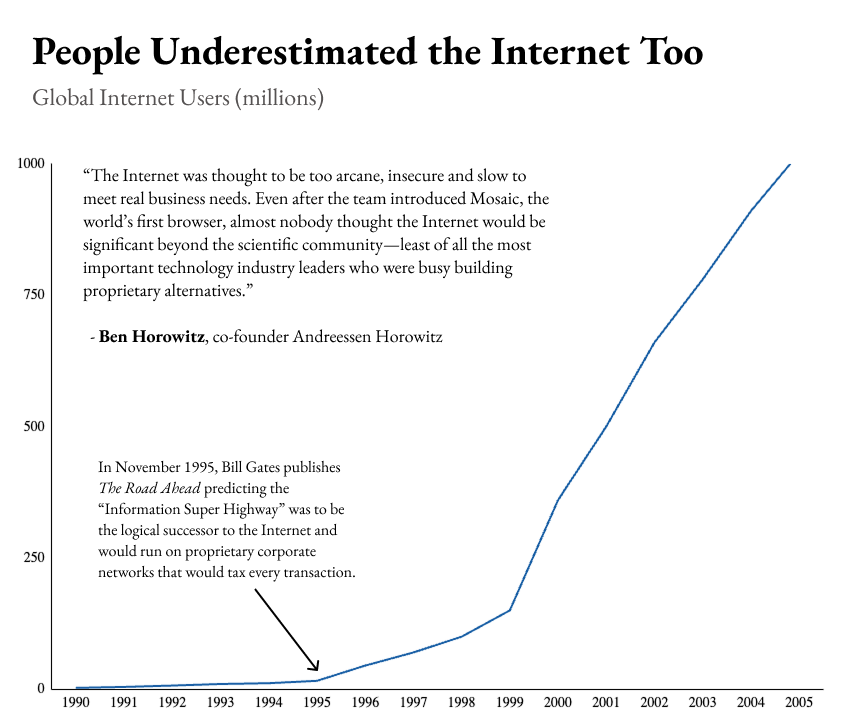


Today, the same historical script is playing out in the realm of financial infrastructure. Sensing both opportunity and threat, major corporations are racing to build private blockchains. In the short term, private chains appear to have the upper hand: faster transaction speeds, better user experience, and large business development teams pushing for adoption. But over time, open, credibly neutral alternatives will slowly erode their market share for two key reasons: 1) No single company can permanently keep up with the pace of innovation in a permissionless system. 2) No legitimate institution wants to build on infrastructure controlled by a competitor.


In 1997, Eric Raymond, a core Linux contributor, explained the underlying logic for the long-term victory of open, permissionless infrastructure in his essay "The Cathedral and the Bazaar." The previously accepted classic theory came from Fred Brooks's "The Mythical Man-Month": software must be developed by a single architect overseeing a small, tightly-knit team, otherwise communication costs would skyrocket exponentially. But Raymond observed that thousands of developers who had never met could simultaneously work on different modules of the Linux kernel, ultimately producing a product that dwarfed those from multi-billion dollar commercial companies. Traditional software was like a finely crafted "cathedral"; the "bazaar" was Fred's term for Linux's distributed development model: public, decentralized, and full of the chaotic, free-flowing energy of iteration. When Linus Torvalds open-sourced the kernel and accepted patches from anyone, he inadvertently pioneered this development paradigm. As Raymond put it: "Release early, release often. Delegate everything you can. Be open to the point of promiscuity." The operating system built using this model powered most internet services by the early 2000s.


Raymond explained that the bazaar model circumvented the problem of exponentially rising communication costs: developers don't need to coordinate directly with each other; everyone simply works synchronously around the code repository, interacting through patches and version updates. The project maintainer integrates all submissions to form a unified standard, which all other developers then use as a baseline. He wrote: "Brooks's law isn't repealed... but given a large enough beta-tester and co-developer base, almost every problem will be characterized quickly and the fix obvious to someone." He added that the negative effects predicted by the law were "overcome by other, nonlinear growth effects."


Raymond also pointed out that the bazaar model breaks down the barrier between users and developers. In the cathedral model, users are merely customers who report bugs to a support ticket system. In the bazaar model, users are co-builders who, upon finding a problem, either submit a fix directly or provide detailed technical descriptions for others to follow up. In the open-source community, "given enough eyeballs, all bugs are shallow." The collective effort of massive participation ultimately leads to overall efficiency surpassing any centralized competitor: "The Linux community... in many ways resembles a free market or an ecology. Many agents pursue their own self-interest, yet the combined result is a self-correcting, resilient system of astonishing complexity and efficiency, far beyond what any centralized planning could achieve."


The Ethereum ecosystem perfectly embodies this pattern. Fabian Vogelsteller, while developing a wallet, found the chaos in various token interface standards and wrote the now-ubiquitous ERC-20 standard. The NFT standard ERC-721 was born from the CryptoKitties development team. Uniswap, now the world's largest decentralized exchange, started as an idea in a Vitalik Buterin blog post, built by Hayden Adams, a mechanical engineer with no financial industry background. These individuals advanced network upgrades without needing anyone's permission. As Sun Microsystems co-founder Bill Joy famously said: "No matter who you are, most of the smartest people work for someone else." A permissionless system allows innovation to spring from anywhere.


The core distinction between the bazaar and the cathedral lies in this: the bazaar's integration layer is lightweight, completely public, and operates on credibility, not top-down authority. Core leaders like Linus Torvalds or Vitalik Buterin gain influence through the voluntary following of developers. Developers follow because core decisions are fully transparent, subject to public critique, and the community can always fork the project if necessary. The internet uses lightweight centralized coordination layers like the IETF and IANA. Wikipedia has a structured editorial review process. All projects that thrive on permissionless innovation manage to be truly open to contributions while having structured integration mechanisms to avoid the feared chaos. And the coordination layer must be maintained by credibility, not coercive control, or the system will quickly collapse.


The bazaar model also requires that the underlying infrastructure cannot be monopolized by a single entity. If Torvalds had tried to privatize the Linux kernel, developers worldwide would have immediately forked the project and continued iterating independently. Raymond refined this theory in "Homesteading the Noosphere." Open-source systems evolved rules similar to Lockean property rights: the developer who writes the initial code first gains founder ownership; continued contribution maintains that ownership; ownership is transferred through formal community succession. Open-source licenses are the formal guarantee of these rules, with community consensus as the soft constraint. If either is missing, developers will migrate to other open-source projects that won't appropriate their labor.


Ethereum's Unreplicable Core Moat


In the Ethereum community, Vitalik has summarized these underlying requirements as "credible neutrality." A coordination mechanism is credibly neutral if it possesses four characteristics simultaneously: the rules are completely transparent, apply equally to all participants, are difficult to arbitrarily change, and anyone can freely participate by following them. These four traits are distilled from mature systems like the internet, Linux, and Wikipedia that attract massive collaboration. Private networks, closed ecosystems, and enterprise blockchains all fail to meet these four points simultaneously.


Over a long enough timeline, credibly neutral systems tend to prevail: the open web replaced corporate private networks, Linux replaced proprietary Unix, Wikipedia replaced Encyclopædia Britannica. In each iteration, the private alternatives held tangible advantages: focused product positioning, strong financial backing, dedicated customer support, professional marketing, and business development teams. But as the open ecosystem matures, these advantages erode, and network effects completely reverse. Once an open system accumulates enough developer tools, applications, and credibility, establishing a perception of stable, unchanging rules, closed systems can no longer compete.


This development pattern is now permeating every layer of financial infrastructure. SWIFT, Visa, Mastercard, and the consortium chains being promoted to institutions today vary in product form and history, but share the same underlying logic: controlled by a centralized entity, harboring platform risk.


For forty years, SWIFT has been owned by member banks and should have remained neutral. But in 2012, under US pressure, it cut off Iranian banks, and in 2022, it was pressured to block several Russian financial institutions. Despite being registered in Belgium and governed by banks, SWIFT ultimately succumbed to US influence, a weakness observed globally. Subsequently, China accelerated its Cross-Border Interbank Payment System (CIPS), Russia built its own System for Transfer of Financial Messages (SPFS), India expanded its Unified Payments Interface (UPI), and Brazil's Pix became a core component of BRICS payment systems. Visa and Mastercard also started as bank cooperatives but have become toll collectors, charging merchants 1.5% to 3.5% fees. Current consortium chains (Canton, Tempo, Arc, etc.) share the same fatal flaw: the interests of the platform operator can always conflict with those of developers building on top.


"The original idea of consortium chains—multiple banks, large companies building their own blockchain together—has largely failed," Vitalik explained. "Such systems combine the worst of both centralized and decentralized worlds." He noted that while the first few participating banks might seem like equal co-builders, the twentieth institution joining is essentially plugging into a system controlled by its competitors. Companies bear all the development costs of a distributed system without gaining the core value blockchains were born to provide: open composability and credible neutrality. Past failures confirm this. From 2017 to 2019, multiple bank consortia tried to rebuild trade finance on blockchain: We.trade, backed by over a dozen institutions including HSBC and Deutsche Bank, went bankrupt in 2022; Marco Polo, with over thirty banks, entered liquidation the next year; Contour followed shortly after, shutting down. The Australian Securities Exchange spent six years and roughly A$250 million building a permissioned ledger with Digital Asset (now developer of Canton), ultimately scrapping the project in 2022. In contrast, Ethereum, owned by no one, has never experienced a full network outage in over a decade, with its ecosystem continually expanding.


This is also the fundamental reason developers choose Ethereum. According to Electric Capital, over 1 million developers have participated in the Ethereum ecosystem since its inception, with 232,000 active developers in the past year alone—no other public chain comes close. Some growth comes from the standard virtuous cycle: Ethereum's concentration of development tools, industry standards, and job opportunities naturally attracts newcomers to learn and build there, which in turn attracts more tools and jobs. But developers and institutions actively choose Ethereum precisely for its extreme decentralization and credible neutrality. For example, last year Robinhood chose to build its Layer 2 on Ethereum rather than develop its own base layer. Johann Kerbrat, head of crypto at the company, stated: "Today, many companies are building their own L1 chains. We also desired the control of our own system, but building a truly secure, decentralized base layer is extremely difficult. Ethereum inherently provides this security base for free. Many new L1s aren't truly decentralized, their security is questionable, and they're essentially just slower, improved databases. We saw no core value."


Erik Voorhees, founder of the privacy-focused AI inference platform Venice AI, expressed a similar view a few days ago. The platform has over 3 million users and generates tens of millions in annual revenue. When asked why they chose to build on Base, Coinbase's Ethereum Layer 2, he said: "We didn't hesitate at all. Among all smart contract platforms, the Ethereum ecosystem is the purest, most resilient, and most mature."


The most fundamental trait of a blockchain is sovereignty. Bitcoin's revolutionary nature lies in being the world's first sovereign computing platform. Before Bitcoin, all computer systems belonged to individuals, companies, or governments and had to obey their owner's will and local laws. A sovereign system follows only its own predetermined rules; no single entity can forcibly change Bitcoin's rules. In the past, sovereignty belonged to monarchs and nations; now, for the first time, a computing platform has achieved sovereignty. This is also why decentralization is so valued in crypto: it's the only path to sovereignty. A chain with only ten validating nodes has its rules dictated by those ten entities. Ethereum, with hundreds of thousands of independent validators spread across global jurisdictions, multiple independent client implementations, and a foundation that explicitly renounces governance power, has long crossed the sovereignty threshold. No single party can claim exclusive ownership of the network. The core value of sovereignty is this: the global financial system can build applications on Ethereum, and all participants need not worry about other institutions, governments, or foundations arbitrarily changing rules to their detriment.


Global Institutions Bet on Ethereum's Open Ecosystem


Ethereum's lead in sovereignty and credible neutrality stems from a historical path dependency that other chains cannot replicate. Ethereum launched in 2015 with Proof of Work, ran for seven years, and only transitioned to Proof of Stake in 2022. Network ownership was sufficiently decentralized through a public crowd sale in 2014 and mining accessible with consumer-grade GPUs, ensuring no single entity holds a large enough token stake to control the network (a key prerequisite for sovereignty in a Proof of Stake system). Most consortium chains today are venture-backed, with tokens concentrated among founding teams, giving a few entities absolute say over consensus. Competitors can copy the technical architecture but not Ethereum's development history.


Since then, Ethereum's lead has compounded: sovereignty and credible neutrality attract developers; an influx of developers brings better libraries, tools, and job markets, further lowering the barrier to entry and attracting more practitioners; applications deposit liquidity and tokenized assets, driving institutional participation. Each layer of the ecosystem reinforces the others. Competitors must build a complete industrial chain simultaneously, while Ethereum's scale advantage continues to grow with compound interest.
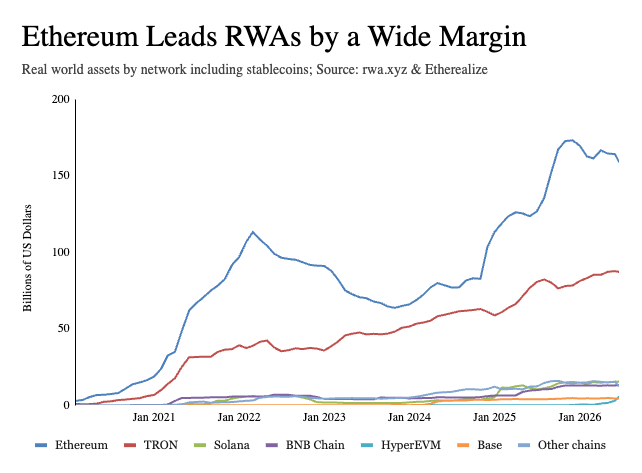


The industry's most sophisticated players are already betting on Ethereum: Coinbase and Robinhood built their Layer 2s on Ethereum; BlackRock and JPMorgan launched tokenized money market funds BUIDL and MONY, both on Ethereum; leading DeFi protocols like Aave, Maker/Sky, Maple, and Uniswap are primarily on Ethereum; the world's top stablecoin issuers settle on Ethereum. Data from Token Terminal's "Q1 2026 Ethereum Industry Report" shows: among the top five public chains, Ethereum hosts 79% of active DeFi lending, 62% of stablecoin issuance, 73% of tokenized funds, and 84% of tokenized commodity assets.


Ethereum's applications are also permissionless, further amplifying its advantages. For example, Uniswap's permissionless listing mechanism gives pricing and liquidity to thousands of long-tail assets, a service centralized exchanges would never provide. Aave's open and highly composable lending markets have spawned an entire ecosystem of specialized pools and risk management tools, far exceeding what the core team alone could develop. Closed systems require platform operators to anticipate all use cases in advance; open systems do not.


The most potent counter-argument to the thesis that "permissionless systems will ultimately win" is not technical but relates to the specific nature of finance: privately controlled networks might be an advantage, not a defect, for the financial industry. When payments fail or funds flow abnormally, regulators need a clear responsible entity; "no one in charge" sounds more like a huge risk than an advantage in a legal context. But this criticism confuses two completely separate layers: accountability mechanisms are built at the application layer; the settlement layer does not need to bear this function. For instance, the ERC-3643 token standard directly embeds KYC verification and cross-border transfer restrictions into smart contracts; issuers can set wallet whitelists, restrict asset transfers, freeze, or recover tokens. Privacy technologies work similarly; zero-knowledge proofs allow institutions to settle on a public chain while hiding transaction details. In contrast, on consortium chains, transaction data is visible only to the company itself and its competitors.


In the early days of the internet, it was widely believed its security was insufficient for commercial transactions. After the HTTPS protocol enhanced security capabilities, most commercial activity migrated to the open web, and such skepticism vanished. The skeptics back then weren't wrong about the internet's early flaws, but they underestimated the self-evolving potential of open networks.


Today, banks and fintech companies building private chains are repeating the mistakes of AOL and Microsoft: trying to replicate an open system but building a walled garden, extracting rent through platform control. This model is doomed to fail. The walls built to exert control also block out external innovation.


Netscape is the model for success. Netscape never tried to monopolize the internet; it built a browser to guide global users onto the open network. Riding the explosive growth of the internet, Netscape became a defining company of its era. Ethereum, with its almost unreplicable credible neutrality, already possesses the potential to become the global settlement layer for finance. The optimal industry strategy is to build applications on top of permissionless infrastructure, not to compete with it head-on.


Трендові криптовалюти

Пов'язані питання

QAccording to the article, what is the 'Cathedral vs. Bazaar' analogy, and how does it relate to Ethereum's development?

AThe 'Cathedral vs. Bazaar' analogy, from Eric Raymond's essay, contrasts traditional, centralized 'cathedral' software development with the open, decentralized 'bazaar' model of Linux. The article argues that Ethereum perfectly embodies this 'bazaar' model, where innovation is permissionless and contributions come from a global, decentralized network of developers, leading to superior long-term evolution and resilience compared to closed, corporate-controlled systems.

QWhat are the four key characteristics of 'credible neutrality' as defined by Vitalik Buterin in the context of Ethereum?

AAccording to the article, Vitalik Buterin defines a credibly neutral coordination mechanism as one that possesses four key characteristics: 1) The rules are completely transparent. 2) The rules apply equally to all participants. 3) The rules are difficult to change arbitrarily. 4) Anyone who follows the rules can participate freely. Ethereum is presented as a system that embodies these traits.

QWhy does the author argue that private or consortium blockchains (like Canton, Tempo) are fundamentally flawed for financial infrastructure?

AThe author argues that private or consortium blockchains suffer from a fatal flaw: they reintroduce platform risk controlled by a centralized entity or a consortium of competitors. This structure fails to provide the core value of blockchains—open composability and credible neutrality. Institutions are reluctant to build on infrastructure controlled by rivals, and these systems cannot match the innovation speed of permissionless networks. Historical failures like We.trade and the Australian Stock Exchange's project are cited as evidence.

QWhat historical examples does the article use to support the thesis that open, permissionless systems ultimately triumph over closed ones?

AThe article supports its thesis with several historical examples: the open Internet defeating corporate proprietary networks (like those envisioned by Bill Gates), the Linux operating system displacing proprietary Unix systems (like Sun Microsystems), and Wikipedia replacing the Encyclopaedia Britannica. Each case shows closed systems initially having advantages but ultimately being overtaken by open ecosystems due to network effects and innovation.

QWhat is described as Ethereum's 'unreplicable core moat' or competitive advantage, and how was it established?

AEtheream's 'unreplicable core moat' is its sovereign independence and credible neutrality, achieved through a unique historical path dependence. This was established by launching with Proof-of-Work in 2015, which allowed for highly decentralized ownership via GPU mining, and conducting a public crowd sale with no single entity holding a controlling stake. This history, combined with its subsequent network effects in developers, tools, and applications, creates a competitive advantage that new chains backed by venture capital and centralized token allocations cannot easily replicate.

Пов'язані матеріали

Report Interpretation: J.P. Morgan Details Micron's Pre-Earnings Sentiment, Current Hardware Sector Dynamics

Morgan Stanley analyst Joshua Meyers' report (June 21, 2026) highlights key trends in the hardware and semiconductor sector ahead of Micron's earnings. The core takeaways are: 1. **Micron & Memory:** Memory remains a high-conviction long theme, driven by strong AI demand and rising ASPs. However, investor focus is shifting to the sustainability of Micron's >80% gross margins and the specifics of potential new long-term supply agreements (SCAs). 2. **Hardware Supply Chain:** AI-related demand for servers, networking, and storage remains robust, but company performance is diverging. Celestica (CLS) shows improved margin confidence, Western Digital and Seagate benefit from pricing, Fabrinet (FN) sees predictable AI optics growth, and Teradyne (TER) anticipates a new Google customer. 3. **AI Capex & WFE Forecasts:** JPMorgan increased its Wafer Fab Equipment (WFE) market growth forecasts to 28% in 2026 and 29% in 2027. AI infrastructure financing is evolving, with higher project-level debt reducing constraints on capex expansion. The report signals that while the AI-driven hardware cycle is strong, the market is entering a phase focused on execution verification (e.g., Micron's SCA details, Fabrinet's ramp with Amazon) and valuation sustainability. Key near-term signals include Micron's guidance, Arista Networks' outlook, and the pace of demand normalization post potential tariff-related pull-ins.

marsbit18 хв тому

Report Interpretation: J.P. Morgan Details Micron's Pre-Earnings Sentiment, Current Hardware Sector Dynamics

marsbit18 хв тому

Research Report Analysis: The Fed's New Chair's Debut – New Leader, But Same Script?

Report Analysis: Federal Reserve's New Chair Debut – A New Captain, But the Same Script? Morgan Stanley's chief global economist Seth B. Carpenter analyzes the first FOMC meeting under new Fed Chair Kevin Warsh in a June 21 report. Warsh deliberately avoided providing forward guidance on interest rates, aligning with his philosophy. However, market expectations for a rate hike this year were reinforced. Key signals lie elsewhere: inflation may fall more than expected, and quantitative tightening (QT) could be more aggressive than anticipated. The FOMC's "dot plot" suggests only one rate hike in 2026. Carpenter argues that if inflation undershoots forecasts, the logic for even a single hike weakens, especially as projections indicate potential rate cuts in 2027. On QT, Warsh's stance is clear. Carpenter notes that measures like halving the Treasury's account balance could shrink the Fed's balance sheet by around $500 billion with minimal market impact. Combined with adjustments to reserve interest and liquidity rules, the ultimate QT scale may exceed expectations, though its market effect might be less disruptive unless the Fed actively sells Mortgage-Backed Securities (MBS). While Warsh initiated a review of the Fed's policy framework, the 2% inflation target remains intact for now. The report concludes that the market may be overestimating the significance of reduced forward guidance and the near-term rate hike risk, while potentially underestimating the scope and manageable nature of the coming balance sheet reduction. The key debates will hinge on upcoming core PCE data, the specifics of the QT path, and the framework review's findings.

marsbit29 хв тому

Research Report Analysis: The Fed's New Chair's Debut – New Leader, But Same Script?

marsbit29 хв тому

Critical Game Week: BTC Retracement Confirmation vs. HYPE Support Battle | Guest Analysis

This weekly analysis outlines a critical juncture for BTC and HYPE markets, focusing on key price level confirmations. **BTC Analysis:** BTC is at a pivotal point after a five-wave rally from the June 5th low of $59,100. The price has broken below a short-term rising channel's lower boundary, with the current move seen as a pullback to test this breakdown. Failure to reclaim this level could lead to a retest of the $59,000-$60,000 support zone. The core scenario hinges on this channel retest outcome. * **Key Levels:** Resistance at $64,500-$65,000 (channel boundary) and $69,500-$70,500. Support at $59,000-$60,000 and $55,000. * **Strategy:** A core bearish stance is maintained (20% short from last week), with short-term plans for tactical trades. Three detailed contingency plans (A/B/C) are provided for short positions on resistance tests or breakdowns, emphasizing strict stop-loss discipline. **HYPE Analysis:** HYPE shows strong momentum but is currently in a corrective phase after hitting a new high of $76.94. The price is retesting the crucial $64-$66 support area. * **Key Levels:** Resistance near $77 and $80-$82. Support at $64-$66 and $52-$54. * **Strategy:** The short-term approach is "buy on dips, avoid chasing rallies." A long position is considered only if clear stabilization signals appear at the $64-$66 or deeper $52-$54 support zones, with tight risk controls. **General Risk Management:** A standardized trailing stop-loss protocol is emphasized: set initial stop, breakeven at +1% profit, then trail stops upward to lock in gains. *Disclaimer: All analysis is presented as a personal trading framework, not investment advice. Market conditions are complex and require dynamic adjustment.*

marsbit42 хв тому

Critical Game Week: BTC Retracement Confirmation vs. HYPE Support Battle | Guest Analysis

marsbit42 хв тому

Research Report Interpretation: Citi Attends AWS Summit, Bullish on Cloud Business Acceleration but Data Governance Remains Key Variable

Citi analyst Tyler Radke's team attended the AWS New York Summit (June 17-18), engaging with over 10 clients and partners. In a June 19 report, they highlighted the summit's focus on scaling agent AI for enterprise deployment. Citi maintains a "Buy" rating on Amazon, forecasting AWS revenue growth to accelerate to 37% in FY27 from 30% in FY26, noting this estimate may be conservative. Key takeaways: 1. **AWS Strategy Shift:** AWS is moving from proof-of-concepts to scalable deployment. New offerings like AWS Context (building enterprise knowledge graphs), Amazon Quick (cross-application AI assistant), and security tool Continuum address core enterprise pain points for AI adoption. 2. **Data Infrastructure Beneficiaries:** Data infrastructure companies like Snowflake, Elastic, Oracle, and ClickHouse are seen as direct beneficiaries of scaling AI workloads, as evidenced by strong growth and use cases presented. 3. **Critical Role of Data Governance:** As AI agents scale from hundreds to thousands, effective data governance becomes the key variable for deploying AI in core business processes. AWS Context represents AWS's strategic extension from providing compute/models to offering a data governance infrastructure layer. The report emphasizes that without solving data governance, AI will remain confined to pilot projects. The investment thesis focuses on AWS revenue acceleration and data infrastructure vendors' growth, while monitoring signals like AWS's quarterly revenue growth, Bedrock AgentCore task volume, and pricing impacts on companies like Elastic.

marsbit49 хв тому

Research Report Interpretation: Citi Attends AWS Summit, Bullish on Cloud Business Acceleration but Data Governance Remains Key Variable

marsbit49 хв тому

Crucial Week of Contention: BTC Tests Support and HYPE's Key Level Battle | Special Analysis

**Market Enters Critical Week: Bitcoin Pullback Test and HYPE Support Battle** The market enters a crucial phase of contention this week. The marginal shifts in Federal Reserve policy expectations continue to dictate the pricing rhythm for risk assets. Meanwhile, in the crypto market, following a period of sideways consolidation, the divergence between bulls and bears is becoming concentrated at key price levels. **Bitcoin (BTC) Analysis & Strategy** * **Technical View:** The 4-hour chart suggests BTC is in a five-wave structure since the June 5th low near $59,100. Price action shows a short-term rising channel. The recent drop below this channel's lower boundary is now being followed by a pullback attempt (wave 40-41). The outcome of this retest is critical. * **This Week's Outlook:** The core focus is whether BTC can reclaim and hold above the channel's lower boundary. * **Bullish Scenario:** A successful hold could lead to a continued rebound, potentially challenging the $69,500 - $70,500 resistance zone. * **Bearish Scenario:** Failure to hold may trigger a renewed test of the $59,000 - $60,000 core support area, with $55,000 as a deeper support level. * **Operational Strategy:** The author maintains a 20% mid-term short position initiated last week near $64,500, based on a model signaling a shift to a bearish structure. Short-term tactics involve using 30% capital for potential "spread" trades, with three contingency plans (A, B, C) outlined for reacting to resistance tests, breakouts, or support breakdowns. **HYPE Analysis & Strategy** * **Technical View:** On the 4-hour chart, HYPE shows strong momentum, having recently broken to a new high since January. The current pullback presents a clear three-wave correction structure, bringing the price back to the critical $64 - $66 support zone. * **This Week's Outlook:** The focus is on the battle for the $64 - $66 support area. * **Bullish Scenario:** Holding this support could signal a continuation of the uptrend from the June 10th low, leading to new highs. * **Bearish Scenario:** A breakdown could extend the correction, potentially testing the deeper $52 - $54 support band. * **Operational Strategy:** The recommended short-term approach is "buy on dips, avoid chasing rallies." A light long position (under 30% capital) could be considered if HYPE shows stabilization signals at the $64-$66 or $52-$54 support zones, confirmed by model signals. Strict stop-loss discipline is emphasized. **General Risk Management:** A strict trailing stop-loss protocol is advised: set an initial stop; move to breakeven at +1% profit; lock in profits progressively thereafter. *Disclaimer: All analysis is presented as the author's personal technical perspective and trading log, not as investment advice. Markets are complex and dynamic; risk control is paramount.*

Odaily星球日报49 хв тому

Crucial Week of Contention: BTC Tests Support and HYPE's Key Level Battle | Special Analysis

Odaily星球日报49 хв тому

Торгівля

Спот
Ф'ючерси

Популярні статті

Що таке ETH 2.0

ETH 2.0: Нова ера для Ethereum Вступ ETH 2.0, широко відомий як Ethereum 2.0, є величезним оновленням для блокчейну Ethereum. Ця трансформація не є лише косметичною зміною; вона має на меті фундаментально покращити масштабованість, безпеку та сталий розвиток мережі. З переходом від енергомісткого механізму консенсусу Proof of Work (PoW) до більш ефективного Proof of Stake (PoS), ETH 2.0 обіцяє трансформаційний підхід до екосистеми блокчейнів. Що таке ETH 2.0? ETH 2.0 — це збірка особливих, взаємопов’язаних оновлень, спрямованих на оптимізацію можливостей та продуктивності Ethereum. Це перетворення розроблене для вирішення критичних викликів, з якими стикалося існуюче механізм Ethereum, зокрема щодо швидкості транзакцій та заторів у мережі. Мета ETH 2.0 Основні цілі ETH 2.0 зосереджені на покращенні трьох ключових аспектів: Масштабованість: Мета — значно підвищити кількість транзакцій, які мережа може обробити за секунду; ETH 2.0 прагне вийти за межі поточного обмеження приблизно в 15 транзакцій на секунду, потенційно досягнувши тисяч. Безпека: Підвищені заходи безпеки є невід’ємною частиною ETH 2.0, зокрема через покращену стійкість до кібератак і збереження децентралізованої етики Ethereum. Сталий розвиток: Новий механізм PoS розроблений не тільки для підвищення ефективності, але й для різкого зменшення споживання енергії, що узгоджує операційну структуру Ethereum з екологічними міркуваннями. Хто є творцем ETH 2.0? Створення ETH 2.0 можна віднести до Ethereum Foundation. Ця неприбуткова організація, яка відіграє важливу роль у підтримці розвитку Ethereum, очолюється відомим співавтором Віталіком Бутеріним. Його бачення більш масштабованого та стійкого Ethereum стало рушійною силою цього оновлення, залучаючи внески зі всього світу від розробників і ентузіастів, які прагнуть покращити протокол. Хто є інвесторами ETH 2.0? Хоча подробиці про інвесторів ETH 2.0 не були оприлюднені, відомо, що Ethereum Foundation отримує підтримку від різних організацій та осіб у сфері блокчейну та технологій. Ці партнери включають венчурні капітальні компанії, технологічні компанії та філантропічні організації, які мають спільний інтерес у підтримці розвитку децентралізованих технологій та інфраструктури блокчейну. Як працює ETH 2.0? ETH 2.0 відзначається введенням низки ключових функцій, які відрізняють його від попередника. Proof of Stake (PoS) Перехід до механізму консенсусу PoS є одним із знакових змін ETH 2.0. На відміну від PoW, який покладається на енергомісткий видобуток для перевірки транзакцій, PoS дозволяє користувачам підтверджувати транзакції та створювати нові блоки відповідно до кількості ETH, яку вони ставлять у мережі. Це призводить до підвищення енергоефективності, зменшуючи споживання приблизно на 99,95%, завдяки чому Ethereum 2.0 стає значно більш екологічною альтернативою. Шардові ланцюги Шардові ланцюги є ще одним ключовим нововведенням ETH 2.0. Ці менші ланцюги працюють паралельно з основним ланцюгом Ethereum, що дозволяє обробляти кілька транзакцій одночасно. Це підходи покращує загальну ємність мережі, усуваючи проблеми масштабованості, які переслідували Ethereum. Beacon Chain У центрі ETH 2.0 знаходиться Beacon Chain, яка координує мережу і управляє протоколом PoS. Вона виконує роль організатора: контролює валідаторів, забезпечує з’єднання шард з мережею і моніторить загальний стан екосистеми блокчейнів. Хронологія ETH 2.0 Шлях ETH 2.0 характеризується кількома ключовими етапами, які відображають еволюцію цього значного оновлення: Грудень 2020: Запуск Beacon Chain ознаменував введення PoS, проклавши шлях до міграції на ETH 2.0. Вересень 2022: Завершення "Злиття" є знаковим моментом, коли мережа Ethereum успішно перейшла з PoW на PoS, відкриваючи нову еру для Ethereum. 2023: Очікуване розгортання шардових ланцюгів має на меті подальше покращення масштабованості мережі Ethereum, закріплюючи ETH 2.0 як надійну платформу для децентралізованих додатків і послуг. Ключові особливості та переваги Покращена масштабованість Однією з найзначніших переваг ETH 2.0 є його покращена масштабованість. Поєднання PoS та шардових ланцюгів дозволяє мережі розширити свою ємність, що дозволяє їй обробляти набагато більший обсяг транзакцій в порівнянні з класичною системою. Енергоефективність Запровадження PoS є величезним кроком до енергоефективності в технології блокчейн. Значно зменшуючи споживання енергії, ETH 2.0 не тільки знижує операційні витрати, але також ближче узгоджується з глобальними цілями сталого розвитку. Підвищена безпека Оновлені механізми ETH 2.0 сприяють підвищенню безпеки по всій мережі. Впровадження PoS, поряд з інноваційними контрольними заходами, встановленими через шардові ланцюги та Beacon Chain, забезпечує вищий рівень захисту від потенційних загроз. Зниження витрат для користувачів З покращенням масштабованості вплив на витрати на транзакції також стане очевидним. Збільшена ємність і зменшені затори, як очікується, призведуть до зниження зборів для користувачів, що зробить Ethereum більш доступним для повсякденних транзакцій. Висновок ETH 2.0 є значною еволюцією в екосистемі блокчейну Ethereum. Оскільки він вирішує важливі питання, такі як масштабованість, споживання енергії, ефективність транзакцій і загальна безпека, важливість цього оновлення не можна недооцінювати. Перехід до Proof of Stake, введення шардових ланцюгів і фундаментальна робота Beacon Chain свідчать про майбутнє, в якому Ethereum може задовольнити зростаючі вимоги децентралізованого ринку. В індустрії, що рухається вперед завдяки інноваціям та прогресу, ETH 2.0 є підтвердженням можливостей технології блокчейн у прокладенні шляху до більш сталого та ефективного цифрового економіки.

177 переглядів усьогоОпубліковано 2024.04.04Оновлено 2024.12.03

Що таке ETH 2.0

Що таке ETH 3.0

ETH3.0 та $eth 3.0: Глибоке дослідження майбутнього Ethereum Вступ У швидко змінюваному світі криптовалют та технології блокчейн, ETH3.0, часто позначуваний як $eth 3.0, став темою значного інтересу та спекуляцій. Цей термін охоплює два основні концепти, які потребують уточнення: Ethereum 3.0: Це потенційне майбутнє оновлення, яке має на меті покращення можливостей існуючого блокчейну Ethereum, зокрема, фокусуючись на поліпшенні масштабованості та продуктивності. ETH3.0 Мем Токен: Цей окремий криптовалютний проект прагне використовувати блокчейн Ethereum для створення екосистеми, орієнтованої на меми, сприяючи залученню до криптовалютної громади. Розуміння цих аспектів ETH3.0 є важливим не лише для криптоентузіастів, але й для тих, хто спостерігає за широкими технологічними тенденціями у цифровому просторі. Що таке ETH3.0? Ethereum 3.0 Ethereum 3.0 пропонується як оновлення вже існуючої мережі Ethereum, яка стала основою багатьох децентралізованих додатків (dApps) та смарт-контрактів з моменту свого виникнення. Передбачувані удосконалення зосереджені в основному на масштабованості — інтегруючи передові технології, такі як шардінг та нульові знання (zk-докази). Ці технологічні нововведення націлені на забезпечення безпрецедентної кількості транзакцій на секунду (TPS), потенційно досягаючи мільйонів, тим самим вирішуючи одну з найзначніших обмежень, з якими стикається сучасна технологія блокчейн. Покращення є не лише технічним, а й стратегічним; воно спрямоване на підготовку мережі Ethereum до широкого прийняття та корисності в майбутньому, позначеному збільшеним попитом на децентралізовані рішення. ETH3.0 Мем Токен На відміну від Ethereum 3.0, ETH3.0 Мем Токен пропонує легшу та грайливішу домену, поєднуючи культуру інтернет-мемів із динамікою криптовалют. Цей проект дозволяє користувачам купувати, продавати та обмінювати меми на блокчейні Ethereum, надаючи платформу, яка сприяє залученню громади через креативність та спільні інтереси. ETH3.0 Мем Токен має на меті продемонструвати, як технологія блокчейн може перетинатися з цифровою культурою, створюючи випадки використання, які є водночас розважальними та фінансово життєздатними. Хто є творцем ETH3.0? Ethereum 3.0 Ініціатива щодо Ethereum 3.0 переважно підтримується консорціумом розробників та дослідників у межах громади Ethereum, зокрема, до складу якого входить Джастін Дрейк. Відомий своїми думками та внеском у розвиток Ethereum, Дрейк є помітною особистістю в обговореннях щодо переходу Ethereum на новий рівень консенсусу, який називається «Beam Chain». Цей колабораційний підхід до розробки свідчить про те, що Ethereum 3.0 не є продуктом єдиного творця, а скоріше втіленням колективної винахідливості, спрямованої на просування технології блокчейн. ETH3.0 Мем Токен Деталі про творця ETH3.0 Мем Токена наразі не відстежуються. Природа мем-токенів часто призводить до більш децентралізованої та громартової структури, що може пояснити відсутність специфічної атрибуції. Це узгоджується з етикою ширшої крипто-спільноти, де інновації часто виникають з колективних, а не індивідуальних зусиль. Хто є інвесторами ETH3.0? Ethereum 3.0 Підтримка Ethereum 3.0 переважно надходить від Фонду Ethereum поряд з ентузіастичною спільнотою розробників та інвесторів. Це базове співробітництво надає значний градус легітимності та підвищує ймовірність успішної реалізації, оскільки воно використовує довіру та авторитет, накопичені за роки роботи мережі. У швидко змінюваному кліматі криптовалют підтримка громади займає важливу роль у розвитку та прийнятті, позиціонуючи Ethereum 3.0 як серйозного конкурента для майбутніх блокчейн-інновацій. ETH3.0 Мем Токен Хоча наразі доступні джерела не надають явної інформації щодо інвестиційних фондів або організацій, що підтримують ETH3.0 Мем Токен, це свідчить про типову модель фінансування для мем-токенів, яка часто спирається на підтримку знизу та залучення громади. Інвестори в такі проекти зазвичай складаються з осіб, які мотивовані потенціалом інновацій, що керуються спільнотою, та духом співпраці, притаманним крипто-спільноті. Як працює ETH3.0? Ethereum 3.0 Відмінні риси Ethereum 3.0 полягають у його запропонованій реалізації технології шардінгу та zk-proof. Шардінг — це метод розподілу блокчейну на менші, керовані частини чи «шарди», які можуть обробляти транзакції одночасно, а не послідовно. Це децентралізоване оброблення допомагає запобігти заторам та забезпечити оперативність мережі навіть під великим навантаженням. Технологія нульових доказів (zk-proof) надає ще один рівень складності, дозволяючи валідацію транзакцій без розкриття підпорядкованих даних. Цей аспект не лише підвищує конфіденційність, а й збільшує загальну ефективність мережі. Також обговорюється включення нульової Ефірної віртуальної машини (zkEVM) в це оновлення, що ще більше підвищить можливості та корисність мережі. ETH3.0 Мем Токен ETH3.0 Мем Токен виділяється завдяки використанню популярності культури мемів. Він створює ринок, на якому користувачі можуть брати участь у торгівлі мемами не лише для розваги, але й для потенційного економічного вигоди. Інтегруючи функції, такі як стейкінг, забезпечення ліквідності та механізми управління, проект сприяє створенню середовища, яке заохочує взаємодію та участь громади. Пропонуючи унікальне поєднання розваг та економічних можливостей, ETH3.0 Мем Токен прагне залучити різну аудиторію, яка охоплює від криптоентузіастів до casual-консумерів мемів. Хронологія ETH3.0 Ethereum 3.0 11 листопада 2024: Джастін Дрейк натякає на майбутнє оновлення ETH 3.0, яке зосереджене на поліпшеннях масштабованості. Це оголошення означає початок формальних обговорень щодо майбутньої архітектури Ethereum. 12 листопада 2024: Очікується, що запропоновану пропозицію для Ethereum 3.0 буде представлено на Devcon у Бангкоку, що готує ґрунт для більш широкого зворотного зв'язку від громади та потенційних наступних кроків у розвитку. ETH3.0 Мем Токен 21 березня 2024: ETH3.0 Мем Токен офіційно потрапляє у список на CoinMarketCap, що означає його дебют у публічному крипто-просторі та підвищує видимість для його меморієнтованої екосистеми. Ключові моменти На завершення, Ethereum 3.0 представляє значну еволюцію в межах мережі Ethereum, зосереджуючись на подоланні обмежень щодо масштабованості та продуктивності через передові технології. Його запропоновані оновлення відображають проактивний підхід до майбутніх вимог і корисності. Натомість ETH3.0 Мем Токен втілює суть культури, керованої громадою, у сфері криптовалют, використовуючи культуру мемів для створення привабливих платформ, які заохочують творчість і участь користувачів. Розуміння окремих цілей і функцій ETH3.0 та $eth 3.0 є надзвичайно важливим для кожного, хто цікавиться поточними подіями в крипто-просторі. З обома ініціативами, які прокладають унікальні шляхи, вони разом підкреслюють динамічну та багатогранну природу інновацій у блокчейн-технологіях.

165 переглядів усьогоОпубліковано 2024.04.04Оновлено 2024.12.03

Що таке ETH 3.0

Як купити ETH

Ласкаво просимо до HTX.com! Ми зробили покупку Ethereum (ETH) простою та зручною. Дотримуйтесь нашої покрокової інструкції, щоб розпочати свою криптовалютну подорож.Крок 1: Створіть обліковий запис на HTXВикористовуйте свою електронну пошту або номер телефону, щоб зареєструвати обліковий запис на HTX безплатно. Пройдіть безпроблемну реєстрацію й отримайте доступ до всіх функцій.ЗареєструватисьКрок 2: Перейдіть до розділу Купити крипту і виберіть спосіб оплатиКредитна/дебетова картка: використовуйте вашу картку Visa або Mastercard, щоб миттєво купити Ethereum (ETH).Баланс: використовуйте кошти з балансу вашого рахунку HTX для безперешкодної торгівлі.Треті особи: ми додали популярні способи оплати, такі як Google Pay та Apple Pay, щоб підвищити зручність.P2P: Торгуйте безпосередньо з іншими користувачами на HTX.Позабіржова торгівля (OTC): ми пропонуємо індивідуальні послуги та конкурентні обмінні курси для трейдерів.Крок 3: Зберігайте свої Ethereum (ETH)Після придбання Ethereum (ETH) збережіть його у своєму обліковому записі на HTX. Крім того, ви можете відправити його в інше місце за допомогою блокчейн-переказу або використовувати його для торгівлі іншими криптовалютами.Крок 4: Торгівля Ethereum (ETH)Легко торгуйте Ethereum (ETH) на спотовому ринку HTX. Просто увійдіть до свого облікового запису, виберіть торгову пару, укладайте угоди та спостерігайте за ними в режимі реального часу. Ми пропонуємо зручний досвід як для початківців, так і для досвідчених трейдерів.

3.2k переглядів усьогоОпубліковано 2024.12.10Оновлено 2026.06.02

Як купити ETH

Обговорення

Ласкаво просимо до спільноти HTX. Тут ви можете бути в курсі останніх подій розвитку платформи та отримати доступ до професійної ринкової інформації. Нижче представлені думки користувачів щодо ціни ETH (ETH).

活动图片