Vitalik: Building Index-Tracking Assets Based on Options Rather Than Debt

marsbitОпубліковано о 2026-06-02Востаннє оновлено о 2026-06-02

Анотація

Vitalik Buterin proposes constructing index-tracking assets using synthetic options rather than debt-based mechanisms. The core problem is enabling exposure to a price index (T, e.g., USD/ETH) in a trust-minimized environment where only ETH is a trustless asset, relying solely on a decentralized oracle. Traditional approaches, like algorithmic stablecoins, use debt positions and require real-time, binding oracles for liquidations, which are difficult to secure. This article suggests a paradigm shift: eliminating liquidation and using options as the fundamental building block, requiring only a "slow" oracle. The design defines two synthetic assets, P and N, with parameters for the index T, a strike price S, and an expiry M. At any time, 1 ETH can be split to create a (P, N) pair or merged back. At expiry M, the oracle determines T's value x. P receives min(1, S/x) ETH, and N receives max(0, 1 - S/x) ETH. This structure inherently avoids insolvency risk (P+N=1) and can share an oracle with prediction markets. To gain stable exposure to T (e.g., USD), a user would hold deeply "in-the-money" P options (with S significantly below the current price) and periodically "roll" them to lower strikes as the price approaches the current strike, rebalancing their portfolio. This transfers the decision of *when* to act from a protocol-enforced liquidation (requiring a real-time oracle) to the user or an automated wrapper. Users can manage MEV risk and oracle dependency by choosing their ...

Original article by Ethereum founderVitalik Buterin

Compiled by | Odaily Planet Daily QIN Xiaofeng (@QinXiaofeng 888 )
Special thanks to Vladimir Novakovski, Curve developers, and others who provided feedback and review for this article.

Suppose you have a price index code T, which represents a certain price index priced in ETH. For example, T could be the USD/ETH price (i.e., the reciprocal of ETH/USD), or CPI/ETH (i.e., CPI/USD * USD/ETH), or the price index of any other commodity, or even more exotic indices (such as the average rent in a city). You want users to be able to gain exposure to T.

Simply put, your goal is to create a synthetic asset that tracks T in an ecosystem where only ETH is a "trustless" asset (or this can be extended to other trustless assets), without relying on a centralized issuer. The only trust dependency is the oracle, but oracles can be made trust-minimized, whereas issuers cannot.

If T is considered the USD/ETH price, then this problem is essentially the same as that of "algorithmic stablecoins." But in reality, it's about perpetual futures.

All methods attempting to provide this functionality must face a fundamental problem: the entire system can only hold ETH, and the sum of its assets and liabilities denominated in T must be zero. Therefore, for every user holding a positive T position, there must be another user holding an equal amount of negative T position. What if T rises too high, causing the negative T holders to become "insolvent"?
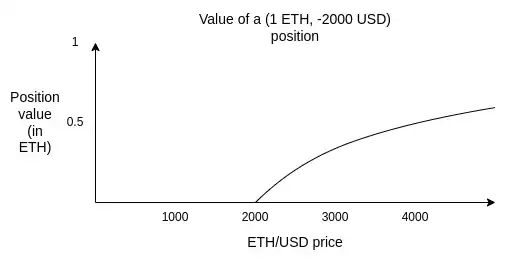
In traditional algorithmic stablecoins, this problem is solved through forced liquidations.

For example, assume the ETH price is $2500, and a user holds a position (1 ETH, -$2000). If the ETH price falls to $2000 (in practice, for a safety margin, it would trigger at a slightly higher price), the system must be able to "force liquidate" that user: allow anyone else to contribute $2000 and receive the underlying 1 ETH, ensuring the entire system doesn't get stuck with an undercollateralized $2000 debt.

The problem with relying on liquidations is that liquidation relies on real-time oracles. You need an oracle that can provide a binding ETH/USD price value and do so in real time.

Real-time oracles are difficult to secure. You can only rely on a limited number of participants who observe real-time signals in an automated manner. You cannot use any mechanism with recourse. You also cannot employ the currently most effective technique for building secure and cheap oracles: placing a prediction market in front of a secure but expensive oracle and only using that expensive oracle when serious disagreements arise.

This article proposes a disruptive idea that can allow synthetic assets to rely only on "slow" oracles: we completely remove the concept of liquidation and change the system's "basic building block" from debt to options. On this foundation, you can choose to build an asset that tracks an index as a higher-level structure, or not do so at all, letting users rebalance themselves. Decoupling these two mechanisms leads to greater stability and flexibility.

Synthetic Options

We define two assets: P and N.

The parameters include: (i) code T, (ii) strike price S, (iii) expiration date M.

At any time, a pair (P, N) can be generated by splitting 1 ETH. Similarly, you can always merge P and N to get back 1 ETH.

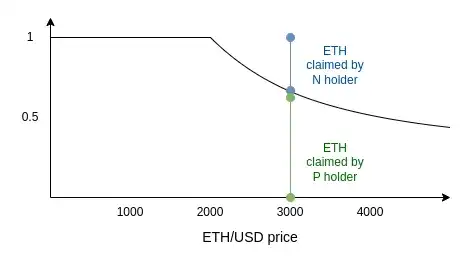
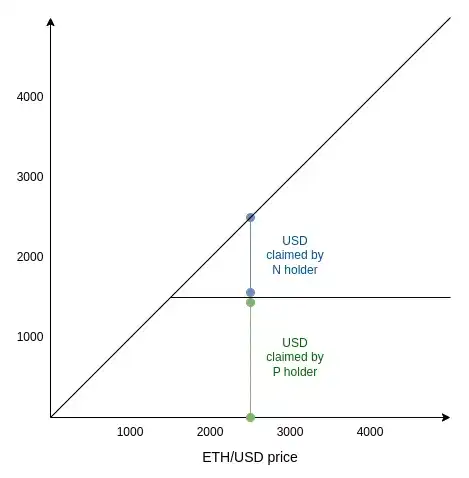
At time M, an oracle is invoked to determine the value of T. Let that value be x. After the oracle is determined:

  • P receives min(1, S / x) ETH
  • N receives max(0, 1 - S / x) ETH

Note: P + N = 1. Therefore, there is no possibility of liquidation.

Also, for ease of understanding, here is the same chart denominated in USD:
An interesting feature of this design is that it is "in effect" a prediction market, and such prediction markets have already existed and been traded for years. See: Scalar Markets | Seer.

This means the design can share the same oracle as a prediction market system, improving security.

How to Use Synthetic Options

Suppose the current price is 2500, and you, as a user, want to construct a portfolio with a certain USD exposure. You buy some (P 1500), which is a P asset with a strike price far below 2500 (here, 1500). Is this enough?

Not quite. Even though the current price is far above 1500, by the expiration date, the price could still fall below 1500. The greater this risk, the more the USD-denominated value of (P 1500) deviates from its maximum value. In fact, it begins to deviate from $1 in a quadratic form. Chart as follows:
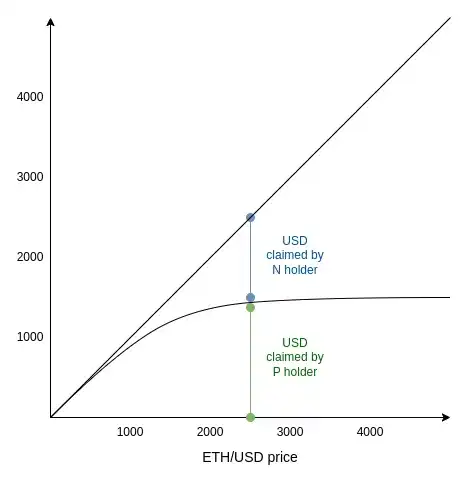
Note that this is just a smoothed version of the curve above. The degree of smoothness depends both on the gap between the current price and 1500 and on the market's expectation of future price volatility.

To understand the principle, assume M is two weeks from now, and the current price is 1499. How much is (P 1500) worth at this time? It corresponds to the possibility that "the ETH/USD price will be above 1500 two weeks from now." ETH can be quite volatile at times, so this value could be high or low, say $50. What if the current price drops to 1399? The price of P would fall but not go to zero completely, as the price could still recover above 1500 before M arrives.

When ETH/USD is far below 1500, N's value approaches zero. When ETH/USD is far above 1500, N's value approaches Price - 1500. In the middle region, it is a smooth curve transitioning from one pattern to the other.

The Black-Scholes equation is a formalized method attempting to estimate a reasonable price for (P 1500) (at least when the index T represents some price, rather than more exotic underlying assets like weather). However, since 2008, the Black-Scholes equation has become synonymous with catastrophic fragility caused by over-reliance on mathematical models—and not without reason. Therefore, we should not overly fetishize the specific details of the curve, at least because we do not want to introduce another oracle that needs to measure expected volatility, skewness, or kurtosis.

Instead, we should remember the following chart, which is the derivative of the previous chart. It tells you: at the current price level, how much ETH exposure does each unit of (P 1500) correspond to?
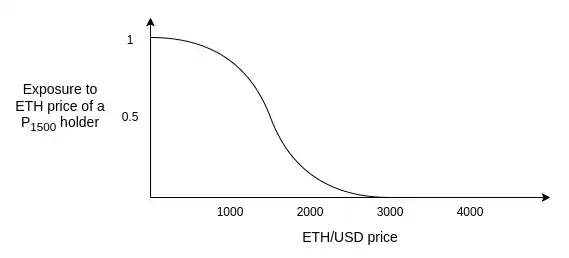
Remember, as a holder of (P 1500), your goal is to "hold" dollars without any exposure to ETH. This chart tells you the strategy: the safe approach is to hold deep "in-the-money" options, and then roll them into options with lower strike prices once the price approaches the strike.

For example, you could follow an algorithm like this: if the current price is X, buy PS with strike price S < X/2 and expiration date 1-2 months in the future. If the price falls below S * 1.5, then roll into PS' with strike price S' < X/4. Do not hold until expiration, because you would be exposed to ETH risk when the oracle determines the price.

Let speculators and market makers hold N and provide liquidity for you.

We can compare the properties of liquidation-based synthetic assets with option-based synthetic assets as follows:
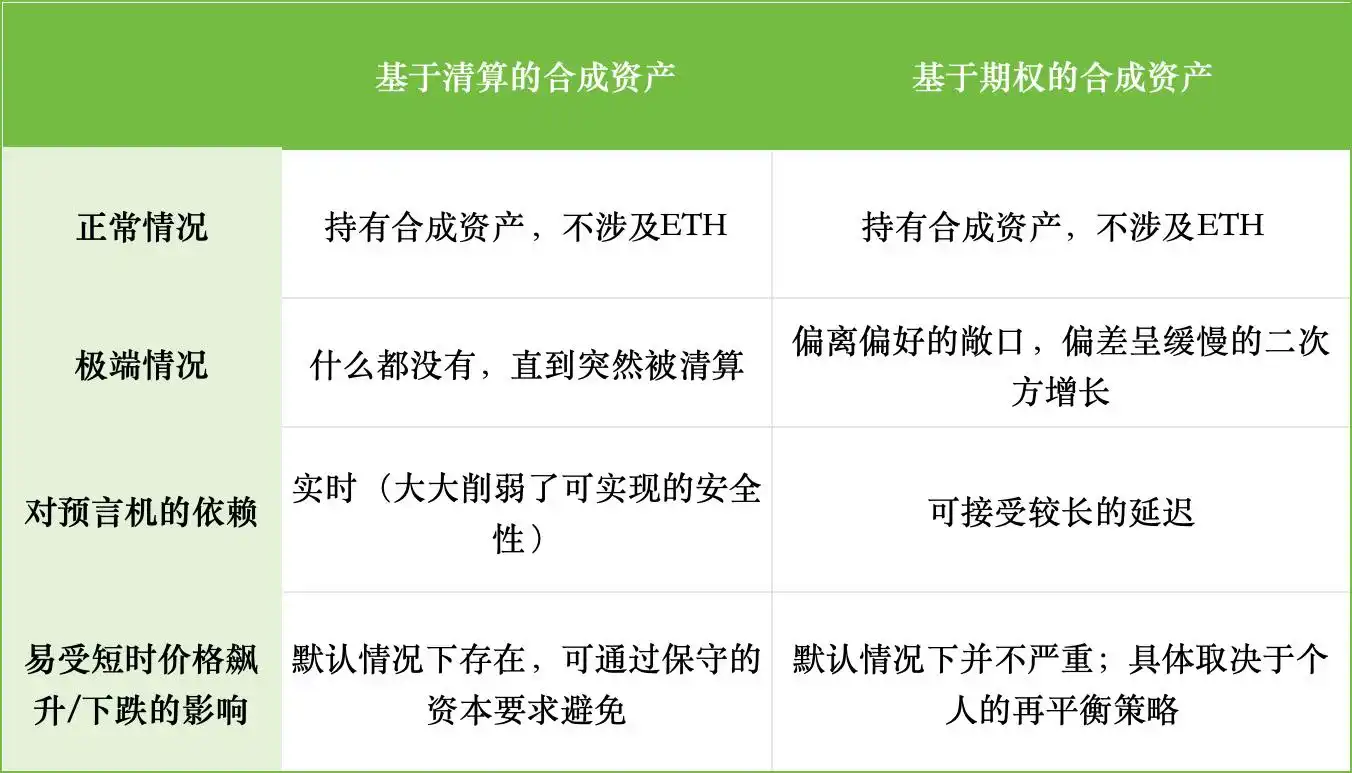
In both systems, action needs to be taken for large price fluctuations: in one system, the protocol liquidates; in the other, users rebalance. The key difference in option-based synthetic assets is that users can choose how to execute this action.

Rebalancing could be done by a fully automated on-chain DAO (Note: fully automated. All rules are set by the DAO, no voting, no AI required). Such a DAO would be a "wrapper" for the option system and provide a "stablecoin." Alternatively, users could choose to rebalance locally using a daemon on their own device.

By shifting the decision point of "when to {liquidate/rebalance}" from an on-chain tool to the user's hands, we gain two advantages:

  1. Reduce users' MEV risk because trades are not visible in advance.
  2. Eliminate reliance on a global canonical oracle. Users still need to rely on oracles that respond faster than (for example) two weeks, but users can hide which oracle they use (e.g., a locally running proxy queries dozens of financial news sites, no one knows which ones, and then takes the median). This helps protect the system from oracle attacks.

The user's main choice lies in timing and threshold. If users rebalance frequently, they are more vulnerable to short-term price fluctuations from counterparties. If users rebalance conservatively, they bear more quadratic drift.

I believe accepting a moderate degree of quadratic drift (e.g., annualized standard deviation around 1-4%) is an underrated strategy. This cost is indeed significant, and it is counterintuitive, making this design unusable as an "accounting stablecoin" (i.e., unable to let receivers, senders, or capital gains tax authorities "pretend it is a dollar").

However, if you view it not from the perspective of "I want to simulate the dollar," but from "I want price stability" (i.e., the ability to pay future known amounts of expenditure), it becomes much more reasonable. The annualized volatility between fiat currencies far exceeds 1-4%. The annualized volatility of expected future expenditures, denominated in their local fiat currency, for each individual or business also far exceeds 1-4%. Furthermore, the equilibrium return rates of algorithmic stablecoins (like RAI) also often fluctuate by roughly comparable magnitudes.

An important decision that needs to be made is: even if you rebalance conservatively, what is the market mechanism through which rebalancing occurs? Losing 2% or more per year in multiple rounds of slippage is very easy, and this is the greatest risk of the entire scheme becoming uncompetitive.

Fortunately, users' time preferences are almost always very low. Users do not care whether they rebalance today, tomorrow, or in three days. We should leverage this to design an ideal market structure with slippage far lower than traditional automated market makers. Rebalancing would then be more like one-sided market making than instant selling.


Пов'язані питання

QWhat is the fundamental problem that all methods trying to provide a synthetic asset tracking a price index T must face?

AThe entire system can only hold ETH, and the total assets and liabilities denominated in T must sum to zero. Therefore, for every user holding a positive T position, there must be another user holding an equal negative T position. The core problem is the risk of negative T holders becoming 'insolvent' if T rises too high.

QWhat is the key limitation of the traditional liquidation-based approach for algorithmic stablecoins?

ALiquidations depend on a real-time oracle. This requires a trust-minimized oracle that can provide a binding ETH price value in real-time, which is very difficult to secure robustly. Real-time oracles are vulnerable and can't easily use the safest techniques like prediction markets with fallback to a slower, expensive oracle only in case of serious disagreement.

QWhat are the two synthetic assets defined by Vitalik, and what is their core mechanism?

AThe two assets are P and N. A pair (P, N) can always be created by splitting 1 ETH, and merged back into 1 ETH. At maturity M, using an oracle-determined value x for the index T, P receives min(1, S/x) ETH and N receives max(0, 1 - S/x) ETH, where S is the strike price. This ensures P + N = 1, eliminating the possibility of liquidation.

QAccording to the article, what is a significant advantage of decoupling the stabilization mechanism (using options) from the user's rebalancing strategy?

AIt removes the dependency on a canonical, real-time global oracle. The decision of *when* to rebalance shifts from the protocol to the user. Users can rely on oracles that are faster than the option's expiry (e.g., two weeks) but can hide which specific oracles they use (e.g., a local agent querying many news sites), making the system more resilient to oracle attacks. It also reduces user MEV risk.

QWhat is a potential major risk for the competitiveness of the option-based synthetic asset system, even if rebalancing is done conservatively?

AThe market mechanism for rebalancing itself. It is very easy to lose 2% or more per year across multiple rounds of slippage. Designing a market structure with much lower slippage than traditional automated market makers is crucial, leveraging the fact that user time preferences for rebalancing are typically very low.

Пов'язані матеріали

Reddit Crypto Discussion: Tech Stocks Surge for 8 Months, Is the Crypto Community Starting to 'Accept Fate'?

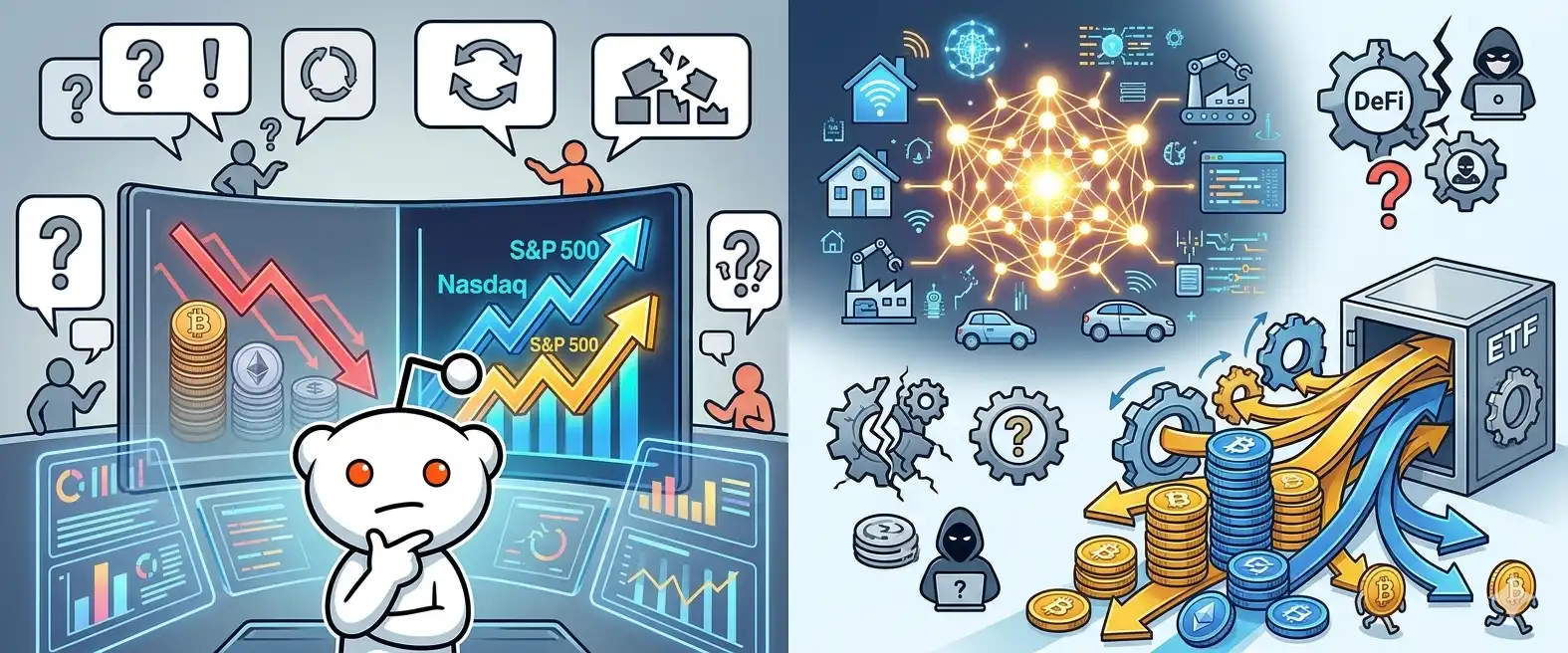
Reddit Crypto Discussion: Has the Community 'Given Up' as Tech Stocks Soar? A recent post on Reddit's r/CryptoMarkets asking if the crypto market feels "dead" compared to surging tech stocks has sparked intense debate. The discussion highlights a community grappling with underperformance: Bitcoin is down ~44% from its October 2025 high and ~20% YTD in 2026, while the S&P 500 and Nasdaq 100 have gained significantly. The debate features classic opposing views. Some users, citing Bitcoin's history, are "cycle believers" who anticipate a return to form, arguing it has "died" many times before. Others counter that crypto's narratives keep shifting without delivering a stable, compelling real-world use case beyond speculation. A prevalent third view pinpoints AI as the core issue: the tech sector's transformative boom is absorbing all attention and capital, while crypto lacks a comparable, impactful utility. Data supports the pessimistic mood. Bitcoin spot ETFs saw their largest monthly net outflow in May 2026 (~$2.3B), indicating institutional de-risking. The Crypto Fear & Greed Index has fallen to "Fear" levels. When asked about the timing of a potential market rotation back to crypto, answers are uncertain. A key practical point raised is the current high-interest-rate environment, which makes stable yields from cash and bonds attractive, reducing incentive to move into volatile assets like crypto. The underlying anxiety, as one user summarized, is "opportunity cost"—the worry about missing gains elsewhere while waiting for a crypto revival.

marsbit23 хв тому

Reddit Crypto Discussion: Tech Stocks Surge for 8 Months, Is the Crypto Community Starting to 'Accept Fate'?

marsbit23 хв тому

Chatbot has been burning money for three years, is it still the 'New Continent' of the AI era?

For years, the AI industry has been guided by a singular "map" — the belief that the AI era's "new continent" would be found in the Chatbot, a super-app akin to the mobile internet's super-apps. This belief was fueled by ChatGPT's explosive 2022 debut. However, three years of heavy investment reveal a different reality: the Chatbot-as-ultimate-entry-point model is struggling. The core issue is economic. Chatbots defy traditional internet economics. Unlike apps with near-zero marginal cost, each AI query consumes significant, expensive compute. More users mean higher costs, not profits. OpenAI, despite ~900M weekly active users, reportedly loses money. The expected network effects and data flywheels that power internet giants are weak in Chatbots, as one user's interactions don't improve another's experience. Monetization is a major hurdle. The subscription model faces low conversion rates, especially in China where users expect AI to be free. The "free + ads" model also struggles. Chatbot interactions often lack commercial intent, and inserting ads compromises the trust essential for an answer engine. Perplexity's minimal ad revenue and subsequent pivot away from ads highlight this difficulty. Switching between Chatbots is easy, making user loyalty low and competition a potential race to the bottom on price. Data suggests the standalone Chatbot's growth is slowing, and user engagement (avg. ~6 mins/day) pales compared to apps like TikTok. The product form itself is limiting; studies show nearly half of interactions are simple Q&A, trapping AI's potential in a passive, single-turn "cage." A contrasting, more successful path is emerging, exemplified by Anthropic. With over 85% of its ~$30B annualized revenue from enterprises, it focuses on AI as a productivity tool, not a companion. The rise of AI Agents (like OpenClaw) and the integration of AI into existing workflows (e.g., Google's AI Overviews, Apple Intelligence in OS) signal a shift. The future may not be a dominant Chatbot app, but AI embedded seamlessly into social apps, operating systems, and hardware — a capability-layer revolution, not a new distribution container. The conclusion is clear: the old "map" centered on a standalone Chatbot super-app is leading to a dead end. To find the true valuable "continent" of the AI era, the industry must update its navigation to prioritize deep integration, practical utility, and sustainable economics over a generic conversation window.

marsbit37 хв тому

Chatbot has been burning money for three years, is it still the 'New Continent' of the AI era?

marsbit37 хв тому

Торгівля

Спот
Ф'ючерси

Популярні статті

Що таке ETH 2.0

ETH 2.0: Нова ера для Ethereum Вступ ETH 2.0, широко відомий як Ethereum 2.0, є величезним оновленням для блокчейну Ethereum. Ця трансформація не є лише косметичною зміною; вона має на меті фундаментально покращити масштабованість, безпеку та сталий розвиток мережі. З переходом від енергомісткого механізму консенсусу Proof of Work (PoW) до більш ефективного Proof of Stake (PoS), ETH 2.0 обіцяє трансформаційний підхід до екосистеми блокчейнів. Що таке ETH 2.0? ETH 2.0 — це збірка особливих, взаємопов’язаних оновлень, спрямованих на оптимізацію можливостей та продуктивності Ethereum. Це перетворення розроблене для вирішення критичних викликів, з якими стикалося існуюче механізм Ethereum, зокрема щодо швидкості транзакцій та заторів у мережі. Мета ETH 2.0 Основні цілі ETH 2.0 зосереджені на покращенні трьох ключових аспектів: Масштабованість: Мета — значно підвищити кількість транзакцій, які мережа може обробити за секунду; ETH 2.0 прагне вийти за межі поточного обмеження приблизно в 15 транзакцій на секунду, потенційно досягнувши тисяч. Безпека: Підвищені заходи безпеки є невід’ємною частиною ETH 2.0, зокрема через покращену стійкість до кібератак і збереження децентралізованої етики Ethereum. Сталий розвиток: Новий механізм PoS розроблений не тільки для підвищення ефективності, але й для різкого зменшення споживання енергії, що узгоджує операційну структуру Ethereum з екологічними міркуваннями. Хто є творцем ETH 2.0? Створення ETH 2.0 можна віднести до Ethereum Foundation. Ця неприбуткова організація, яка відіграє важливу роль у підтримці розвитку Ethereum, очолюється відомим співавтором Віталіком Бутеріним. Його бачення більш масштабованого та стійкого Ethereum стало рушійною силою цього оновлення, залучаючи внески зі всього світу від розробників і ентузіастів, які прагнуть покращити протокол. Хто є інвесторами ETH 2.0? Хоча подробиці про інвесторів ETH 2.0 не були оприлюднені, відомо, що Ethereum Foundation отримує підтримку від різних організацій та осіб у сфері блокчейну та технологій. Ці партнери включають венчурні капітальні компанії, технологічні компанії та філантропічні організації, які мають спільний інтерес у підтримці розвитку децентралізованих технологій та інфраструктури блокчейну. Як працює ETH 2.0? ETH 2.0 відзначається введенням низки ключових функцій, які відрізняють його від попередника. Proof of Stake (PoS) Перехід до механізму консенсусу PoS є одним із знакових змін ETH 2.0. На відміну від PoW, який покладається на енергомісткий видобуток для перевірки транзакцій, PoS дозволяє користувачам підтверджувати транзакції та створювати нові блоки відповідно до кількості ETH, яку вони ставлять у мережі. Це призводить до підвищення енергоефективності, зменшуючи споживання приблизно на 99,95%, завдяки чому Ethereum 2.0 стає значно більш екологічною альтернативою. Шардові ланцюги Шардові ланцюги є ще одним ключовим нововведенням ETH 2.0. Ці менші ланцюги працюють паралельно з основним ланцюгом Ethereum, що дозволяє обробляти кілька транзакцій одночасно. Це підходи покращує загальну ємність мережі, усуваючи проблеми масштабованості, які переслідували Ethereum. Beacon Chain У центрі ETH 2.0 знаходиться Beacon Chain, яка координує мережу і управляє протоколом PoS. Вона виконує роль організатора: контролює валідаторів, забезпечує з’єднання шард з мережею і моніторить загальний стан екосистеми блокчейнів. Хронологія ETH 2.0 Шлях ETH 2.0 характеризується кількома ключовими етапами, які відображають еволюцію цього значного оновлення: Грудень 2020: Запуск Beacon Chain ознаменував введення PoS, проклавши шлях до міграції на ETH 2.0. Вересень 2022: Завершення "Злиття" є знаковим моментом, коли мережа Ethereum успішно перейшла з PoW на PoS, відкриваючи нову еру для Ethereum. 2023: Очікуване розгортання шардових ланцюгів має на меті подальше покращення масштабованості мережі Ethereum, закріплюючи ETH 2.0 як надійну платформу для децентралізованих додатків і послуг. Ключові особливості та переваги Покращена масштабованість Однією з найзначніших переваг ETH 2.0 є його покращена масштабованість. Поєднання PoS та шардових ланцюгів дозволяє мережі розширити свою ємність, що дозволяє їй обробляти набагато більший обсяг транзакцій в порівнянні з класичною системою. Енергоефективність Запровадження PoS є величезним кроком до енергоефективності в технології блокчейн. Значно зменшуючи споживання енергії, ETH 2.0 не тільки знижує операційні витрати, але також ближче узгоджується з глобальними цілями сталого розвитку. Підвищена безпека Оновлені механізми ETH 2.0 сприяють підвищенню безпеки по всій мережі. Впровадження PoS, поряд з інноваційними контрольними заходами, встановленими через шардові ланцюги та Beacon Chain, забезпечує вищий рівень захисту від потенційних загроз. Зниження витрат для користувачів З покращенням масштабованості вплив на витрати на транзакції також стане очевидним. Збільшена ємність і зменшені затори, як очікується, призведуть до зниження зборів для користувачів, що зробить Ethereum більш доступним для повсякденних транзакцій. Висновок ETH 2.0 є значною еволюцією в екосистемі блокчейну Ethereum. Оскільки він вирішує важливі питання, такі як масштабованість, споживання енергії, ефективність транзакцій і загальна безпека, важливість цього оновлення не можна недооцінювати. Перехід до Proof of Stake, введення шардових ланцюгів і фундаментальна робота Beacon Chain свідчать про майбутнє, в якому Ethereum може задовольнити зростаючі вимоги децентралізованого ринку. В індустрії, що рухається вперед завдяки інноваціям та прогресу, ETH 2.0 є підтвердженням можливостей технології блокчейн у прокладенні шляху до більш сталого та ефективного цифрового економіки.

168 переглядів усьогоОпубліковано 2024.04.04Оновлено 2024.12.03

Що таке ETH 2.0

Що таке ETH 3.0

ETH3.0 та $eth 3.0: Глибоке дослідження майбутнього Ethereum Вступ У швидко змінюваному світі криптовалют та технології блокчейн, ETH3.0, часто позначуваний як $eth 3.0, став темою значного інтересу та спекуляцій. Цей термін охоплює два основні концепти, які потребують уточнення: Ethereum 3.0: Це потенційне майбутнє оновлення, яке має на меті покращення можливостей існуючого блокчейну Ethereum, зокрема, фокусуючись на поліпшенні масштабованості та продуктивності. ETH3.0 Мем Токен: Цей окремий криптовалютний проект прагне використовувати блокчейн Ethereum для створення екосистеми, орієнтованої на меми, сприяючи залученню до криптовалютної громади. Розуміння цих аспектів ETH3.0 є важливим не лише для криптоентузіастів, але й для тих, хто спостерігає за широкими технологічними тенденціями у цифровому просторі. Що таке ETH3.0? Ethereum 3.0 Ethereum 3.0 пропонується як оновлення вже існуючої мережі Ethereum, яка стала основою багатьох децентралізованих додатків (dApps) та смарт-контрактів з моменту свого виникнення. Передбачувані удосконалення зосереджені в основному на масштабованості — інтегруючи передові технології, такі як шардінг та нульові знання (zk-докази). Ці технологічні нововведення націлені на забезпечення безпрецедентної кількості транзакцій на секунду (TPS), потенційно досягаючи мільйонів, тим самим вирішуючи одну з найзначніших обмежень, з якими стикається сучасна технологія блокчейн. Покращення є не лише технічним, а й стратегічним; воно спрямоване на підготовку мережі Ethereum до широкого прийняття та корисності в майбутньому, позначеному збільшеним попитом на децентралізовані рішення. ETH3.0 Мем Токен На відміну від Ethereum 3.0, ETH3.0 Мем Токен пропонує легшу та грайливішу домену, поєднуючи культуру інтернет-мемів із динамікою криптовалют. Цей проект дозволяє користувачам купувати, продавати та обмінювати меми на блокчейні Ethereum, надаючи платформу, яка сприяє залученню громади через креативність та спільні інтереси. ETH3.0 Мем Токен має на меті продемонструвати, як технологія блокчейн може перетинатися з цифровою культурою, створюючи випадки використання, які є водночас розважальними та фінансово життєздатними. Хто є творцем ETH3.0? Ethereum 3.0 Ініціатива щодо Ethereum 3.0 переважно підтримується консорціумом розробників та дослідників у межах громади Ethereum, зокрема, до складу якого входить Джастін Дрейк. Відомий своїми думками та внеском у розвиток Ethereum, Дрейк є помітною особистістю в обговореннях щодо переходу Ethereum на новий рівень консенсусу, який називається «Beam Chain». Цей колабораційний підхід до розробки свідчить про те, що Ethereum 3.0 не є продуктом єдиного творця, а скоріше втіленням колективної винахідливості, спрямованої на просування технології блокчейн. ETH3.0 Мем Токен Деталі про творця ETH3.0 Мем Токена наразі не відстежуються. Природа мем-токенів часто призводить до більш децентралізованої та громартової структури, що може пояснити відсутність специфічної атрибуції. Це узгоджується з етикою ширшої крипто-спільноти, де інновації часто виникають з колективних, а не індивідуальних зусиль. Хто є інвесторами ETH3.0? Ethereum 3.0 Підтримка Ethereum 3.0 переважно надходить від Фонду Ethereum поряд з ентузіастичною спільнотою розробників та інвесторів. Це базове співробітництво надає значний градус легітимності та підвищує ймовірність успішної реалізації, оскільки воно використовує довіру та авторитет, накопичені за роки роботи мережі. У швидко змінюваному кліматі криптовалют підтримка громади займає важливу роль у розвитку та прийнятті, позиціонуючи Ethereum 3.0 як серйозного конкурента для майбутніх блокчейн-інновацій. ETH3.0 Мем Токен Хоча наразі доступні джерела не надають явної інформації щодо інвестиційних фондів або організацій, що підтримують ETH3.0 Мем Токен, це свідчить про типову модель фінансування для мем-токенів, яка часто спирається на підтримку знизу та залучення громади. Інвестори в такі проекти зазвичай складаються з осіб, які мотивовані потенціалом інновацій, що керуються спільнотою, та духом співпраці, притаманним крипто-спільноті. Як працює ETH3.0? Ethereum 3.0 Відмінні риси Ethereum 3.0 полягають у його запропонованій реалізації технології шардінгу та zk-proof. Шардінг — це метод розподілу блокчейну на менші, керовані частини чи «шарди», які можуть обробляти транзакції одночасно, а не послідовно. Це децентралізоване оброблення допомагає запобігти заторам та забезпечити оперативність мережі навіть під великим навантаженням. Технологія нульових доказів (zk-proof) надає ще один рівень складності, дозволяючи валідацію транзакцій без розкриття підпорядкованих даних. Цей аспект не лише підвищує конфіденційність, а й збільшує загальну ефективність мережі. Також обговорюється включення нульової Ефірної віртуальної машини (zkEVM) в це оновлення, що ще більше підвищить можливості та корисність мережі. ETH3.0 Мем Токен ETH3.0 Мем Токен виділяється завдяки використанню популярності культури мемів. Він створює ринок, на якому користувачі можуть брати участь у торгівлі мемами не лише для розваги, але й для потенційного економічного вигоди. Інтегруючи функції, такі як стейкінг, забезпечення ліквідності та механізми управління, проект сприяє створенню середовища, яке заохочує взаємодію та участь громади. Пропонуючи унікальне поєднання розваг та економічних можливостей, ETH3.0 Мем Токен прагне залучити різну аудиторію, яка охоплює від криптоентузіастів до casual-консумерів мемів. Хронологія ETH3.0 Ethereum 3.0 11 листопада 2024: Джастін Дрейк натякає на майбутнє оновлення ETH 3.0, яке зосереджене на поліпшеннях масштабованості. Це оголошення означає початок формальних обговорень щодо майбутньої архітектури Ethereum. 12 листопада 2024: Очікується, що запропоновану пропозицію для Ethereum 3.0 буде представлено на Devcon у Бангкоку, що готує ґрунт для більш широкого зворотного зв'язку від громади та потенційних наступних кроків у розвитку. ETH3.0 Мем Токен 21 березня 2024: ETH3.0 Мем Токен офіційно потрапляє у список на CoinMarketCap, що означає його дебют у публічному крипто-просторі та підвищує видимість для його меморієнтованої екосистеми. Ключові моменти На завершення, Ethereum 3.0 представляє значну еволюцію в межах мережі Ethereum, зосереджуючись на подоланні обмежень щодо масштабованості та продуктивності через передові технології. Його запропоновані оновлення відображають проактивний підхід до майбутніх вимог і корисності. Натомість ETH3.0 Мем Токен втілює суть культури, керованої громадою, у сфері криптовалют, використовуючи культуру мемів для створення привабливих платформ, які заохочують творчість і участь користувачів. Розуміння окремих цілей і функцій ETH3.0 та $eth 3.0 є надзвичайно важливим для кожного, хто цікавиться поточними подіями в крипто-просторі. З обома ініціативами, які прокладають унікальні шляхи, вони разом підкреслюють динамічну та багатогранну природу інновацій у блокчейн-технологіях.

158 переглядів усьогоОпубліковано 2024.04.04Оновлено 2024.12.03

Що таке ETH 3.0

Як купити ETH

Ласкаво просимо до HTX.com! Ми зробили покупку Ethereum (ETH) простою та зручною. Дотримуйтесь нашої покрокової інструкції, щоб розпочати свою криптовалютну подорож.Крок 1: Створіть обліковий запис на HTXВикористовуйте свою електронну пошту або номер телефону, щоб зареєструвати обліковий запис на HTX безплатно. Пройдіть безпроблемну реєстрацію й отримайте доступ до всіх функцій.ЗареєструватисьКрок 2: Перейдіть до розділу Купити крипту і виберіть спосіб оплатиКредитна/дебетова картка: використовуйте вашу картку Visa або Mastercard, щоб миттєво купити Ethereum (ETH).Баланс: використовуйте кошти з балансу вашого рахунку HTX для безперешкодної торгівлі.Треті особи: ми додали популярні способи оплати, такі як Google Pay та Apple Pay, щоб підвищити зручність.P2P: Торгуйте безпосередньо з іншими користувачами на HTX.Позабіржова торгівля (OTC): ми пропонуємо індивідуальні послуги та конкурентні обмінні курси для трейдерів.Крок 3: Зберігайте свої Ethereum (ETH)Після придбання Ethereum (ETH) збережіть його у своєму обліковому записі на HTX. Крім того, ви можете відправити його в інше місце за допомогою блокчейн-переказу або використовувати його для торгівлі іншими криптовалютами.Крок 4: Торгівля Ethereum (ETH)Легко торгуйте Ethereum (ETH) на спотовому ринку HTX. Просто увійдіть до свого облікового запису, виберіть торгову пару, укладайте угоди та спостерігайте за ними в режимі реального часу. Ми пропонуємо зручний досвід як для початківців, так і для досвідчених трейдерів.

3.0k переглядів усьогоОпубліковано 2024.12.10Оновлено 2026.06.02

Як купити ETH

Обговорення

Ласкаво просимо до спільноти HTX. Тут ви можете бути в курсі останніх подій розвитку платформи та отримати доступ до професійної ринкової інформації. Нижче представлені думки користувачів щодо ціни ETH (ETH).

活动图片