From 'Global Computer/Settlement Layer' to 'Bulletin Board': What Are Ethereum and Vitalik Trying to Achieve?

marsbitОпубліковано о 2026-03-22Востаннє оновлено о 2026-03-22

Анотація

In a significant shift of perspective, Vitalik Buterin recently proposed that Ethereum's core value may not lie in its function as a "world computer" or "global settlement layer," but rather as a simple yet powerful primitive: a cryptographically secure, globally shared "public bulletin board." This concept emphasizes data availability—a neutral, uncensorable, and permanent data layer where anyone can read and write information, but no single entity (including governments or developers) can alter or erase it. This "global shared memory" supports applications like secure voting systems, certificate revocation lists, and decentralized coordination—scenarios that require verifiable and tamper-proof data publishing rather than complex on-chain execution. The emergence of AI further validates this direction. As AI agents and services grow, so does the need for privacy-preserving and trustless interactions. Proposals like ZK API Usage Credits illustrate how Ethereum can enable anonymous AI model access and agent-to-agent economic coordination, relying precisely on the blockchain’s transparent and immutable data layer. Rather than a step back, this reframing represents a maturation of Ethereum’s vision—from defining what it can do to serving as essential infrastructure for what the world truly needs: a foundational layer of truth in an increasingly automated and opaque digital era.

In the traditional perception of many people, Ethereum's core positioning has always been the "World Computer" or "Global Settlement Layer".

Over the past decade, it has indeed been responsible for executing smart contracts, supporting DeFi, and underpinning NFTs, effectively becoming a programmable financial and application execution layer.

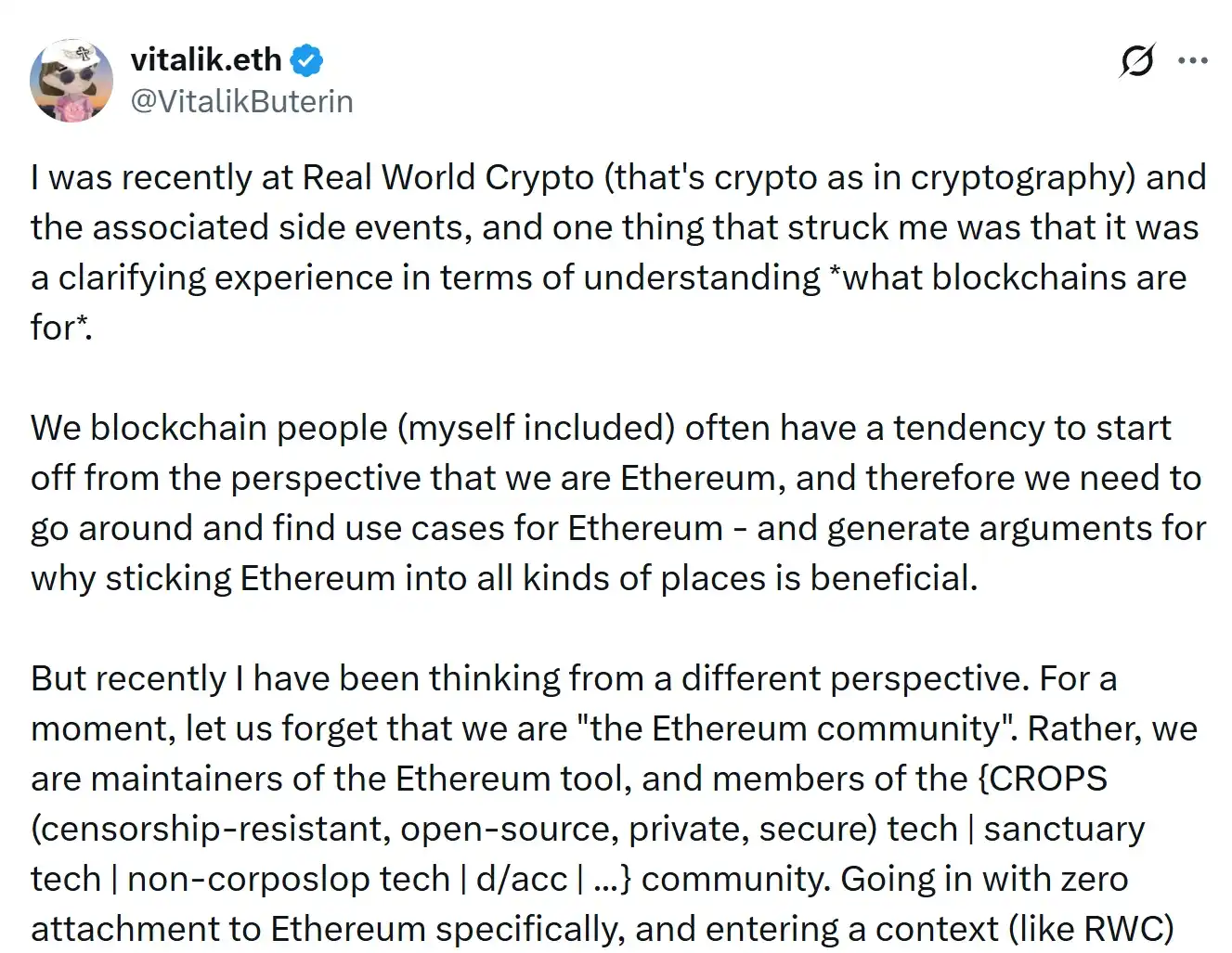
But on March 12, Vitalik Buterin proposed a rather refreshing perspective—the crypto industry may have overcomplicated the actual use cases of blockchain. The most fundamental value of Ethereum might not be the smart contract functionality we have always emphasized, but an extremely simple primitive:

A cryptographically secure, globally shared "public bulletin board".

Many users might wonder, from a "computer" to a "bulletin board", is this a functional regression, or is there another angle to consider?
I. The "Global Shared Memory" Behind the "Bulletin Board"

The so-called "public bulletin board", as the name implies, is fundamentally about data availability.

It's simple to understand: imagine a giant bulletin board posted in a central city square—anyone can read it, nothing can be withdrawn, and there is no censorship. This simply refers to a bulletin board on a global scale: global users can confirm that the data indeed exists, even the most powerful government cannot erase it, and no administrator can prevent you from publishing compliant content.

Ultimately, many digital systems, such as secure online voting and software version control, have a core need not for complex financial transactions, but for an anti-censorship, publicly verifiable data publishing space. This is precisely the "bulletin board" long sought in the field of cryptography:

  • Secure voting systems. Traditional electronic voting relies on centralized databases, which carry the risk of tampering. Publishing voting records on Ethereum allows anyone to verify the results, while the privacy of the votes is protected by cryptography;
  • Certificate revocation systems. Revocation lists for HTTPS certificates, software signing certificates, etc., need a publicly accessible, tamper-proof data source. Blockchain is naturally suited for this role;
  • Multi-party coordination and governance. Open-source projects, decentralized governance, community funds—these scenarios require multiple parties to collaborate without trusting each other. Ethereum can serve as a neutral coordination layer to publish data and verify actions;

These scenarios share a common characteristic: they don't need Ethereum to "run" anything, they just need Ethereum to "remember" something. Vitalik therefore gave a more precise ultimate definition: Ethereum is global shared memory.

Anyone can write to it, anyone can read from it, and no one can unilaterally erase it—not a company, not a government, not even Vitalik himself.

This positioning also corresponds to a clear technical path. The 2024 EIP-4844 (Blob data) was the initial scaling of this bulletin board. The full rollout of PeerDAS (Peer Data Availability Sampling) in 2026 expanded the "area" of the bulletin board a hundredfold. Ethereum is no longer fixated on the TPS of the main chain, but is committed to becoming the global storage center with the largest capacity and highest security, a foundational layer providing globally shared data availability.

II. With AI's Arrival, the Public Bulletin Board Becomes More Necessary

Understanding the essence of the "bulletin board", and then looking at the advent of AI, reveals that these are not two separate things, but two sides of the same coin.

Objectively speaking, the "bulletin board" line of thinking is actually quite related to the current impact of AI on Web3. Because increasingly, the number of conversations people have with AI daily has surpassed the number with any single human. But with current AI services, what you asked, when you asked it, how many times you asked—all are tied to your real identity.

For example, using ChatGPT requires an email and credit card; calling the Claude API leaves clear billing records; every prompt is a digital trace pointing back to you.

Therefore, in February 2026, Vitalik and the Ethereum Foundation's AI lead, Davide Crapis, jointly proposed ZK API Usage Credits, aiming to enable anonymous calls to AI large models using zero-knowledge proofs. The logic of the proposal is clear:

A user deposits funds (e.g., 100 USDC) into a smart contract, which records this deposit in an encrypted list on-chain. Thereafter, each time the user calls an AI API, they don't need to expose their identity; they just need to generate a zero-knowledge proof demonstrating "I have the right to use this credit" to complete the call.

What does this scheme require? A public bulletin board, a publicly verifiable, immutable data layer, to record "who has how much credit", without recording "who is who".

Simultaneously, the proliferation of AI Agents brings another new issue: how can these automatically running programs achieve economic coordination amongst themselves? After all, when one AI Agent needs to call the service of another AI Agent, it needs to pay, establish credibility, and handle disputes. But it has no bank account, no legal identity, and no "real-name information" trusted by centralized platforms.

Ethereum, as an economic coordination layer for AI Agents, provides a natural answer. Agents can initiate transactions on-chain, stake collateral, and establish verifiable reputation records—all built upon the transparent data layer provided by that "bulletin board".

In a broader framework, this positioning of the relationship between Ethereum and AI is even one of integration—as AI's capabilities grow stronger, the needs for privacy protection, verifiability, and decentralization become more rigid.

So, Ethereum is not competing with AI; it is aiming to become the most needed infrastructure in the AI era: a public data layer that anyone can write to, anyone can trust, and no one can shut down.

III. Is the "Smart Contract" Narrative Not Enough Anymore?

Perhaps in Vitalik Buterin's vision, the majority of future Ethereum users might not be "humans", but AI Agents.

Therefore, this shift in positioning from "World Computer" to "Bulletin Board", while easily misinterpreted as lowering expectations, is actually the opposite in understanding.

The "World Computer" is a narrative from an internal perspective, asking "what can our technology do?", while the "Bulletin Board" is a perspective from external demand, asking "what does the world truly need?".

This perhaps also benefits from the people Vitalik met at cryptography conferences—those voting system researchers, certificate protocol designers, privacy tool developers. They had no interest in blockchain or Ethereum, but the things they needed were exactly what Ethereum could provide.

Therefore, the author believes Ethereum is indeed becoming more realistic step by step, because this is the proper stance of a mature technology: it no longer tries to define application scenarios, but instead refines itself into a sufficiently reliable piece of infrastructure, waiting for the scenarios that truly need it to grow naturally.

Just like TCP/IP doesn't explain what the internet can do, but without TCP/IP, the internet can do nothing.

From this perspective, this is perhaps Ethereum's moment of "looking inward when actions don't yield results".

After all, the core, most irreplaceable value of blockchain has always been that truth which is not subject to anyone's will. This means that no matter how fast AI evolves, no matter how blurred the line between reality and illusion becomes, as long as this bulletin board exists, humanity will have a place to store "truth".

This, perhaps, is Ethereum's most honest self-positioning yet.

Пов'язані питання

QWhat is the new core value proposition of Ethereum as proposed by Vitalik Buterin on March 12th?

AEthereum's most fundamental value is not its smart contract functionality, but a simple primitive: a cryptographically secure, globally shared 'public bulletin board' or 'global shared memory'.

QWhat are some specific use cases mentioned for the 'public bulletin board' concept on Ethereum?

ASpecific use cases include secure online voting systems, certificate revocation systems (like HTTPS and software signing certificates), and multi-party coordination and governance for open-source projects and DAOs.

QHow does the proposed 'ZK API Usage Credits' system work for anonymous AI model calls?

AA user deposits funds (e.g., 100 USDC) into a smart contract, which records the encrypted deposit on-chain. For each API call, the user generates a zero-knowledge proof to demonstrate they have the right to use that credit, without revealing their identity.

QWhy is the 'public bulletin board' concept considered even more necessary with the rise of AI?

AAI services currently bind user queries to real identities (via email, credit cards, etc.). The bulletin board provides a privacy-preserving, verifiable data layer for anonymous interactions and serves as an economic coordination layer for AI Agents that lack traditional legal identities or bank accounts.

QHow does the shift from 'world computer' to 'bulletin board' represent a change in perspective for Ethereum?

AThe 'world computer' is an internal, technology-focused narrative asking 'what our technology can do,' while the 'bulletin board' is an external, demand-focused perspective asking 'what the world actually needs.' It represents a maturation, positioning Ethereum as reliable infrastructure rather than defining specific applications.

Пов'язані матеріали

Dialogue with Bloomberg ETF Analyst: Why Bitcoin ETF Holders Did Not Sell During the 50% Plunge

In a recent interview on Coin Stories, Bloomberg Intelligence Senior ETF Analyst James Seyffart discussed the resilience of Bitcoin ETF holders, who largely held their positions despite a 50% price drop, contrary to expectations of panic selling. Seyffart noted that while there was a $9 billion outflow from Bitcoin ETFs starting October 10, it was minor compared to the $250-300 billion inflows prior, and outflows have since reversed by $20-25 billion. He attributed this "diamond hands" behavior to educated investors who understand Bitcoin’s volatility and typically allocate only a small portion (e.g., 1-5%) of their portfolios, leading to rebalancing rather than selling during dips. The conversation also covered the entry of major institutions like Morgan Stanley, which is launching its own Bitcoin ETF, leveraging its vast client assets. Seyffart highlighted the growing efficiency of ETFs, with physical redemptions now allowed, potentially enabling direct Bitcoin transfers to holders in the future. However, he expressed concern over the concentration of Bitcoin custody with Coinbase. Additionally, Seyffart discussed the inverse flow trends between Bitcoin and Gold ETFs recently, with Bitcoin acting more like a risk-on growth asset. He remains optimistic about Bitcoin ETFs eventually surpassing Gold ETFs in size due to Bitcoin’s diverse use cases. Finally, he emphasized the importance of diversification in the current volatile market, where traditional hedges have largely failed, and cash.

marsbit29 хв тому

Dialogue with Bloomberg ETF Analyst: Why Bitcoin ETF Holders Did Not Sell During the 50% Plunge

marsbit29 хв тому

Who Cannot Be Distilled into a Skill?

"This article explores the concerning trend of AI systems distilling human workers into replaceable 'skills,' using the viral 'Colleague.skill' phenomenon as a key example. It argues that the most diligent employees—those who meticulously document their work, write detailed analyses, and transparently share decision-making logic—are paradoxically the most vulnerable to being replaced. Their high-quality 'context' (communication records, documents, and decision trails) becomes the perfect fuel for AI agents, extracted from corporate platforms like Feishu and DingTalk. The piece warns of a deeper ethical crisis: the reduction of human relationships to functional APIs, as seen in derivatives like 'Ex.skill' or 'Boss.skill,' which reduce complex individuals to mere utilities. This reflects a shift from Martin Buber's 'I-Thou' relationship (seeing others as whole beings) to an 'I-It' dynamic (seeing them as tools). While AI can capture explicit knowledge (written documents, replies), it fails to capture tacit knowledge—the intuition, experience, and unspoken insights that define human expertise. However, a greater danger emerges when AI-generated content, based on distilled human data, is used to train future models, leading to 'model collapse' and homogenized, mediocre outputs—a process likened to 'electronic patina' degrading information over time. The article concludes by noting a small but symbolic resistance, such as the 'anti-distill' tool that generates meaningless text to protect valuable knowledge. Ultimately, it suggests that while AI can capture a static snapshot of a person, humans remain 'fluid algorithms' capable of continuous growth and adaptation, leaving their AI shadows behind."

marsbit29 хв тому

Who Cannot Be Distilled into a Skill?

marsbit29 хв тому

South Korea's Crypto Market Shake-Up: How Should Traders View It?

South Korea's crypto market is experiencing significant turbulence following a six-month partial business suspension of its second-largest exchange, Bithumb. This event is widely underestimated globally and is not merely a compliance issue; it disrupts the competitive price discovery mechanism in a market where Upbit and Bithumb collectively hold 96% share. A critical structural information asymmetry exists due to language barriers and capital controls. Local political or regulatory shocks—like the 30% BTC crash in December 2024 after martial law was declared, while global markets fell only 2%—often trigger localized tremors first. This creates brief, highly profitable arbitrage windows for those with access to real-time Korean-language information. The "Kimchi Premium," the price gap between KRW and USD crypto pairs, is frequently misread. It is not just a retail sentiment indicator but a gauge of structural capital friction. Historically, this premium has a non-zero floor of about 1.24% due to capital controls, and its contraction often signals shifts in deeper capital pressures rather than a simple return to normality. Bithumb's suspension is accelerating liquidity concentration into Upbit, increasing systemic risk. Extreme price dislocations, like a 17% flash crash in February 2026 caused by a Bithumb operational error, become more likely and destructive in an overly centralized market. The core conclusion is that this structural information asymmetry will persist. The pro-crypto policies of the new government are driving institutional capital inflows while retail infrastructure tightens, continuously creating fleeting but substantial arbitrage (Alpha) opportunities. The key for global traders is to monitor local Korean signals and build infrastructure to act on them faster than the broader market.

marsbit2 год тому

South Korea's Crypto Market Shake-Up: How Should Traders View It?

marsbit2 год тому

Торгівля

Спот
Ф'ючерси

Популярні статті

Як купити LAYER

Ласкаво просимо до HTX.com! Ми зробили покупку Solayer (LAYER) простою та зручною. Дотримуйтесь нашої покрокової інструкції, щоб розпочати свою криптовалютну подорож.Крок 1: Створіть обліковий запис на HTXВикористовуйте свою електронну пошту або номер телефону, щоб зареєструвати обліковий запис на HTX безплатно. Пройдіть безпроблемну реєстрацію й отримайте доступ до всіх функцій.ЗареєструватисьКрок 2: Перейдіть до розділу Купити крипту і виберіть спосіб оплатиКредитна/дебетова картка: використовуйте вашу картку Visa або Mastercard, щоб миттєво купити Solayer (LAYER).Баланс: використовуйте кошти з балансу вашого рахунку HTX для безперешкодної торгівлі.Треті особи: ми додали популярні способи оплати, такі як Google Pay та Apple Pay, щоб підвищити зручність.P2P: Торгуйте безпосередньо з іншими користувачами на HTX.Позабіржова торгівля (OTC): ми пропонуємо індивідуальні послуги та конкурентні обмінні курси для трейдерів.Крок 3: Зберігайте свої Solayer (LAYER)Після придбання Solayer (LAYER) збережіть його у своєму обліковому записі на HTX. Крім того, ви можете відправити його в інше місце за допомогою блокчейн-переказу або використовувати його для торгівлі іншими криптовалютами.Крок 4: Торгівля Solayer (LAYER)Легко торгуйте Solayer (LAYER) на спотовому ринку HTX. Просто увійдіть до свого облікового запису, виберіть торгову пару, укладайте угоди та спостерігайте за ними в режимі реального часу. Ми пропонуємо зручний досвід як для початківців, так і для досвідчених трейдерів.

250 переглядів усьогоОпубліковано 2025.02.11Оновлено 2025.03.21

Як купити LAYER

Обговорення

Ласкаво просимо до спільноти HTX. Тут ви можете бути в курсі останніх подій розвитку платформи та отримати доступ до професійної ринкової інформації. Нижче представлені думки користувачів щодо ціни LAYER (LAYER).

活动图片