JPMorgan backs crypto bill as Donald Trump vows to ‘not sign other bills’ – What now?

ambcryptoОпубліковано о 2026-07-11Востаннє оновлено о 2026-07-11

Анотація

The House-passed Digital Asset Market Clarity Act of 2025 faces an uncertain future despite gaining significant backing from JPMorgan, a major shift for the traditionally crypto-skeptical bank. According to BitGo CEO Mike Belshe, this support is crucial as regulatory uncertainty has been the largest obstacle to institutional adoption. Should the bill pass, it could simplify market entry for institutional investors, potentially leading to wider cryptocurrency uptake. However, approval odds on Polymarket have dropped to 45%. Supporters, including Rep. French Hill and former CFTC Chairman Michael Selig, are pushing for a Senate vote before the August recess to force a compromise. Ethereum co-founder Joseph Lubin also supports the legislation. Yet, Democratic Senator Elizabeth Warren criticizes the current draft as enabling sanctions evasion. A further complication is former President Donald Trump's vow not to sign other bills until the SAVE America Act is passed, pushing the CLARITY Act's next deadline to August 7th.

The House passed its version of the Digital Asset Market Clarity Act of 2025 nearly a year ago, but the bill is still in a tight spot. However, Mike Belshe, CEO of BitGo, recently pointed out that JPMorgan has shown full support for the CLARITY Act.

He said,

Let that sink in. The world’s largest bank — long crypto-skeptical — is now publicly supporting crypto market structure legislation. This is a different ballgame.

AD

What does this mean for the market?

Belshe emphasized that JPMorgan’s backing of the CLARITY Act is important because regulatory uncertainty has long been the largest obstacle. So banks, asset managers, pension funds, and investment advisers are likely to be encouraged to get ready for increased crypto participation.

Should the bill pass, it might make it simpler for institutional investors to confidently join the market, which could lead to a wider uptake of cryptocurrencies.

This occurs as the approval odds on Polymarket have dropped to 45%, a 20% decrease from 74% two months ago.
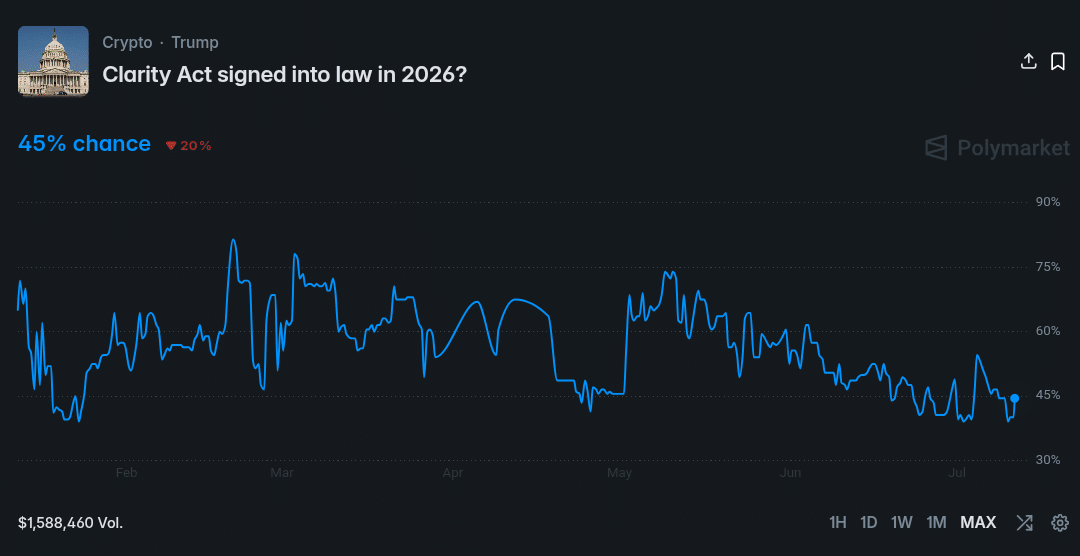
Source: Polymarket

Others supporting the passage of the CLARITY Act

However, regarding the approval, the community still appears to be in favor.

For instance, Rep. French Hill is arguing that the best way to force lawmakers to reach a compromise is to give them a clear deadline to vote on the CLARITY Act before Congress starts its August recess.

Rather than leaving these activities in a regulatory gray area, Hill believes the CLARITY Act would subject them to defined standards and said,

I’ve encouraged Senate leadership to put it on the floor. I think if you schedule a floor date here in the month of July, that will cause these final meetings, these final discussions to take place. You’ve got to have a deadline in Congress to get people to move and find consensus.

Supporters net increases

Not only this, the bill is also supported by Michael S. Selig, the 16th Chairman of CFTC, who said,

The Clarity Act, talking to this future proof notion of making sure that crypto is here to stay.

Echoing similar sentiments, Joseph Lubin, Ethereum’s co-founder, added,
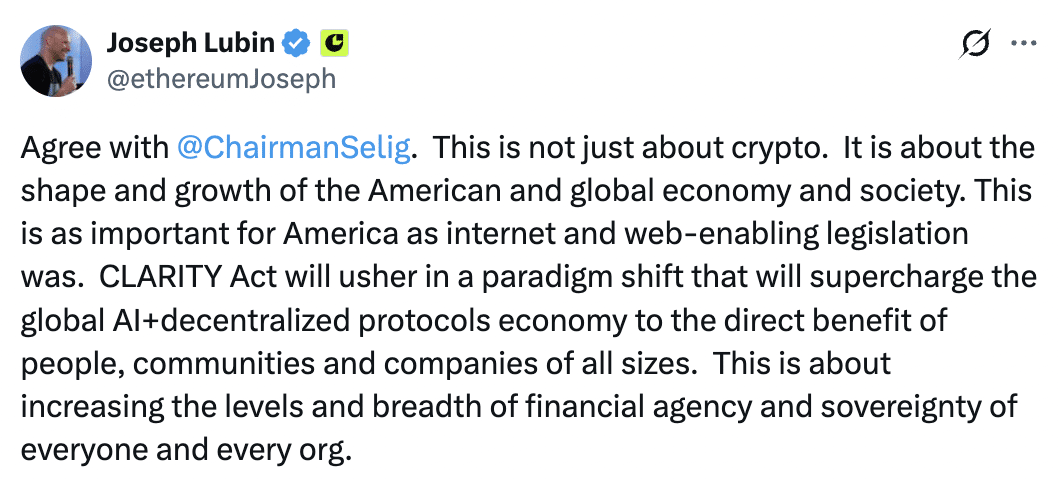
Source: Joseph Lubin/X

In fact, Democratic Senator Elizabeth Warren, who has been a stern supporter of the bill, recently put it best when she said,

As currently drafted, the CLARITY Act is a ticket to sanctions evasion.

However, Trump has stated that he will “not sign other bills” until Republicans in Congress have passed the SAVE America Act. As a result, the CLARITY Act is now awaiting a new deadline of the 7th of August to advance.


Final Summary

  • JP Morgan, supporting the bill, has ignited fresh optimism for the approval of the CLARITY Act.
  • Though the Polymarket odds have fallen to the 45% Senators, CFTC chairman, Ethereum co-founder, and many others are demanding the bill’s approval.


Трендові криптовалюти

Пов'язані питання

QAccording to the article, what is the significance of JPMorgan's public support for the CLARITY Act?

AAccording to Mike Belshe, CEO of BitGo, JPMorgan's support is highly significant because it signals a major shift from a long-time crypto-skeptical stance. It indicates that regulatory uncertainty, a major obstacle, might be addressed, which could encourage banks, asset managers, and institutional investors to prepare for greater participation in the crypto market.

QWhat is the current approval probability for the CLARITY Act on Polymarket, and how has it changed?

AThe current approval odds on Polymarket have dropped to 45%. This represents a 20% decrease from a probability of 74% recorded two months ago.

QWhat strategy did Representative French Hill propose to advance the CLARITY Act?

ARep. French Hill argued that setting a clear deadline for a vote on the CLARITY Act before Congress's August recess is the best way to force lawmakers to reach a compromise and find consensus.

QWho are some of the notable figures mentioned as supporting the passage of the CLARITY Act?

ASupporters mentioned include Michael S. Selig, the 16th Chairman of the CFTC; Joseph Lubin, co-founder of Ethereum; and Democratic Senator Elizabeth Warren, who has been a stern supporter, though she has also voiced specific concerns about the bill's current draft.

QWhat is the main political obstacle currently facing the CLARITY Act, as stated in the article?

AThe main political obstacle is that former President Donald Trump has stated he will "not sign other bills" until Republicans in Congress have passed the SAVE America Act. This has put the CLARITY Act in a tight spot, with its next advancement deadline set for August 7th.

Пов'язані матеріали

a16z Deep Dive: Stop Chasing the 'AI Smell', Here's a Practical Guide to Writing with AI

"Don't Obsess Over AI Detection: A Practical Guide to Writing Alongside AI" by Steph Zinn (a16z Crypto) This guide moves beyond the flawed premise that AI-generated text can be easily spotted by a set of "tells" and that these features automatically mean poor quality. Instead, it focuses on how writers and founders can use LLMs effectively by understanding, controlling, and editing the common stylistic tendencies of AI-assisted prose. The article breaks down AI writing "tells" into four key dimensions: **1. Rhetorical Features (Insight-Shaped Writing):** AI often produces semantically empty, "corporate-sounding" filler language—vague profundities, hedging phrases, excessive parallelism, and summary statements. The advice is to ruthlessly edit these out, using prompts to make language more specific and direct. **2. Voice Features (The Alexa Voice):** Default AI writing relies on a narrow, fungible vocabulary of low-friction, abstract words and cliché phrases that lack personality. While this generic voice is acceptable for support docs or mass communications, founders should preserve their unique voice for impactful writing. Use LLMs to identify and replace jargon, aiming for concrete, distinctive word choices. **3. Structural Features (Form Without Function):** AI tends towards over-structured text with excessive subheadings, lists, roadmaps, and the rigid "three-point" framework. While clear structure is good for readability and SEO, it shouldn't force ideas into unnatural containers. Choose a structure that serves the format and purpose, borrowing from effective examples. **4. Punctuation Features (Dash Panic):** The overuse of em dashes and colons has become a hallmark, but writers shouldn't avoid useful punctuation just to seem "human." The key is avoiding repetitive, distracting patterns. Use punctuation that is grammatically correct and supports the flow of your argument. The core argument is that many so-called AI flaws are just amplified versions of existing bad writing habits. The goal isn't to eliminate AI's role but to use it as a tool while maintaining editorial control. The final question shouldn't be "Can this be detected as AI?" but "Does this writing effectively do its job?"

marsbit1 год тому

a16z Deep Dive: Stop Chasing the 'AI Smell', Here's a Practical Guide to Writing with AI

marsbit1 год тому

Podcast Notes | Conversation with Tom Lee: Bitmine Acquiring Nearly 5% of Total ETH Supply Is Not the End Goal, ETH Price Target Set at $10,000

In a podcast interview, Tom Lee, Chairman of BitMine Immersion Technologies, discusses the company's strategy to accumulate nearly 5% of the total Ethereum supply within 14 months, using equity financing and avoiding debt. BitMine has consistently purchased ETH for over 60 consecutive weeks, with recent weeks combining buybacks with purchases. The company's substantial ETH holdings generate approximately $300 million in annual staking rewards, covering operational costs like the dividends for its 9.5% perpetual preferred stock (BMNP). Lee positions ETH as a store-of-value asset, likening it to stocks or land, rather than a pure cash-flow instrument. Looking ahead, Lee suggests BitMine may continue buying beyond the 5% target if institutional adoption grows. He outlines a bullish price target for ETH: surpassing $5,000 in a new crypto bull cycle and potentially exceeding $10,000 within 1-2 years, driven by Wall Street tokenization and AI-related demand. The discussion also covers BitMine's evolution into an ecosystem player, funding Ethereum Foundation spin-offs and developing its Maven staking platform. Lee acknowledges his significant financial interests are tied to ETH's price and BitMine's performance. The interview provides a framework for evaluating ETH as a long-term asset, emphasizing staking yield sustainability and future institutional demand, while noting the uncertainties surrounding macro cycles and real-world adoption.

marsbit1 год тому

Podcast Notes | Conversation with Tom Lee: Bitmine Acquiring Nearly 5% of Total ETH Supply Is Not the End Goal, ETH Price Target Set at $10,000

marsbit1 год тому

Торгівля

Спот

Популярні статті

Як купити BILL

Ласкаво просимо до HTX.com! Ми зробили покупку Billions Network (BILL) простою та зручною. Дотримуйтесь нашої покрокової інструкції, щоб розпочати свою криптовалютну подорож.Крок 1: Створіть обліковий запис на HTXВикористовуйте свою електронну пошту або номер телефону, щоб зареєструвати обліковий запис на HTX безплатно. Пройдіть безпроблемну реєстрацію й отримайте доступ до всіх функцій.ЗареєструватисьКрок 2: Перейдіть до розділу Купити крипту і виберіть спосіб оплатиКредитна/дебетова картка: використовуйте вашу картку Visa або Mastercard, щоб миттєво купити Billions Network (BILL).Баланс: використовуйте кошти з балансу вашого рахунку HTX для безперешкодної торгівлі.Треті особи: ми додали популярні способи оплати, такі як Google Pay та Apple Pay, щоб підвищити зручність.P2P: Торгуйте безпосередньо з іншими користувачами на HTX.Позабіржова торгівля (OTC): ми пропонуємо індивідуальні послуги та конкурентні обмінні курси для трейдерів.Крок 3: Зберігайте свої Billions Network (BILL)Після придбання Billions Network (BILL) збережіть його у своєму обліковому записі на HTX. Крім того, ви можете відправити його в інше місце за допомогою блокчейн-переказу або використовувати його для торгівлі іншими криптовалютами.Крок 4: Торгівля Billions Network (BILL)Легко торгуйте Billions Network (BILL) на спотовому ринку HTX. Просто увійдіть до свого облікового запису, виберіть торгову пару, укладайте угоди та спостерігайте за ними в режимі реального часу. Ми пропонуємо зручний досвід як для початківців, так і для досвідчених трейдерів.

740 переглядів усьогоОпубліковано 2026.05.07Оновлено 2026.06.02

Як купити BILL

Обговорення

Ласкаво просимо до спільноти HTX. Тут ви можете бути в курсі останніх подій розвитку платформи та отримати доступ до професійної ринкової інформації. Нижче представлені думки користувачів щодо ціни BILL (BILL).

活动图片