ChatGPT Finally Can 'Search Itself': Nearly Four Years of Conversations, Retrieved with One Click

marsbitОпубліковано о 2026-07-20Востаннє оновлено о 2026-07-20

Анотація

ChatGPT, nearly four years old, has long lacked a functional way for users to search their own accumulated history. This changed on July 14th, when OpenAI launched a comprehensive "Unified Search" feature across all platforms and plans. This new search allows users to find and instantly access past conversations, uploaded documents, generated images, and projects within their own ChatGPT account, all from a single sidebar entry. This update signifies a major shift in ChatGPT's role, transforming it from a transient chat tool into a personal knowledge base or "file system" for users' AI-generated content. It completes a critical missing piece as OpenAI expands ChatGPT's capabilities with features like Projects, Memory, Work, and Sites, aiming to make it a central hub for work and creativity. The ability to easily retrieve years of personal data makes that data more valuable as a unique, irreplaceable asset in the AI era. However, it also highlights the increasing weight and potential sensitivity of this data, given default settings that allow conversations to be used for model training and legal precedents involving user logs. While a significant improvement over the previous ineffective search, this move is seen as addressing an industry-wide oversight. As the competition between AI assistants (ChatGPT, Gemini, Claude) moves beyond raw model power, the new battleground is becoming which platform can best organize, retain, and leverage the valuable data co-created by users ...

It's been almost four years since ChatGPT launched.

Over these four years, how many sentences have you chatted with it, how many images have you uploaded, how many projects have you started? You probably can't even count them yourself.

But there's one pain point you must remember: trying to find that conversation from three months ago is basically a matter of luck.

The search box on the sidebar is practically useless. With many conversations, searching for old ones is nearly impossible.

In the OpenAI developer community, complaints about this old search have been long-standing:

Finally able to find that message, why did it take so long; that old search bar has never worked well; with many conversations, searching old ones becomes impossible; digging up old conversations is a nightmare...


These aren't just a few scattered complaints.

ChatGPT can generate anything, but the drafts you've written, code discussions you've had, images you've generated, and resources you've hoarded—as conversations pile up, 'finding records' becomes more like searching for a needle in a haystack. Scrolling the sidebar until your hand aches might not even help you find that crucial discussion from three weeks ago.

But this time, things have changed.
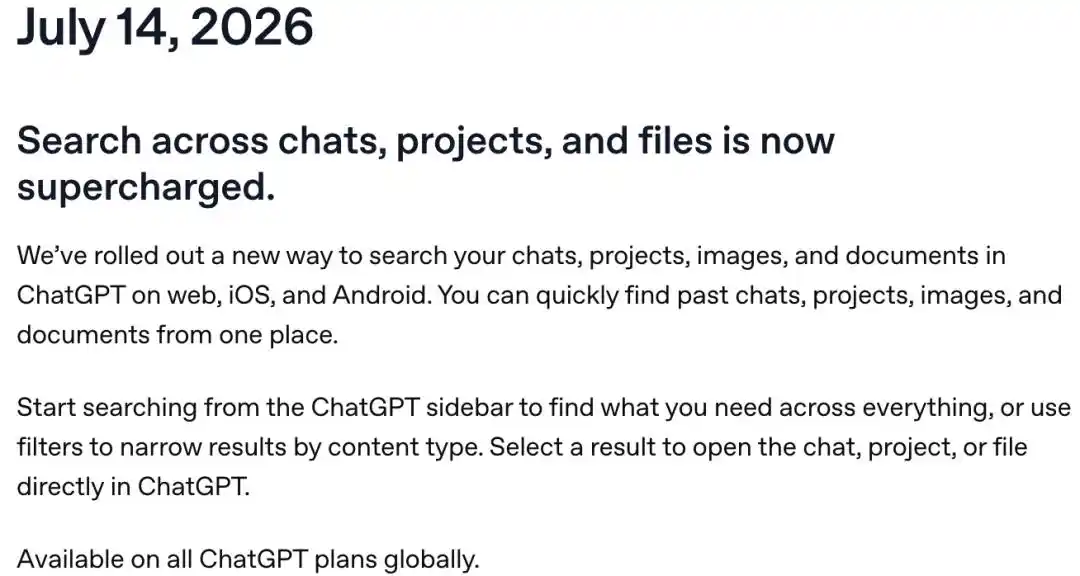
On July 14th, OpenAI rolled out a new unified search for ChatGPT, cramming everything in your ChatGPT into one unified entry: chat history, projects, uploaded documents, generated images—all searchable.

Synchronized across Web, iOS, and Android, available globally across all plans from Free to Enterprise.

If you actually go back and search through those years of 'inventory,' you'll realize: ChatGPT can 'search itself' for the first time.

And this is far from simply adding a search box: it makes your data more valuable.

For everyone, the most valuable asset in the AI era isn't the model, but the massive amount of data generated from your interactions with AI that you've accumulated.

One Entry

Searches Your Entire ChatGPT

This update isn't about making ChatGPT search the internet—that's a feature it's had for a while.

This searches the things you've accumulated in your own ChatGPT account.

The entry is right on the sidebar.

The search scope covers four categories: chats, images, documents, projects, and supports filtering by content type.

When you find something, click to go directly to the target content—no need to scroll back screen by screen.

This is completely different from the previous ChatGPT Search for the web. One helps you find information in the world, the other helps you find information in the things you've accumulated yourself.

However, there's a boundary here: cross-content search only covers content 'uploaded into ChatGPT, or generated within Projects and Work.'

Connected apps like Google Drive hanging outside are not searchable for now, and the official timeline for expanding this isn't provided.

Therefore, what ChatGPT can dig up is still only the portion you've personally handed over to it.

But even this portion is already substantial.

From Chatbot

To Your Personal Knowledge Base

How important can a search box be?

It really can't be underestimated. It's the missing puzzle piece that ChatGPT has needed for nearly four years.

For the past four years, ChatGPT has essentially been a 'conversation tool.' Everything you've chatted about is locked in isolated dialogues.

Its value is highest at the moment of the chat; after a week, it's basically sunk to the bottom of the ocean: you distinctly remember discussing a certain plan, but just can't retrieve it.

Behind this update lies a bigger change: ChatGPT is evolving from a 'chatbot' into a 'personal knowledge base.'

To put it more bluntly, it's starting to develop its own 'file system.'

Notion and Obsidian manage your own notes, Google Search manages all internet information.

And ChatGPT aims to take over an area that has never been specifically managed before: the things you and AI have co-produced over these years.

These are your assets in the AI era.

Models will be replaced generation after generation, but the conversations, projects, and materials you've accumulated with AI—no one can take them away or replicate them.

And now, all this data can be easily found and used at will within ChatGPT.

Your Data

Gets Heavier the More You Search

Search makes your pile of data more useful. It also makes the index in OpenAI's hands more complete, more valuable, but also more sensitive.

The more you can retrieve that conversation from three years ago, the clearer this record itself becomes. But there's a problem here: its boundaries are hard to fully control.

First, look at a default setting most people don't notice.

In consumer plans (Free, Plus, Pro), your conversations are by default used to train models, unless you manually go into Data Controls and turn it off. And most people have never clicked that switch.

Now consider another thing.

On January 5th of this year, in the copyright lawsuit against OpenAI by The New York Times and other media, a U.S. federal court upheld a ruling: compelling OpenAI to hand over 20 million de-identified ChatGPT conversation logs to the plaintiffs.

These 20 million represent only 0.5% of the logs it has retained, the latter being on the order of 'tens of billions.'

OpenAI cited user privacy in its defense; the court didn't accept it, with one key reason being: these conversations were 'voluntarily submitted' by users to OpenAI.
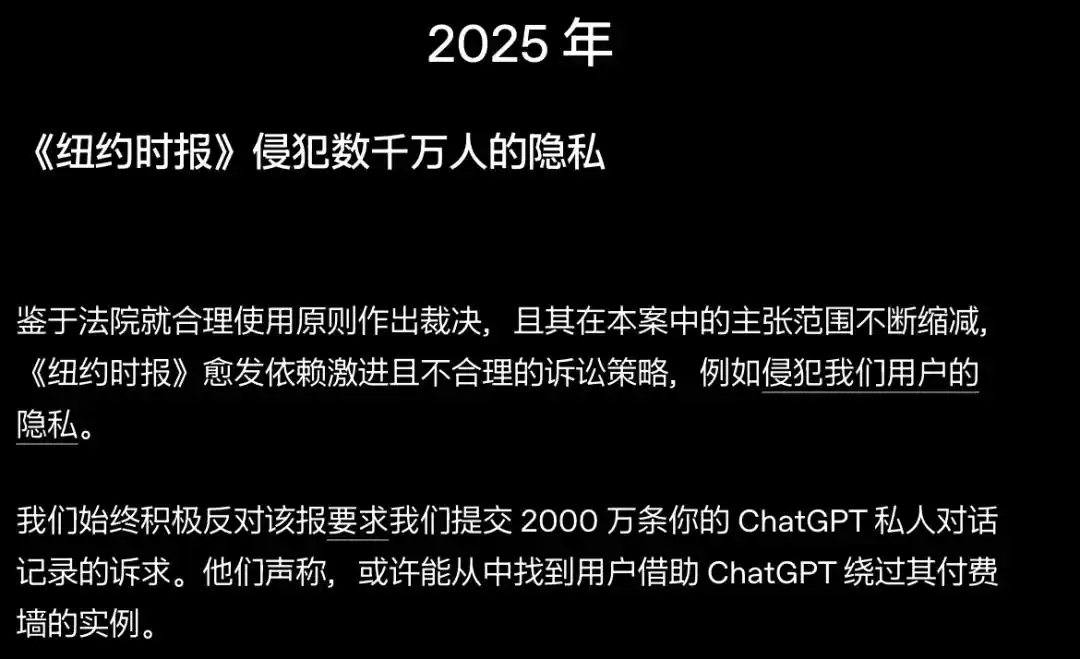
OpenAI website response page: publicly opposing The New York Times' request for 20 million user conversation records. (Source: OpenAI website)

More subtly, according to TechCrunch reports, the plaintiffs previously accused OpenAI of consistently claiming it 'could not search' these logs.

And now, OpenAI turns around and gives every user a 'search anything' feature.

The search upgrade itself didn't change any privacy policies, and the official announcement didn't mention new data uses. But it has made the things you've accumulated over these years carry more weight.

Every sentence you've said to it is both an asset and, in certain circumstances, could be opened up and presented in court.

Why Does ChatGPT Suddenly Need a Search Box?

Because it stopped being just a chatbot a long time ago.

Looking at OpenAI's moves over the past year or two:

File upload, Projects, Memory, then ChatGPT Work capable of running hours-long tasks, Sites for directly generating websites and light apps, the new desktop client merging Chat/Work/Codex, and the successive launches of the three-tier GPT-5.6 models.

The direction is crystal clear: OpenAI wants to turn ChatGPT into where you work.

And many of these moves happened just in the last half-month of July.

When you dump project materials, writing records, code discussions, generated images—all into it, the pile of stuff inside will only grow. The more it grows, the more fatal 'not finding' becomes.

Thus, search became the final piece of the puzzle in this loop.

In a nutshell: ChatGPT is beginning to have its own 'file system.'

You might think it just added a search box, but actually, it's installing the skeleton an operating system should have: the ability to store, manage, and search.

Not OpenAI's Innovation

But the Industry's Overdue Debt

And patching this up is, in a way, making up for a lesson the whole industry needs.

How bad the old search was is common knowledge in the circle.

As soon as the update came out, someone in the comments directly called out: hope Anthropic copies this quickly, Claude's current search is 'terribly bad.'

Interestingly, in 2026, the three giants are almost simultaneously doing the same thing, just with different approaches.
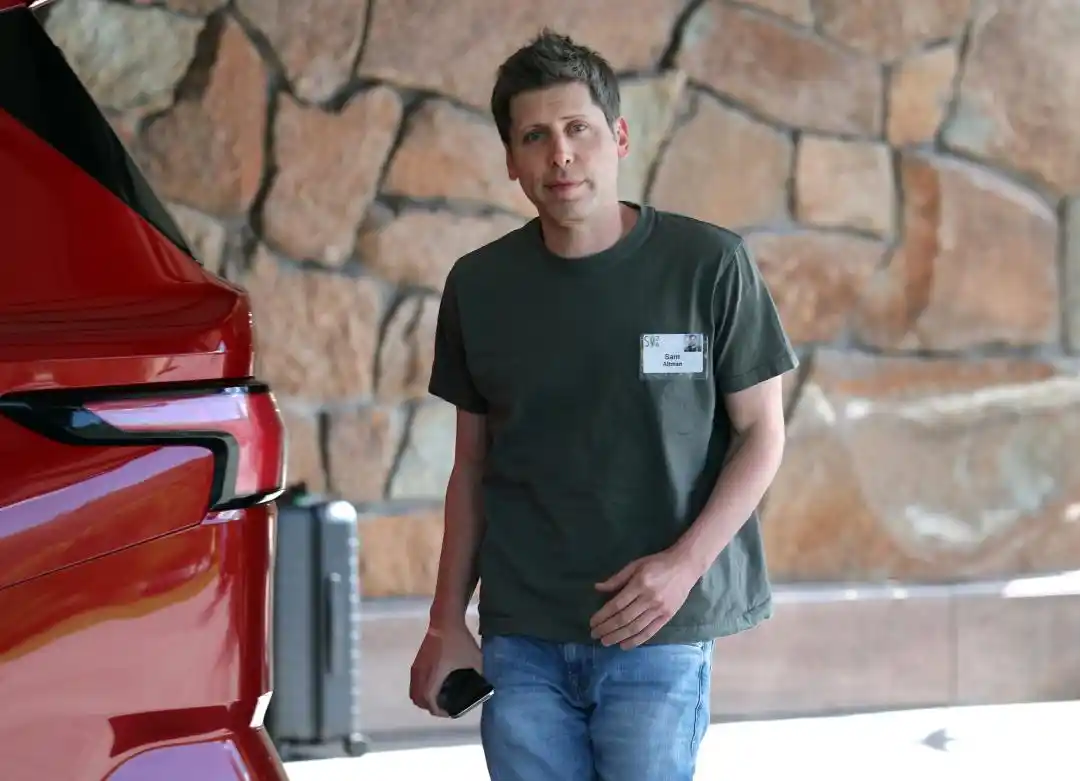
July 7th, Sam Altman appeared at the Sun Valley Summit. One week later, OpenAI densely released Work, Sites, and unified search within half a month. (Source: Kevin Dietsch via Getty Images)

ChatGPT takes the personal assistant route, gathering things you and it produced together into one entry;

Gemini relies on the Google ecosystem, integrating email, cloud drive, calendar;

Claude bets on long-term memory and Skills, gradually accumulating context for you.

Different paths, but the same destination: organizing your data, making it retrievable, and ready on demand.

If the first half of the large model competition was about answering like a human, the second half is quietly shifting the focus elsewhere: who can grasp, and moreover, revitalize your data.

Over the past two years, AI companies have desperately competed on models, yet almost no one seriously considered how to revitalize the pile of data users have accumulated.

This is precisely the key to the second half: whoever can revitalize user data can truly capture users.

Ultimately, for a product launched almost four years ago, it's only today that lets you 'search back through what you said.' What's late isn't this search box, but a re-awareness of the entire industry:

The batch of data you've accumulated together with AI is the most valuable.

References:

https://x.com/testingcatalog/status/2077132529270743286

https://x.com/btibor91/status/2077079848678555932

https://help.openai.com/en/articles/6825453-chatgpt-release-notes

https://openai.com/zh-Hans-CN/new-york-times/

This article is from the WeChat public account "New Zhiyuan", author: ASI Apocalypse, editor: Yuanyu


Трендові криптовалюти

Пов'язані питання

QWhat is the core feature introduced in ChatGPT's July 2026 update according to the article?

AThe core feature is a unified search function that allows users to search across their entire ChatGPT account history, including past chats, projects, uploaded documents, and generated images, all from a single sidebar entry point.

QWhat significant shift in ChatGPT's role does the new search feature represent, based on the article's analysis?

AIt represents a shift from ChatGPT being a 'chatbot' to evolving into a 'personal knowledge base' or a 'file system' for users, organizing and making retrievable the valuable data co-created with the AI over time.

QWhat are the three major AI companies mentioned and their different approaches to managing user data, as outlined in the article?

AThe three major AI companies are OpenAI (ChatGPT), Google (Gemini), and Anthropic (Claude). Their approaches are: ChatGPT aims to be a personal assistant with a unified entry point; Gemini leverages the Google ecosystem (Gmail, Drive, Calendar); and Claude focuses on long-term memory and skills to accumulate context for the user.

QWhat potential privacy concern related to user data is highlighted in the article regarding the new search capability?

AThe article highlights that while the search makes user data more useful, it also makes the records clearer and potentially more sensitive. It references a court case where OpenAI was compelled to hand over 20 million de-identified user chat logs, suggesting that user conversations, once submitted, could be accessed under legal circumstances.

QAccording to the article, what does the industry's late focus on user data search functionality signify for the competition among AI models?

AIt signifies that the competition is shifting from the first half's focus on how human-like the model's answers are, to a new key battleground in the second half: which company can effectively manage, organize, and leverage the user's accumulated data to truly retain users.

Пов'язані матеріали

Base Under Pressure

**Title: The Pressure Mounts for Base** Base, the Ethereum Layer 2 scaling solution backed by Coinbase, is facing significant pressure and public scrutiny from its leadership following the launch of Robinhood Chain. Base co-founder Jesse Pollak recently acknowledged strategic missteps, admitting that the chain's past focus on social and creator tokens (e.g., through Farcaster, Zora) failed to deliver sustainable adoption. He has refocused on core infrastructure, handing leadership of the Base App back to Coinbase's Cobie. While Base remains a top L2 contender alongside OP Mainnet and Arbitrum, and boasts the highest TVL (nearly $12B), its weaknesses are being highlighted by the new competitor. Key criticisms include its slow progress on decentralization. Base has faced issues with its single sequencer causing block production halts, and L2BEAT is reportedly considering downgrading its decentralization rating from Stage 1 to Stage 0. This contrasts sharply with the rapid initial success of Robinhood Chain, whose DEX quickly entered the top five by volume. The leadership styles of the parent companies are also being compared: Robinhood's CEO actively engages with new projects, while a recent incident where Coinbase's Brian Armstrong briefly changed his profile picture—sparking and then crashing a related meme token—drew community ire and mockery. Pollak stated Base is working with Coinbase on tokenized stocks backed 1:1 by real equity, differentiating it from Robinhood's derivatives model. However, the article argues that Base's most urgent task is to address its long-standing technical and trust issues. With more traditional finance players likely to emulate Robinhood's path, Base must use this competitive pressure to solidify its position as long-term financial infrastructure.

Foresight News9 хв тому

Base Under Pressure

Foresight News9 хв тому

White House Concession Removes Ethical Hurdle, Clarity Act Races Against Final Window Before Recess?

On July 21st, industry sources reported that the Trump administration has agreed to include an ethics provision in the "Clarity Act" (Digital Asset Market Clarity Act of 2025). This concession addresses the long-standing conflict-of-interest concerns regarding government officials and the crypto industry, potentially removing the final major obstacle to the bill's progress. Additionally, Patrick Witt, the executive director of the White House's Digital Asset Advisory Committee, confirmed he will remain in his role to help finalize the bill, alleviating previous concerns about his potential departure. The Clarity Act aims to establish a unified federal regulatory framework for the U.S. digital asset market. Its core objective is to resolve regulatory ambiguity by defining different types of digital assets (digital commodities, investment contract assets, and permitted payment stablecoins) and clarifying the respective oversight roles of the SEC and CFTC. This would end the long-running jurisdictional dispute between the two agencies and provide clearer compliance paths for the industry. With the ethics issue moving toward resolution, the most urgent challenge now is time. The U.S. Congress is set to begin its August recess in mid-August, leaving only a few working weeks to finalize the text and advance the bill through the Senate. Industry advocates, like the Blockchain Association's Kristin Smith, stress that this is a critical moment. If negotiations conclude successfully in the coming weeks, the Clarity Act could pass a key hurdle before the recess; otherwise, it may face significant delays. If enacted, the Clarity Act could mark a historic turning point in crypto regulation. By providing a clearer and more predictable legal framework, it aims to reduce uncertainty for businesses, developers, and traditional financial institutions looking to enter the digital asset space, potentially setting a global benchmark for market structure regulation.

Odaily星球日报15 хв тому

White House Concession Removes Ethical Hurdle, Clarity Act Races Against Final Window Before Recess?

Odaily星球日报15 хв тому

AI Era, Industrial Revolution, and Future Civilization Interview — Zhang Dingwen: The Future Does Not Belong to Chasers

"AI Era, Industrial Revolution and Future Civilization: An Interview with Zhang Dingwen – The Future Does Not Belong to Those Who Chase" In this interview, entrepreneur Zhang Dingwen reflects on his entrepreneurial journey and philosophy, moving beyond discussions of financing or success to emphasize understanding the "era" itself. He argues that true entrepreneurs should not chase short-term trends ("winds"), but position themselves in the direction of long-term technological and societal evolution. Zhang shares key lessons from his early days, including the realization that user value does not automatically translate to commercial value. For him, the core of entrepreneurship is not building a company but constantly upgrading one's own "cognition" – the ability to interpret information, ask the right questions, and understand the underlying "causes" behind business outcomes, not just the effects. His thinking has evolved from a focus on creating good products to a strategic focus on building "entrances" – platforms that naturally connect users to digital services. He sees smart wearables, like watches, not merely as hardware but as potential future gateways combining technological, financial, social, and even fashion attributes to create sustained user relationships and ecosystems. Ultimately, Zhang's vision transcends individual products or companies. He discusses business competition in three stages: product, platform, and finally, "civilization" – where the greatest companies influence how society operates by defining new rules and ways of life. He believes the mission of a truly great enterprise is to solve problems of its time, build enduring trust, and contribute lasting value, leaving behind not just wealth but a positive impact on how the world works. The future, he concludes, belongs not to the fastest, but to those with the correct long-term direction and a commitment to continuous learning and evolution.

marsbit26 хв тому

AI Era, Industrial Revolution, and Future Civilization Interview — Zhang Dingwen: The Future Does Not Belong to Chasers

marsbit26 хв тому

Cryptocurrency & Stock Market Barometer丨Strategy Cash Reserves Increase to $3.23 Billion, Halting BTC Purchases; Vanguard and Other Asset Managers Increase Holdings in Strategy Stock (July 21)

Market Overview & Warnings: The article warns of high volatility in South Korean stocks and continued dependence on U.S. stocks on geopolitics. Chinese A-shares remain under pressure. It advises against using leverage in current equity markets. For crypto-linked stocks, most have limited growth except Robinhood, with caution advised. U.S. Stock Market: Bearish bets on U.S. stocks, particularly targeting AI-related companies, have reached record highs since 2010, signaling deep skepticism about the sustainability of the AI-driven rally. Tech and chip stocks led a market decline, with the Philadelphia Semiconductor Index potentially entering a bear market. Increased expectations for Federal Reserve interest rate hikes and geopolitical tensions contributed to the negative sentiment. Bitcoin Treasury Company Updates: * Strategy: Increased its cash reserves to $3.23 billion and paused Bitcoin purchases. Several major asset managers, including Vanguard Group and Capital Group, increased their holdings of Strategy (MSTR) stock. * Global corporate Bitcoin buying slowed significantly to just $1.33 million last week. * Other notable activity: Strive purchased 21 BTC; ORANGE JUICE raised $40 million for Bitcoin acquisitions; Bitcoin Japan Corp. raised $60 million, allocating $4.08 million for its first BTC purchase. Other Crypto Treasury Holdings: * Ethereum: BitMine increased its ETH holdings to 5.78 million, nearing its 5% of supply goal. Its total crypto assets, cash, and securities are valued at $11.5 billion. * Solana: No significant corporate treasury activity reported. * Altcoins: HypeStrat made no adjustments to its treasury; its mNAV ratio fell to a long-term low. (Note: This summary is for informational purposes only and does not constitute investment advice.)

marsbit27 хв тому

Cryptocurrency & Stock Market Barometer丨Strategy Cash Reserves Increase to $3.23 Billion, Halting BTC Purchases; Vanguard and Other Asset Managers Increase Holdings in Strategy Stock (July 21)

marsbit27 хв тому

Торгівля

Спот

Популярні статті

Як купити ONE

Ласкаво просимо до HTX.com! Ми зробили покупку Harmony (ONE) простою та зручною. Дотримуйтесь нашої покрокової інструкції, щоб розпочати свою криптовалютну подорож.Крок 1: Створіть обліковий запис на HTXВикористовуйте свою електронну пошту або номер телефону, щоб зареєструвати обліковий запис на HTX безплатно. Пройдіть безпроблемну реєстрацію й отримайте доступ до всіх функцій.ЗареєструватисьКрок 2: Перейдіть до розділу Купити крипту і виберіть спосіб оплатиКредитна/дебетова картка: використовуйте вашу картку Visa або Mastercard, щоб миттєво купити Harmony (ONE).Баланс: використовуйте кошти з балансу вашого рахунку HTX для безперешкодної торгівлі.Треті особи: ми додали популярні способи оплати, такі як Google Pay та Apple Pay, щоб підвищити зручність.P2P: Торгуйте безпосередньо з іншими користувачами на HTX.Позабіржова торгівля (OTC): ми пропонуємо індивідуальні послуги та конкурентні обмінні курси для трейдерів.Крок 3: Зберігайте свої Harmony (ONE)Після придбання Harmony (ONE) збережіть його у своєму обліковому записі на HTX. Крім того, ви можете відправити його в інше місце за допомогою блокчейн-переказу або використовувати його для торгівлі іншими криптовалютами.Крок 4: Торгівля Harmony (ONE)Легко торгуйте Harmony (ONE) на спотовому ринку HTX. Просто увійдіть до свого облікового запису, виберіть торгову пару, укладайте угоди та спостерігайте за ними в режимі реального часу. Ми пропонуємо зручний досвід як для початківців, так і для досвідчених трейдерів.

427 переглядів усьогоОпубліковано 2024.12.12Оновлено 2026.06.02

Як купити ONE

Обговорення

Ласкаво просимо до спільноти HTX. Тут ви можете бути в курсі останніх подій розвитку платформи та отримати доступ до професійної ринкової інформації. Нижче представлені думки користувачів щодо ціни ONE (ONE).

活动图片