Where Are the Sellers? Low Bitcoin Inflows Hint At Holder Conviction Amid Deepest Pullback of 2025

bitcoinistОпубліковано о 2025-12-09Востаннє оновлено о 2025-12-09

Анотація

Bitcoin is attempting to recover toward $92,000 after a significant 36% pullback, its deepest of 2025. Despite the sharp decline, a CryptoQuant report highlights an unusual trend: cryptocurrency inflows to Binance remain extremely low. Historically, large corrections trigger high exchange inflows as investors rush to sell, indicating fear or capitulation. This time, however, investors are holding rather than offloading assets, showing patience and lack of panic. The current inflow levels are five times lower than during past sell-offs, suggesting strong holder conviction and a resilient market structure. This restraint may signal underlying strength and support a potential bullish recovery once the correction ends.

Bitcoin is attempting to reclaim the $92,000 level as bullish momentum gradually returns after weeks of uncertainty. The market has spent nearly two months in a corrective phase, shedding roughly 36% from its highs, yet signs of stabilization are beginning to emerge. A new CryptoQuant report from analyst Darkfost highlights a striking deviation from typical mid-cycle correction behavior—one that may explain why sentiment is starting to shift.

According to the report, inflows of cryptocurrencies onto Binance remain unusually low, even as Bitcoin has experienced one of its deepest pullbacks of the cycle. Historically, during significant corrections, investors tend to send large amounts of BTC and other assets to exchanges, signaling growing willingness to sell and escalating market fear. This pattern appeared repeatedly in past downturns, often marking periods of capitulation.

But this time, the data suggests something different: investors are not rushing to offload their holdings. Instead, they appear more comfortable holding through volatility, showing patience rather than panic. Such low inflows contrast sharply with prior mid-cycle resets and hint at a more resilient market structure beneath the surface—one where holders may be preparing for the next phase rather than abandoning ship.

A Shift in Inflows Reveals Unusual Investor Behavior

Darkfost notes that today’s data shows a markedly different behavior from what Bitcoin typically displays during major corrections. Instead of focusing on BTC alone, the analysis aggregates total inflows of all cryptocurrencies sent to Binance, offering a broader view of market intent. The logic behind this metric is straightforward: rising inflows signal growing selling pressure, while shrinking inflows indicate that investors prefer to hold rather than exit their positions.
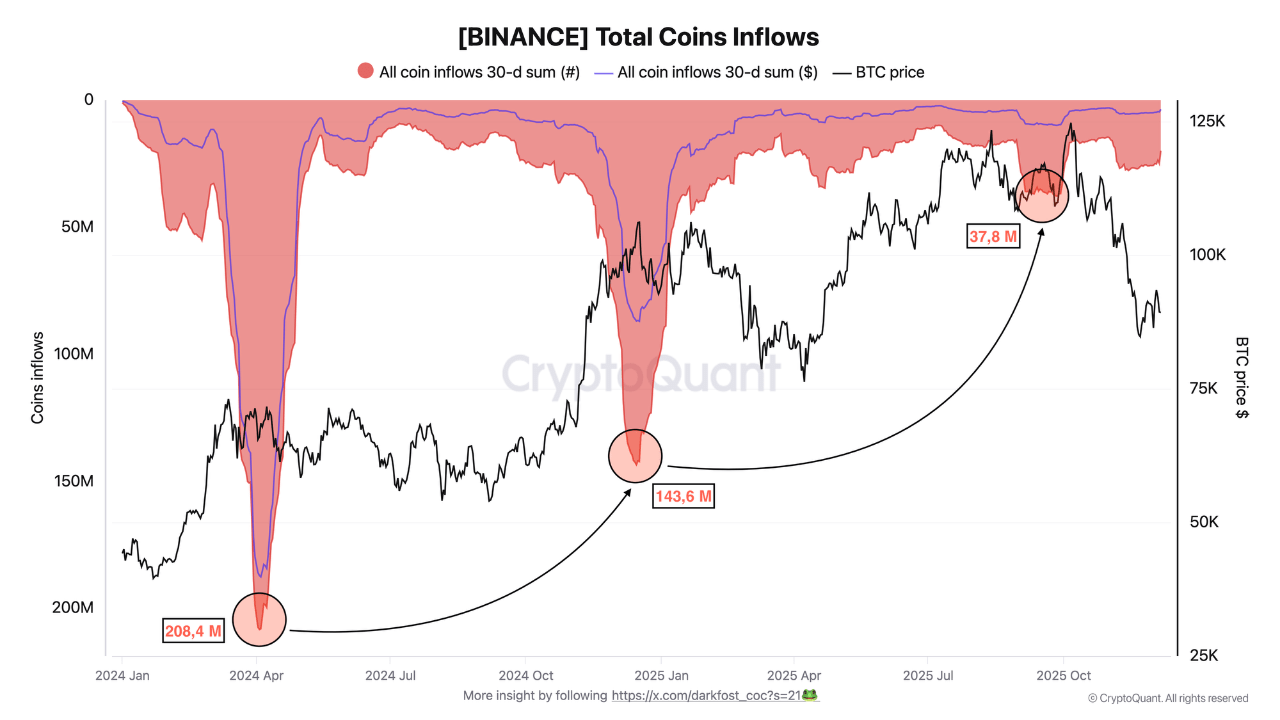
Binance Total Coins Inflows | Source: CryptoQuant

During previous downturns, inflows surged. In April 2024, right after Bitcoin hit a new all-time high at $73,800, total inflows exceeded 200 million coins, reflecting intense selling pressure. A similar spike appeared in December 2024, as BTC broke above $100,000, signaling that investors were preparing to lock in profits.

Today’s environment looks nothing like those periods. Despite experiencing a much deeper correction, inflows are five times lower—and notably stable. Investors are not sending coins to exchanges, which means they’re not eager to sell. Instead, they are sitting through the decline, showing patience rather than panic.

This unusual calm suggests a more confident market structure. If selling pressure continues to fade, this investor restraint could become one of the most constructive signals supporting a future bullish recovery once the correction runs its course.


Пов'язані матеріали

Analyst: Ripple (XRP) Price Could Rise from $2 to $10 in Less Than a Year

Cryptocurrency analyst Chad Steingraber predicts that XRP could surge from $2 to $10 in less than a year, driven by strong institutional demand through recently launched exchange-traded funds (ETFs). Key factors supporting this outlook include the rapid accumulation of XRP by ETFs. Data from SoSoValue shows that XRP-focused ETFs have absorbed over 506 million XRP (worth approximately $506 million) in under a month since their launch in November. This represents about 0.74% of XRP’s circulating supply—a significant level of adoption in a short time. Additionally, the Bitwise Crypto 10 Fund (BITW), which holds XRP as 5% of its portfolio, began trading with over $1.25 billion in assets. Steingraber draws parallels to Bitcoin’s post-ETF performance, suggesting that continued ETF inflows could propel XRP toward a 400% price increase by 2026. Technically, XRP’s chart patterns support a bullish outlook. On weekly charts, the token has broken out of a multi-month symmetrical triangle—a pattern often indicating a strong trend continuation. The measured move from this pattern suggests a potential rise to the $14–$15 range. A second pattern, a bull flag observed on higher timeframes, also points to a target near $14–$15, reinforcing the analyst’s prediction. The article includes standard disclaimers that it is not investment advice and all trading carries risk.

cointelegraph_中文4 хв тому

Analyst: Ripple (XRP) Price Could Rise from $2 to $10 in Less Than a Year

cointelegraph_中文4 хв тому

Bitcoin (BTC) Year-End Push to $100,000 Largely Depends on Fed Policy Pivot Outcome

Bitcoin's potential to reach $100,000 by year-end is heavily dependent on the outcome of the U.S. Federal Reserve's policy shift. The recent 4% drop in Bitcoin, bringing it to a low of $88,140, highlights the market's sensitivity to monetary policy and credit risk. A key factor is the Fed's transition away from quantitative tightening, which concluded on December 1. Over the past six months, this policy has removed $1.36 trillion in liquidity from the financial system. The market is now pricing in a high probability of rate cuts, with expectations for three reductions by September 2026. Lower interest rates and increased systemic liquidity reduce the appeal of fixed-income assets, as seen with money market funds hitting a record $8 trillion. Simultaneously, rising credit risk in the tech sector, exemplified by Oracle's soaring debt protection costs, is pushing investors toward scarce assets like Bitcoin. Oracle, with $105 billion in debt, relies heavily on AI-driven revenues, and the market's growing concern over the sustainability of such debt-fueled growth is creating structural unease. This combination of the Fed's policy pivot, diminishing fixed-income appeal, and tech sector credit risk sets the stage for capital rotation into Bitcoin. The path to $100,000 appears clearer as these macroeconomic and credit dynamics converge.

cointelegraph_中文10 хв тому

Bitcoin (BTC) Year-End Push to $100,000 Largely Depends on Fed Policy Pivot Outcome

cointelegraph_中文10 хв тому

The New Frontier of Privacy Coins: Technology, Prevention, and Regulatory Game

Privacy coins are at a critical juncture, shaped by technological evolution, regulatory pressure, and judicial decisions. In 2024–2025, court rulings, law enforcement actions, and technical adjustments are redefining the boundaries of this sector. Key developments include debates over whether decentralized mixing tools constitute sanctionable property, cross-border crackdowns on anonymous transaction services in Europe and the U.S., and privacy-focused projects adopting more compliant technical designs. Judicially, U.S. courts have issued influential rulings questioning whether immutable smart contracts fit traditional legal frameworks. Meanwhile, European authorities continue to target mixing services accused of facilitating money laundering. Technologically, some privacy projects are incorporating optional privacy features, flexible fee mechanisms, and improved audit interfaces to enhance usability and reduce regulatory friction. Macro-trends show countries advancing comprehensive crypto regulatory frameworks covering custody, trading, stablecoins, and anti-money laundering (AML) standards. Regulatory bodies increasingly demand that high-privacy tools provide verifiable audit trails or compliance-friendly modes to access legal financial services. Looking ahead, three main trajectories are emerging: continued legal clarification around smart contracts and mixer liabilities, a shift in privacy protocols from absolute anonymity toward optional privacy with auditability, and a market reassessment of the regulatory risk associated with privacy assets. This is causing a strategic split within the industry—some communities insist on strong privacy for niche demands, while others pursue “compliance-friendly privacy” models like enterprise-grade confidential transactions or auditable privacy pools. In essence, privacy coins are transitioning from pursuing maximum anonymity to seeking sustainable existence within regulatory boundaries. Future judicial rulings, policies, and protocol upgrades will determine which projects survive market and legal pressures. Those offering meaningful privacy while maintaining legal compliance are most likely to endure.

cointelegraph_中文17 хв тому

The New Frontier of Privacy Coins: Technology, Prevention, and Regulatory Game

cointelegraph_中文17 хв тому

Торгівля

Спот
Ф'ючерси
活动图片