Blackrock Contributes to Bitcoin ETF Recovery of $32 Million After 4-Day Slump

cryptonews.ruОпубліковано о 2026-07-30Востаннє оновлено о 2026-07-30

Анотація

The cryptocurrency ETF market saw a reversal on July 29th. Bitcoin ETFs ended a four-day outflow streak, posting a net inflow of $32.11 million, largely driven by BlackRock's IBIT fund which attracted $89.83 million. This offset outflows from other major Bitcoin ETFs. Meanwhile, Solana ETFs rebounded with a $19.06 million inflow, primarily into Morgan Stanley's new staking-supported MSOL ETF, after significant outflows the previous day. Ethereum ETFs faced renewed pressure, however, with a net outflow of $18.65 million despite some inflows to new staking products. XRP ETFs saw a modest recovery. Conversely, $HYPE ETFs extended their losing streak to five days with further outflows. The data suggests a selective market: Bitcoin regaining support, Solana rebounding, and staking products attracting interest, while Ethereum and $HYPE faced continued selling pressure.

The cryptocurrency exchange-traded fund (ETF) market shifted direction again on Wednesday, July 29. Bitcoin found buyers after four consecutive sessions characterized by outflows, while Solana offset significant losses from the previous day with nearly equal inflows.

Ether funds were less fortunate. After two sessions of growth, they returned to outflows, and $HYPE ETF funds extended their losing streak to five days.

Blackrock Supported Bitcoin Amid Ether Fund Pullback

Blackrock's IBIT ETF became the driving force behind the Bitcoin ETF recovery, attracting an inflow of $89.83 million. This increase offset outflows of $43.08 million from Fidelity's FBTC and $14.64 million from ARK 21Shares' ARKB. As a result, the category ended the period with a net inflow of $32.11 million.

The total trading volume for Bitcoin ETFs reached $1.88 billion, and the aggregate net assets at the day's close stood at $77.46 billion.
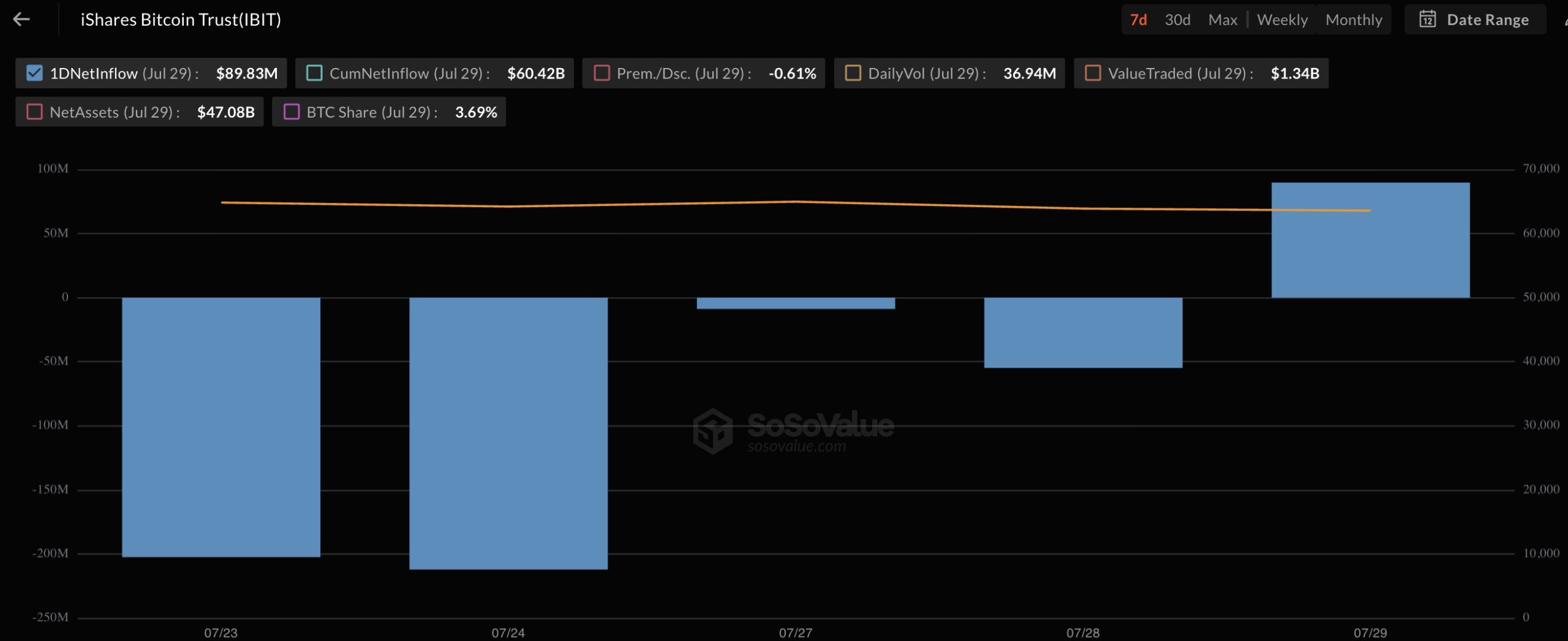
Bitcoin ETF fund flows appear to be largely dictated by Blackrock's IBIT fund, with Bitcoin ETFs' net gains/losses mirroring IBIT's flow dynamics. Source: Sosovalue

Ether ETFs displayed more mixed dynamics. The recently launched Morgan Stanley staking fund, MSSE, attracted $14.30 million, and Blackrock's ETHA ETF attracted $5.16 million.

These inflows were outweighed by outflows from five products. Fidelity's FETH fund lost $16.07 million. Grayscale's ETHE and Ether Mini Trust funds recorded outflows of $9.74 million and $8.09 million, respectively.

The 21Shares TETH fund lost $2.85 million, and Bitwise's ETHW lost $1.36 million. For the period, the net outflow for this category amounted to $18.65 million. Ether ETF trading volume was $563.79 million, with net assets at closing at $10.37 billion.

Solana Recovers Amid Accelerated Selling on Hype Wave

Solana ETFs attracted $19.06 million, offsetting the outflow of $18.07 million recorded during the previous session.

All new capital flowed into the recently launched Morgan Stanley MSOL ETF—a Solana ETF with staking support. The total trading volume reached $60.21 million, and net assets rose to $862.98 million.

Demand for new Morgan Stanley products related to staking was noticeable. The MSSE fund attracted $19.45 million over two days, and MSOL attracted $19 million on its first day of inflows, indicating that investors are responding positively to products that combine token investments with staking yield.

$XRP ETFs also returned to positive territory, though the growth was modest. Franklin Templeton's XRPZ attracted $584,710, bringing the total assets for the category to $988.70 million. Trading volume reached $10.35 million.

$HYPE ETF funds remained under pressure. Bitwise's BHYP fund recorded an outflow of $8.78 million, marking the fifth consecutive day of decline for this category. The trading volume for $HYPE ETF funds was $6.92 million, and net assets decreased to $252.38 million.

The latest fund flow data indicates that the market remains willing to take on cryptocurrency risk but is becoming increasingly selective. Bitcoin regained support, Solana bounced back, and staking products attracted interest. Ether and $HYPE, however, faced another wave of selling.

end-content


Трендові криптовалюти

Пов'язані питання

QWhat was the main reason for the Bitcoin ETF market reversing its four-day outflow streak on July 29?

AThe main reason was a significant influx of $89.83 million into BlackRock's IBIT ETF, which offset outflows from other major Bitcoin ETFs, resulting in a net inflow of $32.11 million for the category.

QWhich newly launched product categories from Morgan Stanley attracted significant investor interest and capital?

AMorgan Stanley's newly launched staking-enabled ETFs attracted significant interest. The Ethereum staking fund (MSSE) attracted $14.30 million, and the Solana staking fund (MSOL) attracted $19.06 million, indicating positive investor reception for products combining token exposure with staking yield.

QHow did the performance of Ethereum ETFs compare to Bitcoin ETFs on the reported day?

AEthereum ETFs underperformed compared to Bitcoin ETFs. While Bitcoin ETFs saw a net inflow of $32.11 million, Ethereum ETFs experienced a net outflow of $18.65 million, with outflows from products like Fidelity's FETH and Grayscale's ETHE outweighing inflows.

QWhat happened to the $HYPE ETF funds during the reported period?

AThe $HYPE ETF funds continued to face selling pressure, with Bitwise's BHYP fund experiencing an $8.78 million outflow. This marked the fifth consecutive day of losses for the category, reducing its total net assets to $252.38 million.

QWhat does the latest fund flow data suggest about the overall sentiment in the cryptocurrency ETF market?

AThe data suggests the market is still willing to take on crypto risk but is becoming increasingly selective. Support returned for Bitcoin, Solana rebounded, and staking products attracted interest, while Ethereum and $HYPE faced continued selling pressure.

Пов'язані матеріали

Breaking: GPT-5.6 Prices Slashed Effective Today

OpenAI has announced significant price cuts for its GPT-5.6 model API, effective immediately. The entry-level **GPT-5.6 Luna** sees the most drastic reduction, with input prices dropping 80% to $0.20 per million tokens and output prices falling to $1.20 per million tokens. The mid-tier **GPT-5.6 Terra** is reduced by 20%, now costing $2.00 (input) and $12.00 (output) per million tokens. The flagship **GPT-5.6 Sol** maintains its original price but introduces a new **Fast mode**, offering speeds up to 2.5 times faster for double the cost. The company attributes these price reductions to efficiency gains achieved through **GPT-5.6 Sol's own involvement in optimizing its production systems**. The model assisted in rewriting GPU kernels and improving speculative decoding, leading to a 20% reduction in end-to-end service costs and over 15% improvement in token generation efficiency. OpenAI emphasizes this process remained human-led. A key focus of the降价 is to lower the barrier for running **AI agent workflows**. By making the capable, tool-calling Luna model significantly cheaper, OpenAI aims to enable more frequent use in cost-sensitive, high-volume tasks like code review and monitoring. This creates a potential feedback loop: model-assisted efficiency gains lead to lower costs, which enables broader agent deployment, which in turn drives further optimization. The new pricing and features will also apply to Codex and ChatGPT Work subscriptions. The changes intensify competition in the large language model market, with OpenAI directly challenging rivals like Anthropic to respond.

marsbit25 хв тому

Breaking: GPT-5.6 Prices Slashed Effective Today

marsbit25 хв тому

South Koreans' 'Gambling Nature' is Actually Forced by Life

This article explores how systemic pressures in South Korea, rather than inherent "gambling" tendencies, drive widespread speculative financial behavior. It begins by noting the high frequency of flights from South Korea to Macau, symbolizing the search for outlets beyond domestic restrictions. The core argument is that ordinary life goals—stable employment, home ownership, and financial security—have become increasingly tied to asset markets due to structural economic factors. South Korea's development model, historically reliant on corporate leverage (chaebols), has evolved into a society where household debt and personal leverage are normalized as pathways to social mobility. Key mechanisms discussed include: * **Housing Policy:** Government measures to improve affordability, like extending mortgage terms to 50 years and the unique *jeonse* (key money) rental system, embed high leverage into the housing market. * **Financial Products:** The recent approval and explosive popularity of single-stock 2x leveraged ETFs (e.g., on Samsung and SK Hynix), easily accessed via mobile apps, lowered barriers to high-risk trading. * **Social Pressure:** Media narratives around soaring corporate profits (e.g., SK Hynix) and employee bonuses create a fear of missing out, pushing individuals to use leverage to "catch up." The article concludes that this "leveraged life" is a product of institutional history and policy choices. When traditional paths to success feel constrained, and policy facilitates debt-based solutions for housing and investment, speculative behavior becomes a rational, if risky, strategy for many. The rapid cycle of regulatory approval for leveraged ETFs followed by a market crash and official apology in mid-2026 exemplifies the system's inherent contradictions. Ultimately, the "bet" is not just on assets, but on using future earnings to secure a place in the present society.

marsbit25 хв тому

South Koreans' 'Gambling Nature' is Actually Forced by Life

marsbit25 хв тому

Торгівля

Спот

Популярні статті

Як купити 4

Ласкаво просимо до HTX.com! Ми зробили покупку 4 (4) простою та зручною. Дотримуйтесь нашої покрокової інструкції, щоб розпочати свою криптовалютну подорож.Крок 1: Створіть обліковий запис на HTXВикористовуйте свою електронну пошту або номер телефону, щоб зареєструвати обліковий запис на HTX безплатно. Пройдіть безпроблемну реєстрацію й отримайте доступ до всіх функцій.ЗареєструватисьКрок 2: Перейдіть до розділу Купити крипту і виберіть спосіб оплатиКредитна/дебетова картка: використовуйте вашу картку Visa або Mastercard, щоб миттєво купити 4 (4).Баланс: використовуйте кошти з балансу вашого рахунку HTX для безперешкодної торгівлі.Треті особи: ми додали популярні способи оплати, такі як Google Pay та Apple Pay, щоб підвищити зручність.P2P: Торгуйте безпосередньо з іншими користувачами на HTX.Позабіржова торгівля (OTC): ми пропонуємо індивідуальні послуги та конкурентні обмінні курси для трейдерів.Крок 3: Зберігайте свої 4 (4)Після придбання 4 (4) збережіть його у своєму обліковому записі на HTX. Крім того, ви можете відправити його в інше місце за допомогою блокчейн-переказу або використовувати його для торгівлі іншими криптовалютами.Крок 4: Торгівля 4 (4)Легко торгуйте 4 (4) на спотовому ринку HTX. Просто увійдіть до свого облікового запису, виберіть торгову пару, укладайте угоди та спостерігайте за ними в режимі реального часу. Ми пропонуємо зручний досвід як для початківців, так і для досвідчених трейдерів.

508 переглядів усьогоОпубліковано 2025.10.20Оновлено 2026.06.02

Як купити 4

Обговорення

Ласкаво просимо до спільноти HTX. Тут ви можете бути в курсі останніх подій розвитку платформи та отримати доступ до професійної ринкової інформації. Нижче представлені думки користувачів щодо ціни 4 (4).

活动图片