For tokenized assets, market trust is not built on the day of issuance.
A single audit can prove the existence of assets at a specific point in time, but when these assets begin to enter on-chain financial scenarios such as lending, payments, and fund management, the market's focus shifts to whether the underlying reserves still genuinely exist and continue to undergo independent verification months or even a year later.
As more and more RWA products enter on-chain financial scenarios, the industry's focus is gradually extending from asset issuance itself to the ongoing transparency and verification mechanisms post-issuance, shifting from "proving asset existence" to "continuously proving asset credibility." Reserve transparency is therefore no longer just an information disclosure requirement during the product issuance stage, but is beginning to become a fundamental capability supporting the sustained participation of RWAs in on-chain finance.
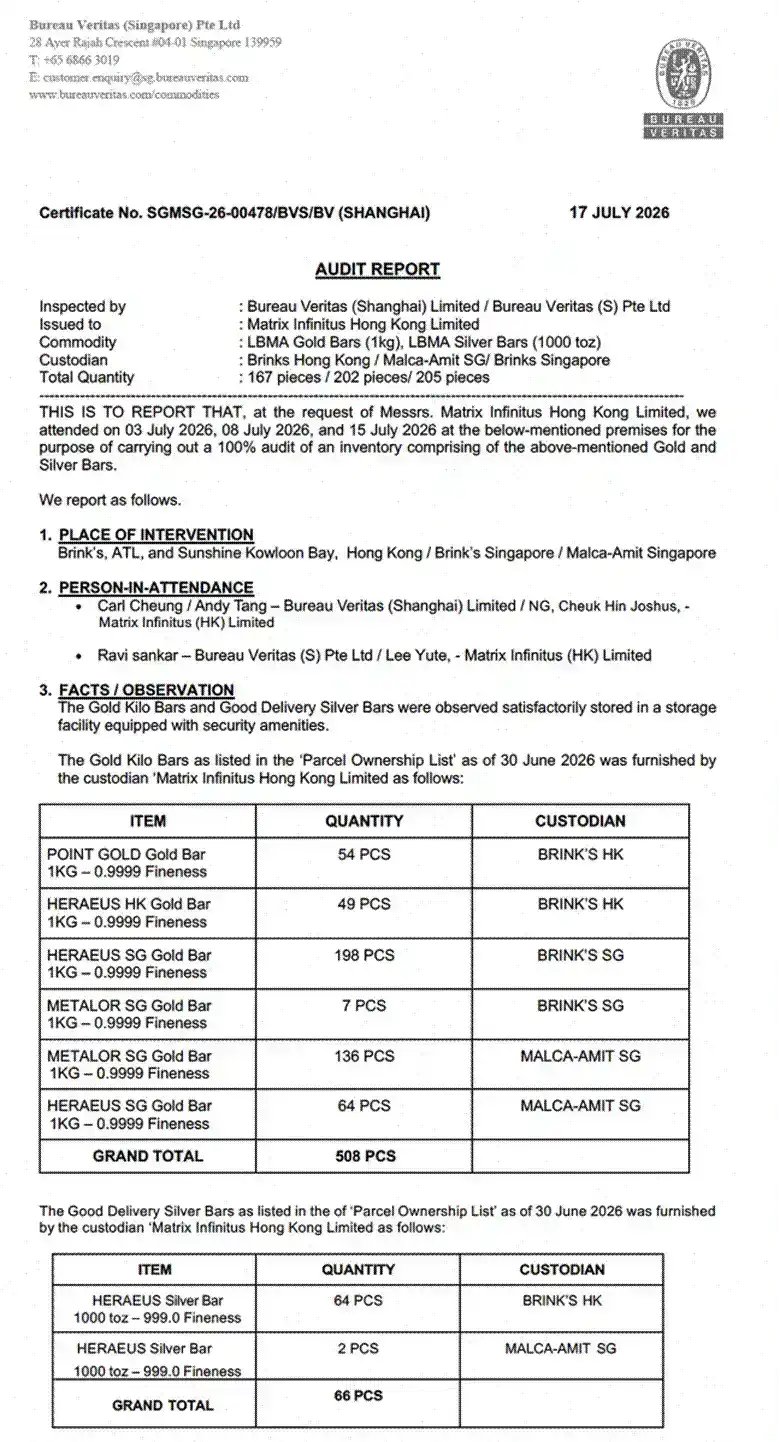
Recently, Matrixdock, the RWA tokenization platform under BIT (formerly Matrixport), completed its fourth consecutive six-month independent reserve audit. The independent reserve verification was again conducted by the international inspection and certification body Bureau Veritas, and for the first time included the tokenized silver product XAGm within the audit scope. This audit covered a total of 574 gold and silver bars from LBMA (London Bullion Market Association)-certified refineries, stored across three institutional-grade vaults in Singapore and Hong Kong.
Compared to a single audit result, two consecutive years of independent verification also reflect that reserve transparency is gradually evolving from a one-time proof of assets towards a continuously operating transparent mechanism.
From One-Time Verification to a Continuously Operating Transparent Mechanism
In traditional financial markets, whether for ETFs, funds, or custodial assets, market trust is not built on a single audit, but relies on continuous information disclosure, third-party verification, and long-term operational mechanisms. For financial products, market trust stems more from a continuous, stable, and transparent mechanism than from a one-time verification result.
As RWAs begin to assume more on-chain financial functions, this type of continuously operating transparent mechanism is gradually becoming a fundamental industry capability, rather than a mere compliance requirement.
According to information released by Matrixdock, this marks the platform's fourth consecutive completion of a six-month independent reserve audit, and the second consecutive year of independent reserve verification performed by Bureau Veritas. This means Matrixdock has maintained a consistent and continuous independent reserve verification mechanism for two consecutive years.
Compared to a one-time asset verification, continuous verification by the same international third-party institution can not only maintain consistency in verification standards but also means that reserve assets can be tracked long-term under a unified methodology. For financial markets, what matters is not the audit result at a single point in time, but whether the verification mechanism can operate long-term and stably. For Matrixdock, reserve transparency does not come from a single audit, but is continuously built through ongoing operation. Two consecutive years of independent verification is precisely a manifestation of this continuous transparent mechanism.
In this audit, Bureau Veritas completed physical verification of all metal bars across the three institutional-grade vaults, including weighing, dimension measurement, and item-by-item cross-checking with vault records. The audit results show that the underlying gold reserves for XAUm are consistent with the circulating token quantity; after applying the corresponding ozPerToken value, the reserve assets for XAGm are also consistent with the circulating token quantity, with no discrepancies found.
Meanwhile, the inclusion of XAGm in the independent reserve audit for the first time signifies that the same set of reserve verification standards is beginning to cover more tokenized precious metal products, rather than being applicable only to a single asset.
Transparency: More Than Just Proving Asset Existence
If reserve transparency in the past primarily meant "proving the genuine existence of assets," then as RWAs enter the on-chain finance stage, it is beginning to take on another, more important function—continuously supporting market trust.
In addition to the semi-annual independent reserve verification, Matrixdock also continuously discloses monthly reserve reports, on-chain Proof of Reserves, and the Gold Allocation Lookup tool among other transparency mechanisms. This provides the market with continuously updated reserve information, rather than relying solely on periodic audit results.
Matrixdock refers to this system as the "Reserve Transparency Stack." This system does not rely on a single proof but combines multiple components—independent third-party verification, on-chain data verification, and continuous information disclosure—to jointly build reserve transparency capability.
Behind this change is also a reflection of the industry's evolving needs. For lending protocols, payment networks, and institutional fund management, what truly matters is not just whether there is sufficient reserve backing on the day of asset issuance, but whether the assets can continuously maintain transparency, verifiability, and traceability throughout their entire lifecycle. Transparency is evolving from a one-time "proof" into an essential trust foundation supporting the continuous operation of on-chain finance.
When Reserve Transparency Begins to Impact On-Chain Finance
In recent years, tokenized gold, U.S. Treasury bonds, and other RWA products are gradually entering more on-chain financial applications such as lending, liquidity management, payments, and institutional reserve management. Real-world assets are shifting from being mere "on-chain representations" to becoming "on-chain financial assets."
This change signifies that the role of the underlying reserve is also transforming. In the past, it primarily supported asset issuance; now, it is beginning to support the continuous circulation, collateralization, settlement, and institutional allocation of assets on-chain. For institutions, assets not only need to be tokenized but also require the capability for continuous verification, continuous disclosure, and continuous operation.
According to information disclosed by Matrixdock, continuous reserve verification helps tokenized assets further enter lending, institutional fund management, and more on-chain financial scenarios. From this perspective, what reserve transparency supports is no longer a single product, but the trust foundation required for assets to enter the on-chain financial ecosystem.
If the competitive focus in the RWA industry over the past few years has been "how to bring real-world assets onto the chain," then as the industry gradually enters a new developmental stage, competition is beginning to shift towards "how to enable these assets to participate in on-chain finance long-term." With asset issuance becoming increasingly mature, continuous verification, continuous disclosure, and long-term operational mechanisms are becoming new focal points for institutions.
For the entire RWA industry, what may truly differentiate players in the future is perhaps no longer just the scale of assets, but who can continuously verify reserves, continuously disclose information, continuously build market trust, and consolidate these capabilities into a long-term, stable, and operating transparent system. As more and more real-world assets enter on-chain financial scenarios like lending, payments, and institutional fund management, reserve transparency is also evolving from a product capability into an important trust infrastructure connecting real-world assets with on-chain finance.
This article is contributed and does not necessarily represent the views of BlockBeats.