February 6, 2026, the last time humans outran AI.
That day, the tokens consumed by humans on OpenRouter were matched for the first time by those consumed by agents.

In just half a year, the gap between the two lines has widened to 5 times.
According to OpenRouter statistics, as of August 10, agent-class token usage grew from about 0.51 trillion to 7.3 trillion, a 14-fold increase; the human line also rose to 1.4 trillion, but only 2.8 times.
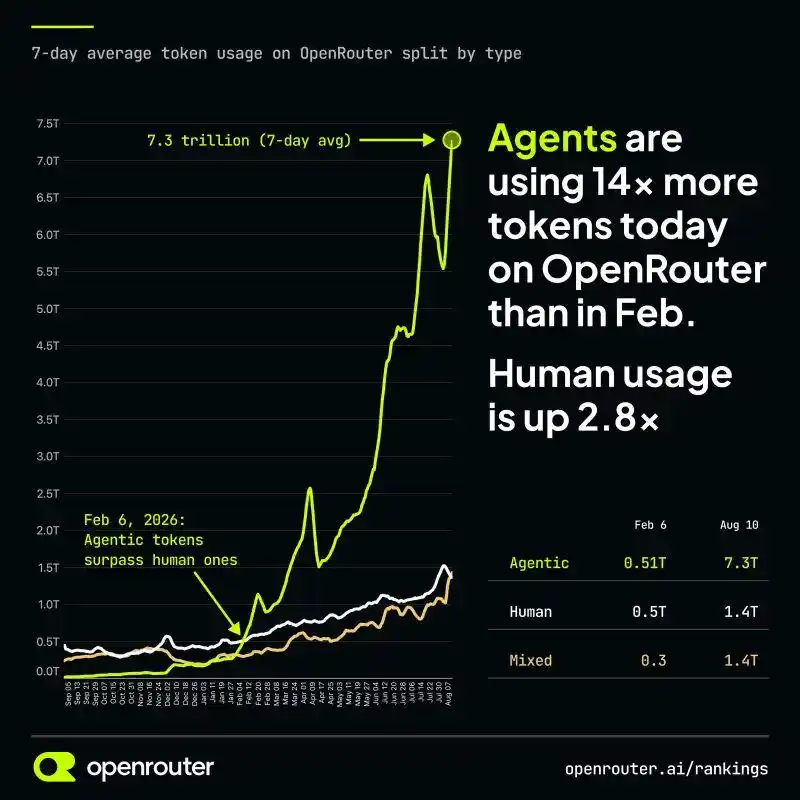
Such a stark contrast makes even Peter feel a bit disoriented: it feels like a decade apart, yet February 6 was only half a year ago.
It Doesn't Matter Who You Are, But How You Use It
First, let's clarify where this data comes from and how it's calculated.
OpenRouter is one of the world's largest model gateways, connecting about 70 model suppliers on one end and developers on the other, processing 28 trillion tokens per week.
According to its co-founder and COO Chris Clark's estimate, this represents about 1% of global inference volume, with half coming from the United States.
How are these 1% of tokens divided between human and agent usage?
OpenRouter doesn't look at who you are, but how you use it, specifically by tracking behavior via API keys:
Metrics like frequency of tool calls, seconds between responses, number of turns in a conversation—seven such signals in total, weighted and scored, then traffic is categorized into Agentic, Mixed, and Human tiers.
Why can behavior alone distinguish them?
The reasoning is simple: humans use AI by asking a question, pausing a while, needing to read, think, and type in between; agents, on the other hand, run non-stop, chaining tool calls, cycling through rounds—a rhythm unmistakably non-carbon-based.
So it's an estimation model, but the direction is correct.
A single human objective can now trigger dozens of model and tool calls. Token statistics don't count how many people are using AI, but how much work AI does on humans' behalf.
One Agent Task Equals a Hundred Chats
What truly widens the gap between humans and agents is the difference in how they are used.
What does a human request look like?
Open a chatbox, type a prompt, wait for a response, copy it, close it.
From start to finish, you and the model exchange less than ten sentences, amounting to a few thousand tokens at most on paper.
But an agent's request is a completely different story.
You give it a goal, and it proceeds on its own: reading files, calling tools, writing results, reading again, revising again, grinding round after round until the task is complete.
Humans pack their initial prompt with goals, specifications, and context, after which the model continuously reads and writes incrementally based on this context.
While you're still in a Q&A mode, an agent can already run for a whole day on a single instruction!
So, the same person, manually copy-pasting in a chatbox in the morning, can deploy an agent in the afternoon and immediately see token consumption jump by an order of magnitude.
Peter hits the nail on the head: the real behavior change that unlocks scale is people starting to let agents run autonomously for extended periods.
Even Cheap Tokens Can Burn Through Budgets
Seeing a 14-fold increase, your first reaction might be: burning money.
It is indeed burning money, but not in the way you think.
Peter adds a point: because agents are inherently multi-turn, nearly 70% of the tokens in an average agent request come from cached prompts, and cached tokens are typically priced much lower.
The logic isn't hard to grasp.
An agent repeatedly reads and writes around the same goal: the first time, it loads that huge chunk of context (code specs, operation manuals, tool lists) and pays full price; each subsequent round only involves incremental updates, with cached portions charged at a fraction of the normal input price.
In other words, within that steep curve, nearly 70% is the same chunk of context being reused repeatedly.
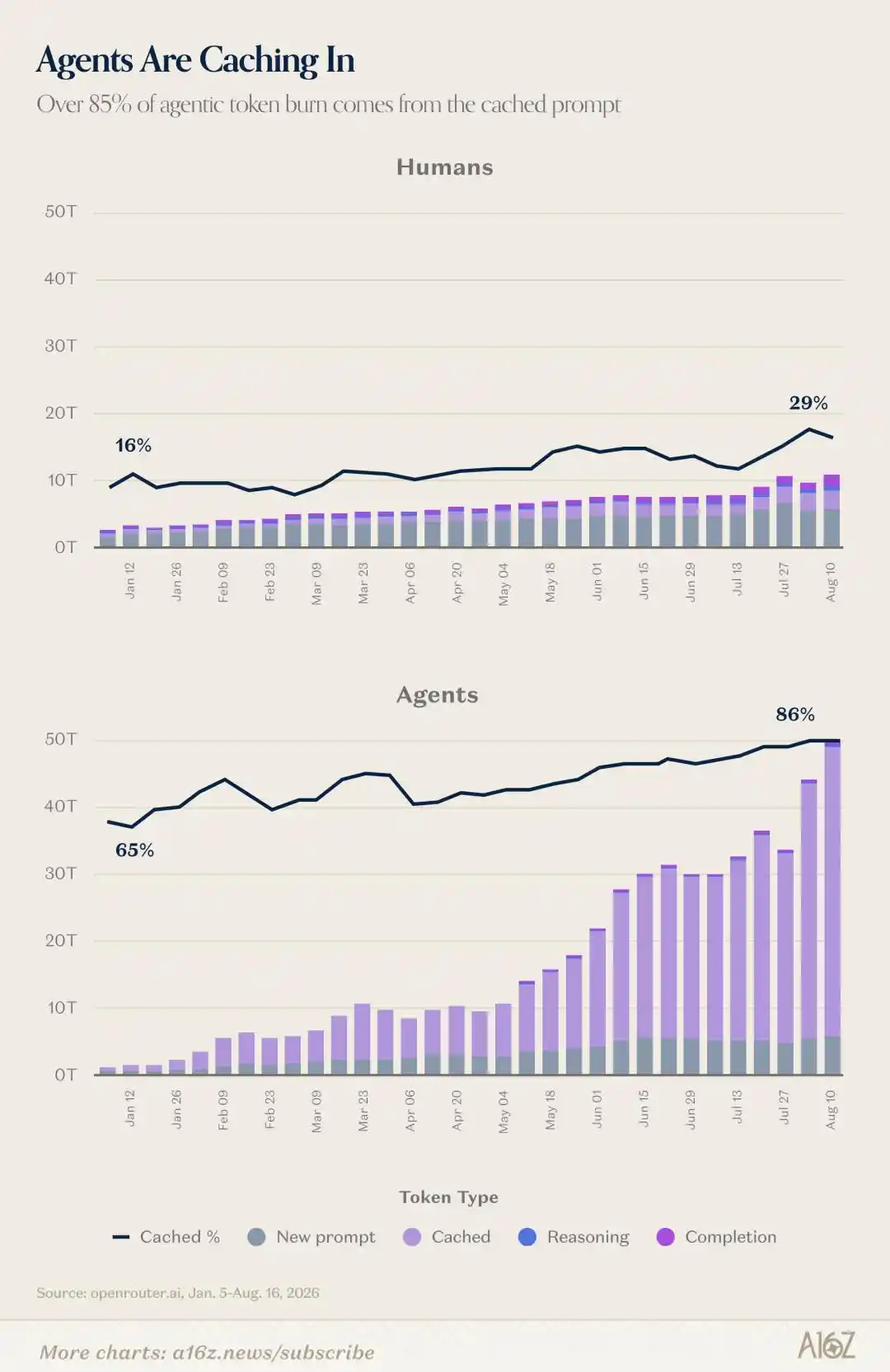
Comparison of token composition between Agent and Human, cached tokens contribute almost the entire increment. a16z cites over 85% by total volume, Peter's original post cites nearly 70% on average per request.
So the unit price indeed drops, but it can't withstand the explosive surge in volume.
Uber CTO Praveen Neppalli Naga revealed earlier this year that company engineers burned through the entire year's Claude Code budget in just four months.
According to media reports, a two-hour demo by him alone cost $1,200.
Unit price discounted by 70%, volume up 14 times—the result of this multiplication isn't hard to calculate.
EY crunched a more intuitive set of numbers: for the same customer service interaction, the cost was about $0.04 in 2023, rising to about $1.20 by 2026—a 30-fold increase.
It's not that the models got more expensive.
Before, it was the customer asking one question, the system answering one, a single straight line.
Now the customer still asks that one question, but behind the scenes, it's checking tickets, querying inventory, flipping through records, thinking a round, revising a round, going through a dozen turns before spitting out one reply.
The same task, done differently, changes the price.
Goldman Sachs estimates that agentic AI could push token consumption 24 times higher by 2030.
Any cost that increases 14-fold in half a year will make people start scrutinizing details. Peter says this is precisely why open-weight models and low-cost token services are suddenly getting attention.
Moreover, although cached tokens are cheap, they consume memory.
An agent running for several hours, never needing to start over from scratch, relies on memory holding that entire context.
This explains half the reason why high-bandwidth memory is so tight lately.
The Divide Isn't Which Model You Use
So, is the money-saving solution to switch to a cheaper model?
The real divide isn't which model you use.
The same model, used as a search box, yields a few thousand tokens a day; connect it to your own files, tools, and a process that can run continuously, and a few million tokens a day isn't surprising.
The gap isn't in the model, but in whether you put it to work in real tasks.
How wide is this chasm? OpenAI provides a set of figures for reference:
The top 10% of companies by depth of usage output 8.3 times more tokens per active user than typical companies. In January, this gap was only 2.6 times.
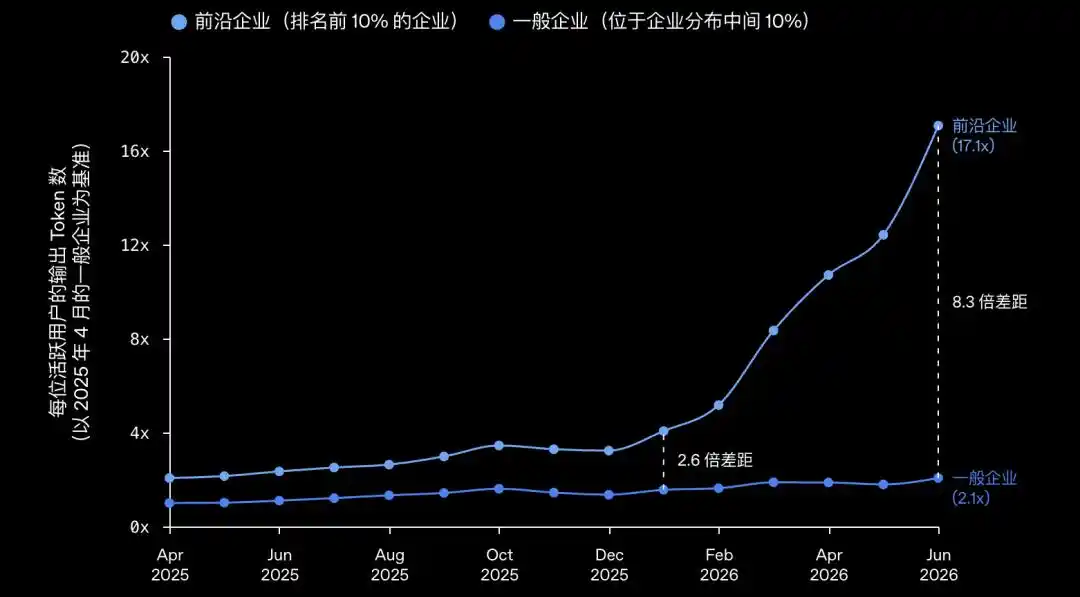
In six months, the gap widened more than threefold.
What creates the gap isn't the model, but the supporting ecosystem.
In the same statistics, 21% of active users at leading companies use plugins weekly, compared to only 9% at typical companies; skill adoption is 19% vs. 3%. Within OpenAI itself, this number is 95%.
Packaging the tasks you regularly do into a set of reusable skills means the agent doesn't have to start from scratch every time.
Fewer searches, fewer reworks—all that saves money.
Tokens Spent, Who Validates?
However, no matter how precisely the accounts are calculated, it doesn't mean the work is done reliably.
The surge in agent traffic doesn't mean AI is acting entirely autonomously. A large number of tasks are still initiated by humans, often with manual approvals interspersed.
A developer in the comments of Peter's original post, serving clients in the service industry, mentioned that the bosses he works with never considered hands-off operation—procurement, sending, signing, every step loops back to a human.
But the problem is, looping back doesn't necessarily mean finding someone.
Another practitioner said their agent deleted 18 videos from an advertising account, and it took a full day before anyone noticed.

This isn't about the model making some outrageous error, but rather that no one was watching that step.
Token expenditure can increase 14-fold in half a year, but the number of people available for validation can't increase that much. This is perhaps the most overlooked and most expensive hidden cost in this round of growth.
Analysis, research, drafts, plans, repetitive execution actions—these will all become surplus going forward.
What's truly scarce is verification, judgment, and deciding what is worth doing.
AI has become the primary consumer of tokens, but to this day, it still can't sign on your behalf.
In the future, the real question will no longer be whether you use AI.
But rather, for all the work AI does on your behalf, who validates it, and who decides the next step.
References:
https://www.linkedin.com/posts/peterjameswalker_february-6th-2026-potentially-the-last-share-7493029881841344512-IK89/
https://the-decoder.com/ai-is-becoming-ais-biggest-customer-as-agentic-token-usage-jumps-14x-on-openrouter/
https://openai.com/signals/enterprise-data/
https://www.a16z.news/p/charts-of-the-week-winds-of-thematic
https://www.ey.com/en_us/insights/ai/agentic-ai-token-costs
This article is from the WeChat public account "New Zhiyuan", author: ASI Apocalypse; Editor: Yuanyu