Animoca, Solv to help Japanese Bitcoin companies generate yield

cointelegraphОпубліковано о 2025-12-10Востаннє оновлено о 2025-12-10

Анотація

Web3 gaming firm Animoca Brands has partnered with Solv Protocol to help Japanese companies with large Bitcoin holdings generate yield on their assets. The collaboration will use Solv's infrastructure to offer annual yields between 4% and 12% through methods like lending markets and liquidity provisioning. This initiative aims to transform Bitcoin from a passive holding into a productive financial tool for corporate growth. Currently, 11 Japanese public companies hold Bitcoin, with Metaplanet being the largest. The venture is backed by investors including Binance Labs and manages over $2.8 billion in assets.

Web3 gaming giant Animoca Brands has partnered with decentralized finance platform Solv Protocol to help large Bitcoin holders in Japan generate yield from their holdings.

The partnership aims to combine Solv’s infrastructure with Animoca Brands’ institutional network to target corporations and listed entities with large Bitcoin (BTC) treasuries, according to a statement shared with Cointelegraph on Wednesday.

Kensuke Amo, the CEO of Animoca Brands Japan, said that most companies only hold Bitcoin, but the new venture with Solv aims to change that.

“Through this collaboration, we aim to create an environment where companies can not only hold Bitcoin as a financial asset but also leverage it as a new revenue engine that drives corporate growth,” he said.

Bitcoin isn’t traditionally a yield-generating asset because holding it in a wallet doesn’t generate interest, dividends, or staking rewards; instead, it requires an external system, such as lending or locking.

Solv offering between 4% and 12% Bitcoin yield

The new venture will utilize Solv’s universal Bitcoin-backed wrapper, enabling treasury firms to generate an annual percentage yield of between 4% and 12%.

Solv generates Bitcoin yield through lending markets, liquidity provisioning to AMM pools, and participation in structured staking programs, according to its white paper.

Ryan Chow, co-founder and CEO of SOLV, said his protocol has proven “Bitcoin can serve as productive capital,” and the next phase of expansion will be “delivering secure, compliant, and high-yield treasury solutions to Japan’s most forward-thinking corporations.”

Related: Metaplanet eyes $135M raise via new Class B shares to fuel more Bitcoin buys

SOLV is backed by investors including Binance Labs and Blockchain Capital, and has over $2.8 billion in managed assets, according to the company.

Metaplanet has the largest Japan-based Bitcoin treasury

There are 11 Japan-based public companies holding Bitcoin on their balance sheets, according to Bitbo. The top company holding Bitcoin, and the fourth-largest overall, is Metaplanet, with roughly 30,823 coins on its balance sheet.
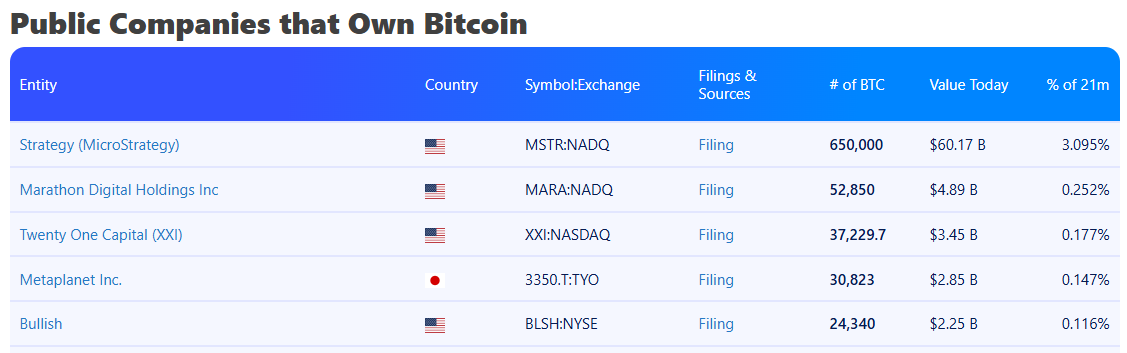
The Japan-based Metaplanet has the fourth-largest listed Bitcoin treasury. Source: Bitbo

Next in line is Nexon, a South Korean video game developer, which has its headquarters in Japan and holds 1,117 Bitcoin. Rounding out the top three is consulting services company Remixpoint.

Only one private company has any Bitcoin in its stash, Mt. Gox, the collapsed exchange that still holds over 34,000 tokens despite going bankrupt in 2014.

Magazine: Mysterious Mr Nakamoto author — Finding Satoshi would hurt Bitcoin

Пов'язані матеріали

Didi in Latin America: Already a Digital Banking Giant

Didi, known in China primarily as a ride-hailing giant, has transformed into a digital banking powerhouse in Latin America, serving over 25 million users. While its financial ambitions were stifled in China by the dominance of Alipay and WeChat Pay—which left little room for competitors—Didi found fertile ground in Latin America’s underbanked markets. Facing a cash-dominated economy and low banking penetration, Didi built its own financial infrastructure from scratch. It partnered with OXXO, a ubiquitous convenience store chain in Mexico, to allow cash top-ups via its DiDi Pay system—effectively creating an alternative banking network. This move not only improved transaction efficiency but also addressed critical safety issues, as drivers carrying cash were often targets of robbery. Leveraging its vast data on driver and passenger behavior, Didi developed a unique "behavioral credit" system, enabling it to offer loans to individuals with no formal banking history. Products like DiDi Préstamos and high-yield savings accounts (DiDi Cuenta) helped capture and retain user funds, turning Didi into a central financial hub. Beyond finance, Didi now facilitates broader economic activities: it supports e-commerce partnerships (like AliExpress’ "buy now, pay later" service) and accelerates the adoption of Chinese electric vehicles by providing auto loans to drivers. This evolution from ride-hailing to integrated fintech and industrial enabler highlights Didi’s adaptability and the success of its "infrastructure-first" strategy in emerging markets. The company’s journey in Latin America underscores a broader lesson for Chinese tech firms expanding abroad: success requires not just exporting technology, but rebuilding the foundational systems that make it relevant—especially in regions where basic services are lacking. Didi’s growth in the region reflects a return to the gritty, ground-up innovation that once defined China’s internet boom.

marsbit2 хв тому

Didi in Latin America: Already a Digital Banking Giant

marsbit2 хв тому

In Surgut, 'Money Launderers' Laundered Nearly ₽100 Million Through Cryptocurrency

In Surgut, Russia, enforcement authorities have dismantled an organized criminal group that laundered nearly 100 million rubles using cryptocurrency. The group specialized in the illegal circulation of payment means, according to an official statement from the Ministry of Internal Affairs. The criminals purchased bank cards from individuals to gain access to their accounts, which were then used to collect illicitly obtained funds. The group subsequently cashed out the money, converted it into cryptocurrency, and transferred it to their "curators," charging a commission of 3-15% for their services. According to data from a cryptocurrency exchange, the transaction volume involving the suspects exceeded 94 million rubles. The purchased bank cards were also used for remote thefts across Russia. Three members of the group have been detained, with another placed under travel restrictions. A criminal case has been initiated under the relevant article of the Russian Criminal Code. The Bank of Russia plans to enhance monitoring of the crypto market and strengthen measures against fraud, including the launch of the "Antidrop" system by mid-2027. This system will provide banks with information on "drops" – individuals whose bank details are used for shadow transactions. As part of this effort, banks will be required to link Russian citizens' accounts to their tax identification numbers (INN).

RBK-crypto6 хв тому

In Surgut, 'Money Launderers' Laundered Nearly ₽100 Million Through Cryptocurrency

RBK-crypto6 хв тому

Торгівля

Спот
Ф'ючерси
活动图片