Bitcoin Treasury Companies That Promised Never to Sell Are Now Selling. Why?

marsbitОпубліковано о 2026-05-08Востаннє оновлено о 2026-05-08

Анотація

The narrative of "never selling" Bitcoin treasuries is unraveling as major holders pivot to using BTC as a liquidity tool. MicroStrategy has formally integrated selling Bitcoin into its financial framework, stating it will sell when beneficial—for instance, to pay dividends if its mNAV ratio falls below 1.22x. CEO Michael Saylor outlined a model where selling BTC is preferable to equity issuance under certain conditions, based on quantified thresholds like a 2.3% annual Bitcoin appreciation break-even. Similarly, Marathon Digital (MARA) sold 15,133 BTC to repay convertible debt, framing it as "balance sheet optimization." Sequans Communications has sold Bitcoin for two consecutive quarters to service maturing convertible bonds, using its BTC holdings as collateral and operational liquidity amidst revenue declines. The shift redefines these companies from pure "belief-based reserves" to leveraged treasuries where capital management decisions—driven by debt obligations, financing costs, and shareholder returns—can override holding dogma. The future path hinges on Bitcoin's price: a bull market above $112,000 would ease financing pressure and absorb tactical sales, while a drop toward $50,000–$58,000 could force more defensive selling to meet liabilities, potentially creating a downward spiral of selling pressure and price declines. Investors must now price in debt maturities, collateral calls, and specific financial triggers alongside Bitcoin exposure.

Author: Gino Matos, CryptoSlate

Compiled by: TechFlow

TechFlow Introduction: Strategy has publicly stated it may sell Bitcoin to pay dividends, MARA sold 15,000 BTC to repay debt, and Sequans used Bitcoin to pay off convertible bonds for two consecutive quarters. The "never sell" narrative of Bitcoin treasuries is collapsing, as these companies transform Bitcoin from a "belief reserve" into a "liquidity tool." When falling prices trigger more selling, and selling further depresses prices, a spiral begins.

Saylor Softens His Stance: Selling Can Be More Cost-Effective Than Issuing Shares

During Strategy's earnings call on May 5, CEO Phong Le stated directly: "We will sell Bitcoin when it is beneficial for the company." Saylor added: Strategy might sell some Bitcoin to pay dividends, "to let the market get used to this idea."

As of May 3, Strategy holds 818,334 BTC, a 22% increase year-to-date, with a market value of $64.14 billion.

This call officially established one thing: BTC selling behavior has been formally incorporated into the company's financial toolkit, backed by a quantitative framework.

Management drew a line—when the mNAV (market cap/net asset value) falls below 1.22 times, selling Bitcoin to pay dividends enhances per-share value more than issuing common stock. According to Saylor's calculation: as long as Bitcoin's annualized appreciation exceeds 2.3%, Strategy's existing Bitcoin reserves can pay dividends "forever"; even if Bitcoin appreciation is zero, the reserves are sufficient for 43 years.
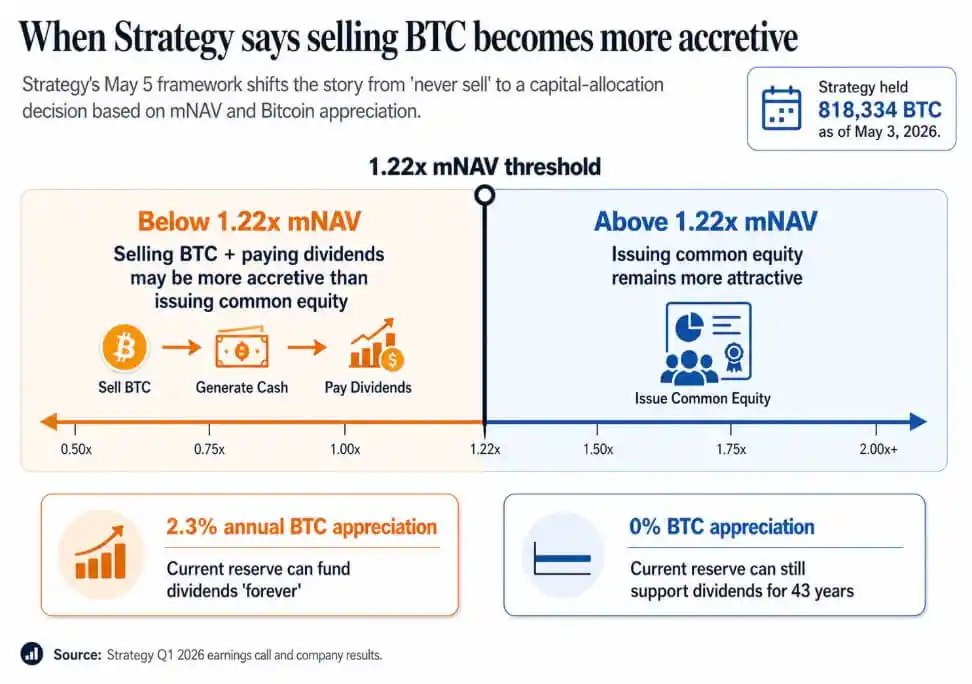
Caption: Illustration of Strategy's 1.22x mNAV threshold—when mNAV falls below this line, selling Bitcoin for dividends is more beneficial to shareholders than issuing stock.

The slogan "never sell" has given way to a model: buy when it enhances value, issue shares when it enhances value, issue preferred shares when it enhances value, and sell Bitcoin when it enhances value. These companies are essentially leveraged treasuries + credit vehicles.

Investors who bought these stocks initially purchased a Bitcoin proxy built on scarcity and a promise of permanent holding. The 1.22x mNAV threshold and the 2.3% break-even appreciation rate represent a more honest version, and a more complex one.

When Bitcoin Becomes Working Capital

Sequans' Q1 report is more straightforward. Revenue fell 24.8% year-over-year to $6.1 million, with an operating loss of $50.5 million. The net realized loss from selling Bitcoin in Q1 was $11.7 million, with proceeds mainly used to repay convertible bonds and repurchase ADS.

As of March 31, Sequans held 1,514 BTC, of which 1,217 BTC served as collateral for $66.2 million in convertible bonds. By April 30, holdings decreased to 1,114 BTC, with 817 BTC securing $35.9 million in debt (due June 1).

This mirrors the operation from November 2025—when Sequans sold 970 BTC, redeeming 50% of its convertible bonds, reducing debt from $189 million to $94.5 million.

For two consecutive quarters, the same pattern: declining revenue, maturing debt, Bitcoin becoming operational working capital. The BTC used as collateral was locked into debt obligations long before any active selling decision.

Sequans is not in the same league as Strategy—its underlying business is weaker, and its treasury position is more fragile. When Bitcoin must be used to repay debt, the logic of "inventory management" takes over.

MARA did the same in March, on a larger scale—selling 15,133 BTC, cashing out approximately $1.1 billion to repurchase convertible notes, slashing 30% of its convertible bond balance at once, and locking in a spread gain of about $88.1 million.

MARA framed this move as "balance sheet optimization," driven by debt structure and financing conditions. This establishes a precedent: BTC selling can be a capital allocation decision independent of Bitcoin belief. The real question is—under what conditions is selling the highest-return choice?

The Bull-Bear Fork: Financing Conditions Determine Everything

If Bitcoin rebounds to Citi's 12-month base case target of $112,000 or the bull case target of $165,000, the equity premium of treasury companies will expand, the window for share issuance will reopen, and large new purchases will be sufficient to absorb tactical BTC sales.

Strategy's 1.22x mNAV threshold would become a technical detail. Companies like Sequans, facing debt pressure during Bitcoin's weak periods, could also resolve their debt issues and enter the next cycle with unrestricted BTC.

If Bitcoin falls toward Citi's adverse scenario of $58,000 (Standard Chartered has hinted at a further drop to $50,000), companies trading near or below NAV will lose the value-enhancing effect of issuing shares.

In such a scenario, dividend obligations on preferred shares accumulate, and BTC selling transitions from capital management to balance sheet defense. Sequans' model could spread to all treasury companies with "thin-margin operations + BTC-collateralized borrowing"—selling Bitcoin to repay debt, shrinking collateral, and reducing free float becoming the only option.

At that point, corporate Bitcoin buying becomes a vicious cycle: falling prices trigger more selling, and more selling depresses prices.
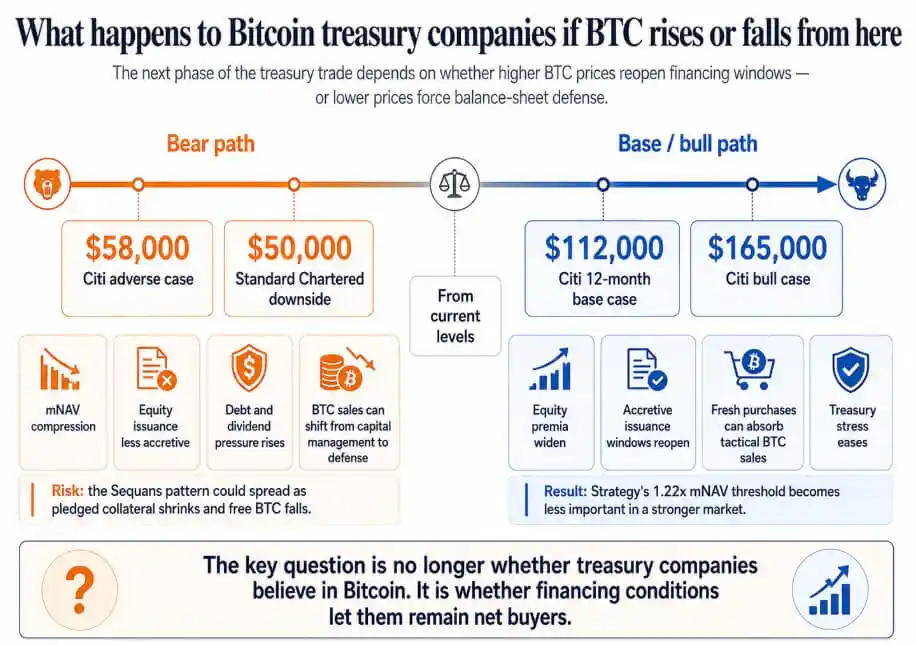
Caption: Two paths for Bitcoin treasury companies—under a bear market scenario ($50,000-$58,000), they face balance sheet pressure; under a bull market scenario (above $112,000), financing pressure eases.

The corporate Bitcoin treasury trade was built on the promise of "permanent holding," which led investors to price these companies as Bitcoin proxies. Once selling becomes an openly acknowledged tool in the model, investors must factor debt maturities, collateral requirements, dividend obligations, and the mNAV level at which management would choose to sell Bitcoin rather than issue shares into their pricing.

Saylor's 2.3% annualized break-even and 1.22x mNAV threshold are more honest. In the next phase of the Bitcoin treasury trade, the weight of financing conditions will not be lower than that of Bitcoin belief.


Пов'язані питання

QWhy are Bitcoin treasury companies like Strategy and MARA starting to sell their BTC holdings after previously promoting a 'never sell' narrative?

AThese companies are shifting their strategy from viewing Bitcoin solely as a 'faith-based reserve' to a 'liquidity tool.' The change is driven by financial models and practical needs. For instance, Strategy has established a quantitative framework, stating that selling BTC for dividends becomes more beneficial to shareholders when its mNAV (market cap to net asset value) falls below a 1.22x threshold. Meanwhile, companies like MARA and Sequans have sold BTC to repay convertible debt, viewing it as a strategic move for capital allocation and 'balance sheet optimization' rather than a departure from belief.

QWhat is the '1.22x mNAV threshold' mentioned in the article for Strategy, and what does it signify?

AThe 1.22x mNAV threshold is a financial model established by Strategy. It signifies the point at which the company deems it more value-accretive for shareholders to sell Bitcoin to pay dividends rather than issuing new common shares. When Strategy's market capitalization divided by its net asset value (predominantly the value of its BTC holdings) falls below this 1.22 multiple, the model suggests selling BTC is the superior financial tool for distributing value, officially incorporating BTC sales into its corporate financial toolkit.

QHow is Sequans Communications using its Bitcoin holdings differently from a company like Strategy?

ASequans is using its Bitcoin holdings primarily as a source of operational liquidity to service debt obligations, unlike Strategy's strategic model for shareholder returns. Faced with declining revenue, significant operating losses, and maturing convertible bonds, Sequans has been forced to sell BTC in consecutive quarters to repay these debts. A substantial portion of its BTC is also held as collateral for its loans, meaning sales are often driven by debt covenants and repayment needs rather than optional capital management, highlighting a more financially pressured and fragile treasury position.

QAccording to the article, what are the potential market scenarios for Bitcoin price and their impact on treasury companies?

AThe article outlines two divergent scenarios based on Bitcoin's price movement: 1) Bull Case (e.g., $112,000 or $165,000): Equity premiums for treasury companies would expand, reopening equity issuance windows. New, large BTC purchases could easily offset any tactical sales, and financial pressures (like Sequans's debt) would ease. 2) Bear Case (e.g., $50,000 - $58,000): Companies trading near or below NAV would lose the ability to issue accretive equity. BTC sales would transition from capital management to balance sheet defense, potentially creating a downward spiral where price declines trigger more forced selling, which further depresses the price.

QWhat key factor does the article suggest will become as important as 'Bitcoin belief' in the next phase of corporate Bitcoin treasury strategy?

AThe article suggests that 'funding conditions' will become a factor with weight equal to or greater than 'Bitcoin belief' in the next phase. Investors must now price in practical elements like debt maturity dates, collateral requirements, dividend obligations, and specific financial thresholds (like Strategy's mNAV model) that dictate when a company might sell BTC. The commitment has shifted from an ideological 'never sell' to a complex financial calculus where liquidity needs, debt management, and shareholder value optimization are paramount.

Пов'язані матеріали

Next-Generation Crypto Security: Not Dependent on Devices, But on Isolated Architecture

Next-Generation Crypto Security: Moving from Device-Reliance to Isolation Architecture For a decade, hardware wallets like Ledger and Trezor have been the gold standard for securing crypto assets by keeping private keys offline. However, as on-chain transactions increase and attacks grow more sophisticated, their limitations are becoming apparent. Security is no longer just about offline key storage but also involves transaction signing, online interactions, supply chain trust, and future quantum computing threats. The next generation of crypto security is shifting from "relying on a more secure device" to "relying on a more robust system architecture." While hardware wallets offer a clear security model, their safety depends on trusting the manufacturer, secure firmware updates, and the physical device itself—introducing central points of failure. Furthermore, during use, the device must interact with online gadgets (e.g., via USB or QR codes), creating potential attack vectors like transaction tampering. The emerging alternative is the "isolation architecture" wallet. Its core principle is to strictly separate private key management and transaction signing (kept offline) from the network broadcast function (handled online). Even if the online component is compromised, attackers can only access already-signed transactions, not the private keys. This approach reduces reliance on any single physical device or vendor. Another critical driver is "post-quantum" security. Current cryptographic algorithms (e.g., elliptic curve) could become vulnerable to future quantum computers. Standards like those from NIST in 2024 are pushing the industry to prepare now, as attackers could harvest encrypted data today for decryption later. Projects like Lock.com (currently in early access) are exploring this direction, combining isolation architecture with post-quantum cryptography in a hardware-independent model. This reflects a broader industry trend: crypto infrastructure is evolving from a collection of single-point tools into integrated systems where security is embedded in the architecture itself. The fundamental question is changing. Users are shifting from asking "Which hardware wallet should I buy?" to "Which security architecture should I trust?" The future of crypto security may depend less on a specific device and more on transparent, verifiable system design that inherently isolates risk.

Odaily星球日报1 год тому

Next-Generation Crypto Security: Not Dependent on Devices, But on Isolated Architecture

Odaily星球日报1 год тому

Торгівля

Спот
Ф'ючерси
活动图片