Бэнкману-Фриду дали совет по выживанию в тюрьме: брить голову, сделать голос ниже и слушать рэп

CointelegraphОпубліковано о 2022-12-27Востаннє оновлено о 2022-12-27

Анотація

Мартин Шкрели, которого называют «самым ненавистным бизнесменом» в США, и который отсидел 4 года за мошенничество, дал совет по выживанию в американской тюрьме бывшему главе обанкротившейся криптовалютной биржи, Сэму Бэнкману-Фриду (SBF).

Мартин Шкрели, которого называют «самым ненавистным бизнесменом» в США, и который отсидел 4 года за мошенничество, дал совет по выживанию в американской тюрьме бывшему главе обанкротившейся криптовалютной биржи, Сэму Бэнкману-Фриду (SBF).

Шкрели, чья фармакологическая фирма, Turing pharmaceuticals, приобрела права на лекарство Daraprim для ВИЧ/СПИД больных людей в 2015 году, повысив его цену всего за одну ночь в 55 раз – с $13,5 до $750 – что находящемуся на свободе под залог бывшему руководителю FTX следует побрить голову, сделать так, чтобы его голос звучал ниже и приобщиться к гангстерской культуре и рэп-музыке.

Бывший заключенный выступил 23 декабря в эпизоде крипто-подкаста Unchained, где он предложил SBF измениться для тюрьмы, поскольку быть богатым белым ребенком из хорошего района «звучит не очень».

«Сэм не будет тем, кто впишется в тюремную обстановку», — сказал Шкрели, добавив, что его «чувствительность» там не пройдет, поскольку это «очень тестостероновое, мужское место».

Наряду с «бритьем головы» и «низким голосом», Шкрели отметил, что SBF должен быстро завести друзей и влиться в культуру тюремной системы. Например, Шкрели посоветовал SBF «больше не говорить, что он из Стэндфордского университета».

«Он также ничего не знает об уличной и криминальной культуре, мой совет – как можно быстрее разобраться в этих вещах, он должен слушать как можно больше рэп-музыки, он должен попробовать все, что можно узнать о бандах».

«Это звучит смешно, но это может спасти вам жизнь», — добавил Шкрели.

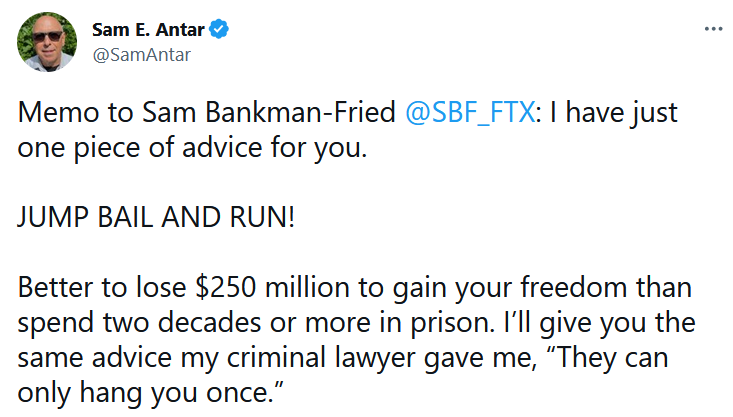
Тем временем другой отсидевший за мошенничество преступник, Сэм Антар, бывший финансовый директор известной в 1980-х годах сети магазинов электроники Crazie Eddie, дал Бэнкману-Фриду альтернативный совет: «Выходи под залог и беги».

Источник: @SamAntar/Twitter

«Памятка для Сэма Бэнкмана-Фрида: У меня есть только один совет для тебя. ВЫХОДИ ПОД ЗАЛОГ И БЕГИ! Лучше потерять 250 миллионов долларов, чтобы обрести свободу, чем провести два десятилетия или больше в тюрьме. Я дам тебе тот же совет, который дал мне мой адвокат по уголовным делам: "Они могут повесить тебя только один раз"».

Шкрели, похоже, зачастил давать плохим парням, связанным с криптовалютами, по поводу тюрьмы. В прошлом месяце он был приглашён в качестве гостя на подкаст The UpOnlyTV. Другим гостем выпуска был основатель печально известной Terra/LUNA До Квон, которому Шкрели сказал следующее:

«Я просто хочу сказать тебе, что тюрьма – это не так уж плохо, это не самое страшное, так что не волнуйся. Я надеюсь, что этого не случится. Но если это случится, все не так уж плохо».

«Приятно слышать», — довольно неловко ответил Квон.

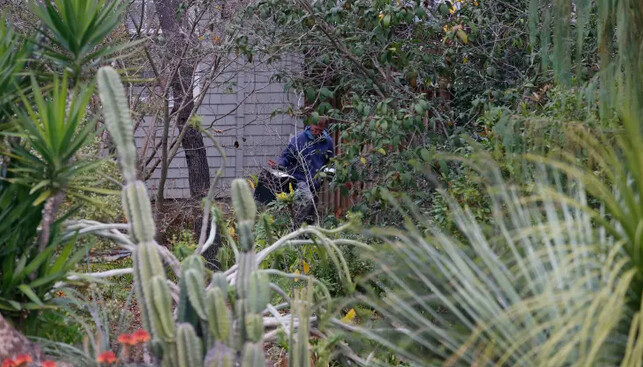
26 декабря газета New York Post сообщила, что в понедельник были замечены рабочие, устанавливающие камеры наблюдения у дома его родителей в Пало-Альто, где основатель FTX находится под домашним арестом.

Установка камер наблюдения: Фото David G. McIntyre, New York Post

В настоящее время SBF находится под домашним арестом в доме своих родителей в Пало-Альто, штат Калифорния, после того как его отпустили под залог в 250 миллионов долларов после экстрадиции с Багамских островов. Он обязан носить на лодыжке GPS-браслет на ноге и может покидать свой дом только для физических упражнений и лечения психического здоровья и наркомании. У него также есть строгие ограничения на то, какие платежи он может совершать.

В начале января он снова предстанет перед судом.

Автор: Brian Quarmby . Источник: Cointelegraph.

Пов'язані матеріали

How to Detect AI-Generated Videos? A Review of Dynamic, Traceable, and Explainable Detection Systems

**How to Detect AI-Generated Videos: A Survey on Dynamic, Traceable, and Explainable Detection Systems** With rapid advances in AI video generation (e.g., Sora, Veo), creating highly realistic, multi-minute videos is now possible, widening the gap with detection research. Current AI video detection, often limited to unreliable binary classifications, is insufficient. This survey, accepted at ACL 2026, reframes the goal as **"factual fidelity verification"**—checking if a video's content (who, when, where, what) aligns with the real world perceptually and cognitively. It categorizes AI-generated videos into three paradigms: **Local Manipulation Videos (LMV**, e.g., face swaps), **Audio-Visual Editing (AVE**, e.g., lip-syncing), and **Generative Video Synthesis (GVS**, fully synthetic videos like Sora's). Detection challenges evolve from visual artifacts in LMV to multi-modal inconsistencies in AVE and higher-level world knowledge violations in GVS. The core proposal is a **Vision-Language Dual-View framework** with four hierarchical layers: 1. **Layer 1 (Intrinsic Visual Cues):** Analyzes low-level signal statistics, noise patterns, and physiological signals. 2. **Layer 2 (Spatiotemporal Consistency):** Checks for temporal coherence in object motion and scene dynamics. 3. **Layer 3 (Cross-Modal Consistency):** Verifies alignment between video, audio, and text within the video. 4. **Layer 4 (Language-Guided World-Level Reasoning):** Uses external knowledge, facts, and physical laws to judge semantic plausibility and factual correctness. The survey traces a shift in detection focus from lower layers (1 & 2) toward higher, language-involved layers (3 & 4). It also reviews evolving evaluation metrics and datasets tailored for each video paradigm. The conclusion advocates for a **dynamic, evidence-first detection system** that moves beyond simple classification. Future trustworthy detection requires combining visual evidence (from CV) with semantic reasoning and explanation (from NLP & multimodal AI), ultimately creating traceable and explainable judgments about a video's adherence to real-world constraints.

marsbit27 хв тому

How to Detect AI-Generated Videos? A Review of Dynamic, Traceable, and Explainable Detection Systems

marsbit27 хв тому

It Turns Out the First Real-World Application of AI x Crypto is in Security Auditing

The article explores the surprising trend where AI's first major impact on crypto has been in security auditing, not in areas like trading or analytics. It details how AI-powered tools are dramatically lowering the barrier to finding smart contract vulnerabilities, enabling attackers to scan thousands of contracts and execute exploits within minutes. This has rendered traditional, manually-produced audit reports with their month-long validity periods increasingly obsolete, creating a critical "structural crack" in the old security model. Cases like Drift Protocol and KelpDAO show that even extensively audited protocols can be hacked through social engineering, operational flaws, or infrastructure misconfigurations beyond pure code review. Attackers are also using AI to find and exploit vulnerabilities in years-old, deployed contracts. Notably, OpenZeppelin's co-founder has expressed a grim view that "all DeFi is insecure" due to AI's asymmetric advantage. In response, the audit industry is undergoing a fundamental shift. While there's a short-term spike in defensive re-audits, the long-term business model is changing. Firms are developing AI-assisted systems and moving from one-time report deliveries towards embedded, continuous services like real-time monitoring and formal verification. Examples include AI tools uncovering critical, previously missed vulnerabilities in heavily audited protocols like Curve Finance and Zcash. The conclusion is that security must become a continuous investment, not a one-time checkbox, and audit firms must rapidly evolve their tools and service models to survive.

marsbit34 хв тому

It Turns Out the First Real-World Application of AI x Crypto is in Security Auditing

marsbit34 хв тому

Never expected that the first tangible application of AI x Crypto is in security auditing

Unexpectedly, the initial major application of AI in the Crypto sphere has turned out to be security auditing. In 2026, DeFi has faced significant security challenges, with 121 hacking incidents resulting in approximately $942 million in losses. While AI was expected to first impact areas like quantitative trading, its initial breakthrough has instead transformed security auditing by drastically lowering the cost and skill barrier for finding smart contract vulnerabilities. The traditional audit model is facing obsolescence. Advanced AI models, such as Claude Mythos, enable attackers to scan thousands of contracts and identify vulnerability patterns at scale, compressing the time from discovery to execution to mere minutes. This renders the month-long validity of traditional audit reports ineffective. Notably, attacks now frequently target well-audited, established protocols by exploiting business logic flaws, operational security weaknesses, and even years-old historical contracts, demonstrating that old audit reports offer zero protection. This pressure is forcing a fundamental shift in the industry. In the short term, a wave of defensive re-auditing is occurring, driven by projects seeking to meet new AI-era security standards and regulatory requirements. In the long run, audit firms' business models are diverging. The one-time report delivery model is declining in value, as evidenced by platforms like Code4rena shutting down. Leading firms are now pivoting towards AI-powered defense, integrating continuous monitoring, real-time on-chain risk detection, and embedding security directly into the development phase, as seen with tools like OpenZeppelin's Skills system. Ultimately, the era of "audit once, secure forever" is over. Security must become a continuous, embedded infrastructure investment for projects. For audit companies, survival depends on proactively transforming from traditional service providers into platforms offering AI-native, ongoing security solutions.

链捕手41 хв тому

Never expected that the first tangible application of AI x Crypto is in security auditing

链捕手41 хв тому

Торгівля

Спот
活动图片