SBF gets prison advice: Shave head, deepen voice and listen to rap

CointelegraphОпубліковано о 2022-12-27Востаннє оновлено о 2022-12-27

Анотація

Martin Shkreli outlined that “Sam isn’t exactly gonna be somebody that fits into prison” and that he needs to rebrand himself to fit in and make friends.

FTX founder Sam Bankman-Fried has been given some free advice on surviving federal prison by former white collar criminal Martin Shkreli, also known as “Pharma Bro.”

Shkreli, who spent around four years behind bars for securities fraud between 2018 and 2022, said the currently-on-bail former FTX executive should consider shaving his head, deepening his voice and skill himself up on gang culture and rap music.

The former prison inmate was speaking on a Dec. 23 episode of the crypto podcast Unchained, where he suggested that SBF needed to rebrand himself for jail, as being a rich white kid from a good neighborhood doesn’t “sound great.”

“Sam isn’t exactly gonna be somebody that fits into prison” Shkreli said, adding that his type of “sensibility doesn’t go over well” there, as it's a “very testosterone filled, masculine place.”

Alongside “shaving his head,” and “deepening his voice,” Shkreli outlined that SBF needs to make friends fast and embed himself in the culture of the prison system. For example, Pharma Bro said SBF should “ no longer say he’s from Standford [University].”

“He also doesn’t know anything about the streets and criminal culture, my advice is to pick those things up as quickly as he can, he should be listening to as much rap music as possible, he should be trying everything there is to know about gangs.”

“This sounds funny, but this could save your life,” Shkreli added.

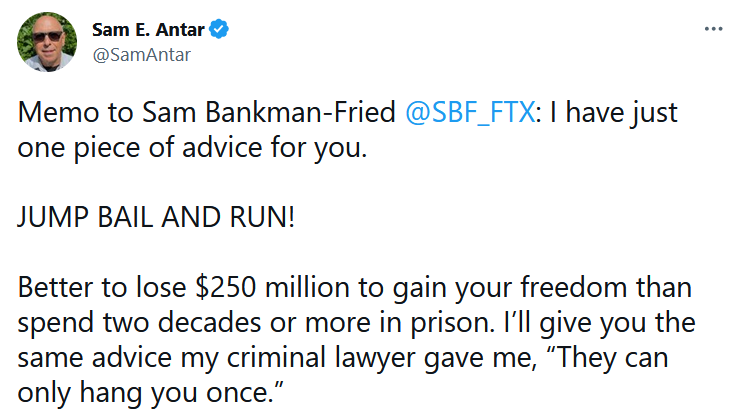
Meanwhile, another former convicted felon, Sam Antar, the former CFO of the famously corrupt 1980s company Crazie Eddie, gave Bankman-Fried an alternative piece of advice: “JUMP BAIL AND RUN [...] They can only hang you once.”

Shkreli appears to have developed a knack for giving crypto bad boys unsolicited advice about prison. During an appearing on the The UpOnlyTV podcast last month, Shkreli was a guest alongside Terra/LUNA founder Do Kwon, and told him:

“I just want to let you know jail’s not that bad, it’s not the worst thing ever, so don’t fret. I hope it doesn’t happen. But if it does happen, it’s not that bad.”

“Good to know,” Kwon replied, rather awkwardly.

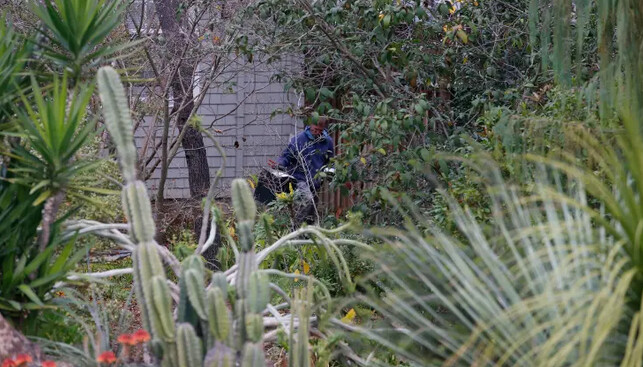
In an update on the unfolding SBF drama, the New York Post reported on Dec. 26 that workers were spotted on Monday installing security cameras outside his parents’ house in Palo Alto, where the FTX founder is staying while on house arrest.

Security camera's being installed: Photo by David G. McIntyre via the New York Post

As it stands, SBF is required to wear an ankle monitor, and can only leave his house for exercise and treatment for mental health and substance abuse. He also has stringent limits on what payments he can make.

He is set to face the courts again in early January.

Пов'язані матеріали

IOSG Founder: Ethereum Doesn't Need Another Leap of Technical Faith, It Needs a Musk-style Compromise

Jocy, founder of IOSG Ventures, argues that Ethereum does not need renewed technological faith but a "Musk-like compromise." The recent formation of ETHLabs—funded by major ETH holders like BitMine and Lubin—highlights a market-driven move to fill a gap left by the Ethereum Foundation (EF), signaling a loss of confidence in its decentralized, hands-off approach. The core critique contrasts Vitalik Buterin's (V) idealistic, technology-first vision with Elon Musk's pragmatic, business-driven execution. The author asserts Ethereum's current shortage is not another technical roadmap but a clear, real-world application narrative and a leader willing to engage directly with commercial realities—like Musk. Internal issues are emphasized, citing EF's management problems and talent drain. While the new decentralized model with independent nodes like ETHLabs addresses the single foundation's limitations, it risks fragmentation without cohesive direction. True cohesion, the author suggests, must come from a shared, compelling narrative around ETH's value, not just from aligned financial interests. Independence claims for new entities are seen as aspirational, needing years of transparency to build trust. The ultimate threat is not competitors like Solana, but the broader shift of attention and talent toward AI. Ethereum has a limited window—12 to 18 months—to recapture focus by delivering tangible, real-world applications. The conclusion urges V to shift from abstract ideals to grounded, pragmatic leadership. The time for this crucial pivot is running out.

marsbit44 хв тому

IOSG Founder: Ethereum Doesn't Need Another Leap of Technical Faith, It Needs a Musk-style Compromise

marsbit44 хв тому

Google Starts Selling TPUs, Big Tech Aims to Produce "Low-Cost Tokens" with AI Chips

Google has begun selling its proprietary TPU chips and AI computing hardware directly to third-party data centers and clients, marking a strategic shift. Previously only accessible via cloud rentals, TPUs are specialized processors designed for the matrix and tensor operations central to AI models. By combining thousands into supercomputing clusters managed by CPUs, Google achieves high-efficiency AI processing. This move enables Google’s Gemini AI to offer competitive token pricing, challenging rivals like OpenAI. It also signals a broader industry trend where AI compute is becoming a commoditized resource like electricity. While NVIDIA remains dominant with its CUDA ecosystem and high-performance GPUs, the focus is shifting from raw power to cost efficiency and system integration. Google’s approach mirrors NVIDIA’s by selling an entire ecosystem—hardware, software, and data center expertise—rather than just chips. This threatens NVIDIA’s grip on the mid-range inference market, where lower-cost, efficient solutions are increasingly demanded. Similarly, cloud providers like Huawei Cloud and Alibaba Cloud in China are developing their own AI chip ecosystems (e.g., Ascend, Zhenwu), packaging chips, clusters, and tools into full-stack solutions. They aim to reduce token costs and capture market share through integrated systems. In summary, the AI infrastructure race is evolving from a competition for the strongest chips to a contest for the most efficient and cost-effective systems. Google’s TPU sales highlight this transition, emphasizing that future success lies in delivering affordable, scalable AI compute as a foundational service.

marsbit1 год тому

Google Starts Selling TPUs, Big Tech Aims to Produce "Low-Cost Tokens" with AI Chips

marsbit1 год тому

Торгівля

Спот
Ф'ючерси
活动图片