WSJ: Elon Musk’s Twitter Poll Shows Users Want Him to Step Down as CEO

Wall Street JournalОпубліковано о 2022-12-20Востаннє оновлено о 2022-12-26

Анотація

After billionaire asks on social-media platform whether he should stay or go, 58% of respondents say he should go

Twitter Inc. faced new uncertainty after a majority of respondents voted in an online poll for Elon Musk to step down as chief, amid broader concerns about how the billionaire is managing his businesses.

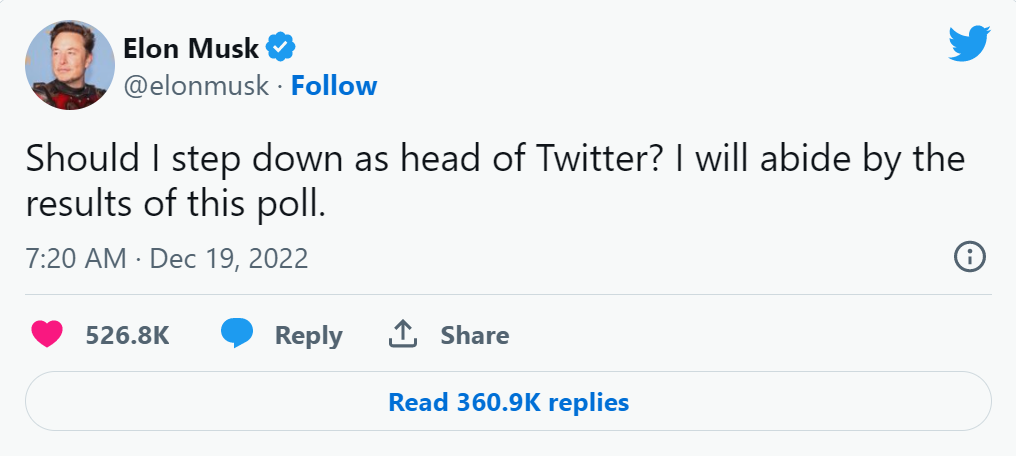
In the 12-hour poll, which Mr. Musk initiated and which closed after 6 a.m. ET Monday, 58% of the more than 17 million Twitter users who voted said he should leave as head of Twitter. Mr. Musk had said when he launched the Twitter poll on Sunday that he would abide by the results.

The result shows how Mr. Musk’s ownership of Twitter has put him in a bind. He has embroiled himself in a series of controversial statements and decisions at the social-media platform that have alienated some users and advertisers, compounding financial problems at a company he bought in a deal valued at $44 billion in late October. Meanwhile, some shareholders in Tesla Inc., which he also runs, have complained that he is distracted by Twitter at the same time the electric-vehicle maker’s share price has been falling and he has been selling parts of his stake.

Mr. Musk now must find someone to take a job running Twitter that he has said no contenders seem qualified for—and even if he finds such a person, Mr. Musk would remain unavoidably involved as the company’s owner.

There is little precedent for Mr. Musk relinquishing control at his major businesses, although he has a deputy at his SpaceX rocket company, where he is chief executive. With Twitter, most of the prior leadership was either fired or left after he took over.

“No one wants the job who can actually keep Twitter alive. There is no successor,” Mr. Musk tweeted Sunday.

Twitter didn’t respond to a question on the poll’s outcome.

Mr. Musk on Monday responded to someone on Twitter who had suggested the results might have been rigged. “Interesting,” Mr. Musk tweeted.

Mr. Musk has warned about Twitter’s financial condition, saying last month that the company had suffered “a massive drop in revenue” and was losing more than $4 million a day. He later raised the possibility of bankruptcy.

Irrespective of whom Mr. Musk might appoint to be the titular head of the company, his own massive financial stake in the business means he remains closely tied to stemming losses at a company that the new owner himself has said he overpaid for.

Mr. Musk’s team this past week reached out for potential fresh investment for Twitter at the same price as the original $44 billion deal, a Twitter investor said.

Some Tesla shareholders have complained that Mr. Musk’s recent focus on Twitter is hurting the auto maker. This month he sold more than $3.5 billion of Tesla stock in his second round of sales since buying Twitter. It wasn’t clear what prompted Mr. Musk to sell additional Tesla stock.
Meanwhile, concerns are growing that Twitter’s problems might infect other parts of Mr. Musk’s business empire. Oppenheimer

The billionaire’s leadership at Twitter has been tumultuous and weighed on sentiment toward his other businesses, particularly car maker Tesla. Shares in the auto maker have fallen more than 56% this year, frustrating some individual investors who partly blame Mr. Musk’s focus on Twitter for the decline. Mr. Musk’s Twitter involvement also has dented Tesla’s brand image.

Tesla shares initially advanced on Monday after the suggestion that Mr. Musk would stop running Twitter, although they closed lower along with the broader market.

There have been questions since Mr. Musk first showed interest in buying Twitter about how he would juggle running the company while also pursuing all his other endeavors.

Bill Nelson, the National Aeronautics and Space Administration’s administrator, said this month he had asked SpaceX President

Mr. Musk said last month that he had too much work on his plate.

“I expect to reduce my time at Twitter and find somebody else to run Twitter over time,” he testified at a trial about his Tesla pay package last month. He also said he has been spending most of his time of late focusing on Twitter. At the time, he wrote on Twitter, “I will continue to run Twitter until it is in a strong place, which will take some time.”

The outcome of the poll adds another disruption at the top of Twitter, which has suffered waves of leadership upheaval. Co-founder and former CEO Jack Dorsey handed over running the company a little over a year ago after a bruising battle with an activist investor. His successor, Parag Agrawal, lasted less than a year and was fired by Mr. Musk immediately after he took over the company in October. Mr. Musk also ousted several other top Twitter executives, and more have left since.

Mr. Musk has been the driving force at Twitter for nearly two months, with many advertisers having paused spending, mass layoffs and resignations, and content-moderation actions that have been abrupt and controversial among many users. This past week has been another one full of twists. Twitter suspended the accounts of several journalists, prompting criticism from some lawmakers and officials before Mr. Musk said Saturday that Twitter would begin reinstating the accounts.

Earlier Sunday, Twitter made another sudden change to its content-moderation rules, saying it would no longer allow “free promotion of certain social media platforms.” That also fueled criticism and questions, including from Mr. Dorsey, who previously endorsed Mr. Musk’s takeover. “Doesn’t make sense,” Mr. Dorsey tweeted Sunday.

The policy also irked Paul Graham, a well-known venture-capital investor who called it “the last straw” and signaled he was decamping Twitter for rival social-media platform Mastodon. Soon after, his account was suspended, before being restored.

Late Sunday, the tweets from @TwitterSupport and a note on the company’s website announcing the policy against promoting other social-media platforms appeared to have been deleted. Twitter’s head of trust and safety, Ella Irwin, said Monday that the company removed the new policy “in response to user feedback.” Ms. Irwin said that links to other social-media sites will be allowed until Twitter determines whether or not to implement a new policy prohibiting them.

Mr. Musk, who has said he intends to make the platform a bastion of free speech, appeared to acknowledge some concerns about the recent, abrupt content-policy changes. “Going forward, there will be a vote for major policy changes. My apologies. Won’t happen again,” he tweeted shortly before posting the poll about his leadership Sunday.

Sen. Elizabeth Warren (D., Mass.) on Sunday sent a letter to Tesla’s board chair, Robyn Denholm, suggesting that Mr. Musk’s involvement with Twitter could be to the detriment of the auto maker’s shareholders. The senator has battled before with Mr. Musk.

Tesla didn’t respond to a request for comment about the share sale or the senator’s letter.

Пов'язані матеріали

EF's Epic Reorganization: 20% Layoffs, Budget Halved, Is Ethereum Gearing Up for a Leaner Future?

The Ethereum Foundation (EF) has announced a major organizational restructuring, involving a 20% staff reduction (approx. 54 employees) and a division into functional clusters like Protocol, Access, User, Community, and Institutional layers. Co-founder Vitalik Buterin further revealed plans to cut the EF's budget by around 40% over the coming years, aiming to reduce its annual spending rate from about 15% to roughly 5% by 2030, transitioning to an endowment-driven model. This overhaul is seen as a long-overdue correction to the EF's ambiguous role. As Ethereum grew, the foundation faced persistent criticism over ETH sales, perceived lack of execution, and unclear strategy, often becoming a focal point for community frustration amid ETH's price stagnation. The reform aims to redefine the EF's boundaries, narrowing its focus to core protocol research, public goods funding, and ecosystem coordination, while offloading more applied development work to the broader market. Concurrently, ecosystem forces like the newly formed Ethlabs (founded by ex-EF researchers) and other independent groups are stepping in to fill the space, signaling a shift from a centralized model to a more distributed, collaborative ecosystem structure. The move was notably praised by Solana co-founder toly, who viewed a "leaner" EF as potentially more decisive and agile.

Odaily星球日报20 хв тому

EF's Epic Reorganization: 20% Layoffs, Budget Halved, Is Ethereum Gearing Up for a Leaner Future?

Odaily星球日报20 хв тому

Dragonfly Partner Haseeb: The Fastest-Growing Companies of the Future May All Get Stuck at 149 Employees

Dragonfly partner Haseeb explores the distorted economics of AI model pricing, drawing parallels to tax policy. He notes that startups and small teams (under 150 users) enjoy heavily subsidized, fixed-price AI subscriptions (like Claude Code), where the marginal cost of an additional token is effectively zero. This creates a powerful incentive for them to maximize token usage ("token-maxxing") and innovate aggressively with AI automation. In contrast, large enterprises (over 150 users) are forced onto "Enterprise" plans, paying per-token API fees with high (~75%) markups. This acts like a steep "tax" on AI-powered labor, disincentivizing marginal automation and experimental use, and encouraging them to retain more human workers. Haseeb argues this pricing creates a "150-person cliff," a regulatory notch similar to labor laws in France that discourage firms from growing past 50 employees. He predicts the fastest-growing future companies may deliberately cap their headcount at 149 to avoid the punitive enterprise pricing. This would foster an "AI-first" management philosophy obsessed with automation and outsourcing to stay lean. While not intentionally designed, this bifurcated pricing could become one of the most influential de facto tax policies, shaping how AI replaces labor—not through mass layoffs at big firms, but through agile, AI-native startups outcompeting them.

marsbit31 хв тому

Dragonfly Partner Haseeb: The Fastest-Growing Companies of the Future May All Get Stuck at 149 Employees

marsbit31 хв тому

How xBubble Breaks Through in the VC-Heavily-Backed OPC Economy

xBubble: Addressing the Structural Gap in the VC-Backed OPC Economy The concept of OPC (One Person Company) is evolving from a buzzword to a significant AI-driven market. While AI coding tools like Replit and Lovable have validated demand from non-technical users wanting to build applications, a key gap remains: the leap from creating a demo to running a stable, evolving business. These tools still require users to manage the development process, including technical judgments for integrations, modifications, and deployments—a major hurdle for OPCs. xBubble, by DAPPOS, tackles this by shifting from "Prompt-to-Code" to "SOP-to-Business." Instead of generating code from instructions, its core is a system of pre-organized SOPs (Standard Operating Procedures) that translate business goals—like "sell World Cup merchandise"—into complete, executable workflows. This includes generating cohesive assets, pages, payment systems, and backend logic. The platform is augmented by a network of third-party service providers who handle infrastructure (hosting, domains, payment setup), acting like "on-site service engineers." Users can pay for these services directly with xBubble credits, simplifying onboarding. This ecosystem aims to deliver not just an app, but a complete, modifiable business launch path. xBubble targets a clear OPC segment: small commercial nodes (e.g., creators, merchants) with existing products, customers, or channels, but for whom a full tech team is unjustifiable. Its potential lies in SOPs accumulating expertise from real cases, improving reliability and reducing delivery costs over time. Additionally, its native support for crypto payments caters to global or digital-native OPCs. In summary, as AI democratizes software creation, xBubble's opportunity is to prove that "SOP-to-Business" provides more immediate value for launching a real, operational business than a powerful but unstructured AI coding tool.

链捕手34 хв тому

How xBubble Breaks Through in the VC-Heavily-Backed OPC Economy

链捕手34 хв тому

If It's Not a Clear Yes, It's a No: A Nine-Year Retrospective by a VC Who Survived Four Cycles

**"Invest Only When Certain": A Nine-Year Retrospective from a VC Across Four Cycles** IOSG founder Jocy shares hard-earned lessons from nine years and over a hundred investments in Web3. The core challenge isn't identifying successful founders, but understanding why talented founders with solid ideas still fail. Through building a "failed founder database," IOSG identified six recurring failure patterns. **Founder Trait Red Flags:** 1. **Emotionally Unstable:** Founders who react defensively to criticism or publicly lash out under pressure (e.g., 80% drawdowns) often fail. Resilience is key. 2. **Lacking Hunger / Having a Fallback:** Founders with significant safety nets (family wealth, cushy fallback jobs) may lack the "do-or-die" commitment needed to survive crypto's brutal cycles. 3. **Unchecked Ego:** Includes "polished execution machines" who excel in known frameworks but struggle when paradigms shift, and "professor-types" who are technically brilliant but resistant to commercial feedback or coaching. **Project Structure Red Flags:** 4. **Token-First, Not Product-First:** Treating the token solely as a fundraising tool with no real utility or connection to product value is a major warning sign. The project should have value even if the token goes to zero. 5. **No Day-1 Exit Thesis:** Founders must have a clear, staged capital strategy from the start, understanding what each funding round needs to prove to unlock the next. "Exit before entry" is crucial. 6. **No Full-Cycle Experience:** Founders who haven't lived through a complete crypto bull/bear cycle (e.g., 2018, 2022) often underestimate their vulnerability. IOSG limits initial checks for such teams to $250k, sizing for risk. **The Positive Flipside: Desirable Founder Traits** The ideal candidate exhibits: obsessive problem-depth, being a second-time founder with a non-consensus vision, strong communication skills with *controlled* ego, relentless perseverance, and a global perspective with agency and taste (increasingly vital in the AI era). **Three Survival Tips for Founders:** 1. **Cash Flow Over Narrative:** Real revenue is what sustains projects, not vanity metrics. 2. **Tokens Are a Liability:** Avoid issuing a token unless absolutely necessary. The hidden costs (market making, liquidity, compliance) are immense, often a multi-million-dollar burden. 3. **Respect Liquidity:** Sell during peaks to build treasury, buy back to support the protocol during troughs. Be realistic about valuations and your ability to deliver for the next round. The final principle is simple yet paramount: **"If it's a borderline 'yes' or 'no,' don't invest."** In an industry that reinvents itself every few years, the discipline to consistently say "no" is the ultimate secret to longevity.

Foresight News59 хв тому

If It's Not a Clear Yes, It's a No: A Nine-Year Retrospective by a VC Who Survived Four Cycles

Foresight News59 хв тому

Торгівля

Спот
Ф'ючерси
活动图片