[Key interpretation] BTC's long empty ratio has dropped sharply, ETH's short line has retreated

JinsОпубліковано о 2022-12-16Востаннє оновлено о 2022-12-19

Анотація

BTC short line adjustment.

1. BTC returns to support position

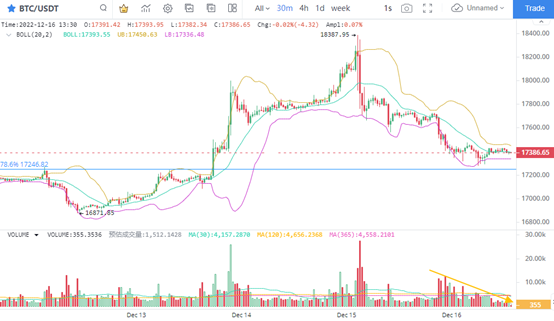
The BTC price is in the 30 minute K line. After the price falls back, the trading volume starts to shrink. At present, the trading volume has been at a very low level. This shows that BTC will further confirm the support effect near the corresponding US $17246 of 78.6% in Fibonacci. Once the support is confirmed to be effective, the BTC price will remain strong. There is little room for the short-term fall of BTC price. It is expected that the negative interest rate increase of the Federal Reserve will still affect the BTC price for a long time, and the short-term impact on the market will be gradually digested.
2. The proportion of major selling is relatively low

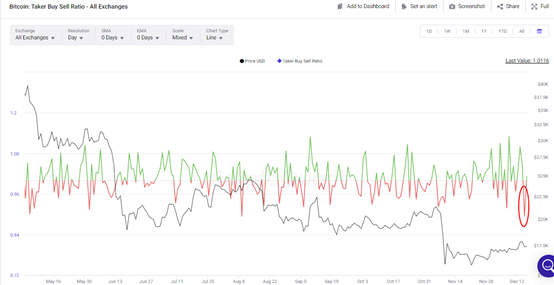
The long short ratio of BTC contract fell slightly, and the indicator had reached 0.894 on December 15, which was the lowest in recent years. On August 9, BTC's multiple air ratio was also close to 0.894. This shows that short-term bearish sentiment of investors has recovered. The article that the long short ratio rebounded slightly to above 0 on December 16 indicates that the recent shock of BTC is still continuing.
3. ETH short line rollback

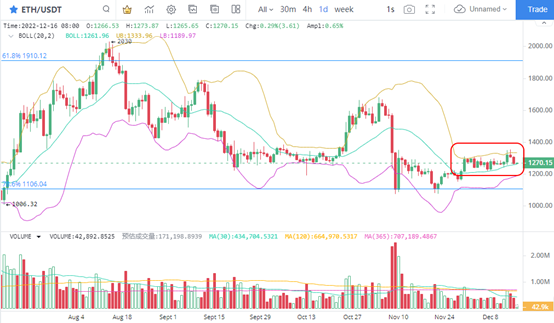
The daily K line chart of ETH shows that with the adjustment, the recent price fluctuation space has not continued to increase, but only fluctuates in small areas. In terms of trading volume, ETH's short-term trading volume rebounded slightly and then retreated, consistent with the price rebound. At present, the middle rail of Bolin Line has supported the ETH price. The Bollinger Line is in the closing stage, and ETH still maintains a relatively strong operation state.
4. EOS impact height fall back

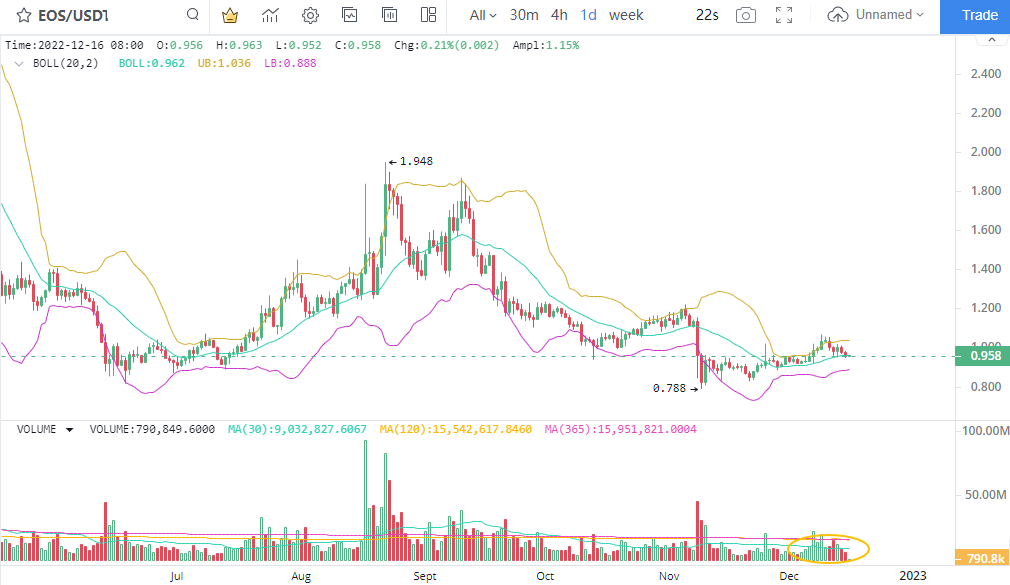
The EOS short line rose and fell back, and the price was below USD 0.962 corresponding to the middle track of the Bollinger line. At present, EOS has little selling pressure during the withdrawal period, and the volume and price performance in recent three months has been relatively stable. Therefore, at present, it is still a low absorption opportunity for downsizing operation. Affected by the poor performance of the overall market, although the relative price of EOS is low, there is still no strong rebound trend. In the early July/August, the price rebound intensity reached 100%, indicating that the price elasticity was good.

Пов'язані матеріали

Report Analysis: What Is Coherent Planning as CPO Booms?

Title: Report Interpretation: What Moves Is Coherent Making Amid the CPO Boom? Summary: JP Morgan analyst Samik Chatterjee reiterates an Overweight rating on Coherent (COHR), citing undervalued growth potential across three core areas: data center optical transceivers, co-packaged optics (CPO) chips, and industrial lasers/thermal management. COHR's 1.6T data center transceivers are in high demand, with pricing remaining firm. The rise of CPO is seen not as a threat but as a catalyst, creating higher demand for sophisticated optical components, an area where COHR holds a competitive edge with its comprehensive portfolio (lasers, isolators, VCSELs, thermoelectric coolers). Each CPO chip offers significantly greater revenue potential than traditional transceivers. Furthermore, its Optical Circuit Switch (OCS) technology targets a potential $4B market with reliability and power advantages. The company is expanding its InP (Indium Phosphide) device capacity fourfold within two years, securing substrate supply and transitioning to more cost-effective 6-inch wafers. As one of only two major suppliers of high-quality pump lasers—currently in severe shortage—COHR can now move up the value chain from components to complete line cards/systems, boosting ASP over tenfold. Gross margin targets (>42%) may be revised upward due to high-end product premiums, cost improvements from the wafer transition, and contributions from new high-margin products like CPO and OCS. Its efficient thermadite thermal material also offers long-term growth. Industrial segment revenue grows at a steady 5-10%, supported by semiconductor equipment orders. Changes in Apple's Face ID protocol present a re-competition opportunity for 3D sensing. Overall, Coherent is positioned as a key infrastructure provider, with AI-driven compute demand fueling the need for high-speed optical interconnectivity. Growth from CPO/OCS, stable industrial performance, and margin improvement support the bullish thesis. *Disclaimer: This summary interprets a third-party analyst report from JP Morgan. It does not constitute investment advice.*

marsbit23 хв тому

Report Analysis: What Is Coherent Planning as CPO Booms?

marsbit23 хв тому

Dan Koe's New Article: Escape the Fate of the Wage Slave, How to Survive in the Tide of AI Replacement?

Dan Koe's article argues that the real threat in the AI era is not technology itself, but financial dependency on employers. He critiques the "wage slavery" of unfulfilling work and identifies five core skills for resilience: agency, taste, persuasion, persistence, and iteration. These are developed not by consuming content, but by starting your own venture. The key to escaping the "employee mindset" is a radical identity shift. This requires: 1) Drastically changing your environment and daily inputs, 2) Choosing a creative medium (like content or code) that provides real-world feedback through trial and error, and 3) Using that feedback to learn and adapt. Koe strongly advocates for content creation over coding for beginners, as it builds irreplaceable subjective taste and audience connection. The practical starting point is a 15-minute self-inquiry to define your "life's work." Answer: What do you know deeply? What innate abilities do you have? What childhood interests were suppressed? Then, identify your contrarian beliefs—what does the mainstream get wrong in your area? The overlap is your unique direction. The final, non-negotiable step is to publish your first piece of content tomorrow. Embrace that it will be bad; the goal is to enter the feedback loop of creation, learning, and iteration, which is the true path to independence.

marsbit32 хв тому

Dan Koe's New Article: Escape the Fate of the Wage Slave, How to Survive in the Tide of AI Replacement?

marsbit32 хв тому

After Laying Off 20% of Staff, What Are the Key Points of EF's New Structure?

Following the completion of a months-long organizational restructuring, the Ethereum Foundation (EF) announced a 20% workforce reduction (approximately 54 employees) on June 23rd. It reorganized its teams into five new core clusters: Protocol, Access, User, Community, and Institutional (plus Operations/Management support units). Officially, this move implements the EF's 2026 Mandate and 2025 Treasury Management Policy, aiming to create a more focused and "self-sovereign" organization. The restructuring prioritizes the CROPS principles—Censorship Resistance, Openness & Freedom, Privacy, and Security—as foundational organizational tenets. The Protocol cluster will focus on core protocol R&D, including MEV reduction and zkEVM. The Access cluster emphasizes preserving user "zero option" for non-custodial, permissionless interaction. The User, Community, and Institutional clusters will manage external engagement, with the latter handling institutional and regulatory matters. While offering enhanced severance and transition support for affected employees, the EF did not disclose budget allocations or specific KPIs for the new clusters. This has led to market uncertainty about the impact on project funding and development priorities. Analysts note the announcement's positive tone of mission focus contrasts with a backdrop of recent EF leadership changes and broader ecosystem pressures. The true impact—whether this signifies strategic realignment or reactive contraction—will become clearer as the new structure's resource allocation and project prioritization are revealed in the coming months.

marsbit33 хв тому

After Laying Off 20% of Staff, What Are the Key Points of EF's New Structure?

marsbit33 хв тому

Top-Tier MEV Bot Loses $7.5 Million: Is 'Approval' the Most Overlooked Fatal Risk On-Chain?

The article discusses a sophisticated attack on a prominent Ethereum MEV (Miner Extractable Value) bot, Jaredfromsubway.eth, resulting in a loss exceeding $7.5 million. Unlike typical exploits involving key leaks or smart contract bugs, this attack was a carefully orchestrated "reverse hunt." The attacker spent weeks deploying fake tokens and liquidity pools that mimicked legitimate assets like WETH and USDC. These pools were designed to appear as profitable arbitrage opportunities, tricking the automated bot's trading logic. During its normal operation, the bot was induced to grant ERC-20 token approvals to the malicious contracts. Once sufficient permissions were accumulated, the attacker drained the bot's funds by calling these pre-approved allowances. This incident highlights the often-underestimated risks associated with token approvals in Web3. The article explains that approvals are a fundamental mechanism, allowing smart contracts (like DEXs) to move a user's tokens on their behalf. However, risks arise from practices like granting infinite approvals, the persistence of approvals even after disconnecting from a dApp, and the potential for a once-trusted contract to become compromised later. The piece concludes with advice for managing approval risks: users should adopt the principle of least privilege (approving only the needed amount), use separate wallets for storage versus interactions, and regularly audit and revoke unnecessary approvals using tools like Revoke.cash. It also emphasizes the role of wallets like imToken in providing proactive defenses, such as risk warnings and clear, readable transaction signing interfaces, to help users make informed decisions. Ultimately, wallet security must extend beyond private key protection to include active management of token approvals.

marsbit38 хв тому

Top-Tier MEV Bot Loses $7.5 Million: Is 'Approval' the Most Overlooked Fatal Risk On-Chain?

marsbit38 хв тому

Precious Metals Decline Alongside, What Signal is Gold Sending to the Market?

Gold and silver prices have declined recently, moving in tandem with a sell-off in risk assets like South Korean semiconductor stocks. This is unusual, as gold typically rises when equities fall due to its safe-haven status. The synchronized drop signals a shift in market focus: it's not about finding safety, but about the rising cost of holding assets that do not yield interest. This cost is the real interest rate. The key driver is a change in Federal Reserve policy expectations under new Chair Kevin Warsh. Despite holding rates steady, the Fed's rhetoric has turned more hawkish, emphasizing persistent inflation risks. This has led markets to price in a "higher for longer" rate environment, increasing the appeal of cash and bonds while pressuring zero-yield assets like gold and tech stocks with high future cash flow valuations. Technically, gold breached the $4,100/oz support level, approaching the critical $4,000 psychological and technical zone. A break below could trigger accelerated selling from momentum traders and ETFs. While long-term supportive factors like central bank buying and geopolitical risks remain, short-term price action is dominated by liquidity and opportunity cost dynamics. The South Korean market meltdown, driven by crowded AI-trade unwinding, is a symptom—not the cause—of this broader macro repricing. Both markets are reacting to the same pressures: higher real rates and a stronger US dollar. In summary, the concurrent decline in equities and precious metals highlights that diverse assets can share exposure to a common macro variable—the price of money. The near-term path for gold and silver depends primarily on the persistence of Fed hawkishness, dollar strength, and real yields, which currently override their traditional safe-haven narratives.

marsbit48 хв тому

Precious Metals Decline Alongside, What Signal is Gold Sending to the Market?

marsbit48 хв тому

Торгівля

Спот
Ф'ючерси
活动图片