Bullish Divergences On Ethereum Chart, What’s Incoming?

newsbtcОпубліковано о 2022-12-13Востаннє оновлено о 2022-12-13

Анотація

The Ethereum price is trading laterally on its daily chart. The coin has moved south by 1.8% in that timeframe. Both the bulls and bears are trying to take over...

The Ethereum price is trading laterally on its daily chart. The coin has moved south by 1.8% in that timeframe. Both the bulls and bears are trying to take over the market as the altcoin remains within a congested price zone. If the altcoin price is rejected at higher levels, the chance of a reversal might increase.
This would mean that bulls represented an upper hand. Moving sideways, however, will bring the asset close to its local support line of $1,220. The current technical outlook indicates that the bulls have not exited the market. If the bulls remain in the market, a breakout above the $1,300 price mark can be predicted.
In the event of continued consolidation, the chance of a move upward cannot be completely ruled out. The significant recovery often allows the traders to replenish their losses before the altcoin starts to trade southward.
Traders might be presented with an opportunity to enter the market at $1,220 before ETH attempts to revisit the $1,300 price. Ethereum is trading at a price nearly 74% below its all-time high secured in 2021.
Ethereum Price Analysis: One-Day Chart
Ethereum Price

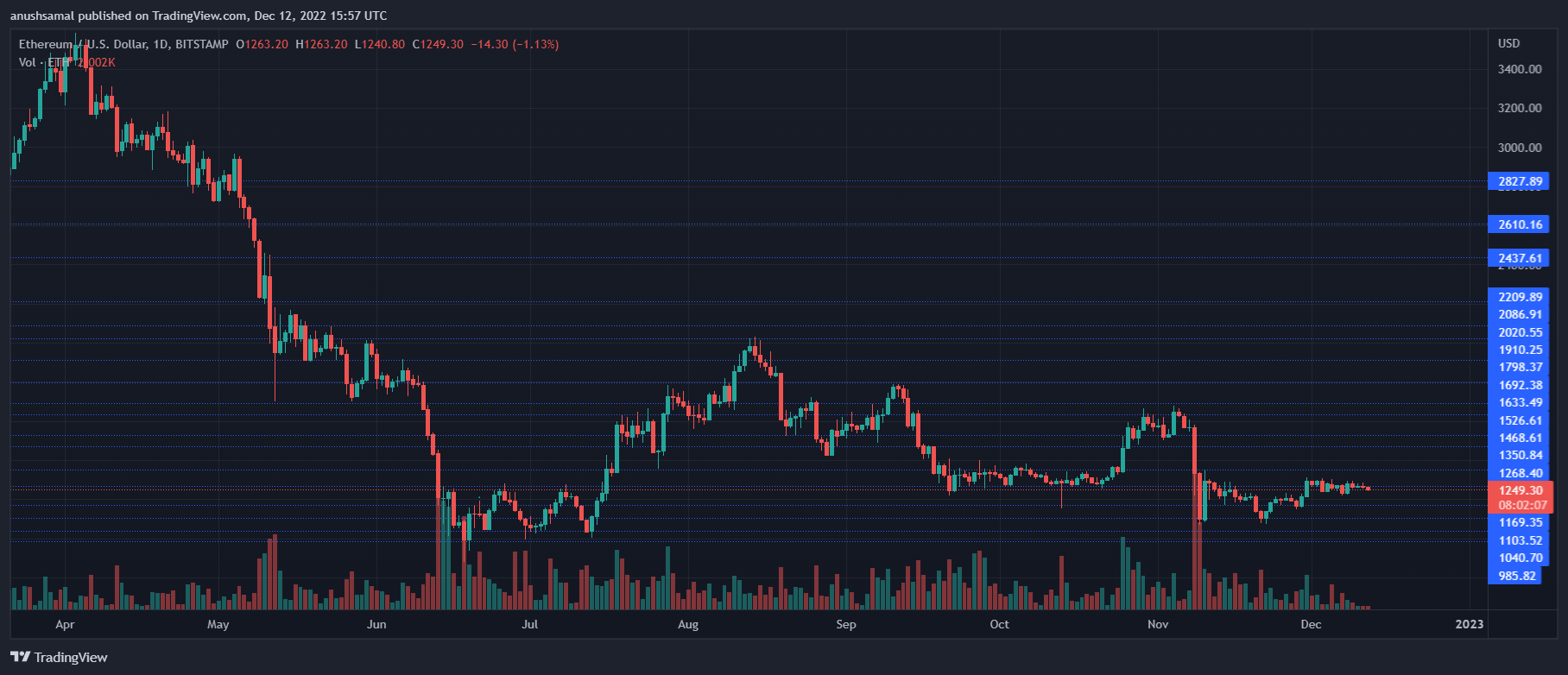
Ethereum was priced at $1,251 on the one-day chart | Source: ETHUSD on TradingView ETH was exchanging hands at $1,251 at the time of writing. The coin has been swaying between the $1,220 and $1,300 marks. However, indicators have continued to side with the bulls as buyers have shown interest in the asset.
Overhead resistance for the Ethereum price was at $1,260. After breaking through that barrier, the coin will face a new one at $1,300. On the flip side, falling from the $1,251 level will drag the altcoin to $1,200 and then to $1,170. The amount of ETH traded in the last session declined slightly, indicating some loss in buying strength.
Technical Analysis
Ethereum

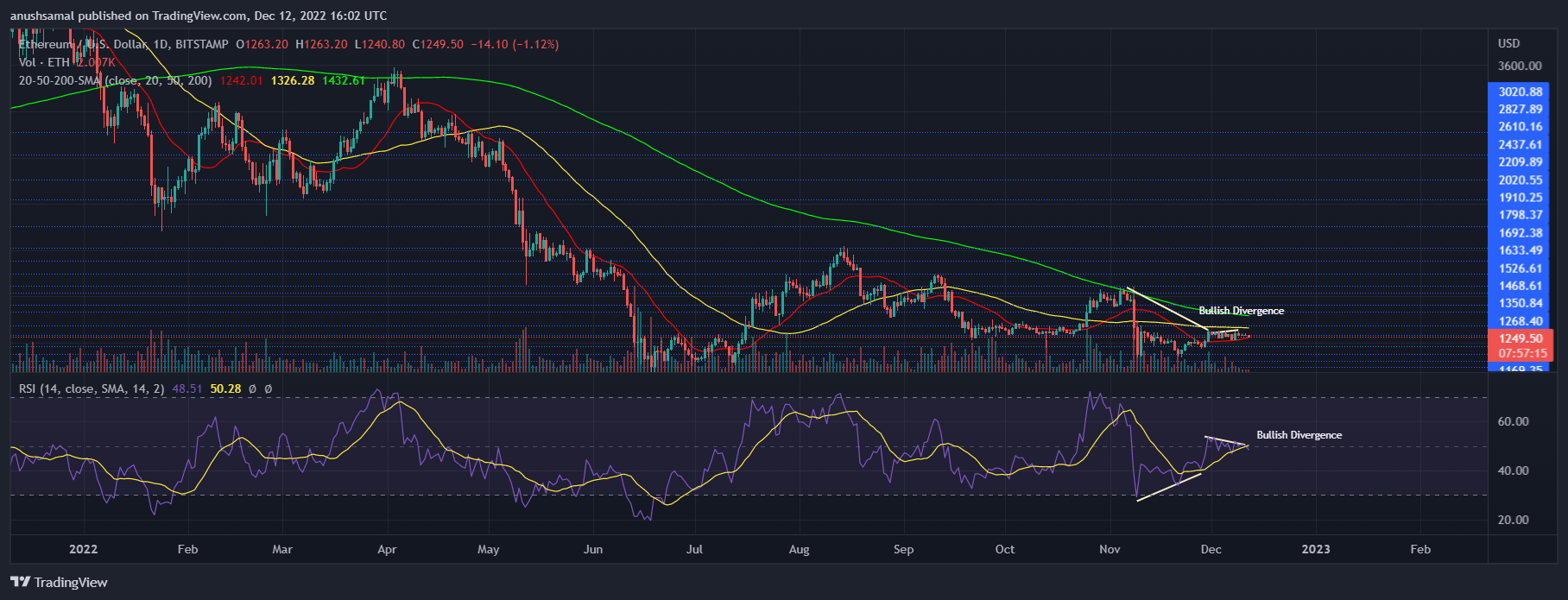
Ethereum registered a fall in buyers on the one-day chart | Source: ETHUSD on TradingView The chance of Ethereum registering an uptick increases owing to the several bullish divergences on the chart. Bullish divergences are tied to the coin picking up momentum. The Relative Strength Index also spotted a bullish divergence, indicating that buying strength could get stronger.
The RSI was just above the half-line, meaning buyers were more than sellers on the chart. The Ethereum price was spotted slightly above the 20-Simple Moving Average Line. This denoted that buyers were still in charge of driving the price momentum in the market.
Ethereum

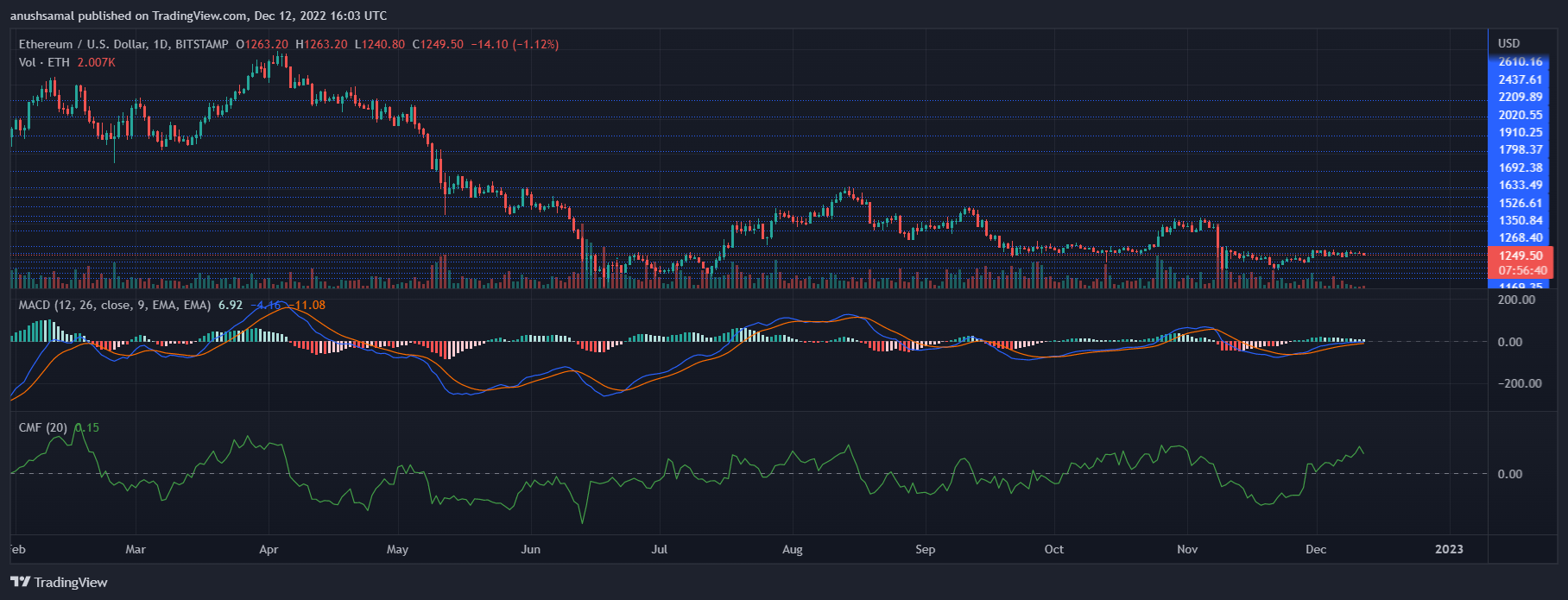
Ethereum displayed a buy signal on the one-day chart | Source: ETHUSD on TradingView Other technical indicators for the altcoin continued to exhibit buying strength. The Moving Average Convergence Divergence portrays that price momentum continued to form green signal bars.
The green histograms were the buy signal for the coin, which could further mean an entry point for traders. The Chaikin Money Flow (CMF) indicates investor interest by capturing capital inflows and outflows. CMF was positive as it was above the half-line, meaning capital inflows exceeded outflows.


Пов'язані матеріали

How the CLARITY Act Reshapes the Stablecoin Yield Economy

The CLARITY Act, recently advanced by the U.S. Senate Banking Committee, fundamentally reshapes the stablecoin yield economy by closing loopholes left by the earlier GENIUS Act. Its Section 404 expands the ban on "hold-to-earn" rewards to all Digital Asset Service Providers (DASPs) and their affiliates, prohibiting any passive, interest-like yield. Crucially, it introduces a legal distinction, permitting "use-to-earn" rewards based on actual activities like spending, trading, or staking. In anticipation of this regulatory shift, major Wall Street asset managers—Morgan Stanley, BlackRock, and JPMorgan—have launched a series of tokenized money market funds (e.g., BlackRock's BRSRV, JPMorgan's JLTXX) designed explicitly for stablecoin reserve assets. These products represent a new, compliant yield layer: the stablecoin issuer earns interest from the underlying tokenized fund, which can then be passed to users through redesigned activity-based rewards. This marks a paradigm shift from a "hold-to-earn" to a "use-to-earn" market. While pathways remain for exchanges to redesign rewards (Path A) and for DeFi protocols to offer yield (Path B), the tokenized reserve asset layer (Path C) emerges as the most robust and strategically positioned infrastructure. However, this concentration—exemplified by BlackRock's BUIDL fund backing over 90% of USDtb's reserves—introduces new systemic risks. The final outcome hinges on regulatory decisions, particularly the OCC's proposed 20% cap on tokenized assets in reserves, which will determine the scalability of this new financial infrastructure layer.

marsbit1 год тому

How the CLARITY Act Reshapes the Stablecoin Yield Economy

marsbit1 год тому

Kalshi and Coinbase Receive CFTC Approval, Ushering in the Most Regulation-Friendly Era for the Crypto Industry?

The U.S. Commodity Futures Trading Commission (CFTC) took two landmark actions on May 29. It approved Kalshi's application to list a Bitcoin perpetual futures contract and issued a no-action letter to Coinbase Financial Markets. This allows Coinbase to offer certain perpetual futures products to U.S. customers through a subsidiary, with digital assets permitted as collateral. These moves, coupled with a new CFTC policy statement, provide a clearer regulatory pathway for perpetual contracts in the U.S., moving them from a regulatory gray area. CFTC Chair Mike Selig stated this is a key step for U.S. crypto leadership but noted the policy is not yet permanent. The article explains that CFTC's previous reluctance stemmed from legal ambiguities, as perpetual contracts lack an expiration date. However, such contracts dominate global crypto derivatives, accounting for ~78% of centralized exchange volume in 2025, forcing U.S. regulators to adapt to competition from offshore platforms like Hyperliquid. The approvals offer two compliance paths: Kalshi's direct listing and Coinbase's model using foreign futures. This is expected to attract institutional capital back to regulated U.S. venues, stimulate the launch of more products like ETH perpetuals, and enhance U.S. competitiveness in the global crypto derivatives market. The author suggests this may signal a "regulatorily friendly" era for crypto.

marsbit4 год тому

Kalshi and Coinbase Receive CFTC Approval, Ushering in the Most Regulation-Friendly Era for the Crypto Industry?

marsbit4 год тому

Sharplink CEO: Ethereum's Future Is Playing Out Now

This article presents a perspective from Joseph Chalom, CEO of Sharplink and a former BlackRock executive. He argues that current controversies surrounding the Ethereum Foundation (EF) and ETH's price miss the bigger picture for institutional adoption. Chalom asserts that Ethereum is decisively winning in the three key attributes institutions value most: trust, security, and liquidity. He cites its dominance in stablecoin settlement, tokenized real-world assets (RWA), and high-value DeFi as evidence. This success is attributed to the EF's consistent, long-term protocol development over a decade, including major upgrades like The Merge and a robust future roadmap. He defends Ethereum's decentralization as a core strength, not a weakness, stating institutions require a neutral infrastructure not controlled by any single entity. Comparing ETH to Amazon, Chalom suggests critics focusing on short-term price are missing its potential to become the foundational settlement layer for the entire global financial system. The article encourages a contrarian "be greedy when others are fearful" investment approach, drawing parallels to Warren Buffett's strategy and BlackRock's continued investment during crypto winters. Chalom concludes that while the EF correctly focuses on core protocol attributes (CROPS: Censorship Resistance, Capture Resistance, Open Source, Privacy, Security), a leadership gap exists in market-facing narrative and institutional adoption. He calls for ecosystem participants, including his own firm Sharplink, to become more vocal advocates to support Ethereum's impending "supercycle" of institutional adoption.

链捕手5 год тому

Sharplink CEO: Ethereum's Future Is Playing Out Now

链捕手5 год тому

Deconstructing the Investment Methodology of the 'Stock God Serenity' in One Article

"Serenity's Bottleneck Investment Methodology: A Deep Dive" This article dissects the "bottleneck point investment" strategy of the pseudonymous investor Serenity, known for exceptional returns (YTD 4502.45%). The core methodology involves identifying a major technological trend (e.g., AI compute expansion), mapping its supply chain, and investing early in the most irreplaceable, supply-constrained upstream component before the market fully values it. The framework is broken down into a five-factor model: 1. **Deterministic Demand**: Anchored in a large, validated trend. 2. **Constrained Supply**: The component must be difficult to replicate or scale quickly. 3. **Low Market Attention**: Opportunities exist where coverage is sparse. 4. **Value Capture**: The company must have pricing power, high margins, and customer lock-in. 5. **Catalyst**: A near-term event to trigger price discovery (earnings, customer ramp, etc.). The article provides illustrative examples like $AXTI (InP substrates for photonics), $RPI (edge hardware for AI agents), and $AAOI/$LITE (components for cloud ASICs). To apply this method, a six-step process is outlined: identify the macro trend, map the supply chain, pinpoint the true bottleneck, gather evidence (client wins, certifications), assess risks ("anti-thesis table"), and size the position according to research depth. Crucially, the article notes significant limitations: risk of overfitting inferences from sparse data, valuation challenges for pre-revenue companies, liquidity/reflexivity risks due to Serenity's own market influence, and survivor bias amplified by a strong AI bull market. The key takeaway is to emulate the rigorous research process—finding the trend, the bottleneck, the evidence—rather than blindly copying specific stock picks, emphasizing the discipline of "walking through the narrow gate."

marsbit5 год тому

Deconstructing the Investment Methodology of the 'Stock God Serenity' in One Article

marsbit5 год тому

Торгівля

Спот
Ф'ючерси
活动图片