
Huobi正在使用Chainlink储备金证明(PoR)来提高HBTC的透明度

火币资讯Опубліковано о 2022-11-23Востаннє оновлено о 2022-11-23

Анотація

减少包装资产的风险对于提高DeFi内的互操作性至关重要。Chainlink的储备金证明能够可靠和及时地监测链下或跨链储备金。

我们很高兴地宣布Huobi正在使用Chainlink储备金证明(PoR)来帮助提高以太坊主网上HBTC(H-Token)的透明度。通过使用储备金证明,可以验证Huobi在比特币区块链上的储备金钱包中的BTC数量与以太坊上的HBTC——Huobi包装的BTC通证的数量相匹配。Huobi在其链下系统中使用储备金证明来验证HBTC在铸造前已获得完全的担保。

0

Huobi是一家为全球数千万用户提供服务的数字资产交易所。作为我们使命的一部分,我们使用区块链技术为其他众多行业赋能,连接传统和数字经济,为此我们创建了H-Tokens。H-Tokens作为CeFi和DeFi市场之间的桥梁,能够显著地改善流动性。H-Tokens的特点是它是以太坊上的一整套包装资产,并由其它区块链上的数字资产作为支持。HBTC正在引领H-Tokens生态系统的增长,并且已成为区块链世界中采用最广泛的包装资产之一。

0

减少包装资产的风险对于提高DeFi内的互操作性至关重要。Chainlink的储备金证明能够可靠和及时地监测链下或跨链储备金。
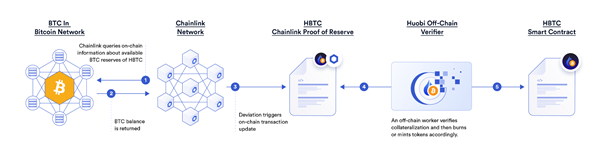
“我们很高兴Huobi使用Chainlink PoR来帮助提高其HBTC储备金的透明度。为包装资产增加透明度对于DeFi生态系统的健康和持续增长至关重要。”——Tomasz Wojewoda (Chainlink Labs全球销售主管)。

0

“降低包装资产的风险对DeFi未来的增长至关重要,尤其是随着它与传统市场的联系越来越紧密。通过使用Chainlink的储备金证明,我们现在能够增加HBTC抵押品的透明度。”——Edward (火必资产和商业中心主管)。

0

关于Chainlink

Chainlink为预言机服务的开发、访问和销售建立了行业标准,可服务于任何区块链上的混合型智能合约。Chainlink预言机网络可以将智能合约可靠地连接至任何外部API,并安全地展开链下计算,为应用实现丰富的功能。Chainlink目前为DeFi、保险和游戏等各大行业保障了数百万亿美元资产,并为全球企业和领先的数据提供商提供通用的门户,一站式接入所有的区块链。

通过访问chain.link或阅读docs.chain.link上的开发者文档了解更多关于Chainlink的信息。如要讨论集成,请联系我们的专家

0

关于Huobi

Huobi集团创立于2013年,数字经济领军企业。致力于区块链领域的核心技术突破以及区块链技术和产业融合,围绕区块链产业上下游,发展包括产业区块链、公链、数字资产交易、数字资产安全钱包、数字经济研究等业务,已形成全球数字经济产业生态体系。

0

Huobi集团在全球多个国家与地区拥有数字资产服务商合规牌照,在日本、韩国、直布罗陀等多个国家和地区设有合规运营主体。Huobi集团坚持践行全球化、专业化、合规化、多元化的“四化”服务,为上百个国家和地区的千万级用户提供安全、可信赖的价值网络服务。

Пов'язані матеріали

A Company Once on the Brink of Bankruptcy Just Surpassed Bitcoin in Market Cap

On June 22nd, driven by rising stock prices, SK Hynix’s market capitalization reached $1.35 trillion, surpassing Bitcoin's total market cap of approximately $1.29 trillion. This temporarily made it South Korea's highest-valued company. The core driver of this surge is HBM (High Bandwidth Memory), for which SK Hynix is the primary supplier to NVIDIA, holding over 60% market share. AI's demand for high memory bandwidth has translated into immense profitability, with SK Hynix reporting a 72% operating profit margin in Q1. The company's success follows a 13-year bet on HBM technology, beginning in 2009. It nearly failed after the 2001 dot-com bubble, was acquired by SK Group in 2012, and was subsequently recapitalized to continue its long-term HBM development. The article contrasts this with the Crypto AI narrative. Capital currently favors AI infrastructure players like SK Hynix due to "real orders, physical barriers, and quantifiable profit margins." In comparison, Crypto AI projects, promising decentralized compute and data markets, remain largely conceptual with limited tangible progress. Examples include Bittensor, whose core mechanisms are still under development, and Bitcoin miners transitioning to AI, who face significant funding gaps and execution challenges. The piece cites analysis suggesting the AI sector has absorbed nearly all new market liquidity since 2022, leaving little for crypto. It concludes that the current AI infrastructure红利 is captured by entities with proven technical barriers and supply capabilities, while crypto networks still need to define their concrete role in the value chain.

链捕手3 хв тому

A Company Once on the Brink of Bankruptcy Just Surpassed Bitcoin in Market Cap

链捕手3 хв тому

Bittensor Moves Towards Ultimate Decentralization: The Critical 18 Months for the TAO Ecosystem is Here?

Bittensor, a decentralized AI protocol, is accelerating its transition to full decentralization over the next 18 months, as outlined in a recent post by co-founder Const. The project currently operates in a "semi-decentralized" state: ownership and network participation are open and permissionless, with TAO distribution based on competitive contribution. However, protocol upgrades and governance have remained under core team control to enable rapid iteration in the fast-evolving AI sector. This strategic shift comes as the ecosystem matures, boasting 128 subnets and a large community. Const argues that continued centralization now poses risks, including single points of failure and regulatory scrutiny. The upcoming decentralization roadmap includes optimizing validator competition, opening liquidity pools, introducing governance rights for Alpha holders, and refining economic models. The move could fundamentally reshape TAO's value proposition, adding governance premiums to its existing valuation based on AI narrative and scarcity. It also signals a potential maturation of the AI crypto sector, where competition may shift from hype to sustainable protocol design and real economic activity. Bittensor positions itself not just as another AI token, but as foundational infrastructure aiming to decentralize intelligence production—analogous to Bitcoin's role in decentralizing money—with the goal of creating a resilient "Millennium Intelligence Federation."

marsbit16 хв тому

Bittensor Moves Towards Ultimate Decentralization: The Critical 18 Months for the TAO Ecosystem is Here?

marsbit16 хв тому

Japan's AI Dark Horse Emerges: How a 7B Small Model Challenges Fable and Mythos?

In June 2026, Sakana AI's new model Fugu caused a stir in the AI community. Its Fugu Ultra variant achieved scores of 73.7 on SWE-Bench Pro and 82.1 on TerminalBench 2.1, surpassing GPT-5.5 and Claude Opus 4.8, and was claimed to be comparable to export-restricted models like Fable 5 and Mythos Preview. Remarkably, the core of this high-performance system is not a massive model, but a small 7B-parameter RL Conductor model. Fugu operates as a multi-agent orchestrator: the 7B model acts as a "foreman," dynamically analyzing user tasks and delegating subtasks to a pool of top-tier global models (e.g., GPT-5, Gemini 3.1 Pro). It then synthesizes and verifies their outputs. This architecture represents a paradigm shift from monolithic models to an expert-team approach. It enhances performance in complex, multi-step engineering tasks like code review and security testing by enabling cross-validation from specialized models, improving long-session stability and token efficiency. However, Fugu's strengths come with trade-offs: it faces inherent latency due to multiple API calls, relies heavily on underlying US model APIs (creating dependency risks), and its benchmark comparisons with Fable/Mythos are based on reported scores, not head-to-head testing. For Japan's AI ecosystem, which lacks the massive compute and data resources of the US or China, Fugu exemplifies an "asymmetric breakthrough" strategy. Instead of competing directly in parameter scale, it focuses on intelligent orchestration of existing global models, offering a degree of AI sovereignty and resilience. While a significant system-level innovation, its ultimate capability is still bounded by the underlying models it coordinates.

marsbit16 хв тому

Japan's AI Dark Horse Emerges: How a 7B Small Model Challenges Fable and Mythos?

marsbit16 хв тому

Торгівля

Спот
Ф'ючерси
活动图片