Celsius had 'insufficient' accounting and operational controls, says examiner

CointelegraphОпубліковано о 2022-11-21Востаннє оновлено о 2022-11-21

Анотація

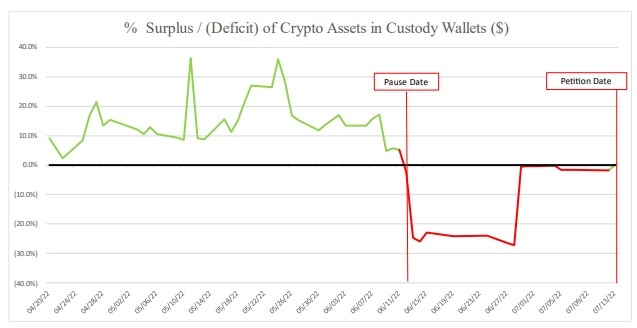
The examiner revealed that Celsius’ digital assets in its customer’s Custody wallets account officially became underfunded on Jun. 11.

The independent examiner in crypto lender Celsius’ bankruptcy case has alleged that the company failed to set up “sufficient” accounting and operational controls in its handling of customer funds.

In an interim report released on Nov. 19, examiner Shoba Pillay made a number of stark observations in her court-appointed investigation into the bankrupt cryptocurrency lending platform.

One of the main revelations in Pillay’s report was that Celsius’ “Custody” program was launched “without sufficient accounting and operational controls or technical infrastructure,” which allowed shortfalls in Custody wallets to be funded from its other holdings.

“[...] no effort was made to segregate or separately identify any assets associated with the Withhold accounts, which were commingled in the Main wallets.”

When it was launched on Apr. 15, Celsius’ Custody program allowed users to transfer, swap and use coins as loan collateral. It was introduced after the firm was ordered by the New Jersey security regulators to create a product that was distinguished from Celsius’ “Earn” product, which receives rewards.

This co-mingling of wallets means that there is now uncertainty on which assets belonged to the customer at the time of the bankruptcy filing, said Pillay, noting:

“As a result, customers now face uncertainty regarding which assets, if any, belonged to them as of the bankruptcy filing.”

The interim report has also shed light on what ultimately forced the lending platform to halt withdrawals on Jun. 12.

Pillay said the breaking point came around on Jun. 11, when customers’ Custody wallets became underfunded. By Jun. 24, this fell a further 24% to $50.5 million in underfunding.

Celsius’ Surplus and Deficit of Digital Assets in Custody Wallets. Source: U.S. Bankruptcy Court.

The revelation comes as a filing with the New York-based bankruptcy court last week states that Celsius customers must file claims against Celsius by Jan. 3. 2023 in order to be eligible for distributions from the case.

However, customers who agree with Celsius’s scheduling of their claims do not need to submit proof of claim, according to a Nov. 20 Twitter post from Celsius.

Pillay said that Celsius’ Custody and Withdrawal programs were created on short notice following “intense regulatory pressure” from New Jersey’s Bureau of Securities, who started an investigation into whether Celsius’ “Earn” accounts constituted securities pursuant to U.S. securities laws in mid-2021.
Other accounting insufficiencies highlighted in the report include a revelation that Celsius, founded in 2017 by Alex Mashinsky and Daniel Leon, didn’t start tracking its balance sheet until after this confrontation with regulators in May. 2021, which it then used Google Sheets.

The collapse of the Terra ecosystem was one of the main factors that led to Celsius’ financial troubles in May. 2022, which saw its native coin, Luna Classic (LUNC), formerly LUNA, and the network’s algorithmic stablecoin TerraClassicUSD, USTC — previously TerraUSD (UST) — fall north of 98% in value.

Celsius also stated on Nov. 20 that its next court date is scheduled for Dec. 5, where they plan on advancing discussions around its Custody and Withhold accounts, among other matters.


Пов'язані матеріали

Second Half of U.S. Crypto Policy: The Clarity Act Aims for 60 Votes, CFTC's "One-Person Commission" Becomes Biggest Variable

In a pivotal year for US crypto policy, the "CLARITY Act" is advancing in the Senate but faces a high hurdle, needing 60 votes to pass. Key challenges include bridging partisan divides on ethics and swaying undecided Republican senators within a tight legislative calendar of only about 40 working days. The policy "second half" involves intense negotiations on a broader framework for Web3 and DeFi, including crypto tax reforms and the Blockchain Regulatory Certainty Act. A significant uncertainty is the understaffed CFTC, operating with four commissioner vacancies, which complicates regulatory clarity. Meanwhile, the departure of key "crypto champions"—SEC Commissioner Hester Peirce and Senator Cynthia Lummis—will impact ongoing policy efforts. Industry experts are cautiously optimistic but realistic. Sara K. Weed notes that while progress is being made, CLARITY is unlikely to pass this Congress, pushing agencies like the SEC and CFTC to provide more guidance. Sulolit Mukherjee suggests meaningful crypto tax legislation is more likely to be attached to larger must-pass bills. Rashan Colbert discusses the jurisdictional debate over prediction markets, emphasizing the need for a regulatory framework that fosters their development as financial tools rather than treating them broadly as gambling. The clock is ticking, but opportunities remain for substantive progress through continued bipartisan dialogue and pragmatic efforts.

marsbit19 хв тому

Second Half of U.S. Crypto Policy: The Clarity Act Aims for 60 Votes, CFTC's "One-Person Commission" Becomes Biggest Variable

marsbit19 хв тому

Dan Koe's New Essay: Escaping the Fate of the Wage Slave, How to Survive the AI Replacement Wave?

Dan Koe argues that the true threat in the AI era isn't technology itself, but a reliance on others for one's livelihood and happiness. The core problem is "wage slavery"—spending life on unfulfilling work. To survive and thrive, one must escape this by building their own enterprise. The key is developing five elements: Agency (initiative), Taste (discernment), Persuasion, Persistence, and Iteration. These boil down to problem-solving skills and experiential knowledge, which cannot be learned passively but only through doing your own projects. The solution is to become "unemployable" by shifting your identity. This requires: 1) Radically changing your environment to force growth, 2) Choosing a medium (like content creation) that provides real feedback through trial and error, and 3) Mastering either code or, preferably, media (content). Content creation is more valuable because its subjective nature and need for human perspective create a durable advantage over generic AI output. To start, define your life's work by answering foundational questions about your innate knowledge, unique abilities, and contrarian beliefs. Then, immediately act by publishing your first piece of content. The cycle of creating, receiving feedback, and iterating is the essential path to developing the skills needed for an independent, meaningful career and financial resilience.

marsbit55 хв тому

Dan Koe's New Essay: Escaping the Fate of the Wage Slave, How to Survive the AI Replacement Wave?

marsbit55 хв тому

Research Report Analysis: Morgan Stanley Details SanDisk SNDK, The Truth About Cloud Data Center Pricing Power and AI Inference Benefits

Morgan Stanley raised its price target for SanDisk (SNDK) from $1100 to $1750 on June 22, maintaining an Overweight rating. The upgrade is driven by AI inference demand reshaping the NAND market, particularly for KV Cache and context window storage in cloud data centers. These cloud clients exhibit price inelasticity and sign long-term contracts, granting SanDisk significant pricing power. SanDisk's New Business Model (NBM) agreements, covering over one-third of FY27 bit shipments with 3-5 year terms and fixed price/price collar structures, are crucial. They are projected to sustain gross margins around 80% even at floor prices, providing a buffer against cyclical downturns. Morgan Stanley forecasts gross margins to surge from 30.3% in FY25 to 86.7% in FY27e. With NAND supply expected to remain tight into 2026/2027 and cloud/data centers becoming the largest end-market, SanDisk holds supply-side pricing power. The company targets 15-19% bit growth via technology transitions, not capacity expansion. Revenue is projected to grow ~6.6x from FY25 to FY27, with EPS rising from $2.74 to $14.73, driven by high-margin cloud business. Key upside catalysts include faster enterprise SSD adoption and edge AI growth. Downside risks involve slower industry growth, competitor capex increases, market share loss, and competition from Chinese players like YMTC. The investment thesis rests on AI-driven structural demand, NBM's margin protection, and sustained supply tightness. The $1750 target implies ~28x FY27e P/E.

marsbit1 год тому

Research Report Analysis: Morgan Stanley Details SanDisk SNDK, The Truth About Cloud Data Center Pricing Power and AI Inference Benefits

marsbit1 год тому

A Threefold Performance Leap! NEAR Achieves 200ms Physical Block Time Limit with SPICE

NEAR's core development team, Near One, has announced its next major protocol evolution: SPICE (Separation of Consensus and Execution). Currently in development, SPICE represents the most significant upgrade before the full implementation of Nightshade 3.0. Its core innovation is decoupling the consensus layer, responsible for ordering transactions, from the execution layer, which processes them. This allows the consensus layer to run at full speed without waiting for transaction execution to complete. Once deployed, SPICE is projected to triple NEAR's block production speed, achieving a 200ms block time, which is considered the physical limit due to the speed of light and network latency. This leap will dramatically reduce transaction latency and finality, with transactions confirming in roughly 0.4 seconds—faster than a typical card payment. The upgrade also enables more complex, long-running transactions and significantly improves user experience for applications like NEAR Intents and near.com. Beyond raw speed, SPICE enhances network scalability and security. It enables deeper parallelism, efficiently distributing workload across shards and improving resource utilization. The simpler block structure and lighter contracts also facilitate formal verification and security auditing. Furthermore, SPICE lays the critical groundwork for future Nightshade 3.0 features, most notably atomic cross-shard transactions, which would simplify complex contract logic and eliminate development hurdles caused by asynchronous execution. The Near One team is actively developing SPICE, targeting deployment in the coming months.

Foresight News2 год тому

A Threefold Performance Leap! NEAR Achieves 200ms Physical Block Time Limit with SPICE

Foresight News2 год тому

Торгівля

Спот
Ф'ючерси
活动图片