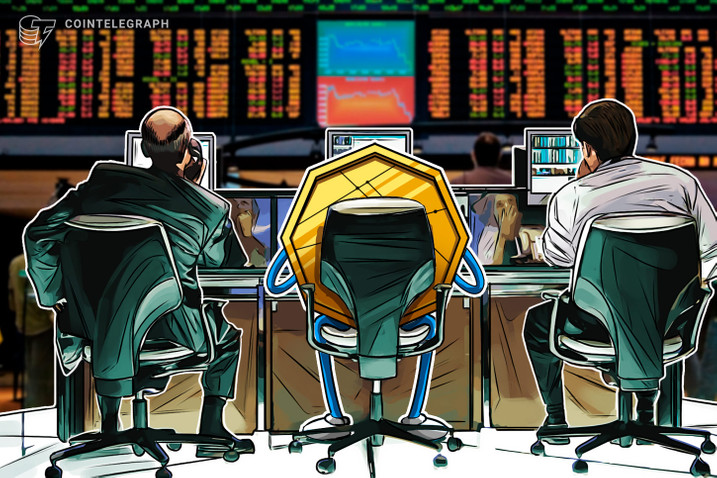
FTX will be the last giant to fall this cycle: Hedge fund co-founder

CointelegraphОпубліковано о 2022-11-18Востаннє оновлено о 2022-11-18

Анотація

This bear market has seen the collapse of Celsius, Three Arrows Capital, Voyager, and now FTX, but the worst is likely over, a hedge fund executive suggests.

While the FTX crisis is continuing to unfold, the former head of risk at Credit Suisse believes the exchange's fall from grace should be the last catastrophic event — at least in this market cycle.

CK Zheng, the former head of valuation risk at Credit Suisse and now co-founder of crypto hedge fund ZX Squared Capital said that FTX’s fall was part of a “deleveraging process” that began after the COVID-19 pandemic and further accelerated after the fall of Terra Luna Classic (LUNC), formerly Terra (LUNA).

“When LUNA blew up a few months ago, I expected a huge amount of deleveraging process to kick in,” said Zheng, who then speculated that FTX should be last of the “bigger” players to get “cleaned up” during this cycle.

Before its collapse, FTX was the third largest crypto exchange by volume after Binance and Coinbase.

“I’m sure there are multiple players that will probably get impacted [...] in the following weeks, you know, small, large — but I would say this one in terms of magnitude will be one of the larger ones before the whole cycle really ends.”

On Nov. 14, crypto exchange BlockFi admitted to having “significant exposure” to FTX and its affiliated companies. A day later, a Wall Street Journal report suggested it was preparing for a potential bankruptcy filing.

A number of exchanges have also halted withdrawals and deposits this week, citing exposure to FTX, including crypto lending platform SALT and Japanese crypto exchange Liquid.

On Nov. 16, institutional crypto lender Genesis Global said it would temporarily suspend withdrawals citing 'unprecedented market turmoil.'

The fate of these businesses are yet to be determined.

Zheng noted that moments like this are all normal signs of a lengthy, stressful crypto winter which “basically wipes out many of the weak players.”

On a positive note, however, Zheng said that the FTX collapse is unlikely to shake institutional investor confidence, at least for those investing in blockchain technology and certain cryptocurrencies such as Bitcoin and Ethereum.

“For many of the institutional investors [...] as long as they think about the longer term, they think about how blockchain technology is going to advance in the future to help the financial industry [...] that’s still in place.”

CoinShares’ head of research James Butterfilll in a Nov. 14 note revealed that inflows into cryptocurrency investment products rose sharply last week after institutional investors bought the dip triggered by FTX’s collapse.

Investors see the #FTX collapse as an opportunity with crypto inflows totalling US$42mhttps://t.co/neDkmnr6ae
— James Butterfill (@jbutterfill) November 14, 2022

Digital asset investment products saw inflows totaling $42 million in the week ending Nov. 13, the largest increase in 14 weeks.

On the other hand, their outlook wasn’t so optimistic for blockchain equities, which registered $32 million in weekly outflows.

Zheng said it was “mind-boggling” how much damage an MIT-educated, 30-year-old young person can do to the crypto ecosystem — referring to FTX former CEO Sam Bankman-Fried.

He believes the fall of FTX was the result of a lack of clear rules and regulations governing crypto exchanges. Zheng said it may also have been the result of a top-heavy management structure that may not have had the necessary know-how to run a business of such a size.

“Obviously, they’re smart in one aspect, but they’re running a $32 billion company is very different than, you know, when you manage a small company.”

Пов'язані матеріали

Research Report Analysis: Morgan Stanley Details SanDisk SNDK, The Truth About Cloud Data Center Pricing Power and AI Inference Benefits

Morgan Stanley raised its price target for SanDisk (SNDK) from $1100 to $1750 on June 22, maintaining an Overweight rating. The upgrade is driven by AI inference demand reshaping the NAND market, particularly for KV Cache and context window storage in cloud data centers. These cloud clients exhibit price inelasticity and sign long-term contracts, granting SanDisk significant pricing power. SanDisk's New Business Model (NBM) agreements, covering over one-third of FY27 bit shipments with 3-5 year terms and fixed price/price collar structures, are crucial. They are projected to sustain gross margins around 80% even at floor prices, providing a buffer against cyclical downturns. Morgan Stanley forecasts gross margins to surge from 30.3% in FY25 to 86.7% in FY27e. With NAND supply expected to remain tight into 2026/2027 and cloud/data centers becoming the largest end-market, SanDisk holds supply-side pricing power. The company targets 15-19% bit growth via technology transitions, not capacity expansion. Revenue is projected to grow ~6.6x from FY25 to FY27, with EPS rising from $2.74 to $14.73, driven by high-margin cloud business. Key upside catalysts include faster enterprise SSD adoption and edge AI growth. Downside risks involve slower industry growth, competitor capex increases, market share loss, and competition from Chinese players like YMTC. The investment thesis rests on AI-driven structural demand, NBM's margin protection, and sustained supply tightness. The $1750 target implies ~28x FY27e P/E.

marsbit5 хв тому

Research Report Analysis: Morgan Stanley Details SanDisk SNDK, The Truth About Cloud Data Center Pricing Power and AI Inference Benefits

marsbit5 хв тому

A Threefold Performance Leap! NEAR Achieves 200ms Physical Block Time Limit with SPICE

NEAR's core development team, Near One, has announced its next major protocol evolution: SPICE (Separation of Consensus and Execution). Currently in development, SPICE represents the most significant upgrade before the full implementation of Nightshade 3.0. Its core innovation is decoupling the consensus layer, responsible for ordering transactions, from the execution layer, which processes them. This allows the consensus layer to run at full speed without waiting for transaction execution to complete. Once deployed, SPICE is projected to triple NEAR's block production speed, achieving a 200ms block time, which is considered the physical limit due to the speed of light and network latency. This leap will dramatically reduce transaction latency and finality, with transactions confirming in roughly 0.4 seconds—faster than a typical card payment. The upgrade also enables more complex, long-running transactions and significantly improves user experience for applications like NEAR Intents and near.com. Beyond raw speed, SPICE enhances network scalability and security. It enables deeper parallelism, efficiently distributing workload across shards and improving resource utilization. The simpler block structure and lighter contracts also facilitate formal verification and security auditing. Furthermore, SPICE lays the critical groundwork for future Nightshade 3.0 features, most notably atomic cross-shard transactions, which would simplify complex contract logic and eliminate development hurdles caused by asynchronous execution. The Near One team is actively developing SPICE, targeting deployment in the coming months.

Foresight News1 год тому

A Threefold Performance Leap! NEAR Achieves 200ms Physical Block Time Limit with SPICE

Foresight News1 год тому

Торгівля

Спот
Ф'ючерси
活动图片