Ethereum enthusiasts on the fence about buying the dip

AmbcryptoОпубліковано о 2022-11-10Востаннє оновлено о 2022-11-10

Анотація

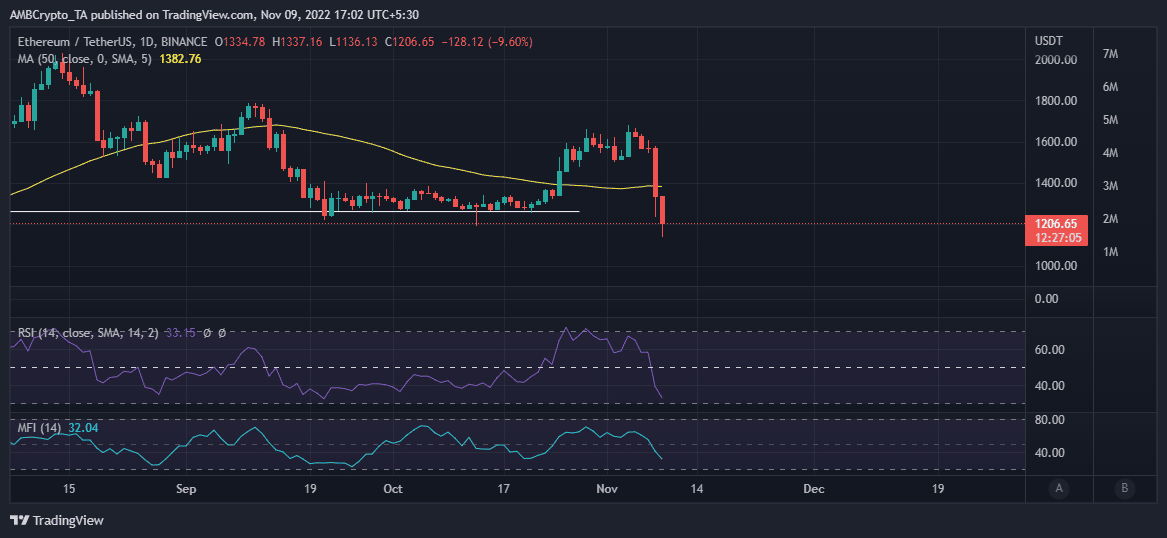
Ethereum experienced a sizable discount this week as the latest FTX-related events wreak havoc on the market. ETH reverted to price levels below $1,200 and the last time it was within this range was in July.

Ethereum [ETH] experienced a sizable discount this week as the latest FTX-related events wreak havoc on the market. ETH reverted to price levels below $1,200 and the last time it was within this range was in July.

""

ETH, so far, dropped by as much as 30% this week courtesy of the ongoing market crash. Many traders were wondering whether this was a good time to buy back or to wait until the sell pressure witnessed a slowdown. But before traders make a decision, here are some recent observation that may help provide more clarity.

""

ETH Whales are buying at discounted prices

""

Glassnode researchers observed a continued increase in the number of addresses holding 32 ETH or more. Why is this important? Well, 32 ETH is the minimum requirement to run a validator node. Operating an Ethereum validator node can be quite lucrative. It thus, made sense why many aspiring validators were taking advantage by accumulating at lower prices.

Glassnode also reported a continued increase in the total value of ETH locked in ETH 2.0 deposit contracts. Furthermore, the same report revealed that ETH 2.0 deposit contracts reached a new all-time high at 14.8 million ETH.
Source: Glassnode

""

The total value staked in ETH 2.0 also increased despite the bearish market conditions. This was a sign that ETH holders were not just buying the dip but staking to take advantage of growth opportunities in the next bull run.

""

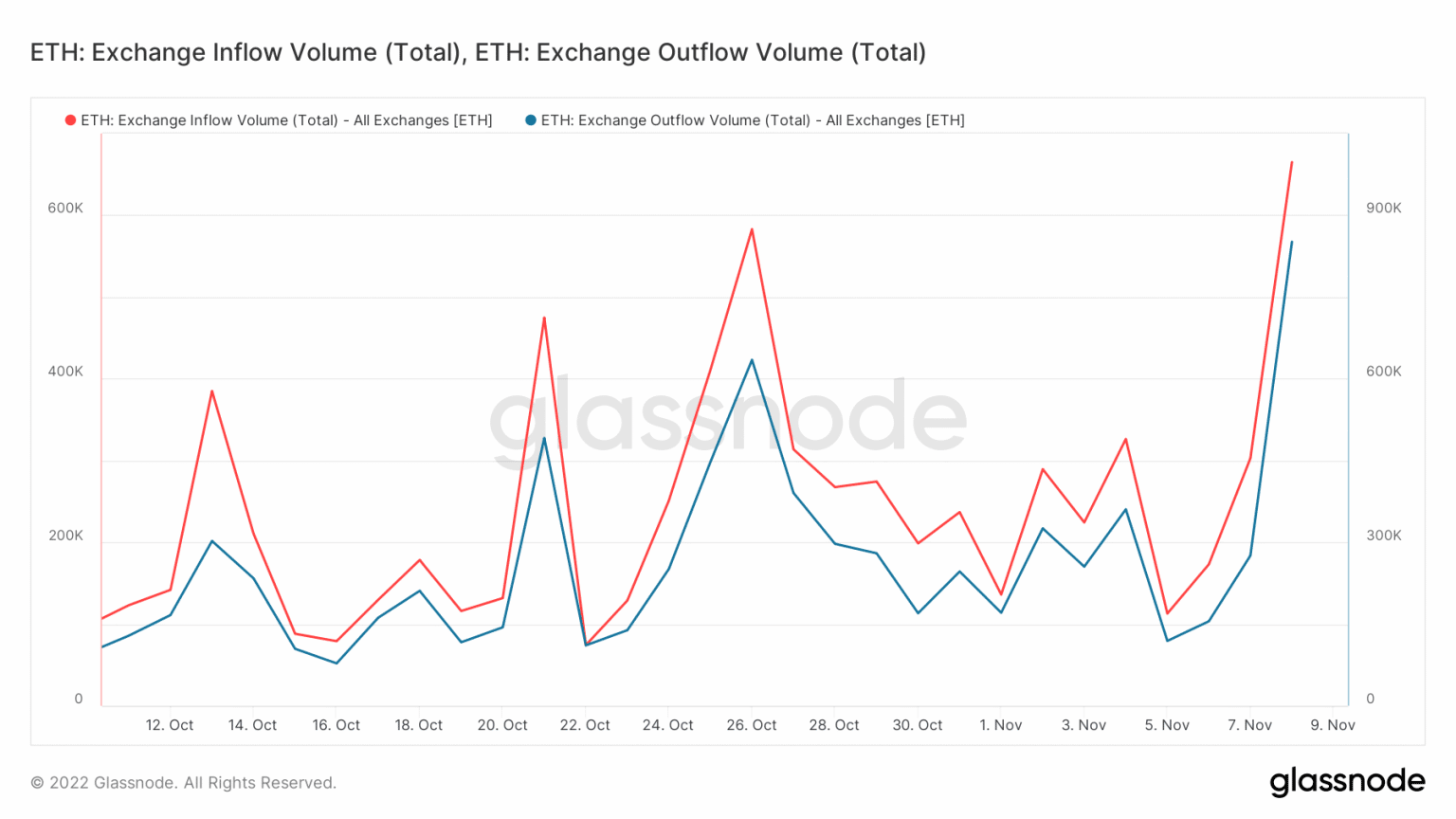
A look at ETH exchange flows also confirmed that there was healthy accumulation despite the downside. ETH exchange outflows outweighed exchange inflows at the time of writing.

""

The exchange outflow metric registered 851,225 ETH while the exchange inflow metric registered 664,811 ETH at press time. Higher exchange outflows than inflows can be considered as a bullish sign. This accumulation can also be considered as a bit of a bullish recovery back above $1,200, after briefly dropping as low as 1,136.
Source: TradingView

""

More upside in the future?

""

ETH’s downside came shy of the oversold zone, but there was still a chance that it might drop into oversold territory if the selloff continued. That would happen if the current FUD maintains its level but so far the sell pressure seemed to be tapering out.

""

The observed return of bullish demand was also one of the key signs confirming accumulation. Traders should expect more bullish short-term recovery if the sell pressure dies down giving way to more upside.


Пов'язані матеріали

A Threefold Performance Leap! NEAR Achieves 200ms Physical Block Time Limit with SPICE

NEAR's core development team, Near One, has announced its next major protocol evolution: SPICE (Separation of Consensus and Execution). Currently in development, SPICE represents the most significant upgrade before the full implementation of Nightshade 3.0. Its core innovation is decoupling the consensus layer, responsible for ordering transactions, from the execution layer, which processes them. This allows the consensus layer to run at full speed without waiting for transaction execution to complete. Once deployed, SPICE is projected to triple NEAR's block production speed, achieving a 200ms block time, which is considered the physical limit due to the speed of light and network latency. This leap will dramatically reduce transaction latency and finality, with transactions confirming in roughly 0.4 seconds—faster than a typical card payment. The upgrade also enables more complex, long-running transactions and significantly improves user experience for applications like NEAR Intents and near.com. Beyond raw speed, SPICE enhances network scalability and security. It enables deeper parallelism, efficiently distributing workload across shards and improving resource utilization. The simpler block structure and lighter contracts also facilitate formal verification and security auditing. Furthermore, SPICE lays the critical groundwork for future Nightshade 3.0 features, most notably atomic cross-shard transactions, which would simplify complex contract logic and eliminate development hurdles caused by asynchronous execution. The Near One team is actively developing SPICE, targeting deployment in the coming months.

Foresight News44 хв тому

A Threefold Performance Leap! NEAR Achieves 200ms Physical Block Time Limit with SPICE

Foresight News44 хв тому

Deep Insight: Decentralized Inference is Not Hype, but a Key Track for AI to Break Through Centralized Monopoly

Decentralized Reasoning: Beyond the Hype, a Key to Breaking AI's Centralized Monopoly A future scenario where a powerful AI model is banned by a major government illustrates the core value proposition of decentralized AI: resistance to censorship. The core bet of decentralized inference networks is mitigating this risk, with other benefits like cost being secondary. The path is extremely difficult, involving four key challenges: 1. **Running Massive Models:** Distributing a single model across a decentralized GPU swarm requires sophisticated techniques like pipeline and speculative decoding to overcome crippling network latency, aiming for usable speeds (e.g., 30-40 tokens/second). 2. **Proving Model Integrity:** Verifying that a node runs the correct model is critical. Solutions range from cryptographically secure but slow ZKML to faster, economically-secure methods like statistical fingerprints, deterministic re-execution, or live-weight proofs, each involving trade-offs between integrity, latency, and cost. 3. **Ensuring Prompt Privacy:** Simply sharding a model does not protect user inputs from nodes. Robust solutions currently require trusted hardware (TEEs) or advanced cryptography (FHE), which are not yet widely deployed in consumer swarms. 4. **Building a Real Market:** Identifying the ideal customer is tough. Beyond speculative AI agents, the viable market currently consists of startups embedding AI and projects needing batch processing (e.g., synthetic data generation), where decentralized aggregation can be an advantage over low-latency needs. The article analyzes several projects tackling these problems, such as Dolphin Network (live-weight proofs), Inference.net (statistical verification), Morpheus (TEE-based), and Darkbloom (Apple Secure Enclave). It provides a framework: decentralization is a "tax" for latency-sensitive applications (e.g., chat) but a potential supply-side advantage for throughput-oriented tasks (e.g., batch processing). The long-term vision is a closed data loop where decentralized inference generates valuable data (traces, preferences) to feed decentralized training networks, which in turn produce better open-weight models for the inference networks. A due diligence checklist advises focusing on projects that: are truly decentralized at specific layers; have a credible integrity method; offer real cost benefits; ensure genuine privacy; handle node reliability; have paying users; and are built by teams with deep AI expertise. The ultimate goal should be products that appeal beyond the crypto-native audience, using crypto mechanisms invisibly to deliver better cost, performance, or privacy.

Foresight News1 год тому

Deep Insight: Decentralized Inference is Not Hype, but a Key Track for AI to Break Through Centralized Monopoly

Foresight News1 год тому

Торгівля

Спот
Ф'ючерси
活动图片