1. Review
""
The FTX incident has entered a new phase on November 9, one thing to be sure is that what happened within the last 24 hours will almost certainly be embroidered in the history of cryptocurrency. Here's a timeline of major moments of the incident, with some key numbers that we hope readers perceive a full picture of the entire incident.
""
1) On Nov. 2, Coindesk leaked that Alameda's balance sheet is at stake, with about $6 billion of the total $14.6 billion in assets being FTT and SOL.
""
2) On Nov. 6, CZ claimed on Twitter that he is selling off about $23 million of FTT on hand. The price of FTT began to fall after the tweet, and stabilized near $22 after Alameda's CEO Caroline responded that Alameda is willing to take all of it for $22. But nearly $1 billion in assets have fled FTX and Alameda in just two days.
""
3) November 8, 11:00 (UTC +8), a rumor said FTX sold off 100 million $BIT and other tokens held to replenish liquidity, the news further triggered mass panic in FTX's bankruptcy and led to falling in FTT price even to $ 16. But in the afternoon of Nov 8, several hot wallets on FTX are silent for 2 hours that no coins are transferred out, further aggravated the panic. FTT continues to bring down the whole market.
""
4) On November 9 at 0:09 (UTC+8), SBF and CZ simultaneously tweeted to express that FTX and Binance have reached a non-binding agreement: Binance will acquire FTX Global to help FTX cope with the liquidity crash. The statement was like a booster to the market that FTT bounced back above $ 20; BTC and ETH also returned to $ 20,000 and $ 1,500 levels, respectively.
""
5) November 9, 2:00 pm The US Commodity Futures Trading Commission said they are supervising the acquisition of FTX by Binance. There are voices suggesting that the acquisition may be fast because the deal is a steal, which could result in severe loss of the previous investors of FTX and it may violate the antitrust laws of each country. These voices have raised concerns about whether the deal could be completed. What’s worse, SBF stated in an internal letter to the company on Tuesday morning that $6 billion had been taken from FTX in the past three days, giving the market a signal that fundings of FTX are more insufficient than anticipated. Starting 8:00 on November 9, FTX suspended all cryptocurrency withdrawals. This series of plots led to a further market collapse, with FTT prices, so far, falling below $5, BTC falling below $17,000 at the lowest, and ETH falling below $1,300. The number of stable coins in FTX's wallet has now fallen by more than 80% valued currently less than $200 million with less than 40 BTC.
""
2. The Scope of the FTX Incident and Prediction on the Next
""
2.1 Impact
""
The impact of the FTX incident may exceed the Luna and 3AC collapse and affect the institutions implicated by 3AC but not filed for bankruptcy. If they are also involved in this event, lent to FTX, it is highly likely the institutions are facing liquidation, and extend the fire to everywhere in the industry. The impact of this incident can be elaborated from the following 3 aspects:
""
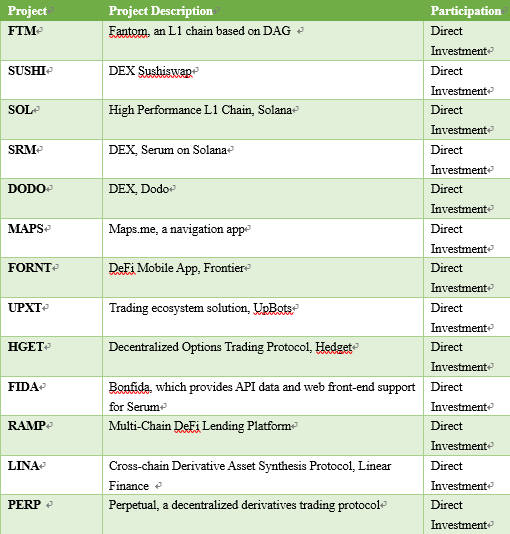
a) Direct impact: this refers to the projects directly invested by FTX and Alameda as well as centralized institutions with which FTX has direct lending/borrowing and other cooperation relationships. At the project level, it mainly involves major L1 chains and DEX including Solana, Fantom and Serum, etc., as shown in the table below, which are the direct victims of the FTX incident.
By analysis on Alameda's portfolio, the tokens currently held by Alameda's monitorable wallet are as follows by value: BIT, SUSHI, FTT, SRM, LDO, MATIC, RNDR, etc.
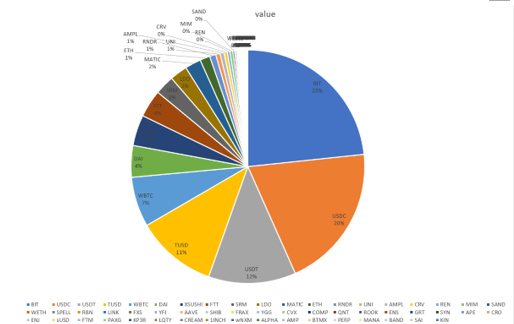
>BIT: It is yet to confirm whether FTX will break the promise and unlock, as FTX promises earlier not to unlock, but BIT has accounted for 23% of total value in the Alameda wallet, and the market is not confident enough on this as it is already deemed as a high-risk coin
>SUSHI: Alameda has a total of 3.4 million xSUSHI and eligible to withdraw 4.8 million SUSHI. SUSHI is relatively safe for now as the price is too low to be liquidated in a large amount on chain; it is not feasible to do so. At the moment, the market lacks to confidence and panic merely because of Alameda's huge holdings.
>MATIC and RNDR: Relatively more liquid, and they are not assets from SOL-system; it is the ideal target for cash inflow to be sold as priority. The price of RNDR has fallen 26% and 20% for MATIC. If the tokens in the balance are transferred to the exchange account, the decrease in price will follow.
>FTT: FTX's own platform coin. It is also said that Alameda borrowed a large amount FTT from FTX as collateral for borrowing. But the information regarding loans behind the scene cannot be traced on chain, the details of liquidation are not available at the moment. Taking the collateral into consideration, price of FTT may produce a favorable position for Alameda as the last card.
>SRM: One of the projects which have been extremely close to Alameda and FTX. The current price has been severely under the issuance price as the same as the other protocols on Solana, and the TVL is down by 20-30% in 24 hours.
>SOL: There is a risk of liquidation on large bulk of assets on chain. A large on-chain account currently has 2,095,598 SOLs (worth over $38 million) in collateral and 48,038,000 USDC in debt, which would trigger liquidation if the oracle were to resume, causing a significant drop in price.
""
As for the organizations that have business connections with Alameda, there is no public information to confirm, but they sure exist.
""
b) Indirect impact: On projects which Alameda acts as a market maker or equity swap, or projects that are deeply tied to FTT and related assets, such as bitDao, MIM, etc. Although these projects do not receive direct investment from FTX, their business tangled; they sure will be affected at large by current situation of FTX.
""
c) Aftershock: Other assets in the market, mainly driven by correlated assets and market panic.
""
In short, in the three years since the rise of FTX, as the second-ranked centralized exchange, the business has penetrated into every single business line of the industry. We can no longer fully quantify how much damage this event will cause to the project, but we are asserted that compared to the LUNA incident, the FTX incident to the crypto world is as the Lehman Brothers incident does to the financial world.
""
2.2 Follow-up on market and forecasting
""
a) For the market, it was already in a bear market before the FTX incident. With the tightening of macro monetary policy and in light of unfavorable incidents like Luna and Three Arrows Capital, BTC fell all the way to $18,000. But in recent months, although the Fed's continued imposing interest rate hikes has tightened the macro environment, the whole market has calmed to a rather stable state. BTC has held steady at the $ 18,000 level, and also slowly rebounded all the way to about $ 21,000. It is almost the end of interest rate hikes, the collapse of FTX has slit the throat of the market, making BTC falling below $17000 again and ETH falling below $1300. The last time we saw BTC around $17,000 was two years ago, in November 2020. Except for $18,000 price level that lasted for five-month is reasonable, any price level below seems not to be convincing and reliable, and the market has not reached a consensus on the next key point of price level yet.
""
b) In the light of the possible paths yet to happen, first of all, Binance’s acquisition faces many difficulties: this acquisition is subject to close scrutiny by US regulators and the risk of possible violation of US antitrust laws, which even a small term may lead to the failure of this acquisition. In addition, FTX's financial vulnerability far exceeded market expectations to the point that CZ also tweeted on his hard feelings, dauting to other possible buyer in the market, such as Coinbase, which stated clearly on not buying FTX. In all, we believe that Binance is approaching the close of FTX acquisition, but one possibility cannot be ruled out that it is possible that a US-based force will eventually step in and rescue FTX to preserve the influence of the domestic elites in the cryptocurrency world. No signs have been given on the hypothesis, and the market will still be on fire until some refreshment is in place.
""
c) Impact on the industry: this incident has once again aggravated the distrust of centralized exchanges, and in order to cement the confidence on the industry, both Binance and Huobi have claimed to disclose the auditable Merkle Tree for proof of reserve or POF within a month. Meanwhile, the voices for proposing stricter regulation have risen again from inside the industry, such as Coinbase CEO has expressed that the FTX incident will become the beginning for all crypto companies to be exposed in a stricter regulatory environment in the US. This event will be an iconic historical event in terms of regulations.