Ocean Protocol jumps 27% in the past day, what’s behind the rise?

cryptoslateОпубліковано о 2022-03-22Востаннє оновлено о 2022-03-22

Анотація

Ocean Protocol, an open-source protocol that aims to allow individuals and businesses to exchange and monetize data, has seen a dramatic climb in support in the last number of days.

Ocean Protocol, an open-source protocol that aims to allow individuals and businesses to exchange and monetize data, has seen a dramatic climb in support in the last number of days. Its token Ocean has gained 27% in 24 hours and is up 39% in the last 7 days. So what is the main driver of this demand?

Since February, the team at Ocean Protocol has been steadily making announcements about their roadmap, partnerships, and grants program. In their 2022 update, they outlined some of the ambitious plans for the year, including the release of Ocean V4 which data tokens will be available for public testing in Q1 2022.

They have plans to release some very interesting features with V3, including: solving rug pulls, Data NFTs, Data farming and expansion of the Ocean DAO and ecosystem. The data NFTs will provide an IP framework that combines ERC20 and ERC721 and potentially enables multiple revenue streams against the base IP, with different sub-licenses.

Supporting ecosystem growth

Ocean Protocol was founded in 2017 by Bruce Pon and AI researcher Trent McConaghy. Its software is built to facilitate data exchange, making data sets easily accessible to startups and researchers. It also links users who need data or do not have resources to store it. The OCEAN token is designed to be multipurpose and is used to validate the best data tokens and to allow users to both participate in governance and buy and sell data. 

Algovera is a community of people globally working to accelerate the development of decentralized AI products and using Ocean Protocol grants to build a unique ecosystem, “I was pursuing traditional commercialization funding for an AI startup for 18+ months with slow progress. I started exploring alternatives and came across the Ocean Protocol ecosystem. I joined weekly town hall meetings, met with builders, and experienced my first taste of a Web3 community. Within 2 months, I had written and been awarded my first grant and finally kickstarted my project. I quit my job and haven’t looked back.” says Richard Blyhman, Founder of Algovera. 

Data is a growing area of interest

Three central things happened recently that are contributing significantly to the rise in Ocean’s popularity. Firstly, the much-anticipated launch of Version 4 of their protocol which is going to propel data management into monetizable funnels like never before. The second is that they recently opened calls for Round 16 of their grants program with 200,000 OCEAN up for grabs and just this week they have announced their premier sponsorship of Binance blockchain week, demonstrating public support for their ecosystem and the projects being developed within it.  

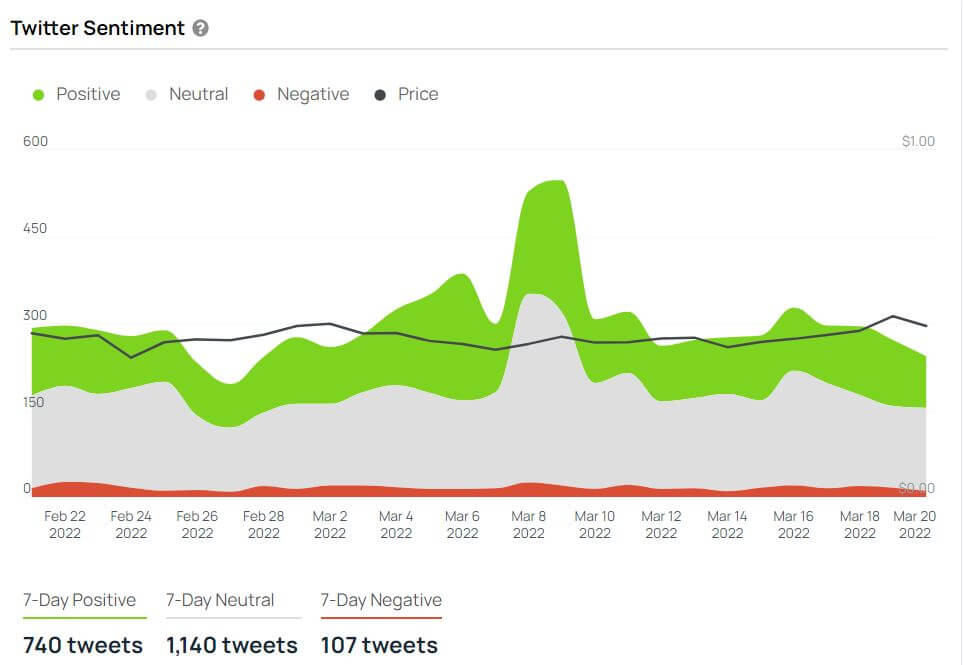
Also, at Cryptoslate analytics a spike in positive Twitter sentiment was detected for Ocean Protocol this week which further verifies the positive performance of the token.
Taking a closer look at the macro trend in this space and dissecting it with Cryptoslate data, readers will note that AI tokens overall have risen by 10% in the last 7 days. According to Cryptoslate data, the world of AI and Blockchain is heating up with a number of projects coming into the scene and driving awareness of different use cases for artificial intelligence in the world of blockchain.

Blockchains are designed to help trace and verify transactions. These transactions are loaded with data. As more of the world’s leading industries and brands adopt blockchain into their business models, harnessing the power of data will be of utmost importance, and ensuring the quality of that data will be a key function of the blockchain industry in the future. Ocean protocol has already developed a foundation within the data landscape and consistently supports data-led initiatives that use blockchain technologies to bring added value to layers of untapped, open-source data. They are recognized for maintaining support for the projects using their ecosystem and have earmarked 140M USD for grants within the OceanDAO.


Пов'язані матеріали

Claude Code Introduces Dynamic Workflows: Enabling AI to Form Teams and Collaborate

Claude Code introduces dynamic workflows, enabling AI to coordinate teams of specialized agents for complex tasks. This transforms Claude from a code assistant into a programmable workbench. Workflows address key limitations of single-agent systems: agentic laziness (premature task completion), self-preferential bias (favoring own outputs), and goal drift (losing sight of original objectives). The system allows Claude to dynamically create execution frameworks using JavaScript. It can split tasks, dispatch parallel agents for isolated work (e.g., in separate worktrees), implement adversarial validation, run tournaments, and synthesize results. This multi-agent approach is valuable for tasks requiring deep research, factual verification, code migration, root cause analysis, large-scale triage, and qualitative sorting. Key patterns include: classify-and-route, fan-out-and-synthesize, adversarial verification, generate-and-filter, tournaments, and loop-until-done. While token usage is higher, workflows excel where tasks resemble programming—needing problem decomposition, isolated context, hypothesis testing, and handling many details. They extend Claude Code's utility beyond technical work to areas like business plan review, resume screening, and naming brainstorm. The feature is not a universal solution but points to a future where AI tool competitiveness depends on organizing reliable, reusable, and auditable execution flows for complex goals.

marsbit8 хв тому

Claude Code Introduces Dynamic Workflows: Enabling AI to Form Teams and Collaborate

marsbit8 хв тому

Hyperliquid, Wall Street's 24/7 Trading Convenience Store

Hyperliquid: The 24/7 Trading "Convenience Store" for Wall Street Hyperliquid, a decentralized cryptocurrency exchange, has become a go-to platform for Wall Street traders seeking to trade around the clock, especially during traditional market closures. Founded by Jeff Yan, a former quantitative trader, after the FTX collapse, the platform emphasizes user self-custody of assets. It offers a wide range of perpetual contracts—leveraged derivatives with no expiry—on assets from Bitcoin and crude oil to the S&P 500 and even pre-IPO companies like SpaceX. A notable example involves a hedge fund trader who capitalized on geopolitical news over a weekend, securing a 243% return on oil derivatives before markets reopened. The platform, run by just 11 employees, generated approximately $800 million in revenue last year, and its native token HYPE has seen significant growth. Its rise highlights the merging of traditional finance and crypto. While U.S. users are currently restricted, recent CFTC rule changes could open access. The platform is known for its transparency, having processed $10 billion in liquidations during a market crash while competitors faltered. Regulators warn of the high risks and complexity of perpetual contracts for retail investors. Key to its appeal is a strong community culture, direct engagement with founders, and a simple interface. Despite rules against VPN use, it attracts global users with its permissionless approach. Hyperliquid plans to expand into prediction markets and options, aiming to eventually host all financial activity.

marsbit8 хв тому

Hyperliquid, Wall Street's 24/7 Trading Convenience Store

marsbit8 хв тому

Who Funds the Agents?

**Summary: Who Funds AI Agents?** OpenAI recently shut down a feature allowing AI agents to shop for users, highlighting the challenge of creating a secure and regulated environment for agent-driven transactions. While payment infrastructure exists, a crucial governance layer—defining spending limits, fraud detection, tax handling, and return policies—is largely missing. The potential is enormous: AI agents already processed $73M across 176M transactions last year, with McKinsey forecasting this could grow to $3-5T in global consumer commerce by 2030. The core competition isn't just about processing payments, which can be very cheap (especially with crypto-based settlement), but about controlling the rules that govern agent spending. Key players like Stripe and Coinbase are racing to dominate this governance layer. Stripe's acquisition of wallet provider Privy allows it to set spending policies, identity checks, and human-in-the-loop approvals directly at the wallet level. Similarly, Coinbase's stack, including its x402 protocol and AgentKit, embeds governance rules. This vertical integration across settlement, wallet, and governance layers is becoming the dominant strategy. Control over the governance layer is where significant future value lies. If agents handle trillions in transactions, even a small fee for managing compliance, fraud prevention, and policy enforcement could generate billions in annual revenue. The companies that successfully integrate across the payment stack will capture value from idle agent balances, transaction fees, and governance services, positioning themselves as the foundational banks of the AI agent economy.

marsbit35 хв тому

Who Funds the Agents?

marsbit35 хв тому

Торгівля

Спот
Ф'ючерси

Популярні статті

Як купити SNT

Ласкаво просимо до HTX.com! Ми зробили покупку Status Network Token (SNT) простою та зручною. Дотримуйтесь нашої покрокової інструкції, щоб розпочати свою криптовалютну подорож.Крок 1: Створіть обліковий запис на HTXВикористовуйте свою електронну пошту або номер телефону, щоб зареєструвати обліковий запис на HTX безплатно. Пройдіть безпроблемну реєстрацію й отримайте доступ до всіх функцій.ЗареєструватисьКрок 2: Перейдіть до розділу Купити крипту і виберіть спосіб оплатиКредитна/дебетова картка: використовуйте вашу картку Visa або Mastercard, щоб миттєво купити Status Network Token (SNT).Баланс: використовуйте кошти з балансу вашого рахунку HTX для безперешкодної торгівлі.Треті особи: ми додали популярні способи оплати, такі як Google Pay та Apple Pay, щоб підвищити зручність.P2P: Торгуйте безпосередньо з іншими користувачами на HTX.Позабіржова торгівля (OTC): ми пропонуємо індивідуальні послуги та конкурентні обмінні курси для трейдерів.Крок 3: Зберігайте свої Status Network Token (SNT)Після придбання Status Network Token (SNT) збережіть його у своєму обліковому записі на HTX. Крім того, ви можете відправити його в інше місце за допомогою блокчейн-переказу або використовувати його для торгівлі іншими криптовалютами.Крок 4: Торгівля Status Network Token (SNT)Легко торгуйте Status Network Token (SNT) на спотовому ринку HTX. Просто увійдіть до свого облікового запису, виберіть торгову пару, укладайте угоди та спостерігайте за ними в режимі реального часу. Ми пропонуємо зручний досвід як для початківців, так і для досвідчених трейдерів.

67 переглядів усьогоОпубліковано 2024.12.12Оновлено 2026.06.02

Як купити SNT

Обговорення

Ласкаво просимо до спільноти HTX. Тут ви можете бути в курсі останніх подій розвитку платформи та отримати доступ до професійної ринкової інформації. Нижче представлені думки користувачів щодо ціни SNT (SNT).

活动图片