[Key interpretation] BAND increased 70% of its main positions, and BTC's spot trading volume accounted for a sharp increase,

HuobiОпубліковано о 2022-11-04Востаннє оновлено о 2022-11-07

Анотація

BTC has a strong price elasticity and plans to make a breakthrough.

1. BTC continues to recover

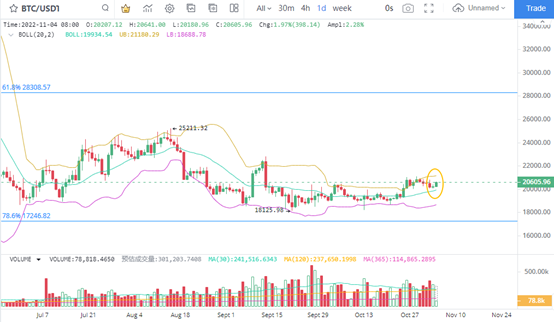
The daily K line chart shows that the BTC price started to rebound after reaching the middle track of the Bollinger Line, and the typical large-scale upward trend growth is confirmed. Recently, although the Federal Reserve has raised interest rates, it has little impact on BTC prices. Since the BTC's large-scale operation status has not changed much, the judgment of rebound remains unchanged. While paying attention to the short-term pressure level of $22500, pay attention to the large range rebound profit opportunity of $28308 above.
2. BTC Investors Focus on Spot Trading

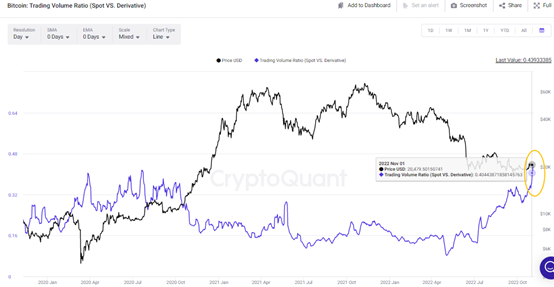
After the confirmation of BTC bottom was extended for a long time, the buying and selling enthusiasm of spot traders was also growing, which led to positive changes in BTC prices. From the change of the ratio between spot trading volume and contract trading volume, the value has reached 0.439 on November 3. After the ratio of spot trading volume to contract trading volume reached 0.082 on May 2, the current value has returned to a high of 0.439, which is higher than 0.41 in July 2021. This shows that the spot price has a low absorption trading opportunity, and investors tend to buy in the spot market rather than contract trading.
3. ETH support is effective

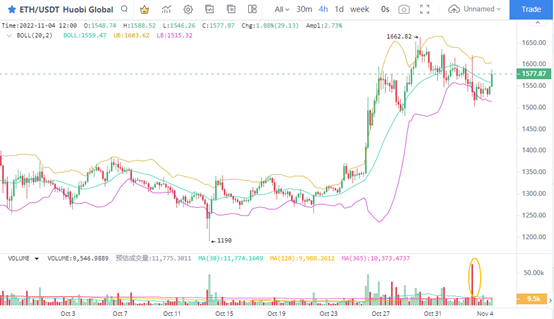
The 4-hour K line chart shows that the ETH price is in good shape. The recent price correction period saw a large volume on November 3, and the rebound period saw ETH hit below $1600. ETH rebounded and rose along with BTC price. At present, the contract position is still at a short-term low level, which can confirm that investors are still keen on spot trading, making ETH price have a strong foundation.
4. BAND soars and the main force escapes

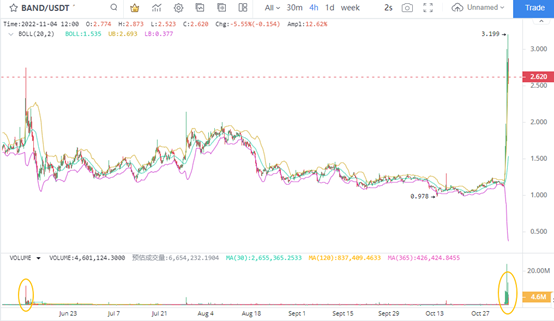
BAND has stabilized and recovered in the short term, and the price has risen rapidly. It only takes 28 hours to reach a maximum of $3.199 in the 4-hour K line. In terms of amplitude, BAND short-term fluctuation reached 183%. From the perspective of the main trading method, the price fluctuation of a large-scale test plate on June 9 reached 53%, while the price fluctuation on July 29 reached 35%, which is the second test plate. On November 3, the first 4-hour TULA BAND of the main force rose by 14%, so the next price rise will be more smooth.
5. Main position reduction of BAND

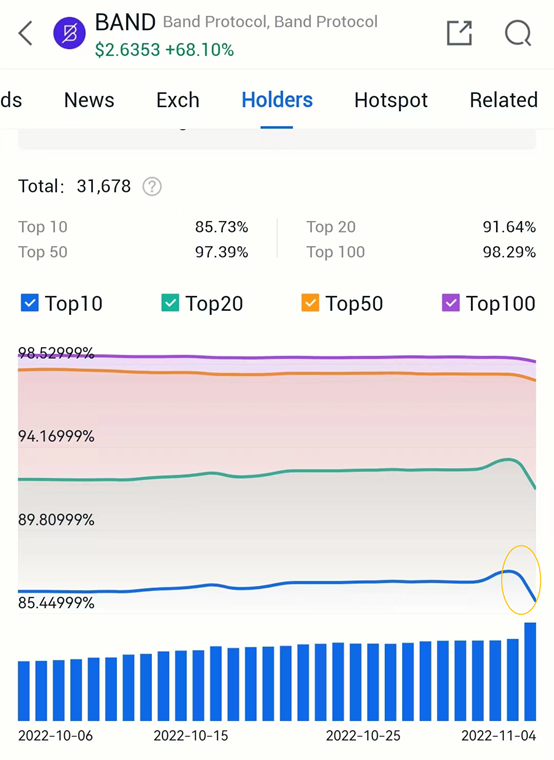
In fact, after the main force raised the price this time, it also prompted the shipping signal. The top 10 major holders of coins dropped from a short-term peak of 87.07% to a low of 85.73%. In terms of value, the top 10 major players in holding coins completed trading action by reducing positions by 1.34 percentage points. Therefore, the main force of this time is still characterized by price increase and position reduction. In particular, when BAND reached a peak value of more than $2.5, there was an obvious sign of large-scale position reduction.

Пов'язані матеріали

Soaring Over Tenfold Within the Year: The Frenzy Over SK Hynix Leveraged Products

South China Morning Post The leveraged ETF tracking SK Hynix has surged over tenfold year-to-date, fueled by intense market speculation on the memory chip sector. By June 22, the value of the 'South Korea 2x Long SK Hynix ETF' listed in Hong Kong had skyrocketed by more than 1,061% since the start of the year, while its asset size exploded over twenty times from the end of last year. The rally is driven by AI-driven demand for high-bandwidth memory (HBM), with SK Hynix recently sampling its next-generation HBM4E product. However, industry professionals warn of significant risks. Leveraged ETFs magnify both gains and losses. During a recent market correction, while the underlying SK Hynix stock fell 19.1%, its double-leveraged ETF dropped nearly 38%. Korean regulators noted that such products could theoretically lose 60% in a single day. Additionally, these ETFs face risks like time decay in volatile markets, liquidity spirals during mass redemptions, and extreme price dislocations from market-making failures, as seen in early June when an ETF moved opposite to its underlying stock. The trading is predominantly driven by retail investors, with institutional capital largely absent due to the products' high volatility. Analysts caution that with the semiconductor sector at elevated valuations and facing geopolitical and supply chain uncertainties, leveraged ETFs pose a substantial threat of amplified losses for uninformed investors.

marsbit59 хв тому

Soaring Over Tenfold Within the Year: The Frenzy Over SK Hynix Leveraged Products

marsbit59 хв тому

18 Months, Over 50x Surge: KIOXIA's Epic Comeback

KIOXIA, a NAND flash memory giant, staged a dramatic comeback driven by AI demand. After a period of significant losses, a failed merger, and missed HBM opportunities, its 2024 IPO began modestly. However, fueled by explosive demand for AI data storage, its stock price skyrocketed over 50 times within 18 months, making it Japan's most valuable company, surpassing Toyota. Its Q1 FY2026 profit guidance soared 30-fold year-over-year, with 2026 NAND capacity already sold out. Key to its success is its 3D NAND technology, BiCS FLASH. As the inventor of NAND, KIOXIA advanced its technology through generations, reaching over 200 layers by 2023. Key innovations include CBA (CMOS directly Bonded to Array), which separately manufactures control circuits and memory arrays for better performance, and OPS (On Pitch Select Gate) to increase density. The company is now developing high-capacity packages like an 8TB solution stacking 32 dies. Looking beyond NAND, KIOXIA is exploring 3D DRAM with its OCTRAM technology, using oxide semiconductor transistors for ultra-low leakage to reduce power consumption. This fundamental research differs from HBM and represents a long-term bet to extend its 3D expertise from NAND into future DRAM architectures. KIOXIA's story highlights how technological assets and shifting market cycles can rapidly transform a company's fortunes. While questions remain about sustaining growth beyond the current AI boom, its resurgence demonstrates that in semiconductors, being down does not necessarily mean being out.

marsbit1 год тому

18 Months, Over 50x Surge: KIOXIA's Epic Comeback

marsbit1 год тому

Market Trends in U.S. Stocks (June 23): Peak at Listing? SpaceX Loses Over $800 Billion in Three Days, Tech Stocks Experience Severe Internal Divergence

Stock Market Trends (June 23): Did SpaceX Peak at IPO? The company loses over $800 billion in market value in three days as a sharp divergence unfolds within the tech sector. SpaceX's post-IPO decline of over 20%, falling below its first-day close, reflects a swift market repricing. The catalyst is a clear shift in narrative from "AI platform potential" to concerns over rising capital costs, as its $8.57 billion IPO and subsequent $20 billion debt offering are earmarked for acquisitions and refinancing existing bridge loans rather than de-leveraging. While high-valuation tech stocks like Google, Meta, Amazon, and Microsoft faced pressure, Micron surged nearly 7% to a record high following a strategic supply deal with Anthropic for HBM and memory, highlighting robust, tangible demand in AI infrastructure. The broader market saw funds rotate into more defensive industrial and financial names. Macro factors included a dip in oil prices to a three-month low on news of a US-Iran framework deal, though logistical hurdles for resuming full Strait of Hormuz shipments remain. Key events ahead include Nvidia's shareholder meeting, Micron's earnings, and the May PCE inflation data. The latter will be crucial in determining whether the sell-off in high-valuation growth stocks, which appears to have just begun, will persist.

marsbit1 год тому

Market Trends in U.S. Stocks (June 23): Peak at Listing? SpaceX Loses Over $800 Billion in Three Days, Tech Stocks Experience Severe Internal Divergence

marsbit1 год тому

Interview with MicroStrategy CEO: Beyond the 32 BTC Selling Stir, 6 Trillion AI Agents are the Ultimate Endgame for Bitcoin

Interview with Strategy CEO: Beyond the 32 BTC Sale, 6 Trillion AI Agents are Bitcoin's Ultimate Endgame Strategy CEO Phong Le discusses the recent sale of 32 BTC, clarifying it was a minor, strategic move to demonstrate operational liquidity and internal process robustness to creditors and rating agencies, not a reaction to market fears. He emphasizes Strategy's disciplined, data-driven decision-making framework involving its board and complex financial modeling, distancing the company from centralized "black box" operations seen elsewhere in crypto. Le outlines the company's resilience and long-term focus, citing the "doing nothing" strategy during the 2022 bear market as a testament to its conviction in Bitcoin's underlying value proposition for global sovereignty and freedom. He reveals that generative AI was instrumental in developing their Stretch (STRC) preferred stock product, cutting development time from years to months. The most visionary part of the discussion centers on Agentic AI. Le envisions a future with 6 trillion autonomous AI agents conducting commerce, particularly in off-world environments like Mars, which would naturally adopt decentralized crypto rails and seek yield-bearing assets like Bitcoin as a core store of value. Finally, Le addresses the STRC product, expressing confidence it will return to its $100 par value through reserve replenishment and the initiation of dividend payments, and dismisses concerns about competition with stablecoins. He concludes by affirming Strategy's philosophy of expanding Bitcoin access through all available means, from self-custody to ETFs, to onboard the next wave of users.

marsbit1 год тому

Interview with MicroStrategy CEO: Beyond the 32 BTC Selling Stir, 6 Trillion AI Agents are the Ultimate Endgame for Bitcoin

marsbit1 год тому

Торгівля

Спот
Ф'ючерси
活动图片