Here’s What’s Keeping Ethereum From Taking Bitcoin’s Shine, ETH Claims $1,500

newsbtcОпубліковано о 2022-10-28Востаннє оновлено о 2022-10-31

Анотація

Ethereum is finally coming back to life after a long period of consolidation and leading the current bullish momentum in the crypto top 10 by market cap. The slow price...

Ethereum is finally coming back to life after a long period of consolidation and leading the current bullish momentum in the crypto top 10 by market cap. The slow price action might be boring for most market participants, but an expert believes ETH underwent a critical stage to create a lasting bottom.
At the time of writing, Ethereum (ETH) trades at $1,550 with sideways movement over today’s trading session and a 20% profit in the last seven days. The meme coin records a 30% profit over the same period. In the crypto top 10, ETH’s price performance is only surpassed by Dogecoin (DOGE).

Ethereum ETH ETHUSDT CHART 1

ETH’s price with bullish momentum on the daily chart. Source: ETHUSDT Tradingview Ethereum Close To Another Multi-Year Bottom?
Senior Commodity Strategist for Bloomberg Intelligence Mike McGlone believes Ethereum’s migration to a Proof-of-Stake (PoS) consensus will be crucial in its long-term appreciation. In the current macroeconomic landscape, high energy prices and high inflation have taken a toll on global markets.
The U.S. Federal Reserve (Fed) has tightened its monetary policy in response to this situation. As a result, Ethereum and other risk assets returned to their pre-pandemic levels.
Still, the second crypto by market cap has been unable to hold the line close to its 2017 all-time high at around $1,400 to $1,500. As McGlone emphasized, ETH’s price has prevented further downside at these levels despite the Fed implementing its most aggressive strategy in forty years.
In that sense, the expert believes Ethereum is cementing its position “at the epicenter of the digitalization of finance.” McGlone wrote:
(…) the No. 2 crypto may be forming a foundation around $1,000 (…). Our graphic shows the No.2 crypto potentially building a base around the 2018 peak, when global liquidity topped out around plus 14%. Ethereum appears at a discount within an enduring bull market (…).
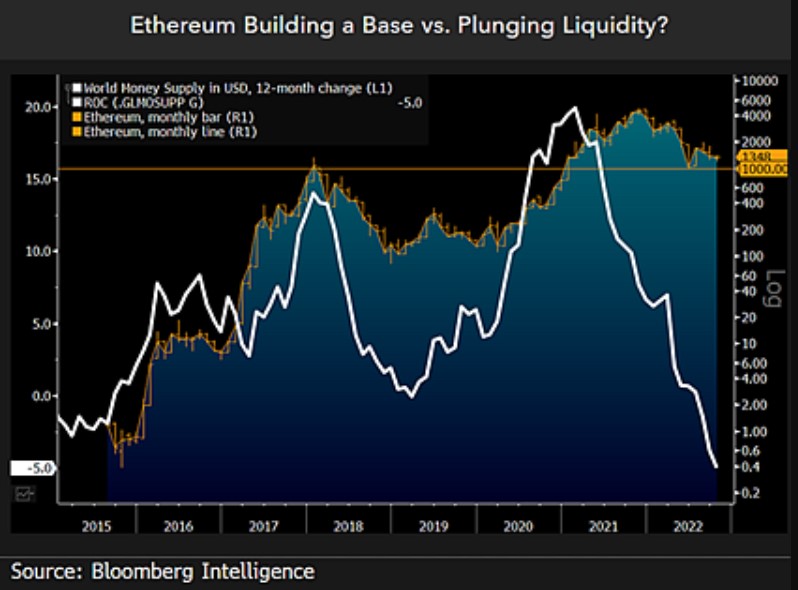
Ethereum ETH ETHUSDT Chart 2

Source: Mike McGlone via Twitter The Ultimate Deflationary Asset
If macroeconomic conditions improve and the Fed pivots its monetary approach, Ethereum might finally reclaim previously lost territory and steal Bitcoin’s thunder. The expert hints at a faster decline in the supply of ETH versus BTC.
Rising demand for digital assets and a decline in supply will prove positive for the second crypto by market cap. McGlone wrote:
(…) new Ethereum supply shrinking more quickly after a protocol change that began moving coins from circulation in August 2021 and this year’s merge. The 52-week rate-of-change in the number of new Ethereum coins from Conmetrics vs. the total outstanding has fallen under 2% and is on path to drop below that of Bitcoin.

Ethereum ETH ETHUSDT Chart 3

Source: Mike McGlone via Twitter Tags: ETHethereumETHUSDThttps://www.newsbtc.com/tag/ethusdt/

Пов'язані матеріали

The Disappearing Buy Button

"The Vanished 'Buy' Button" In June 2026, major Chinese online brokers Futu and Tiger were barred from allowing mainland Chinese users to purchase or deposit funds for US stocks, following a multi-department regulatory crackdown. This move, part of China's long-standing capital controls, aims to stem the outflow of domestic capital to support the development of local technology sectors, particularly in AI, where China perceives itself to be lagging. The restriction highlights a growing divergence between national economic strategy and individual investor needs. With slowing wage growth and a deflating property market, Chinese retail investors saw US tech stocks—which dominate global indices and capture a quarter of global economic growth—as a crucial avenue for wealth preservation. Domestically, the A-share market has only recently seen its technology sector surpass the long-dominant financial sector in index weight, reflecting a state-directed shift toward "new quality productive forces." The crackdown mirrors past actions against cryptocurrencies and tech deals, prioritizing financial stability and onshore control. It also aims to funnel liquidity and listings to Hong Kong and mainland exchanges to retain economic sovereignty. This regulatory gap creates an opportunity for decentralized finance. The emerging narrative shifts from "banking the unbanked" to "brokering the unbrokered"—using crypto and tokenized real-world assets (RWAs), like stocks, to provide global access to productive assets for those excluded by traditional finance, from Chinese散户 to users in other restricted markets. Simultaneously, the AI era is reshaping global capital flows. US tech giants act as "macro hedge funds," issuing cheap foreign-currency debt to fund expansion, leveraging their superior credit. However, non-US AI supply chain players (e.g., in semiconductors) are also rising. The competition for asset ownership and low-cost financing rights is intensifying, making access to capital a new societal divide as AI devalues routine intellectual labor. Finance remains in the "business of hope," but its gates are being redrawn.

marsbit6 хв тому

The Disappearing Buy Button

marsbit6 хв тому

According to Strategy, MSTR Has Delivered an Annual Return of 42% Since Adopting the 'Bitcoin Standard,' Even Though Its Treasury Is Underwater

According to Strategy (formerly MicroStrategy) Executive Chairman Michael Saylor, the company's stock MSTR has delivered a 42% annualized return since August 10, 2020, when it adopted its "Bitcoin standard" strategy. This performance surpasses that of Bitcoin itself, the "Magnificent Seven" tech stocks, and the S&P 500 over the same period. Saylor frequently highlights this to demonstrate the success of transforming the software firm into a leveraged Bitcoin investment vehicle. Despite this strong long-term stock performance, Strategy's core Bitcoin treasury position is currently at a loss. As of July 29, the company holds 843,775 BTC, purchased for an average of $75,476 per coin, implying an unrealized loss of approximately $11.4 billion. The disparity arises because MSTR stock acts as a leveraged proxy for Bitcoin, allowing for high annualized returns over a multi-year period even when recent purchases are underwater. To address its increasingly complex capital structure, which now includes multiple classes of preferred stock, Strategy introduced a new reporting framework on July 24. Key metrics include "Net BTC per Share," "$BTC Hurdle ARR" (the annual Bitcoin yield needed to cover financing costs), and "$BTC Floor ARR" (the minimum yield to maintain a sustainable leverage ratio). The company continues to accumulate Bitcoin and recently bolstered its dollar reserves by $525 million to strengthen coverage for preferred stock dividends.

cryptonews.ru7 хв тому

According to Strategy, MSTR Has Delivered an Annual Return of 42% Since Adopting the 'Bitcoin Standard,' Even Though Its Treasury Is Underwater

cryptonews.ru7 хв тому

Base Launches 'Human Verification', Is the Airdrop on the Agenda?

Base has launched "Base Verify Onchain," a new verification mechanism aimed at solving the problem of Sybil attacks and duplicate participation in on-chain activities like airdrops, rewards, voting, or minting. While blockchains can track wallet addresses, they cannot determine if multiple wallets belong to the same person. The system works by connecting off-chain identity verification with on-chain smart contract rules. Developers can set specific eligibility criteria in their contracts (e.g., requiring a verified X account or a Coinbase One membership). Users connect their wallet and sign a message, which is sent to Base Verify's off-chain service. This service checks if the user meets the pre-set conditions against verified credentials. If they do, it issues a short-lived cryptographic proof containing an identityHash. The application then submits this proof to the smart contract. The contract verifies the proof's validity, checks expiration, and crucially, uses the identityHash to ensure the same verified identity cannot participate more than once, even if using a different wallet address. This identityHash is unique per application contract, preventing cross-application tracking. Base Verify Onchain is positioned as a tool for reliably enforcing participation rules ("who" and "how many times") in specific on-chain scenarios. It is not a general identity system or KYC solution. Its announcement has sparked speculation about a potential future Base token airdrop, for which this tool could be used to prevent abuse. However, Base has previously stated that work on a network token is still in early exploration stages.

marsbit22 хв тому

Base Launches 'Human Verification', Is the Airdrop on the Agenda?

marsbit22 хв тому

Торгівля

Спот
活动图片