[Special attention] Is there no pressure for APTOS price rise? Let's see the analysis

HuobiОпубліковано о 2022-10-27Востаннє оновлено о 2022-10-28

Анотація

After APTOS was launched into the mainstream exchanges, the market performance was strong and a breakthrough was planned.

The valuation of the public chain Aptos will reach 2.75 billion dollars if it is not online. The goal of the public chain Aptos is to build a scalable, secure, trusted and scalable smart contract platform.

Unlike Ethereum, which focuses on decentralization and security, Solana extends its performance to the extreme. Aptos tries to find a more balanced position between the two.

With the launch of the main network Aptos Autumn on October 17, the head exchanges simultaneously support the online trading of APT. The Layer1 public chain project APTOS expects that the TPS can reach 160000, and the project ushers in a period of rapid development.

It is worth noting that APTOS is an L1 blockchain, aiming to become the most secure and scalable blockchain in history. At the same time, Aptos was developed by former Meta employees, and its own popularity has become the focus of recent market attention. Of course, the core of its technological innovation is Move, which is based on Rust and can be said to be the fastest network application programming language in the world.

1. Price performance

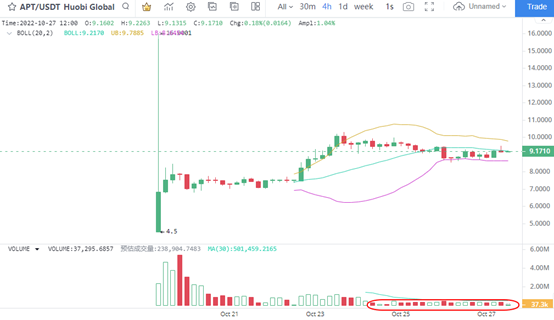
On October 19, after APTOS was listed and traded in Huabi Global, its price showed a strong performance. After rebounding from the daily level of $7.31, the price rose to the highest level of $10.29.
2. TVL value recovery

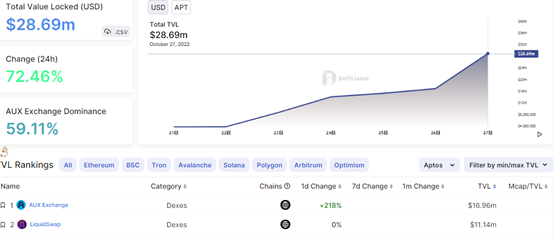
After APTOS was listed on the main exchange, its TVL on the chain also increased rapidly. According to the data on October 27, the data on the APTOS chain showed that there was a locked position worth US $28.69 million, an increase of 726% compared with the 3.47 million on October 21. Among them, AUX Exchange and LiquidSwap have the largest lock positions, reaching 16.96 million US dollars and 11.14 million US dollars, accounting for 97.9% of the total.
3. Aptos Token Economics

At 15:37 Taiwan time, Aptos officially announced its token economy overview on Twitter. The initial total supply of APT was 1 billion. The detailed token allocation is as follows:

Community:

51.02%, 510217359767 (510 million) pieces

Core contributors:

19.00%, 1900000000000 (190 million) pieces

Aptos Foundation:

16.50%, 165000000000 (165 million) pieces

investor:

13.48%, 134782640233 (134 million) pieces

Some 410217359767 (410 million) APTs of the community are held by the Aptos Foundation, and the remaining 100000000 (100 million) APTs are held by Aptos Labs.

In addition, the Aptos Foundation will distribute 410 million tokens within ten years in three types of situations:

125000000 APT (125 million) for ecosystem projects, grants and other community growth plans in support of community categories

5000000 APT to support Aptos Foundation's programs for foundation categories

The remaining 1/120 part of the community and foundation allocated is expected to be unlocked linearly every month in the next 10 years

The number of tokens held by investors is relatively small, accounting for 13.48% of the total number of tokens held, which is 134 million APTs.

From the perspective of the holding time of token holders, the lock in period of core contributors and investors is 4 years.

From the launch of the main network, all investors and current core contributors have a four-year unlocking period. The detailed unlocking conditions are as follows: no $APT will be unlocked in the first 12 months;

3/48 APTs will be unlocked every month from the 13th month to the 18th month (including the 18th month) after the release of the main website;

After the 19th month after the release of the main website, 1/48 APTs will be unlocked every month;

All APT tokens will be fully unlocked four years after the main network is launched.

Therefore, judging from the selling pressure, the market selling pressure of APT has not changed much since the launch of APT in major exchanges recently. In terms of trading volume, APT's trading volume after October 24 was in a shrinking state, which means that APT's price performance was relatively stable. From October 19 to October 24, APT continued to rise in volume, with the closing price rising by 9.32%. After the short-term shrinkage is over, we can continue to focus on low absorption opportunities and wait for the price to break through.

Пов'язані матеріали

Raised $1.3 Billion in Seven Weeks, Yet SpaceX's Weighting Halved: The Dilution Trap of the NASA ETF

A new ETF named NASA, launched just seven weeks ago, has rapidly become the world's largest space-themed fund, amassing $1.3 billion in assets. Its primary draw is its unique position as a "pure" space ETF holding SpaceX stock through a special purpose vehicle (SPV). However, its exposure to SpaceX has been drastically diluted from 10.3% to 4.6% due to a massive, rapid inflow of investor cash. New money is forced into buying other public space stocks like Rocket Lab, meaning investors seeking SpaceX exposure end up with a portfolio of other companies. Further complications arise from the SPV's valuation mechanism, which only updates during specific manager trades, potentially lagging behind SpaceX's market price. This SPV will also face a six-month lock-up post-IPO, preventing investors from selling that portion if SpaceX shares drop after listing. The article highlights a valuation bubble in the broader space sector, with stocks like Planet Labs surging nearly 1000% in a year, driven more by the "SpaceX IPO narrative" than underlying fundamentals. Meanwhile, SpaceX's own financials show significant losses in 2024, and its record-breaking IPO valuation bundles its space business with other Musk assets like xAI, creating a complex investment proposition. The core warning is that the NASA ETF essentially uses SpaceX as bait but delivers a different product. The real beneficiaries may be the ETF issuers collecting high fees, while investors face dilution and hidden risks ahead of SpaceX's historic IPO on June 12th.

marsbit10 хв тому

Raised $1.3 Billion in Seven Weeks, Yet SpaceX's Weighting Halved: The Dilution Trap of the NASA ETF

marsbit10 хв тому

NEAR Doubles: 3 Major Trends Become the 'Engine' for Token Price Surge

NEAR token price surged from around $1.24 in early May to over $2.5, with its market cap returning above $3 billion. This significant growth, occurring amidst broader market volatility, is attributed to three key factors. First, the AI narrative has been a major driver. NEAR co-founder Illia Polosukhin is a co-author of the seminal Transformer paper, the foundation of modern AI models like ChatGPT. NEAR has integrated AI capabilities into its ecosystem, notably through the Near.com super-app, positioning itself as a key decentralized AI infrastructure project. Endorsements from figures like Arthur Hayes further boosted market sentiment. Second, NEAR is enhancing its utility as a privacy-focused blockchain. With the launch of NEAR Intents for cross-chain transactions, privacy features like Confidential Payments and Confidential Intents have become critical to protect users from MEV attacks. These functionalities allow private transfers of assets like ETH and BTC across more than 35 chains, balancing privacy with usability and appealing to institutional and enterprise users. Third, a new tokenomics mechanism is providing buy-side pressure. Following the full unlocking of its initial supply in late 2025, NEAR now employs a fee-burn model. All protocol fees generated by the NEAR Intents layer are used to buy back and effectively remove NEAR tokens from circulation. With NEAR Intents TVL exceeding $80 million, this creates consistent monthly buybacks estimated around $3 million, reducing sell pressure. Additional technical upgrades planned for mid-2026, including dynamic re-sharding and post-quantum security, aim to further strengthen the network's scalability and robustness.

marsbit13 хв тому

NEAR Doubles: 3 Major Trends Become the 'Engine' for Token Price Surge

marsbit13 хв тому

After $HYPE Hits a New High, Is It Worth Considering the Stock of "HYPE Version MicroStrategy" $PURR?

**HYPE Hits New Highs: Is $PURR, the "HYPE Version of MicroStrategy," Worth Considering?** The stock of Hyperliquid Strategies (NASDAQ: $PURR), a publicly-traded company that exclusively buys and holds the cryptocurrency HYPE, has gained over 100% year-to-date, mirroring HYPE's own 150% surge to new all-time highs. This has sparked discussions about PURR being a more "capital-efficient" play than MicroStrategy's bitcoin strategy, given its reported ~$1 billion unrealized gain on a ~$220 million investment. The article clarifies that PURR is essentially a pure-play wrapper for HYPE, with no other business. It resulted from a 2025 SPAC merger led by firms like Paradigm and Atlas Merchant Capital, bringing traditional finance veterans to its board. Its value is entirely derived from the price of HYPE. While PURR offers a crucial compliance bridge for US-based institutional and retirement accounts unable to access HYPE directly, the analysis questions the "capital efficiency" narrative. The outsized gains are attributed to HYPE's exceptional performance, not superior corporate strategy. For investors who can buy HYPE directly, holding PURR introduces unnecessary risks: potential shareholder dilution from future stock offerings, incomplete passthrough of staking rewards, market hour mismatches, and counterparty risk via its single custodian. A key metric is its mNAV (modified net asset value). Current calculations show PURR trades at a discount to its HYPE holdings, but this could flip to a premium depending on the execution of registered share issuances. The article concludes that PURR is primarily a "conduit product." The investment thesis hinges entirely on one's bullishness on HYPE itself, not on the PURR wrapper, which adds friction and risk for those with direct crypto access.

marsbit42 хв тому

After $HYPE Hits a New High, Is It Worth Considering the Stock of "HYPE Version MicroStrategy" $PURR?

marsbit42 хв тому

The Real Progress and Investment Opportunities of Decentralized AI Computing Power Networks in 2026

In 2026, the AI compute market is marked by centralized GPU consolidation and a significant GPU shortage for smaller players. In this context, Decentralized Physical Infrastructure Networks (DePIN), valued at $9.4B+, have emerged as a viable, revenue-generating alternative. Leading protocols like Aethir ($150M ARR), io.net (130k+ GPUs), Akash, Bittensor, and Render are carving out distinct niches, moving beyond hype to deliver verifiable income primarily from non-crypto-native clients. The key advantage of decentralized GPU networks lies in serving latency-tolerant, cost-sensitive workloads like AI inference, fine-tuning, data preprocessing, and agent operations, offering substantial cost savings (45-80%) compared to major cloud providers. However, reliability variance, lack of robust SLAs, and fragmented tech stacks remain significant adoption hurdles. The sector is maturing with critical 2026 shifts: 1) Evolution of tokenomics towards demand-driven, revenue-linked models (e.g., Render's BME, io.net's IDE), and 2) Clearer enterprise adoption pathways, with traditional firms integrating decentralized compute. For new entrants, opportunities are now concentrated in specialized tooling layers (orchestration, verification, SLA management), vertical applications (e.g., bio-med, content generation), and innovative token designs tied to real usage, rather than generic GPU aggregation. The convergence with the emerging AI Agent economy presents a significant future growth vector.

marsbit43 хв тому

The Real Progress and Investment Opportunities of Decentralized AI Computing Power Networks in 2026

marsbit43 хв тому

Торгівля

Спот
Ф'ючерси
活动图片