DeFi TVL Finally Recovers, Algorand Hits New ATH

u.todayОпубліковано о 2022-10-18Востаннє оновлено о 2022-10-18

Анотація

According to data provided by the leading decentralized finance (DeFi) total value locked (TVL) aggregator DeFi Llama.

According to data provided by the leading decentralized finance (DeFi) total value locked (TVL) aggregator DeFi Llama, the TVL in DeFi protocols has rebounded to the $54 billion mark.
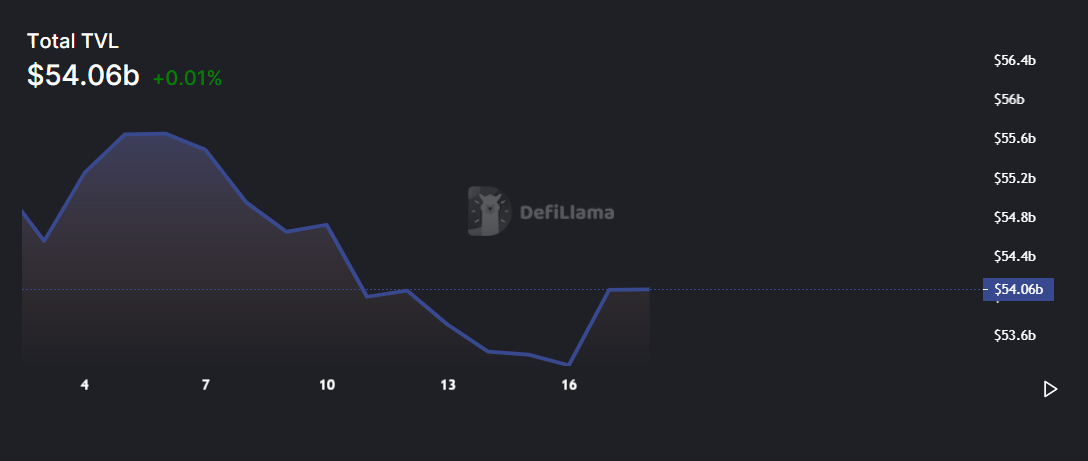
DeFi TVL - Source: DeFi Llama

Source: DeFi Llama Per the data, the total TVL was down — between $53.7 and $53.29 billion — since Oct. 12. It’s important to note that in September, the TVL was down to $52.22 billion, the lowest since March 2021.
Currently, the largest DeFi protocol across all chains remains the Ethereum-based MakerDAO with a market dominance of 14.48% and $7.83 billion TVL. 
Algorand hits new all-time highs
The young proof-of-stake (PoS) blockchain Algorand — initially released in 2019 — just hit an all-time high (ATH) of $275.15 million, according to DeFi Llama data. 
Furthermore, the top DeFi protocol in Algorand, called Algofi, saw a nearly 33% increase in its TVL in the past 30 days. According to DeFi Llama data, Algofi has a 48% market dominance with a TVL of roughly $133 million.
The new milestone has also affected Algorand’s native utility token ALGO, giving it a roughly 3% push to the upside. ALGO is trading at $0.33 at the time of writing, according to CoinMarketCap Data.
Last week, Solana’s (SOL) TVL dropped 12.5% to $1.1 billion due to the Mango hack, according to a U.Today report. The numbers are still declining. Solana’s TVL has now plunged to $928 million, per DeFi Llama data.


Трендові криптовалюти

Пов'язані матеріали

The Computing Power Dilemma in the Sino-US AI Rivalry

The Sino-US AI rivalry faces a fundamental bottleneck: the widening compute power gap. While Chinese AI chip companies have seen investment surges, their current focus remains largely on the less demanding inference market. The real challenge lies in the high-end training chip sector, crucial for developing cutting-edge large language models (LLMs), where Nvidia holds a near-monopoly. The compute disparity is stark. US tech giants like Meta, Google, and xAI command massive GPU clusters, enabling them to train trillion-parameter models rapidly. Estimates suggest US data center count and total compute capacity significantly outstrip China's. This "brute force" advantage allows for faster model iteration and exploration of larger parameter scales, with top US models reportedly leading their Chinese counterparts by 8 to 15 months. Chinese alternatives, such as Huawei's Ascend and others from companies like Moore Thread and Biren, are emerging. They show promise in inference and some training scenarios, closing the performance gap with mid-range Nvidia products. However, the core hurdle extends beyond raw chip performance to the entrenched software ecosystem, exemplified by Nvidia's CUDA platform. The path forward involves "walking on two legs": navigating import restrictions while heavily investing in the domestic chip industry. Though still in a catch-up phase, China's vast market, talent pool, and capital are fostering progress. The ultimate test is whether Chinese firms can build a competitive hardware-software ecosystem to power the next generation of AI.

marsbit8 хв тому

The Computing Power Dilemma in the Sino-US AI Rivalry

marsbit8 хв тому

He Kaiming's Team's New Work: After Deleting VAE and Private Data, Text-to-Image Generation Becomes Even Stronger

KaiMing He's team introduces **MiniT2I**, a minimalist text-to-image (T2I) model that challenges the complexity of mainstream approaches. It eliminates components commonly considered essential: the VAE encoder-decoder, AdaLN conditioning mechanisms, auxiliary losses, private training data, and post-training alignment stages like RL/DPO. Instead, it uses a pure flow-matching objective trained directly on RGB pixels. The model employs a simplified **MM-JiT** Transformer architecture. It removes AdaLN blocks for conditioning and instead prepends two lightweight text adapter blocks to a standard pre-norm Transformer, allowing frozen T5 text features to adapt to the denoiser. Training follows a two-stage, LLM-like paradigm using only public datasets: pre-training on LLaVA-recaptioned CC12M for coverage, followed by fine-tuning on ~120k high-quality image-text pairs. With just 258M parameters (B/16), MiniT2I achieves competitive scores (0.87 on GenEval, 84.2 on DPG-Bench), outperforming larger pixel-space models. Scaling to 912M parameters (L/16) yields results comparable to SD3-Medium (~2B parameters) in style, composition, and imagination, though it lags in text rendering and named entities due to public data limitations. Key advantages include lower computational cost (~570 GFLOPs vs. ~1379 for latent models) and architectural simplicity. Acknowledged limitations include patch boundary artifacts in pixel space, side effects of high CFG scales, resolution ceilings for sequences longer than 1024 tokens, and the aforementioned data bottlenecks. The work demonstrates that high-performance T2I generation is possible with a radically simplified, publicly reproducible baseline.

marsbit12 хв тому

He Kaiming's Team's New Work: After Deleting VAE and Private Data, Text-to-Image Generation Becomes Even Stronger

marsbit12 хв тому

The Insurance Industry Faces Its Biggest Competitor: Are Prediction Markets the "Barbarians at the Gate"?

The insurance industry, long a stable "ballast" in the economy, may face a significant challenge from the rise of prediction markets, which are beginning to function as a new form of risk hedging and insurance. Platforms like Kalshi and Polymarket are demonstrating their utility in areas traditionally dominated by insurers. Examples include Kalshi's partnership with sports insurance broker Game Point Capital to offer more cost-effective hedging for NBA team performance bonuses, and Polymarket's collaboration with real estate platform Parcl, allowing users to hedge against housing price fluctuations in major US cities. A New York bar also used Kalshi to hedge a marketing promotion tied to an NBA game outcome, highlighting prediction markets' potential for small business risk management. These markets offer advantages over traditional insurance and sports betting in transparency, liquidity, and flexibility. They allow information monetization across a wider range of events, act as neutral platforms rather than direct counterparties, and provide clearer pricing. A historical precedent is the "Mattress Mack" marketing campaigns, which used sports betting for large-scale customer refunds, but prediction markets offer a more systematic and accessible model. Experts like SIG CEO Jeff Yass see their potential for efficient, parameter-based risk sharing, such as for weather-related property damage. However, challenges remain, including liquidity issues, unclear regulatory boundaries, and potential manipulation of event outcomes. Despite these hurdles, prediction markets represent a growing competitive force for both traditional gambling platforms and segments of the insurance industry.

marsbit13 хв тому

The Insurance Industry Faces Its Biggest Competitor: Are Prediction Markets the "Barbarians at the Gate"?

marsbit13 хв тому

Insurance Industry Faces Its Biggest Competitor: Are Prediction Markets the 'Barbarians at the Gate'?

"Insurance Industry Faces New Rival: Are Prediction Markets the 'Barbarians at the Gate'?" Prediction markets, exemplified by platforms like Kalshi and Polymarket, are emerging as potential disruptors to the traditional insurance industry by offering alternative risk-hedging mechanisms. These markets allow users to bet on specific event outcomes, effectively creating a form of customizable, on-demand insurance. Key examples highlight this shift. In sports, Kalshi partnered with insurance broker Game Point Capital to provide NBA teams with more affordable options to hedge performance bonuses compared to traditional insurers. In real estate, Polymarket's collaboration with Parcl lets users speculate on city-specific housing price indices, allowing homeowners to hedge against price drops or buyers against price increases. Furthermore, businesses like a New York bar have used Kalshi to hedge marketing promotions (e.g., offering free drinks if a team wins), framing the transaction explicitly as placing a "hedge." The article argues prediction markets offer advantages over traditional insurance and even sports betting in transparency, liquidity, and flexibility. They provide a wider range of event coverage, act as neutral platforms rather than counterparties, and offer clearer pricing. The piece cites historical precedents like large "refund promotion" hedges by businesses using sportsbooks but notes prediction markets modernize the concept. However, challenges remain for widespread adoption as an insurance alternative, including limited liquidity in some markets, unclear regulatory status, and potential vulnerabilities in event resolution mechanisms. Despite these hurdles, prediction markets are positioning themselves as new tools for risk management, directly challenging certain segments of the conventional insurance landscape.

Odaily星球日报19 хв тому

Insurance Industry Faces Its Biggest Competitor: Are Prediction Markets the 'Barbarians at the Gate'?

Odaily星球日报19 хв тому

Торгівля

Спот
Ф'ючерси

Популярні статті

Як купити ALGO

Ласкаво просимо до HTX.com! Ми зробили покупку Algorand (ALGO) простою та зручною. Дотримуйтесь нашої покрокової інструкції, щоб розпочати свою криптовалютну подорож.Крок 1: Створіть обліковий запис на HTXВикористовуйте свою електронну пошту або номер телефону, щоб зареєструвати обліковий запис на HTX безплатно. Пройдіть безпроблемну реєстрацію й отримайте доступ до всіх функцій.ЗареєструватисьКрок 2: Перейдіть до розділу Купити крипту і виберіть спосіб оплатиКредитна/дебетова картка: використовуйте вашу картку Visa або Mastercard, щоб миттєво купити Algorand (ALGO).Баланс: використовуйте кошти з балансу вашого рахунку HTX для безперешкодної торгівлі.Треті особи: ми додали популярні способи оплати, такі як Google Pay та Apple Pay, щоб підвищити зручність.P2P: Торгуйте безпосередньо з іншими користувачами на HTX.Позабіржова торгівля (OTC): ми пропонуємо індивідуальні послуги та конкурентні обмінні курси для трейдерів.Крок 3: Зберігайте свої Algorand (ALGO)Після придбання Algorand (ALGO) збережіть його у своєму обліковому записі на HTX. Крім того, ви можете відправити його в інше місце за допомогою блокчейн-переказу або використовувати його для торгівлі іншими криптовалютами.Крок 4: Торгівля Algorand (ALGO)Легко торгуйте Algorand (ALGO) на спотовому ринку HTX. Просто увійдіть до свого облікового запису, виберіть торгову пару, укладайте угоди та спостерігайте за ними в режимі реального часу. Ми пропонуємо зручний досвід як для початківців, так і для досвідчених трейдерів.

333 переглядів усьогоОпубліковано 2024.12.11Оновлено 2026.06.02

Як купити ALGO

Обговорення

Ласкаво просимо до спільноти HTX. Тут ви можете бути в курсі останніх подій розвитку платформи та отримати доступ до професійної ринкової інформації. Нижче представлені думки користувачів щодо ціни ALGO (ALGO).

活动图片