Here’s a Realistic Worst Case Scenario for Bitcoin and Crypto, According to Analyst Jason Pizzino

dailyhodlОпубліковано о 2022-10-12Востаннє оновлено о 2022-10-13

Анотація

A popular crypto strategist is mapping out where Bitcoin (BTC) and the rest of the...

A popular crypto strategist is mapping out where Bitcoin (BTC) and the rest of the crypto markets may bottom out in a worst case scenario.
In a new strategy session, Jason Pizzino tells his 276,00 YouTube subscribers that it is within the realm of possibility for the total market capitalization of crypto assets to lose another 40% of its value even after this year’s deep correction.

“So for the realistic zone probably somewhere around an 80% – 82% drop brings us down to about $550 billion, and if we’re looking anything in the middle, sure you can take your $600 or $700 billion. Currently, we’re down 74% to the [June] low of $762 billion.
So for a drop from where we currently are back to the low of [$762] billion, that’s about a 14% drop for the total cryptocurrency market cap. That can be quite significant. Maybe you’re going to see 10% off Bitcoin, 20% off ETH and throw another several percent on the rest of the market… That’s very realistic. 
Somewhere to the bottom of that range ($550 billion) is about a 40% drop from where we currently are.”
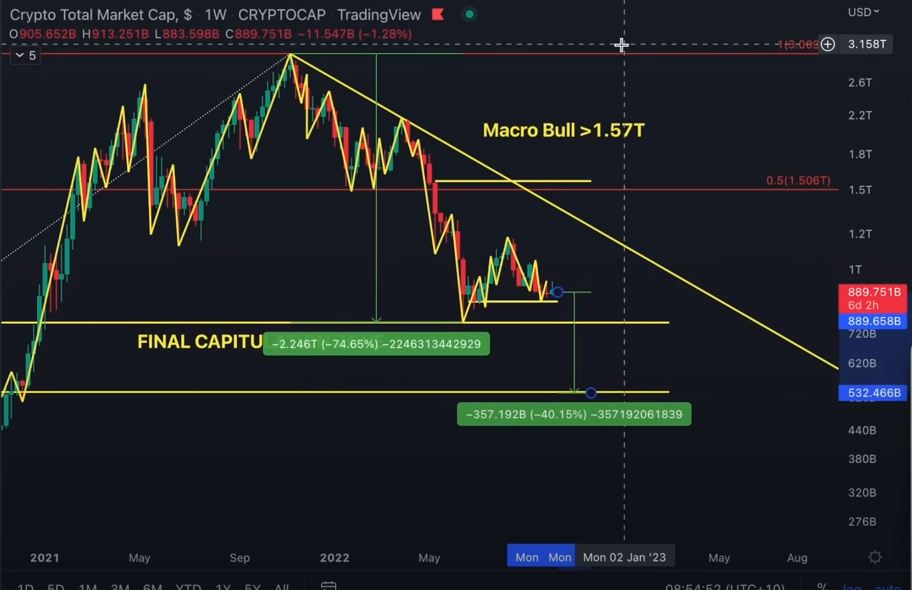
Source: Jason Pizzino/YouTube At time of writing, the total crypto market cap stands at about $887 billion.
As for Bitcoin, Pizzino says a drop of a similar magnitude would drive BTC down to levels last seen in July 2020.
“Would it even be possible for Bitcoin to drop 40%? From the current price to significant support levels at about $11,000 – $11,500, which is our bottom of the cycle buy zone, that’s your 40% drop… So it is within a realistic view.”
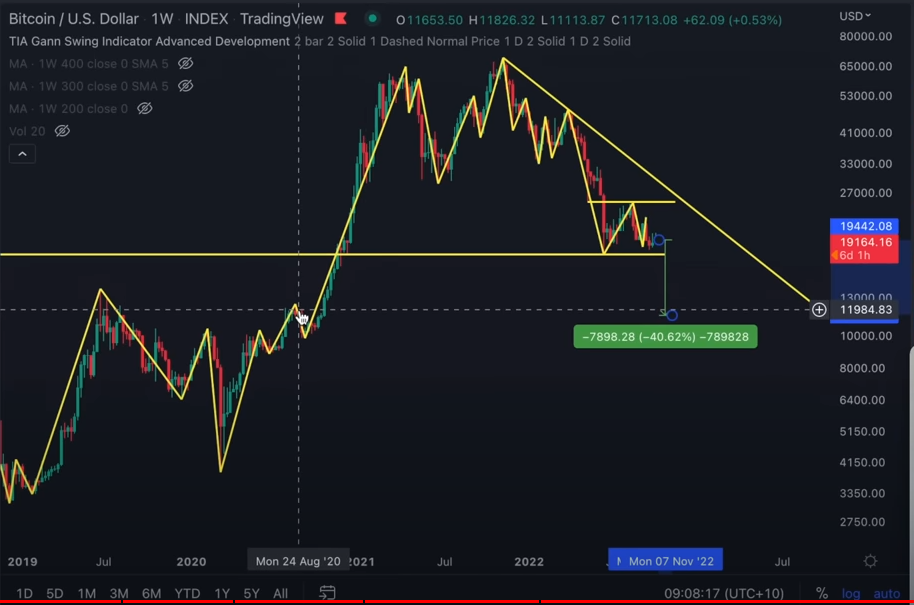
Source: Jason Pizzino/YouTube Looking at Ethereum (ETH) challenger Cardano, Pizzino says that an even deeper correction is conceivable for ADA considering that the smart contract platform almost lost all of its value during the 2018 bear market.
In a worst-case scenario, the analyst sees ADA plummeting all the way down to $0.17.
“Previous cycle for ADA, it’s been down 98%, so it’s not really unrealistic to think that this could go even further to my downside target, maybe 94% – 95% down from the top, which is still less that the previous cycle.”
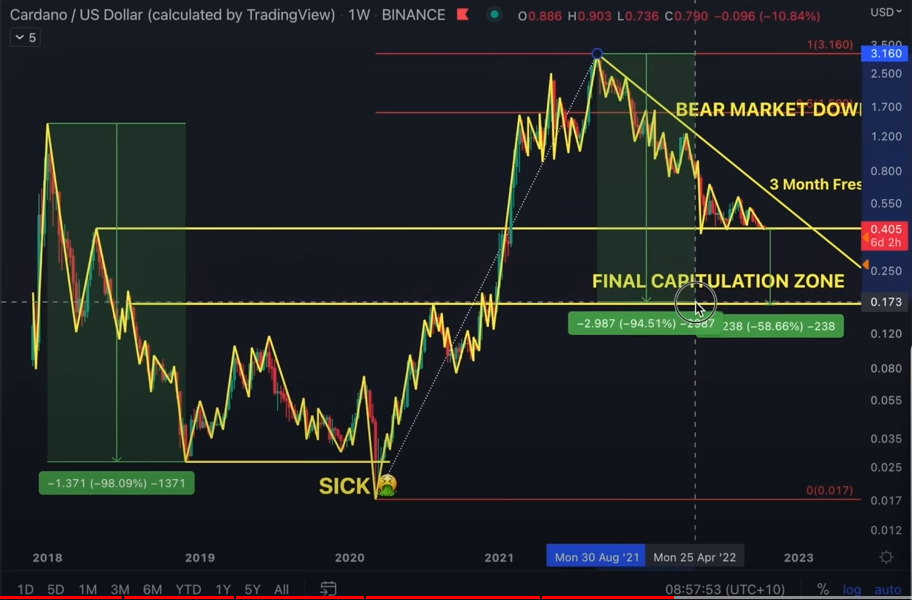
Source: Jason Pizzino/YouTube At time of writing, Cardano is swapping hands for $0.39.
The trader also has his eye on Solana (SOL), which he says could plunge below $20 if the crypto markets lose 40% of its value. Pizzino also says it’s possible for Solana to follow the footsteps of Cardano and wipe out about 60% of its market capitalization, taking SOL to as low as $12.
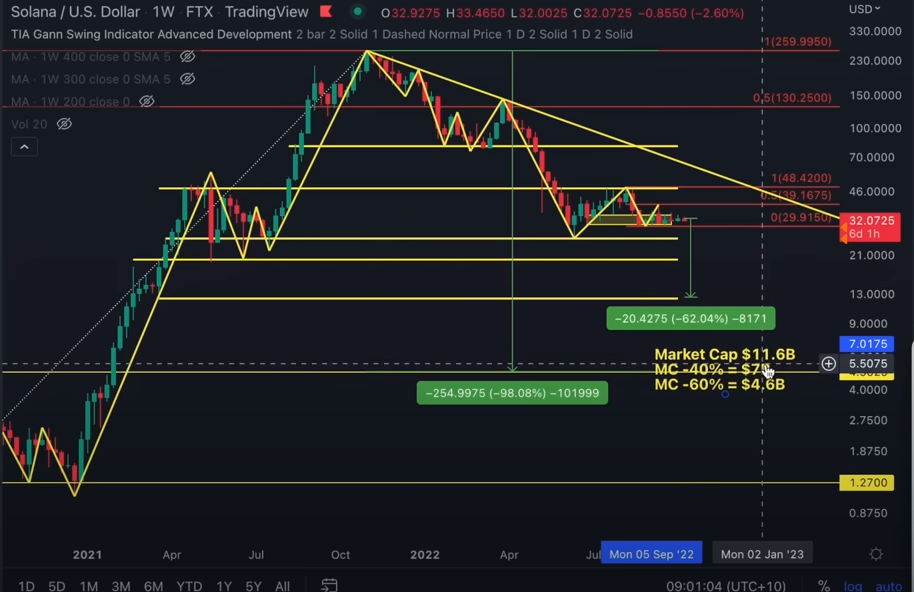
Source: Jason Pizzino/YouTube At time of writing, SOL is trading at $30.88.

I

Пов'язані матеріали

Fed Turns Hawkish, Wall Street Capitulates, Citi Stands as 'Last Holdout': Insists on Resuming Rate Cuts in October

Amid a surprisingly hawkish shift from the Fed and most of Wall Street capitulating on rate cut expectations, Citigroup stands as a notable outlier, holding firm to its forecast for monetary easing to restart this October. Following the June FOMC meeting, where the "dovish bias" was removed and the dot plot shifted dramatically, markets priced in nearly 37bps of tightening for 2026. Major banks like Deutsche Bank and Goldman Sachs revised their calls, predicting rate hikes as soon as September. Citigroup, however, maintains a baseline scenario for a 25bps rate cut in October, followed by two more cuts in December and January 2027. Its counter-consensus view rests on three key arguments: 1) Plunging oil prices are eliminating a major inflation upside risk. 2) Rising initial jobless claims are mirroring seasonal weakening patterns seen in 2024-2025, signaling a labor market cool-down. 3) The strong core PCE is an "outlier," heavily influenced by AI-related prices and equity market gains rather than broad consumer price pressures, with other inflation metrics showing more moderation. While Wall Street largely "surrenders" to the hawkish Fed narrative, with Deutsche Bank forecasting two hikes and Goldman Sachs warning of potential back-to-back moves, Citigroup remains the "last holdout," betting that disinflationary forces will pave the way for cuts before year-end.

marsbit2 хв тому

Fed Turns Hawkish, Wall Street Capitulates, Citi Stands as 'Last Holdout': Insists on Resuming Rate Cuts in October

marsbit2 хв тому

Open Systems Will Ultimately Prevail: Why Ethereum Is the Next Linux?

The article "Open Systems Will Ultimately Prevail: Why Ethereum Is the Next Linux?" argues that Ethereum, like Linux before it, will triumph over closed, proprietary systems in finance due to its open, permissionless, and credibly neutral nature. It draws a historical parallel: just as the open internet defeated corporate private networks and Linux outcompeted proprietary Unix systems, open financial infrastructure like Ethereum will surpass private blockchains. The core advantage lies in the "bazaar" development model (as described in Eric Raymond's "The Cathedral and the Bazaar"), where decentralized, permissionless innovation by a global community of developers outpaces the controlled "cathedral" approach of centralized entities. This model fosters rapid innovation, as seen with Ethereum standards like ERC-20 and applications like Uniswap, which were built without needing permission. Ethereum's key, irreplicable strength is its credible neutrality: transparent, equally applicable, immutable rules that allow anyone to participate. This ensures sovereign independence, meaning no single entity (company, government) can control or change its core rules—a critical feature for global financial infrastructure. In contrast, private blockchains and consortium chains (like SWIFT or various bank-led projects) suffer from platform risk, central control, and an inability to attract broad developer ecosystems, leading to frequent failures. The article notes that major institutions (e.g., BlackRock, JPMorgan, Coinbase, Robinhood) are already building on Ethereum or its Layer 2 networks, recognizing its security, developer ecosystem, and network effects. While critics argue finance requires accountable, controlled systems, the response is that compliance (KYC, regulations) can be built at the application layer on top of a neutral settlement layer like Ethereum, just as secure commerce was built on the open internet via HTTPS. Ultimately, the thesis is that attempting to build walled-garden, proprietary financial networks is a flawed strategy that stifles innovation. The winning approach is to build applications on top of open, credibly neutral infrastructure like Ethereum, which is poised to become the foundational settlement layer for global finance.

Foresight News13 хв тому

Open Systems Will Ultimately Prevail: Why Ethereum Is the Next Linux?

Foresight News13 хв тому

The Computing Power Dilemma in the Sino-US AI Rivalry

The Sino-US AI rivalry faces a fundamental bottleneck: the widening compute power gap. While Chinese AI chip companies have seen investment surges, their current focus remains largely on the less demanding inference market. The real challenge lies in the high-end training chip sector, crucial for developing cutting-edge large language models (LLMs), where Nvidia holds a near-monopoly. The compute disparity is stark. US tech giants like Meta, Google, and xAI command massive GPU clusters, enabling them to train trillion-parameter models rapidly. Estimates suggest US data center count and total compute capacity significantly outstrip China's. This "brute force" advantage allows for faster model iteration and exploration of larger parameter scales, with top US models reportedly leading their Chinese counterparts by 8 to 15 months. Chinese alternatives, such as Huawei's Ascend and others from companies like Moore Thread and Biren, are emerging. They show promise in inference and some training scenarios, closing the performance gap with mid-range Nvidia products. However, the core hurdle extends beyond raw chip performance to the entrenched software ecosystem, exemplified by Nvidia's CUDA platform. The path forward involves "walking on two legs": navigating import restrictions while heavily investing in the domestic chip industry. Though still in a catch-up phase, China's vast market, talent pool, and capital are fostering progress. The ultimate test is whether Chinese firms can build a competitive hardware-software ecosystem to power the next generation of AI.

marsbit19 хв тому

The Computing Power Dilemma in the Sino-US AI Rivalry

marsbit19 хв тому

He Kaiming's Team's New Work: After Deleting VAE and Private Data, Text-to-Image Generation Becomes Even Stronger

KaiMing He's team introduces **MiniT2I**, a minimalist text-to-image (T2I) model that challenges the complexity of mainstream approaches. It eliminates components commonly considered essential: the VAE encoder-decoder, AdaLN conditioning mechanisms, auxiliary losses, private training data, and post-training alignment stages like RL/DPO. Instead, it uses a pure flow-matching objective trained directly on RGB pixels. The model employs a simplified **MM-JiT** Transformer architecture. It removes AdaLN blocks for conditioning and instead prepends two lightweight text adapter blocks to a standard pre-norm Transformer, allowing frozen T5 text features to adapt to the denoiser. Training follows a two-stage, LLM-like paradigm using only public datasets: pre-training on LLaVA-recaptioned CC12M for coverage, followed by fine-tuning on ~120k high-quality image-text pairs. With just 258M parameters (B/16), MiniT2I achieves competitive scores (0.87 on GenEval, 84.2 on DPG-Bench), outperforming larger pixel-space models. Scaling to 912M parameters (L/16) yields results comparable to SD3-Medium (~2B parameters) in style, composition, and imagination, though it lags in text rendering and named entities due to public data limitations. Key advantages include lower computational cost (~570 GFLOPs vs. ~1379 for latent models) and architectural simplicity. Acknowledged limitations include patch boundary artifacts in pixel space, side effects of high CFG scales, resolution ceilings for sequences longer than 1024 tokens, and the aforementioned data bottlenecks. The work demonstrates that high-performance T2I generation is possible with a radically simplified, publicly reproducible baseline.

marsbit23 хв тому

He Kaiming's Team's New Work: After Deleting VAE and Private Data, Text-to-Image Generation Becomes Even Stronger

marsbit23 хв тому

Торгівля

Спот
Ф'ючерси
活动图片