$7.8mln ETH deployed into DeFi – Is Ethereum Foundation setting the tone?

ambcryptoОпубліковано о 2026-03-19Востаннє оновлено о 2026-03-19

Анотація

The Ethereum Foundation has deployed 3,400 ETH (worth approximately $7.8 million) into DeFi protocol Morpho, signaling strong institutional confidence in Ethereum’s staking and lending ecosystem. This follows an earlier deposit of 2,400 ETH and $6 million in stablecoins in October 2025. The move is seen as a strategic effort to encourage broader DeFi adoption and strengthen Ethereum’s financial infrastructure. This activity coincides with growing institutional interest, including BlackRock’s Staked ETH ETF (ETHB) recording its largest inflow of 28,810 ETH ($67.18 million) and Grayscale’s Ethereum Mini Trust locking 76,800 ETH in under a week. Total Value Locked (TVL) in DeFi has surpassed $100 billion, with Ethereum dominating nearly 60% of the market. The upcoming CLARITY Act is expected to further accelerate institutional participation, positioning Ethereum’s DeFi as a key area for long-term investment and a hedge during market volatility. The Ethereum Foundation still holds over $400 million in ETH, underscoring its ongoing influence.

Staking yields are one of the main bridges connecting TradFi and DeFi.

Put simply, staking yields let traditional investors earn “predictable” returns while getting exposure to the decentralized ecosystem, similar to earning interest in banks. That’s why many in TradFi see the CLARITY Act as a real disruptor, as it could speed up DeFi adoption and reshape capital flows.

Ethereum [ETH], however, seems to be ahead of the curve.

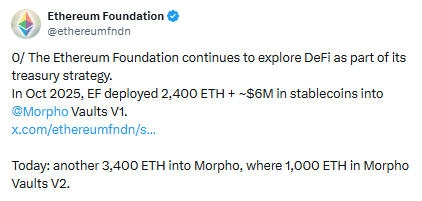
The Ethereum Foundation recently deployed 3,400 ETH into Morpho, including 1,000 ETH into Morpho Vaults V2. Back in October 2025, they had already added 2,400 ETH plus about $6 million in stablecoins into Morpho Vaults V1.
Source: X

From a strategic perspective, these moves carry real weight.

For instance, the Ethereum Foundation (a non-profit focused on network development) is showing that it’s actively putting capital to work in DeFi. By doing so, it signals confidence in Ethereum’s staking and lending ecosystem while also encouraging broader adoption across the network.

Notably, this strategy is playing out in real time.

On the 17th of March, the BlackRock Staked ETH ETF (ETHB) saw its largest inflow since inception, with a net flow of 28,810 ETH (about $67.18 million) and $0.3 billion in trading volume, highlighting growing institutional interest in Ethereum’s staking ecosystem.

And it doesn’t stop there.

Grayscale’s Ethereum Mini Trust has locked in 76,800 ETH in under a week alone. Technically, this shows that large ETH holders are allocating more and more capital into DeFi, with the Ethereum Foundation’s moves setting the pace.

Naturally, the question is: Does this give the network an edge as the CLARITY Act draws closer?

Ethereum treasuries deploy ETH, showing DeFi as a risk-off catalyst

Beyond network-level breakdowns, the DeFi sector is seeing unprecedented growth.

In fact, Total Value Locked (TVL) recently crossed $100 billion for the first time since February, demonstrating that staking continues to attract capital even in a broader risk-off environment.

Ethereum, which represents nearly 60% of the market, is clearly benefiting the most, making this trend a strong bullish signal for the network.

Against this backdrop, the CLARITY Act could become a meaningful catalyst for Ethereum, both technically and fundamentally. Backing this, the Ethereum Foundation is deploying millions into the financial infrastructure, showing that developers are laying the groundwork for broader DeFi adoption.


Source: Arkham

As the chart above shows, the Ethereum Foundation recently deposited $7.88 million of ETH to Steakhouse, a billion-dollar DeFi asset manager.

More importantly, the Foundation still holds over $400 million in ETH, highlighting its continued influence and strategic role in supporting the network’s growing market share.

According to AMBCrypto, this is just the start of a deeper trend.

As noted earlier, the CLARITY Act could act as a major catalyst, driving even greater institutional interest in Ethereum DeFi, with more ETH treasuries likely following BitMine’s playbook. Recent inflows into BlackRock’s ETHB only reinforce this momentum.

At the heart of it all, the Ethereum Foundation is clearly leading the way. Its recent “strategic” moves clearly signal the network’s direction, positioning Ethereum’s DeFi ecosystem as a key focus for long-term investors and a safety net during periods of intense volatility, supported by a 6% jump in ETH TVL so far this month.


Final Summary

  • Ethereum treasuries, including the Ethereum Foundation, are deploying hundreds of millions of ETH into DeFi protocols, signaling confidence and driving network growth.
  • Big inflows into BlackRock’s ETHB and Grayscale’s Ethereum Mini Trust show that traditional finance is increasingly participating in Ethereum staking, with the CLARITY Act likely acting as a catalyst.


Пов'язані питання

QWhat is the significance of the Ethereum Foundation deploying 3,400 ETH into Morpho, according to the article?

AThe deployment signals the Foundation's confidence in Ethereum's staking and lending ecosystem, actively putting capital to work in DeFi to encourage broader adoption and set a strategic tone for the network.

QHow does the article connect the CLARITY Act to the growth of Ethereum's DeFi ecosystem?

AThe CLARITY Act is seen as a potential major catalyst that could accelerate DeFi adoption and drive greater institutional interest in Ethereum, reshaping capital flows and providing regulatory clarity.

QWhat recent institutional developments highlight growing interest in Ethereum's staking ecosystem?

ABlackRock's Staked ETH ETF (ETHB) had its largest inflow with a net flow of 28,810 ETH (about $67.18 million), and Grayscale's Ethereum Mini Trust locked in 76,800 ETH in under a week, showing increased institutional participation.

QWhat does the Total Value Locked (TVL) crossing $100 billion indicate for the DeFi sector and Ethereum specifically?

AIt demonstrates that staking continues to attract capital even in a risk-off environment, with Ethereum benefiting the most as it represents nearly 60% of the market, making it a strong bullish signal for the network.

QHow much ETH does the Ethereum Foundation still hold, and what does this signify for its role in the ecosystem?

AThe Ethereum Foundation still holds over $400 million in ETH, highlighting its continued influence and strategic role in supporting the network's growth and market share through DeFi deployments.

Пов'язані матеріали

Bitcoin Withdrawals Continue: 8 Years of Storage in a Coldcard Cold Wallet Ended in Zero

Coldcard Hardware Wallet Hacked: Losses Mount Due to Vulnerable Seed Generation A critical vulnerability in Coldcard hardware wallets has led to a continued wave of fund thefts. According to Galaxy Research, the total stolen has reached 1,367.05 BTC (approx. $88.6 million) from 4,585 addresses, a significant increase from the initial 594.5 BTC reported on July 30, 2026. Most of the stolen funds remain on the attackers' addresses. The issue is not with the current firmware, which Coinkite has updated, but with seed phrases generated on vulnerable devices between March 2021 and the release of fixed firmware versions. Due to a programmer error, devices switched from using a hardware random number generator to the software-based Yasmarang generator, which was initialized with publicly accessible data like the chip's serial number. This made the seed phrases predictable through offline brute-force attacks, meaning wallets remain at risk until funds are moved to a new wallet generated with the patched firmware. Affected devices include Mk2/Mk3 with firmware 4.0.1–4.1.9 (and up to 5.0.3), Mk4/Mk5 up to version 5.6.0, and Q models up to 1.5.0Q. The only exceptions are seeds created with a high-entropy method like at least 50 independent dice rolls or a strong unique BIP-39 passphrase. All other owners must generate a new seed on the fixed firmware and transfer their assets. A case highlighting the human impact involves a 39-year-old long-term investor who lost 2 BTC (approx. $130,000) in minutes. He had accumulated the Bitcoin over eight years through physical labor, viewing it as a financial lifeline and a retirement plan in a country suffering from hyperinflation. His story underscores that even conservative "buy and hold in cold storage" strategies can be compromised by such underlying technical flaws. From a technical perspective, this incident echoes historical failures where weak random number generators undermined cryptographic security, challenging the assumption that offline storage is automatically foolproof.

cryptonews.ru1 год тому

Bitcoin Withdrawals Continue: 8 Years of Storage in a Coldcard Cold Wallet Ended in Zero

cryptonews.ru1 год тому

Торгівля

Спот
活动图片




