[Key interpretation] What will happen?BTC non-zero address grew zero for two consecutive months

HuobiОпубліковано о 2022-10-09Востаннє оновлено о 2022-10-10

Анотація

BTC volatility drops, prepare for next week's market signal.

1. BTC shrinkage adjustment or in place

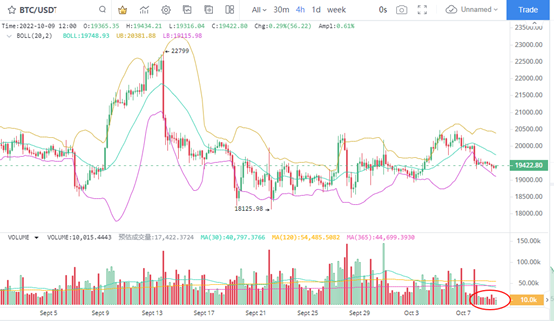
In the 4-hour K line chart of BTC, after the price fell back from the middle track of Bollinger Line, the continuous low consolidation and the closing price further declined. In terms of trading volume, it also reached the lowest level in September, indicating that the adjustment of BTC has come to an end, and investors' enthusiasm for short-term trading has dropped to the freezing point. From the current point of view, BTC is in the key position of the steering wheel.
2. BTC has realized the value transfer to the main force

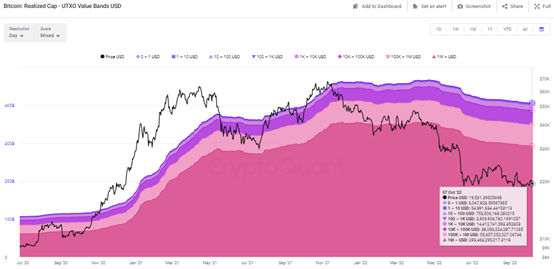
From the perspective of BTC's realized UTXO value, the proportion of investors holding currency funds is still high. At present, the number of investors holding currencies worth more than 100 million dollars accounts for a very large proportion. On October 7, 2022, the total market value of these investors' currency holdings was US $293.4 billion, an increase of 400% compared with US $58 billion in March 2020. Although BTC is in the adjustment stage, the market value of these investors has not decreased significantly. This shows that whales with a large amount of money still have a great impact on BTC prices. As long as Jujing holds coins stably, BTC will still maintain its current running rhythm.
3. The number of BTC non-zero addresses stagnates

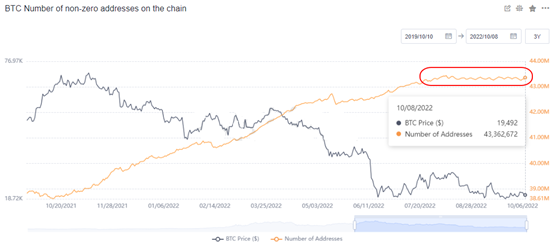
The number of non-zero addresses of BTC remained stable. On October 8, the number was 43.36 million, which was very small compared with 43.38 million on August 5. This shows that the recent enthusiasm of small and medium-sized investors for entering the market is very low, and BTC has not changed hands to retail investors. At the same time, it shows that BTC investors are in a very obvious wait-and-see stage. The divergent trend of BTC in the hands of investors has not expanded, and the market is facing greater uncertainty.
4. ETH preliminary support is still effective

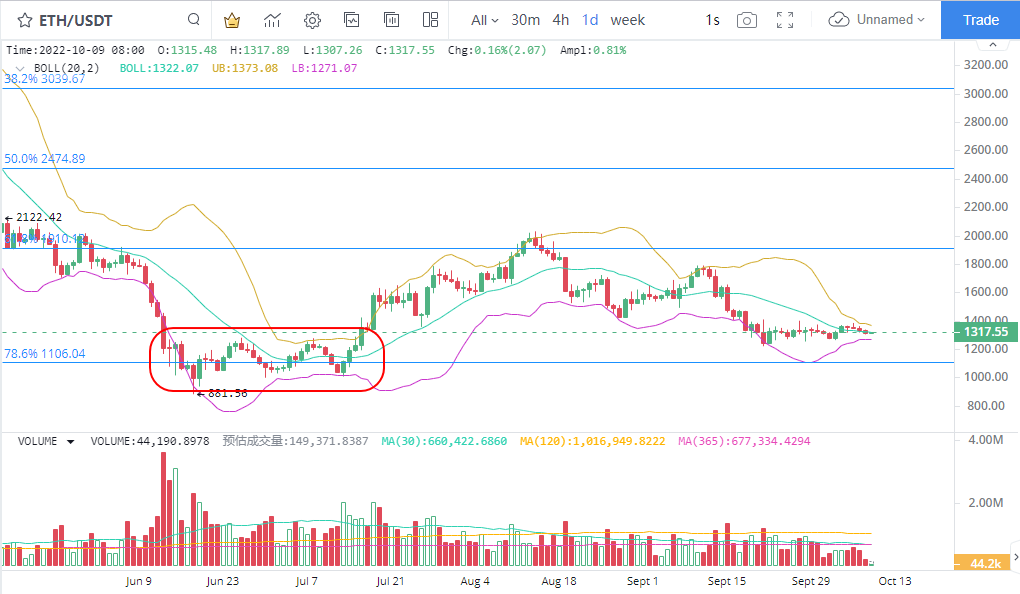
In terms of daily K line, ETH completed an oversold rebound at the bottom during the fall in June 2022, and the three bottom patterns during this period still support ETH. Although the current ETH trading volume is shrinking, the change still needs further high intensity volatility to really prompt the trading direction. Spot trading volume hit the lowest level in four months. At the same time, it is estimated that the leverage ratio has soared to a new historical high, and ETH has great potential for volatility. The higher the leverage ratio, the greater the volatility potential.
5. ETH estimates that leverage ratio reaches a new high

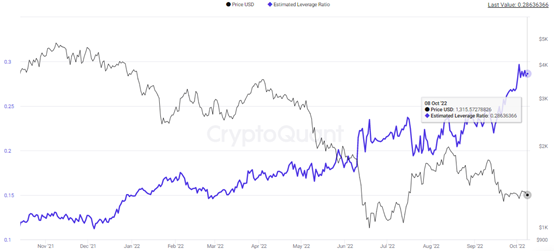
As the number of ETH in the exchange continued to decline, the estimated leverage ratio reached the highest value in history, reaching 0.296 on October 2. It is estimated that the leverage ratio remains above 0.282 in the near future, which means that ETH has a high leverage ratio and a high volatility potential before the change. The estimated leverage ratio that continues to grow shows that the trading risk of investors is still soaring rapidly, making it more likely that a large number of positions will explode.

Пов'язані матеріали

Which Crypto Sectors Have Been "Eaten" by AI Agents?

The article examines which crypto sectors have been increasingly dominated by AI Agents and which remain human-centric. In certain high-speed, efficiency-driven areas, AI Agents have taken clear control. This includes derivatives/perpetuals trading, where bots outperform humans significantly (e.g., a contest showed 0% of AI Agents were liquidated vs. 43% of humans), arbitrage/MEV extraction, and yield optimization (with ~68% of new DeFi protocols in Q1 2026 featuring autonomous AI Agents). Spot trading and portfolio optimization are also seeing heavy Agent adoption. However, the shift is not universal. In "battleground" sectors, both Agents and humans coexist. In prediction markets, Agents dominate short-term arbitrage, but humans still outperform in long-term, nuanced judgment calls. In DeFi lending, while liquidation is automated, core deposit/borrow decisions remain largely human-driven. Sectors still firmly led by human activity include stablecoin payments and card-based spending (driven by real-world economic activity and remittances) and wallets, which serve as the crucial human-verification and approval layer. The rise of Agents increases the need for robust human-Agent verification layers. Projects like World/AgentKit, t54, Self Protocol, and Kite AI are building infrastructure to create trust, security, and accountability by binding Agents to verified human identities. In conclusion, while AI Agents have decisively "eaten" speed and optimization-focused crypto sectors, human judgment, trust, and real-world context remain dominant in areas that create broad economic value, such as payments and identity. The future likely involves a symbiotic relationship where Agents require human verification and oversight to operate effectively.

Foresight News8 хв тому

Which Crypto Sectors Have Been "Eaten" by AI Agents?

Foresight News8 хв тому

After Rising 11 Times in a Year, Micron's Earnings Report Becomes a Stress Test for the AI Memory Market

**Micron's Upcoming Earnings: A Crucial Test for the AI Memory Rally** Investors in AI memory stocks face a critical moment on June 24th, when Micron Technology reports quarterly earnings. The stock, having surged approximately 11-fold from $103 to $1,134 over the past year, carries immense market expectations. Wall Street consensus forecasts a staggering ~932% year-over-year jump in EPS to around $19.72 and ~270% revenue growth to ~$345 billion, largely driven by sold-out HBM (High Bandwidth Memory) capacity through 2026. Analysts have aggressively revised estimates upward over the last 90 days, with EPS expectations rising 68%. This creates a high bar: even strong results risk a sell-off if they fail to meet these elevated projections. Notably, price forecasts from institutions like Citi (predicting ~200% DRAM price increases in 2026) are already among the most bullish on Wall Street, not conservative. The key metric to watch is gross margin, guided to a record ~81%. Such peak profitability raises questions about sustainability in the historically cyclical memory sector. While management has signaled continued strength, the stock's direction post-earnings will likely hinge more on forward guidance for the next quarter and details on HBM capacity expansion for 2027, rather than the already-anticipated stellar past results. The report represents a major pressure test for the high-flying AI memory trade.

marsbit13 хв тому

After Rising 11 Times in a Year, Micron's Earnings Report Becomes a Stress Test for the AI Memory Market

marsbit13 хв тому

Торгівля

Спот
Ф'ючерси
活动图片