1. BTC transaction volume reaches a new high
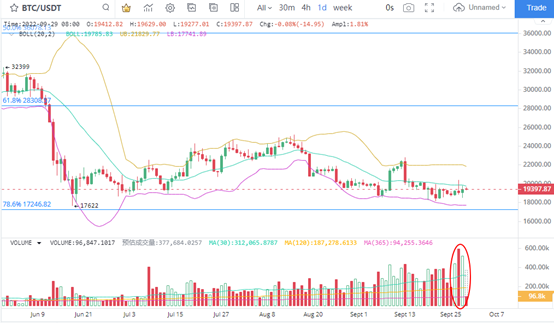
The BTC price fluctuates quite frequently in the short term, making the trading volume record high in the near future. According to statistics, the BTC spot trading volume on September 28 has reached a historical high of 58 billion US dollars. The daily K line chart also shows that BTC's recent trading volume has continued to grow, reaching a very important stage of long short competition.
Since August 27, the closing price of BTC has been significantly lower than 20000 US dollars in most trading days, which means that the recent consolidation is also a short-term accumulation in the final stage. As the US dollar index is still strong, it not only appreciates against most currencies, but also may push BTC prices to break. Therefore, it is necessary to be relatively cautious about the low absorption around 20000 dollars.
2. Significant recovery of BTC large transactions
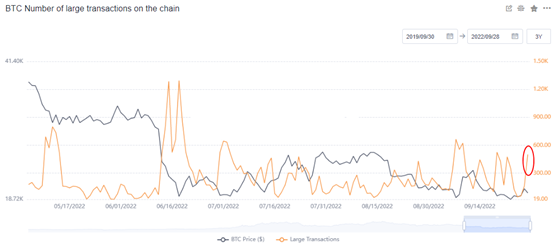
BTC's large transactions rebounded significantly, reaching a high of 501 on September 28, which is a good performance in recent years. 501 large BTC transactions, with the number of transactions reaching 250000 BTCs. Considering the large volume of spot and chain transactions, the activity of the main force is also increasing, but BTC did not rise significantly, but maintained a horizontal consolidation below 20000 dollars. This shows that the large-scale operation of BTC may be the trading signal of the main position reduction, and the price is ready to break down in the near future.
3. BTC long-term main loss trading continuation
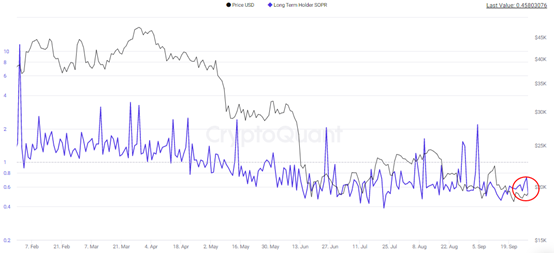
BTC's long-term investors' loss trading has not ended. According to the SOPR indicator measuring long-term investors' profit and loss performance, the recent SOPR indicator value of long-term investors continues to be lower than 0.6, which means that investors' loss trading space has reached - 40%. At the same time, on September 28, the SOPR index continued to fall back to the low of 0.458, which means that the loss space reached 0.542%. Considering that the SOPR index has been continuously lower than 1 since May, it means that the loss trading of long-term investors has never ended. However, after the loss intensified on the 28th of the 9th page, the selling pressure of BTC may push the price down.
4. ETH double cross star prompt will change the wheel
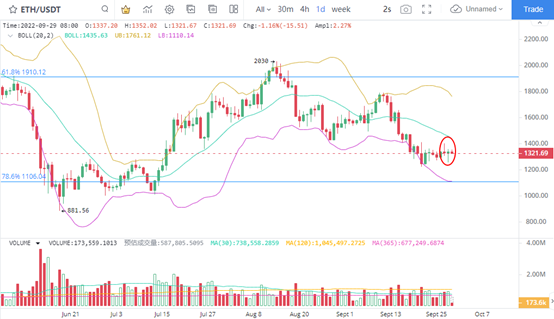
In the daily K line chart, after the appearance of the ETH double cross oscillation pattern, the price is on the eve of the change. At present, ETH has taken 6 trading days to collate the sideways market. The closing price fluctuates very little, and the maximum intraday fluctuation is within 8%. Due to the long period of sideways trading, the cost price of investors was released around 1300 dollars, and the selling pressure also increased at this time.
5. The number of ETH active addresses rebounds
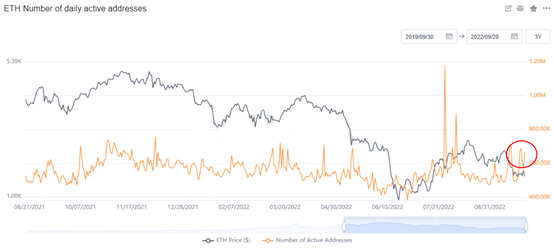
The number of active ETH addresses has remained strong recently, in sharp contrast to the low price performance. Therefore, ETH's investor trading activity is at a high level. Further analysis shows that the number of sending addresses of ETH remains at a high level, while the number of receiving addresses is relatively low, which means that investors' trading enthusiasm or selling is maintained. There are not many investors who really enter the market to copy the bottom, and the support effect for ETH is relatively limited.
6. The cooperation between LINK and SWIFT benefits the currency price
The international capital clearing system SWIFT cooperates with Chainlink (LINK), a price oracle provider, to carry out a proof of concept (POC) project, which will enable traditional financial companies to conduct transactions across block chain networks.
Chainlink co-founder Sergey Nazarov and SWIFT strategic director Jonathan Ehrenfeld Sol é announced the project at the SmartCon 2022 conference held in New York on September 28.
Sol é said at the meeting that "institutional investors have undeniable interest in digital assets", and added that these traditional financial participants want to access digital assets and traditional assets on a platform.
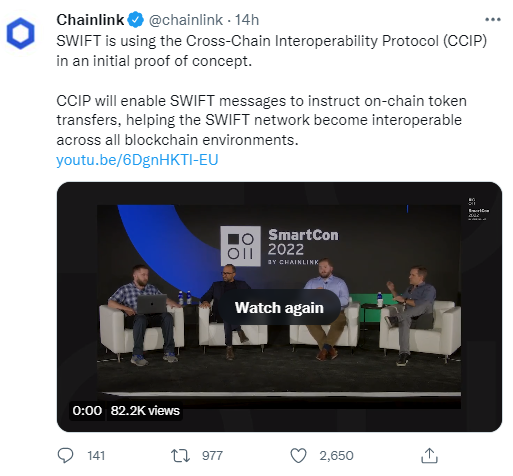
POC uses Chainlink's Cross Chain Interoperability Protocol (CCIP) to allow SWIFT messages to indicate token transfers in almost every blockchain network. According to Nazarov, this will accelerate the adoption of DLT blockchains in capital markets and traditional financial fields.
SWIFT inter-bank messaging system is the most widely used platform in traditional cross-border legal currency transactions, connecting more than 11000 banks worldwide. In August, the system recorded 44.8 million messages on average every day.
However, transactions on the SWIFT network may take several days to complete. The company has also been exploring blockchain and DLT technologies as well as central bank digital currency (CBDC) to promote faster payment.
Chainlink added that this cooperation with SWIFT enables financial institutions to obtain blockchain functions without replacing, developing and integrating new connections into the old system. It said that this requires a large number of modifications at an "abnormally high" cost.
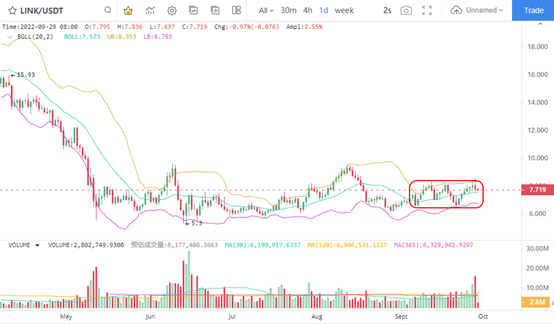
In terms of price, LINK has been in line with the trend of mainstream currencies recently, continuing the sideways consolidation. In fact, this pattern is also a sign of the price readiness. It is believed that under the positive stimulus, some bullish trading signals may appear below $8 during the continuous high volume period of LINK, which deserves further attention from investors.